Lightscape

Melbourne is a well-known destination for the arts – with its major festivals, winter blockbuster exhibitions, and live music scene. The city itself is often the setting, not just the host – witness Open House, White Night, and more recently RISING. As the backdrop, canvas or screen for these events, Melbourne largely draws on its built environment. In contrast, and as the latest example to join Melbourne’s art calendar, the Royal Botanic Garden is currently hosting Lightscape, a major exhibition that literally sheds new light on its historic collection of flora, and allows us to enjoy the city’s lungs at night, when the gardens are usually closed.
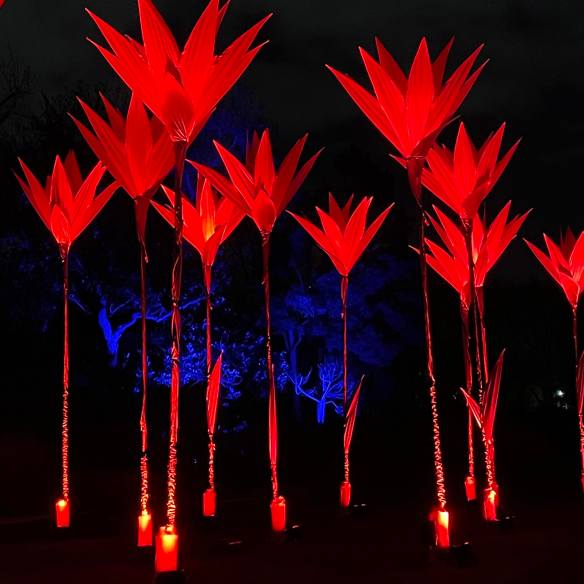
“Flower Lawn” by Jigantics (photo by Rory Manchee)

The key pieces as you tour the installations are:

1. Sea of Light by ITHICA Studio – the sequence of programmed lights create an impression that the lawns are moving, rather like waves on the shore

2. Liquid Sky by Genius Laser Technology – lasers reflect on layers of mist sprayed among the foliage, creating psychedelic clouds in the night air

3. Winter Cathedral and Laser Garden, both by Mandy Lights – the former is a series of illuminated arches made from strings of fairy lights, that give the impression of a more solid structure; while the latter projects lasers into the depths of the fern gully, that flicker like fireflies.

4. Flower Lawn by Jigantics – enormous “plants” that are lit up by a changing sequence of colours

Throughout the gardens, there are a range of animated lights, illuminated displays and projections. I’m sure everything has been carefully designed and planned, but there are some happy accidents: the lasers from Liquid Sky extend beyond their misty clouds to flicker amongst the foliage of surrounding trees; many lights reveal the natural iridescence of flowers that we are unable to see by day; and the reflection of the Winter Cathedral on the nearby lake suggests the climactic scene in Peter Carey’s novel “Oscar and Lucinda”, when the crystal chapel sails down the river.

The only disappointment about Lightscape is the choice of audio to accompany the installations. The sound quality is fantastic, but the actual music is quite conservative, even pedestrian – at times, I was expecting a David Copperfield reveal. I wonder what artists such as Oren Ambarchi or Lawrence English would have done instead – a missed opportunity?

Next week: Dud Housing
Let There Be Light

Q: What do a selection of 19th century oil paintings, a 50-year old piece of 16mm film, and a 21st century carpet have in common?

A: They are all exhibits in ACMI’s winter show, “Light”, based on works from the Tate’s Collection.

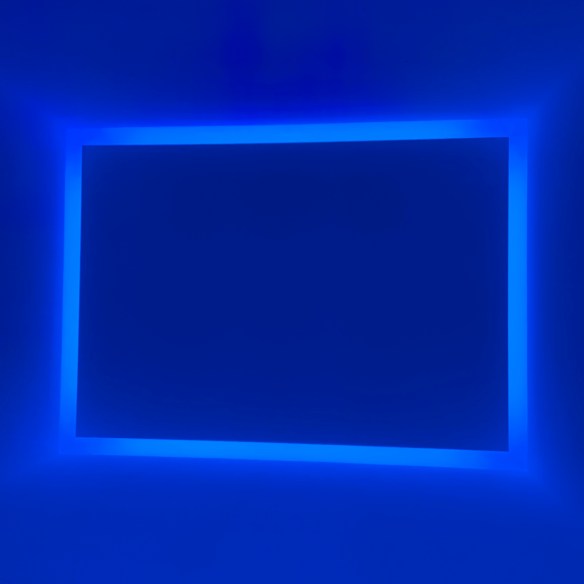
Image: James Turrell, “Raemar, Blue” (1969) on display at ACMI (Photo by Rory Manchee)

Despite ACMI’s brief to showcase the moving image, only three of the art works in the exhibition consist of film. A few more incorporate movement in the form of kinetic sculptures. But otherwise, this is mostly a collection of paintings and photography (and yes, a carpet).

Does it work? Yes, because just as light can be regarded as an essential building material, the use, portrayal and capture of light is essential to render colour, shadow, depth, perspective and narrative in all forms of art.

Arranged thematically, by theory or technique of how light is represented and rendered in art, the exhibition is both diverse and cohesive. It avoids the risk of overload because the selection is quite compact (given the wide remit of the topic). It also avoids choosing works based on technical prowess alone. Therefore, the exhibition succeeds through the combined principles of quality over quantity, and content over form.

It was timely to see mention of The Enlightenment as a key source of artistic exploration, as well as being a driver in the fields of of scientific discovery and liberalism. The exchange of ideas between and across different disciplines has always been essential to progress in the sciences, the arts and the humanities.

My favourite exhibits among the works I hadn’t seen before were by Olafur Eliason, Lis Rhodes and Peter Sedgley. And it’s always a pleasure to immerse yourself in one of James Turrell‘s installations. The only slight disappointment was that visitors are kept at quite a distance from Yayoi Kusama‘s The Passing Winter, an intriguing cube-shaped sculpture that is like one of her infinity rooms in miniature. The last time I saw it in London, it was possible to peer right in to get the full effect.

All in all, highly recommended.

Next week: Hands on the wheel

When is a print not a print?

Alongside drawing, painting and sculpture, print-making is one of the oldest forms of visual art. Although it wasn’t generally recognised as a fine art discipline in the west until the European Renaissance (with the work of Dürer, among others), the practice can be traced back to Paleolithic times when humans first made hand-prints on cave walls. It evolved largely through developments in paper-making and image creation, such as Japanese wood-block printing 1200 years ago, or metal plate engravings in the Middle Ages, and has developed alongside related technologies in lithography, etching, off-set press printing, photography, lino-cut and silk-screen printing, to name a few key methods.

Print-making in this “classical” sense uses a combination of mechanical, manual and chemical processes to transfer an image (created from one or more media) from one surface to another, using ink or paint to “carry” the image between the plate and paper or other printed surface.

While the printing industry has been using the same techniques for centuries (in the service of book publishing, newspapers, advertising, packaging, textiles, etc.) there are key differences between the commercial and the artistic.

First, traditional print-making still retains a high-degree of manual process, and the work is usually produced in limited numbers (sometimes in single editions), and even where multiple copies are generated, variations and differences will appear thanks to inherent “imperfections” of the process.

Second, despite the importance of technical process in print-making, the practice should not be seen as a mere mechanical exercise in reproducing an image – the resulting image is still far more important than the actual technique (i.e., content over form should be the order of the day).

Third, the role of “mark-making” in print-making is as significant as the brush strokes in an oil painting, and are part of the artist’s signature. Equally, choice of materials is also important, just as an artist working in oils will make specific decisions about their brushes, pigments, medium and canvass.

In terms of art curation, print-making can get lumped in with other “works on paper”, which may extend to collage, photography, photo-montage, graphic design and illustration. Photography itself can be used in the course of print-making (e.g., rayographs), but a photographic print of a film-based negative is not the same as print-making in this context.

Likewise, the use of digital processes to capture, create, manipulate, transfer and reproduce an image on paper (or other medium) is further blurring the boundaries as to what constitutes a “print” as opposed to a “technique”.

This delineation between traditional print-making and image creation processes was further highlighted by the recent Experimental Print Prize organised by Castlemaine Art Museum in Victoria’s gold field region. While there were examples of etching, lino-cut, lithography, photographic and other techniques on display, the prize is intended to push the boundaries into more conceptual notions of “what is a print?”.

Examples included the use of light-sensitive paper to create long-delay images, a neon-light to generate an after-image on the viewer’s retinas, and a muon particle detector to track and plot their “image” onto a computer monitor. Although these are all interesting approaches, they perhaps over-step the boundary of permanence, which is usually a feature of print-making, to the extent that the fixed paper and ink endure long after the artist has made his or her mark. Nevertheless, the museum is to be applauded for bringing a new dimension to an ancient art-form.

Next week: Literary legacies


Eileen Agar – My Brush With Surrealism

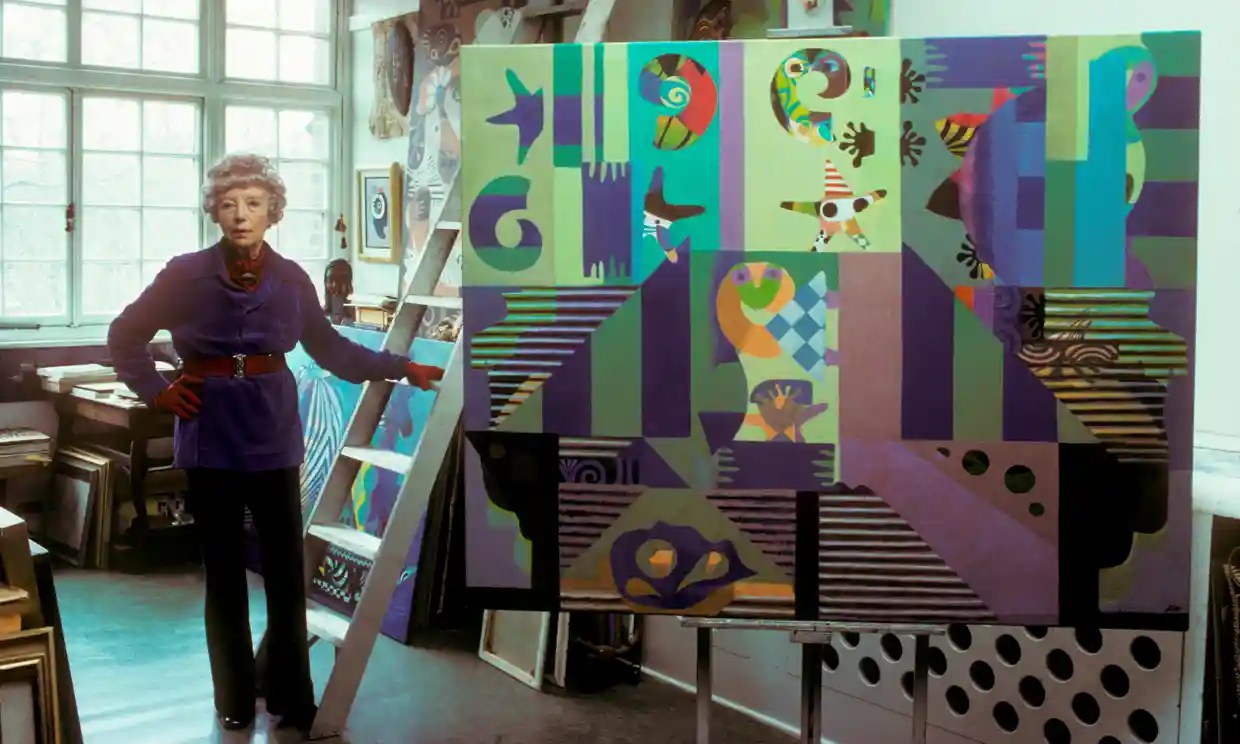
When I was a teenager, I kept a scrapbook of newspaper and magazine clippings, mostly relating to art, film, music and design. There was no particular theme, other than images that caught my eye. Sometimes, choices were triggered by things I had watched on TV, heard on the radio or seen at exhibitions. But there was one photograph which I cut out for no other reason than it mentioned Surrealism, featuring the artist Eileen Agar standing next to one of her paintings.

Eileen Agar in her studio, 1977 (Photo by David Reed) – Image sourced from The Guardian)

Although I had been interested in surrealist art for a while (probably thanks to ubiquitous reproductions of Dali and Magritte), I don’t think I had heard the name Eileen Agar, nor was I aware of having seen her work. That changed, somewhat, the following year, when I visited the major retrospective of Dada and Surrealism art at London’s Hayward Gallery, where she had several pieces on display. Yet, with such a huge exhibition, I don’t recall registering the name, nor making the immediate connection with the photo I had seen some months earlier.

A few years later, I was working for Kensington & Chelsea Council, where part of my role was to assist local residents with their housing problems. One day, I received a call from a woman who was concerned about her neighbour, whom she described as the “well-known artist, Eileen Agar”. The caller thought that Ms Agar needed some assistance with her accommodation, perhaps even relocating to somewhere more suitable. Following up the call, I duly contacted Ms Agar, but when asked about her housing situation, she replied “I’m fine, thank you, as long as I have enough light to paint by.” So I respected her wish not to be bothered or troubled by the Council.

By now, the penny had dropped, and I made the connection between the name Eileen Agar, her comment about “enough light to paint by” and the photo in my scrapbook – with its enormous studio window behind her.

Soon after, I was talking to some friends who were looking for ideas that would make good subjects for TV documentaries. I suggested a couple of topics, and happened to mention Eileen Agar, who by then was probably the last surviving surrealist artist who had been directly connected to figures like Picasso, Moore, Dali, Eluard, Breton, Man Ray, Penrose et al. Certainly, she was one of the few women included in the International Surrealist Exhibition of 1936.

Eventually, that idea turned into a documentary, called “Colour of Dreams” directed by Susanna White, originally broadcast in 1989. It formed part of Channel 4’s series “Five Women Painters”, with an accompanying book of the same name. Ms Agar was the only artist of the five still living at the time, and was guest of honour at the preview screening I was fortunate enough to attend.

Ironically, despite not receiving the same level of recognition that most of her male counterparts did during their lifetimes, Ms Agar attracted quite a lot of attention in her final years. Apart from being included in the TV series, she was the subject of a significant retrospective exhibition, and published her autobiography, before she passed away in 1991.

On my first visit to Auckland Art Gallery a few years ago, I was reminded again of that tangential connection, when I saw Ms Agar’s mixed media collage called “Tree of Knowledge”. Within the context of a modest collection of European surrealism, this was a significant work, and immediately recalled that original cutting.

(Sadly, unless it tours Australia, I won’t get to see the current Whitechapel show, “Angel of Anarchy”.)

Next week: Getting out of town