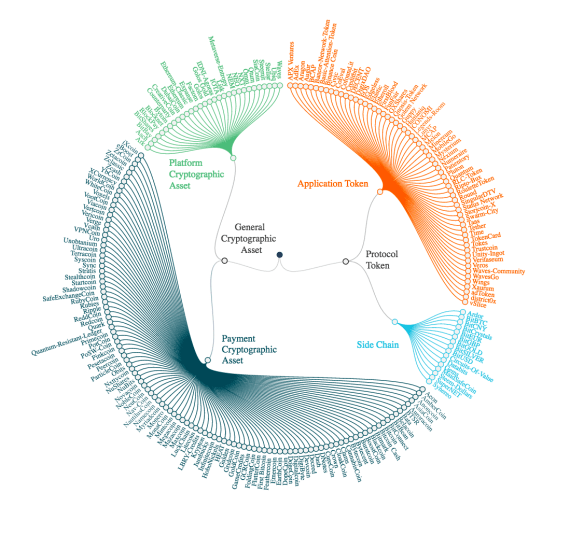
The General Taxonomy for Cryptographic Assets

It’s not often I get to shamelessly plug a project I have been involved with – so please indulge me in the case of Brave New Coin’s recent publication, “The General Taxonomy for Cryptographic Assets”. It’s a significant piece of work, designed to bring some structure to the classification of this new asset class.

In particular, it aims to help market participants (traders, brokers, investors, fund managers, asset managers, portfolio managers, regulators etc.) make sense of the growing list of digital currencies, as not all tokens are the same. Each one has a specific use case that needs to be understood in the context of Blockchain applications, whether decentralized protocols, or trust-less payment solutions.

Currently capturing around 60 data points and metrics on around 700 tokens, in the coming months the underlying database will double in size, and constantly maintained thereafter to keep current with the most significant assets.

Useful for portfolio screening, construction and diversification, the Taxonomy methodology and underlying database, when combined with Brave New Coin’s aggregated market data and indices will provide a 360-degree view of each asset, combining key elements of a CUSIP or ISIN record, a company directory profile and a regulatory filing.

The significance of having access to robust market data and reference data tools cannot be underestimated, given the price volatility and emerging nature of this new asset class. The Taxonomy will be presented at various Blockchain and Crypto events over the coming weeks, but for further information, the authors can be contacted at: contact@bravenewcoin.com

Next week: APAC Blockchain Conference

Equity crowdfunding comes to town

Earlier this month, the Australian Securities and Investments Commission (ASIC) announced it had approved the first seven crowdsourced funding platforms (CSFs). It seems that after much debate, equity crowdfunding is finally open for business.

Image: Aaron Pruzaniec, sourced from Wikimedia Commons

Although not named in the ASIC media release, the seven successful applicants are:

There are significant limitations to the CSF legislation – namely:

  • the type of eligible companies (only smaller, public unlisted companies);
  • the amounts individual investors can invest (up to $10,000 per company per 12 month period); and
  • how much companies can raise (no more than $5m in any 12 month period)

Also, there is no indication as to whether other CSF license applications are still pending, or which applications may have been rejected. It may also be difficult to assess the relative merits of each platform, since there only appears to be one class of license.

Meanwhile, legislation is already in the pipeline to extend the CSF regime to proprietary companies – which would significantly expand the potential number of issuers.

Compared to some of the largest initial coin offerings (ICOs) over the past 18 months, a $5m capital raise looks like small change. If anything, ICOs took the decade-old crowdfunding experience and supercharged it with Blockchain, cryptocurrency and decentralized issuance platforms. But then, regulators tend to lag markets and technology; plus, their primary focus is protecting the interests of less sophisticated retail investors (as well as market stability).

It’s also worth remembering that a limited crowdsourced funding model has been available in Australia for several years, almost as long as crowdfunding itself: Enable Funding (formerly ASSOB) was established in 2007, but with a much more restricted license than the latest CSF legislation. (And in other countries, early-stage companies have been able to more easily raise equity capital via market listings on secondary boards of the main exchanges – e.g., Mothers in Japan, GEM in Hong Kong, and AIM in London.)

The new CSF regime (and whatever else comes in its wake) does raise a few interesting points:

1. Although expressly confined to equity issuance in the form of common shares, by giving it a more generic name, does this mean CSF will be used for other types of securities (bonds, structured finance)?

2. What expectations has ASIC placed on the number of raises, and the total amounts to be raised, over the next 3-5 years – how will it measure or define the success of CSF?

3. More importantly, where is investor money expected to come from – will investors switch from property or other assets?

4. How will the increasing practice of issuing digital tokens as traditional securities (and potentially vice versa) add to the demand for CSF platforms and services?

It’s very early days, of course, and very small scale, but judging by the response so far to one of the first companies to take advantage of the CSF legislation, investors like what they are seeing.

Next week: Australia Post and navigating the last mile


The year ahead in Blockchain, crypto, FinTech….

I’m approaching my second anniversary working within the Blockchain and digital currency sector, but already it feels like a lifetime – such has been the pace at which the industry has grown and evolved.

The number (and size) of Initial Coin Offerings (ICOs) in 2017 was staggering. The cryptocurrency markets were equally breathtaking for their price gains (and corrections), matched only by the speed and extent to which some regulators responded. It was a rollercoaster ride, but by the end of the year, it’s fair to say this new asset class had finally arrived.

(For a round-up of 2018 forecasts and predictions for the sector, my colleagues at Brave New Coin have been publishing some handy guides.)

My personal (but far from unique) view on cryptocurrencies in general is that they represent a new asset class. As such we are seeing huge opportunities for investment and innovation, backed by Blockchain and other decentralized and distributed ledger technologies (DLT), as well as some truly innovative and disruptive solutions. There is still some hype, and considerable asset price volatility, plus pure investor speculation; but there are some great projects out there building solid business models; and sound investment cases for network protocols, industry utilities, scalable solutions and core platforms.

In 2018, I expect to see one or more of the following developments:

  1. A fully deployed, government-backed Blockchain project that will change the way citizens engage with public services
  2. A truly decentralized autonomous organisation that learns to make decisions for itself  (based on a set of dynamic, self-replicating governance rules) as to how resources are allocated, stakeholders are rewarded and participants are incentivized (for all its faults, the DAO was possibly the first new corporate structure since the joint stock company)
  3. Following Japan’s lead, more governments will recognise cryptocurrencies as legal forms of payment, while at least one Central Bank will issue a public digital currency as a form of legal tender (not just an inter-bank instrument)
  4. Traditional securities (equities, bonds, commercial paper, asset securitization) will be issued in the form of digital tokens (via a new form of Token Issuance Program) leading to wider distribution, fractional ownership and reduced cost of capital raising, plus streamlined share registry and custodial services, thanks to DLT
  5. Likewise, “traditional” digital tokens will be issued as formal securities, backed by new types of financial products, allowing for greater financial innovation and funding flexibility
  6. At least one crypto-backed ETF will list on a major exchange, along with more crypto-derivatives such as swaps and options.
  7. One or other crypto-currency will be adopted as a day-to-day payment solution for micro-payments

Only two or three years ago, none of the above seemed very likely, or at least not in the short-term. Today, there are multiple initiatives working across each of these trends. So this is not a case of “if”, but “when”.

Enjoy the ride!

Next week: Bring Your Own Change


Bitcoin – to fork or not to fork?

Anyone following the crypto-currency markets this past two weeks will be fully aware that this has been a turbulent time for Bitcoin and other blockchain assets. First, the SEC published its Report on the DAO.  Second, there was a significant arrest in connection with the Mt Gox failure. And third, Bitcoin underwent a fork which has resulted in a new version, known as Bitcoin Cash. Meanwhile, at the time of writing, the price of Bitcoin itself is testing renewed highs, and continues to enjoy a 3-month long rally.

What implications do each of these developments have for the digital asset industry?

Photo by Andre Chinn – Image sourced from Flickr under Creative Commons

The Mt Gox-related arrest came as Japanese authorities began separate criminal proceedings against the former head of the failed exchange. These developments underscore two things: 1) as with any complex financial fraud investigation, bringing the culprits to justice takes time. 2) exploiting the financial system for ill-gotten gain is not exclusive to crypto-currencies – just ask investors in Australia’s CBA bank how they feel about losing nearly 4 per cent of the value of their shares in one day on the back of a money laundering scandal.

It also means that as regulators play catch-up, exchanges, brokers and other participants in the crypto-currency markets will need to ensure that they are updating their security and privacy systems (to prevent future hacks) while ensuring they comply with AML/KYC/CTF provisions. No bad thing, to instil confidence and trust in this emerging asset class, which is entering a new phase of maturity.

The SEC Report on the DAO, meanwhile, has put ICO’s (Initial Coin Offering) and TGE’s (Token Generation Event) on notice that in some cases, these products will be treated as securities, and will be subject to the same regulation as public offers of shares etc. As a result, token issuance programs will need to structure their sale processes to be either fully compliant with, or exempt from, the regulations; at the very least, they must remove any suggestion that these tokens are capable of creating security interests in financial or dividend-bearing assets, unless that is the express intention. (In some cases, these tokens are sold as membership services, software and IP licenses, or as network access permits. Any “return” to the buyer comes from the network value effects, service discounts or user rewards, similar to frequent flyer schemes and customer loyalty programs.)

Again, this suggests a coming of age for digital assets, and a growing maturity in the way token sales can be used as an alternative to VC funding and other traditional sources of raising operating capital and project financing.

The Bitcoin fork was hugely anticipated, with a mix of fear and excitement – fear because of the unknown consequences, excitement at the prospect of Bitcoin holders getting “free money” in the form of “Bitcoin cash“, via a 1:1 issue. Without getting into the technical details, the fork was prompted by the need to increase Bitcoin’s blockchain processing speed and transaction capacity; and while nearly everyone connected to Bitcoin’s infrastructure agreed on the need to accelerate block performance, there was a schism as to how this should be achieved. Some exchanges said they would not recognise the new currency, and only some Bitcoin miners said they would engage with it (especially as the cost of mining the new asset was more expensive than Bitcoin core). In addition, most exchanges were advising their customers not to attempt performing any Bitcoin transactions for several days, before and after the fork, until the system settles down again.

In the aftermath of the fork, at least one more exchanges has said it will probably offer some support Bitcoin cash; while due to the nature of the fork, Bitcoin cash’s own block processing time was something like 6 hours – meaning transactions could not be confirmed, and holders of the new asset could not easily transfer or sell it, even if they wanted to. It feels like a combination of a liquidity squeeze, a trading halt, and a stock split resulting from a very complex corporate action.

So far, the value of Bitcoin has held up, while the value of Bitcoin cash has steadily declined (despite an early spike), almost flat-lining to less than one-tenth of the value of Bitcoin:
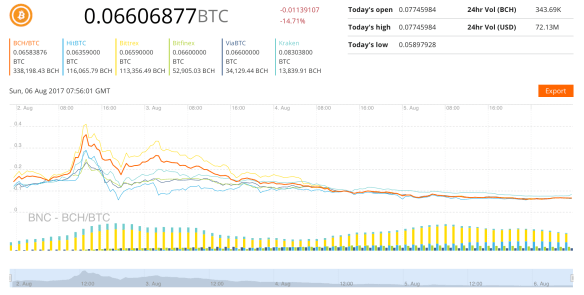
Relative value of Bitcoin cash (BCH) to Bitcoin (BTC) – Market Data Chart sourced from Brave New Coin

I’m not a “Bitcoin absolutist“, as I think different currency designs and technical solutions will continue to emerge based on specific use cases. These products will continue to co-exist as markets come to understand and appreciate the different attributes and functionality of these digital assets.

As a consequence of recent events, some new token projects are refining the design of their issuance programs, more legal opinions are being commissioned, and raise targets are being adjusted in light of the current climate. But the number of new projects coming to market shows no sign of abating, and the better projects will have successful and sustainable sales. The total market cap of all digital assets is now well over $100bn (although the data reveals something of an 80:20 scenario – the top few assets account for the bulk of that value); and more institutional investors and asset managers are taking a greater interest in this new asset class.

NOTE: The comments above are made in a purely personal capacity, and do not purport to represent the views of Brave New Coin or any other organisations I work with. These comments are intended as opinion only and should not construed be as financial advice.

Next week: Bringing Back Banter