Technology vs The Human Factor

Several times over the past month I have been reminded that the pursuit of technology for its own sake can give rise to misguided innovation; so-called solutions that are divorced from real world problems cannot justify the effort or resources. It feels like we are entering a new phase of the post-industrial revolution era, where a lack of “the human touch” will render many new inventions as worthless, irrelevant or redundant.

Street scultpure, Nagoya. Photo © Rory Manchee (all rights reserved)

Street sculpture, Nagoya. Photo © Rory Manchee (all rights reserved)

In no particular order:

  • At the second Above All Human conference in Melbourne, there was a consistent theme: how do we make sure there is a real connection between human needs and bleeding edge technology?
  • A Slow School of Business excursion to an eco-friendly homestead in rural Victoria offered a practical lesson on how to create harmony between technology and nature, and still achieve a modern (but modest), highly personal and comfortable home.
  • The economic debate about whether technology is improving our standard of living (as reported in the latest CPA magazine), which also echoes a recent CEDA report on automation and the implications for job losses.
  • A Q&A with Shayne Elliott, the new CEO of ANZ Bank, which prompted the observation that big data analytics, process automation and digital disruption are all very well, but will prove meaningless unless they can improve the customer experience. (But Elliott also conceded that the likes of Uber and Airbnb have succeeded because of complacency among industry incumbents.)

Advances in technology don’t have to lead us to the dystopian worlds of “Modern Times” or “Metropolis” (or any of the other post-apocalyptic visions that cinema and literature like to give us). However, the understandable focus on innovation must take the “human factor” into greater account when making design decisions, undertaking cost-benefit analysis and opting for one technology format over another.

Conclusion? It’s not totally clear whether we are entering another dot.com market correction, but there is a case to be made for whether or not we are seeing enough of a “technology dividend” from the current digital disruption and economic displacement centred on the use of cloud, social and mobile platforms; and whether we need a new methodology to measure the impact of the Internet of Things, robotics, AI, nano-technology, AR/VR, cognitive apps, wearables, 3-D printing, etc.

Next week: It’s never too late to change….

Why The Service Sector Lacks Self-Awareness

If you did a root cause analysis of companies that rate poorly for customer service, I predict it would reveal one or more of the following:

  • Outdated processes
  • Inadequate staff training
  • Poor product knowledge
  • Operational silos

What it usually comes down to is a chronic lack of self-awareness. (This is not helped if there is a failure of leadership, or a toxic culture within the organisation.) Despite all the customer feedback forms, platitudes such as “your call is important to us”, and the regular customer advocacy reports, unless service providers can truly put themselves in the shoes of their customers, they will never have sufficient knowledge or self-awareness with which to fully evaluate the “customer experience”.

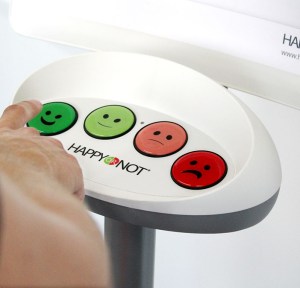
Image: Customer Feedback Device (Source: Smarte Carte)

Image: Customer Feedback Device (Source: Smarte Carte)

Today’s customers are more knowledgable (because they have access to more information, they can shop around, and in some cases, they have more choice). Today’s customers are also actively encouraged to engage with corporate social media (by following, liking and sharing, and by becoming surrogate brand advocates). However, the increased levels of expectation that this “engagement” creates are not always matched by the post-sales customer experience.

I have written before about how companies can improve their customer service, using a practical 7-point scheme. I would challenge any organisation that rates itself highly for customer service, to assess its performance against those criteria, as well using the ubiquitous customer satisfaction scores (CSAT, NPS®, CES, etc.).

Nearly every time I have an interaction with a telco, utility, bank or other service provider, I receive an immediate follow-up customer feedback request. Once upon a time, I would have been quite willing to provide constructive feedback, as I used to believe that it was important for the voice of the customer to be heard. Nowadays, I am more hesitant, because I don’t believe this feedback is ever properly acknowledged, analyzed or acted upon.

So many of these feedback request forms are self-serving, because the person you dealt with is in effect soliciting personal feedback on their individual performance. And while that is important, it is rarely done in the specific context of the customer’s own experience, and is more concerned with the company’s internal policies and procedures.

I am also increasingly sceptical about feedback processes that are ostensibly used for staff training. First, time is valuable, so it would be nice if companies could reward their customers for making the effort to engage. Second, on the rare occasions where a company has contacted me in response to a complaint submitted online or via a feedback form, I never learn what specific steps the company is taking to rectify problems caused by operational or policy failings. Thirdly, why should I be responsible for telling you how to train your staff or improve your service – surely that’s your job!

In many cases, it is not the performance of an individual customer service representative that is the problem. More likely, it’s poor customer service training, inadequate product knowledge or a myopic perspective, reinforced by silo operations. When even the most pleasant and competent service rep tells me, “I’m sorry, but it’s the way the system is designed…”, they probably don’t realize what a disservice they are doing: a “system” is only as good as the people who design it, and the people who implement it. So, they are in effect criticising their own colleagues, and the organisation they work for.

This lack of self-awareness by customer service staff is reinforced by the limited discretion in trying to resolve customer problems. Along with the use of internal jargon and bewildering acronyms, there is nothing worse than having to complain long or loud enough in order to escalate a problem. It would be wonderful if companies could empower their staff by giving them (well-defined) individual discretion on problem solving, and incentivize them for taking responsibility for the end-to-end resolution process.

In addition, it’s really infuriating being handed from one specialist, team or department to another, especially due to labyrinthine help line service menus. Telco on-boarding processes are particularly notorious for having complex operational procedures, multiple hand-offs and ring-fenced communications. I recall one large service provider who told me that in-bound call-centre staff were unable to speak directly to their own web support teams, and even if they communicated via internal e-mail, they could not guarantee a response.

If I am beginning to sound a bit like a broken record, it’s because recent experiences only reinforce my belief that many companies still don’t understand what it’s like to be one of their customers. But there’s a huge paradox here: on the one hand, companies are trying to reduce customer churn, increase “stickiness”, and improve the share of wallet or lifetime customer value; on the other, the cost of new customer acquisition appears to be cheaper (thanks to social media tools and web analytics), so it doesn’t matter if they lose a few customers, because it’s not that difficult or expensive to find new ones.

If it’s no longer true that “the customer is always right”, because profit margins are being squeezed and companies are being told to “stop delighting your customers”, then service providers have to do a much better job of managing customer expectations. They also need to demonstrate genuine empathy and concern if things go wrong (which is difficult if they don’t have sufficient self-awareness). And if things do go wrong, they need to ask the customer “what could we have done differently to provide you with better customer service?”.

In my professional experience of product management and business development, understanding customer needs and identifying ways to improve service delivery (along with customer-centric perspectives rather than product-led processes), are genuine sources of competitive advantage. But it takes considerable self-awareness to engage customers beyond the level of a single transaction, to develop genuine rapport, and to build sustainable long-term relationships. If your organisation is challenged by poor customer service, and if you recognise this is in part due to a lack of self-awareness, please get in touch – I’d be very interested to understand your problem.

Next week: Idea over Form – Gehry vs Ando

#AngelCube favours B2B #startups…

The latest intake to AngelCube‘s accelerator program presented at the recent Startup Victoria meetup event. It was interesting to see that all 6 pitches were aimed at B2B audiences, since I have heard several angel investors and startup advisers express a strong preference for end-consumer products (or those with 2-sided markets). Perhaps there is more appetite for enterprise solutions, despite the longer lead times for sales, and the challenge of strategies required to displace incumbant products.

Screen Shot 2015-08-31 at 5.18.46 pmWhether there is a new interest in B2B startups, or whether more founders are identifying B2B opportunities, there’s probably some further analysis to be done. Meanwhile, here are the 6 fledgling startups in the order they pitched on the night:

Screen Shot 2015-08-31 at 5.45.53 pm1. Peer Academy

Peer Academy aims to “change the way professionals learn”. It does this by offering students access to open enrollment classes via an online market place. The classes are conducted by facilitators and experts (“hosts”) who have been “screened” for quality by Peer Academy, with a focus on “soft” management and leadership skills.

Peer Academy hopes that students will act as “warm leads” for corporate sales, by taking their classroom experience back into their organisations, and acting as champions or brand advocates. With follow-up introductions to training and HR managers, Peer Academy then curates programs for corporate clients, by matching training needs to individual users.

I like the notion of “peer-to-peer” learning (although I presume that the hosts are expected to have more advanced and developed skills than their students), and there is certainly a trend for alternative learning platforms. At least one major bank has expressed interest in sourcing corporate training via Peer Academy, who take a 30% commission on course sales.

A huge challenge will be to engage corporate clients who already have established relationships with trusted training providers, or who have existing panels of approved organisations, or who outsource training procurement to third parties.

Screen Shot 2015-08-31 at 6.04.05 pm2. Jack

Workplace wellbeing is becoming big business ($5bn and counting?), and in the process, sedentary workers are in the firing line. According to Apple CEO TIM Cook, “Sitting is the new cancer”, and hence the recent fad/trend/fashion for sit-stand desks which is driving market interest in ergonomic solutions. The team at Jack have built a device that can monitor how much time people are sitting or standing, and even provide some feedback on user posture.

As you would expect, Jack uses cloud connectivity to monitor user activity, and to relay data via cross-platform apps and dashboards. It also uses elements of social media engagement and gamification, and has already launched a pilot scheme with several desk suppliers, as well as a paid beta at a well-known payments provider.

Customers will buy the device plus pay for a monthly subscription service. There is a direct competitor, but Jack claim their device can be retrofitted to any sit-stand desk. The unit price is much higher than, say a Fitbit, but since this is not a consumer product, Jack is confident it can sustain current pricing.

Finally, with the data it aims to collect, Jack reckons it may even be able to help reduce insurance premiums, although this will no doubt be subject to actuarial scrutiny, Work Cover and OH&S requirements, as well as data privacy issues.

Screen Shot 2015-08-31 at 6.24.11 pm3. Coin-Craft

In the professional services and consulting sectors, tracking project costs and resourcing have become highly demanding activities – witness the plethora of project management, costing, billing, ERP and time-tracking solutions on the market. Based on personal experience, the founders of Coin-Craft have identified a specific need among architects, and have built an all-in-one tool for Project Management, Cashflow Analysis and Resource Planning. Built “for architects by architects”, Coin-Craft is designed to help clients stay optimal, by managing staff over/under utilisation, and tracking cashflow projections.

The system also claims to integrate with third-party accounting software, and has around a dozen firms using the service, with another 30 in the pipeline. Although Coin-Craft have chosen a niche client base to protect their market entry, they claim the solution can also be adopted by engineering practices, graphic art studios and project management firms.

However, feedback from the audience suggested there are already similar, mature products that are tracking individual billable hours against specific projects, so Coin-Craft may need to work on their value proposition and differentiation.

Screen Shot 2015-08-31 at 6.38.22 pm4. CurveUp!

As social media and content marketing become more ubiquitous (if not more sophisticated), companies need to understand the value of their direct marketing spend. Mostly, they can do this via web analytics, e-commerce tracking, campaign conversions, and cost of customer acquisition. According to CurveUp! however, measuring the ROI of your PR activity is not so easy using “conventional” social media monitoring tools. For example, CurveUp! claim they can deliver tailored reports to show which blog post or article converted to a ticket sale for a concert or event.

Currently using web and online sources only, CurveUp! track mentions and link this to customer data. Some platforms, such as Instagram, are harder to track, and even via a possible API solution, it will only be possible to monitor the number of views and shares, but otherwise little or no data will be available.

However, at least one online market place has expressed interest, and CurveUp! has the potential to integrate with Facebook and Google, so that clients could possibly use campaign codes to track referral activity from mention to firm sale. Overall, the service will need to align itself with the ROI outcomes linked to PR campaign goals – which will vary between clients and markets, depending on organisational KPIs around brand advocacy, share of wallet, products per customer and customer satisfaction.

Screen Shot 2015-08-31 at 6.56.07 pm5. TribeGrowth

In a similar vein, the team at TribeGrowth claim to have built “artificial intelligence for social media marketing“. Their goal is to help clients build an audience and get customers, via the use of “intelligent engagement” to generate conversions.

Initially targeting startups, professional service providers and the hospitality sector, TribeGrowth offers a tiered monthly subscription service, and claims to be a (cheaper) alternative to agencies or even Twitter ads.

Currently in private beta (and so far, only designed for Twitter and Instagram), TribeGrowth focuses on audience growth by careful selection of connections and influencers. According to the founders, this is not “pay & spray”, but uses machine learning to refine audience outreach and engagement.

Screen Shot 2015-08-31 at 6.59.11 pm6. SweetHawk

Finally, and in what was probably the most technical presentation of the evening, came SweetHawk, which is building “voice for e-commerce”. I have to confess that, although I had previously heard about this product, I’m still not totally clear how it works.

In essence, it’s an outbound platform that enables companies to have more focused/targeted real-time conversations with warm sales prospects, namely people who are visiting their websites. Personally, I would find that a bit spooky, if I was browsing a site and suddenly a widget popped up asking me if I wanted to receive a call right there and then. Isn’t it a bit like stalking?

The business model is designed to offer tiered services in return for monthly subscription fees – depending on call volumes and functionality, such as workflow tools. I would see it as sitting somewhere between an outbound sales call centre and a SaaS-style inbound helpdesk solution.

On the plus side, I do see the opportunity to deliver superior and more responsive customer service, except that SweetHawk appears to be a sales and prospecting platform, not an after-sales or support solution. I’m also used to live chat tools that pop up on various software and other service sites I use, so I would probably engage with a similar offering if I was browsing to purchase.

Final Thoughts

While none of these pitches has so far demonstrated anything truly disruptive (but let’s not criticise them for that), they all seem reasonably sensible and logical solutions using a mix of digitally-driven technologies (cloud, mobile, social, peer-to-peer, data analytics) that we are all increasingly familiar with. So, rather than major game changers, I see each of them building on established platforms. By refining the potential that new technologies and business models are creating, they are tapping into better-defined client needs rather than taking a “build it and they will come” approach.

In conclusion, I was generally impressed by the 6 pitches on offer, although some of the presentations will no doubt be reworked in light of the audience feedback and Q&A, and before the plucky founders hit the investor road show organised by AngelCube.

The event was hosted by inspire9, and sponsored by BlueChilli and PwC.

Next week: More on FinTech – another look at data and disintermediation



It’s not enough to be #disruptive – you also have to #collaborate

For most tech #startups, especially in #fintech, it’s no longer just about being #disruptive – there’s a growing realization that entrepreneurs also have to be #collaborative.

One year on from his last visit to Melbourne, Stripe co-founder John Collison was back in conversation with Paul Bassat from Square Peg Capital, courtesy of Startup Victoria and sponsors Envato, LIFX, BlueChilli, Bank of Melbourne and PwC. Previously, John spoke about the need to be “disruptive rather than incumbent”, yet it seems that Stripe’s growing success can be attributed to relationships with other providers in the payments industry, such as AliPay and VISA, plus deals with retail sites such as Catch Of The Day and RedBalloon. Oh, and it probably helps that most U.S. presidential candidates are using Stripe for campaign donations….

Stripe has already launched an SDK platform for developers, and is planning to launch StripeConnect, a market place platform. The point being, the more users (upstream and downstream) you can plug into your platform, the greater the traction, but also the deeper the collaboration. Why would you want to annoy your potential partners, vendors and suppliers?

Meanwhile, Australia is now Stripe’s 4th largest market, and close to being its 3rd largest.

Going forward, despite some criticism (e.g., it’s still not rolled out in Australia), ApplePay has huge potential. It has an estimated 800m credit cards registered with iTunes (making it 5x bigger than PayPal), and with people currently paying as little as $1.69 per song download, ApplePay could crack the market for broader micropayments (e.g., the $2 on-line daily newspaper?).

However, Stripe stills sees that there are disconnects between traditional credit card application processes, account registration forms, payment solutions, merchant set-up and downstream payments for low-value (but high volume) transactions.

Looking ahead, Collison is talking up opportunities in same-day delivery for e-commerce (hard to see this happening outside of Australia’s main metro areas – unless the infrastructure is there…), and better video-conferencing services (again, in Australia this is hampered by poor broadband services).

A few days later, and Adrian Stone from AngelCube was in conversation with StartUpGrind‘s Melbourne convener, Chris Joannou. Adrian restated the sentiment that angel investors tend to back founders rather than ideas, which can seen by some of the ventures AngelCube has backed so far, including Tablo, LIFX and CoinJar. Each venture has been successful in raising early-stage funding (despite some teething problems and much pivoting), although AngelCube itself has not yet completed an exit.

Rather like his associate Dave McClure from 500 Startups, Adrian recognizes that for various reasons, VCs are having to make smaller, multiple bets, rather than betting the farm on single or a few ideas.

Perhaps this gives further credibility to the proposition that every portfolio (including individual members in retail and industry superannuation funds?) should have a discretionary 1-2% allocation to startups, but you still need an investment vehicle or platform to screen and manage opportunities. Sadly, we see that there is still a disconnect between institutional investors and startup founders. The former are having to get bigger to reduce operating costs, yet this means they have what one friend of mine has defined as the “Allocation Gap”. And of course, founders far outnumber the available sources of VC funding. Time for a rethink on how investors can collaborate to access startup opportunities?

Next week: Cultural Overload