A Journey Through England

As travel restrictions have eased over the past 12 months, I’ve been taking advantage of the opportunity to visit family and friends overseas.

Late last year, I spent a month in the UK, and it was a trip of very mixed experiences. It was the first time I had been back in nearly 4 years, the longest period of time I have ever been away from the country of my birth.

It’s nearly 30 years since I left London to live and work abroad, and even though I am still “from” the UK, I don’t really consider myself to be “of” it. Despite family ties and social links, with each visit back I feel less and less connected to the place. As a result, I tend to experience my time there as a visitor, rather than a returning expat.

This sense of dislocation has become especially evident since Brexit, and the quagmire that is UK domestic politics. Not only does the political environment feel quite alienating, the profile of the political leadership is almost unrecognisable: last time I was back, Theresa May was still Prime Minister; when I arrived in early November, Rishi Sunak was in the second week of his Premiership.

Luckily, the rolling programme of public sector strikes and other industrial unrest had limited impact on my own travel schedule, even though it has become almost impossible to plan train journeys too far ahead thanks to unreliable timetables and complex booking systems. Fortunately, the grocery shortages evident during the UK winter had yet to take hold, and before I left Australia, I had managed to lock in a favourable exchange rate to offset the effect of inflation.

I spent most of the time in the Peak District, but also visited Manchester, Sheffield, Milton Keynes, London and Kent – a north-west to south-east trajectory. The Dark Peak was my base, and I really appreciate the scenery in and around the town of Glossop, where I stayed – but for a town that used to boast one of the highest number of pubs per capita, quite a few local hostelries were only open from Thursday to Sunday, probably a consequence of Covid, energy costs and broader inflation?

Manchester itself was a dispiriting experience – the city centre (Piccadilly Gardens) resembled a zombie theme park, and there was a palpable sense of anger and an all-pervading threat of violence in the air. Maybe I was there on a bad day, but the overall mood was definitely “off”. By contrast, Sheffield city centre, which I’d not visited since the early 1990s, felt welcoming and had a much more positive vibe.

I have to admit to being pleasantly surprised by my weekend in Milton Keynes. Its reputation, as a planned New Town, for being soulless and devoid of personality is probably undeserved. Yes, it helps if you know how to navigate the network of roundabouts and ring roads (anyone familiar with Canberra would have sense of déjà vu), but I can definitely see the attraction, especially for families, with its acres of space and many recreational activities. If necessary, it’s possible to commute to London, plus there are nearby country parks and village pubs to frequent on the weekends.

Despite my familiarity with the geography and fabric of London, I now see it through the eyes of a tourist. Even though the overall layout remains the same, the constant changes in the built landscape can disorient the infrequent visitor. Because I no longer rely on it every day for work, I actually think London’s public transport has improved, but I’m sure it would only take a strike on the underground, or the wrong type of leaves on the train tracks at Clapham Junction to disabuse me of this situation. While London has always existed in an economic bubble in relation to the rest of the country, it probably wouldn’t take much to undermine the city’s renewed self-confidence as it tries to navigate a post-Brexit role in international banking, finance, trade and commerce.

Judging by a financial services conference I attended, compared to the same conference 4 years ago, there was a lot more focus on regulation as the UK (and the City in particular) disentangles itself from the EU – and as in many other areas, there is confusion about the transition process: understanding which rules continue unaffected; the scope and impact of any interim arrangements; and the anticipation of totally new measures yet to come into force.

Of course, the worst of petty British bureaucracy probably doesn’t even need the headache of Brexit to tie itself in knots. One small example I witnessed: in a country pub, I was told at the bar that I could not be served soy milk with my tea, and that the barman risked losing his license if he complied with my request – but oat milk was OK; and bizarrely, dishes that contained soy and served in the pub restaurant were also available. Go figure. I still can’t work out whether this was a quirk of local licensing laws, a capricious whim of the hotelier, or just a cranky member of staff.

My final port of call was the outer London suburbia of north-west Kent. Close enough to the London bubble to be popular with commuters, it’s also where I spent much of my childhood and teenage years. I wouldn’t say that familiarity breeds contempt, but it gets increasingly hard to feel any nostalgia for the place. Whenever I go back, it naturally feels much smaller (physically, socially, culturally) than when I was growing up there. Fortunately, when I caught up with a bunch of high school friends (all of whom have long since moved away from the area), there was a “very comfortable familiarity”, as one of our group described it afterwards: “not overly nostalgic but warm and generous. It’s the kind of thing I might have disdained when younger but I really enjoy it.” There speaks the wisdom of age(ing).

There’s no doubt a great deal I should be grateful for having been born in the UK, and probably a lot more that I take for granted as a result when I am there: walks in the country, spending some quality time with close family, good pub meals, excellent art exhibitions, even the inter-city train journeys through “England’s green and pleasant land” (no irony intended). All of which make the many varied and minor disappointments even harder to accept – I somehow expect better of the place, even after all this time away.

Next week: Hong Kong – Then and Now
 

Eat The Rich?

There has recently been a spate of satirical films and TV series that take aim at the vanity, self-indulgence and sense of entitlement of the uber-rich. I’m thinking in particular of “The Menu”, “The Triangle of Sadness”, “Glass Onion” and “White Lotus”.  You could also include “Succession” on that list (especially in light of the latest revelations from the House of Murdoch), but this is more of a traditional drama than the others, both in terms of format and content.

Nothing radically new in these stories, their themes or the way they plot their narratives. What is perhaps surprising is the fact that these are not small, independent, art-house productions. They have substantial budgets, exotic locations, stylish design, creative cinematography, and some big names in the credits.

Plus, they receive major theatrical releases, or are luring audiences to premium streaming services. So, they are generally commercial. Best of all, they are attracting awards and nominations – which should hopefully encourage studios to invest in more projects like these (rather than green-lighting yet another sequel in the never-ending round of comic book and super hero franchises).

Of course, these particular stories could simply represent a sign of the times, reflecting current world events, and holding up a mirror to our social-media obsessed age. They also resonate with audiences who are looking for some escapism in the form of critiques of the upper classes, the filthy rich, the social elites, the global power brokers, and those hangers-on who hover and follow in their wake.

I wouldn’t suggest these productions are waging a form of class war, but they represent a kind of morality play: why would anyone want to feel jealous of, let alone become, these people?

Next week: A Journey Through England


Recap…

My last blog was about the Voice so as the debate on the proposed referendum gains momentum, and while both sides begin to frame their campaigns, it felt like a good time to revisit some earlier posts on this topic.

First, the thorny issue of Australia Day continues to cause discomfort, for the Indigenous population, professional cricketers and politicians alike. But as evidenced during last week’s Invasion Day gatherings, the Voice has even managed to cause division within the Aboriginal and Torres Strait Islander community, some of whom have indicated their intention either to boycott the referendum process or to vote “no”. The “no” campaign itself will likely be split between those holding more radical views, and those representing more conservative values.

Second, a large component of the Indigenous community calling for a “no” vote is predicated on the question of Sovereignty and the need for Treaty and/or Republic before anything else. The apparent discord again reveals some weaknesses in the structure of Australia’s Constitutional Monarchy, and even the model of Federation itself. The disconnect between the foundation of the Commonwealth of Australia, and the marking of Australia Day suggest that there are perhaps bigger constitutional matters that need to be resolved first.

Third, the Voice is again forcing Australia as a country to reflect on its own identity, to reassess its place in the world, to re-connect with its core values, and even to find its purpose. It’s a topic, like Treaty and Republic, that continues to challenge our politicians and thought leaders. Can Australia continue its claim to be a democratic, socially progressive, pluralistic, secular and technology advanced country if the Head of State continues to be the British Monarch (who also happens to be the Supreme Governor of the Church of England), if we still practice all sorts of segregation and discrimination in the name of faith-based institutions, if we are unable/unwilling to address the issue of Sovereignty, and if our economic success is still over-dependent upon outdated industries and business practices? The Voice referendum may not be designed to address these specific questions, but the result will have tremendous consequences on the future of our political, social and economic institutions.

Finally, my own current thinking is generally in support of the referendum for the Indigenous Voice to Parliament. However, I would like to see more certainty about how the Voice will work in practical terms, if not more detail on the Parliamentary processes themselves. I also think there should be more clarity on where the Voice sits on the path towards a Treaty, and the formation of a Republic, and what comes next, since these issues are all inextricably linked. But if it transpires that a large component of the Indigenous community is against the referendum, it will probably cause me to rethink my own position.

Next week: Kick-start


Finding a Voice

Australia’s Prime Minister recently announced his Government’s plans to hold a national referendum on the “Indigenous Voice to Parliament“. The Voice is a key outcome from the Uluru Statement from the Heart, and the path towards Treaty and Truth. It will require amendments to the Australian Constitution. The inevitable debate about the detail, purpose and scope to be enshrined in the Voice has now been heightened by the death of Queen Elizabeth II, and related issues of Australia’s pre- and post-colonial history, the experience of Federation and the fate of the Republican movement.

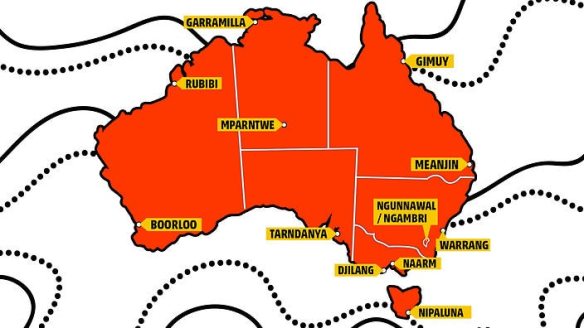
NAIDOC guide to Indigenous place names in Australia (image sourced from SBS)

One of the first comments in the wake of the Prime Minister’s announcement came from the Green Party, who indicated that their support for the Voice would be conditional on there being a Treaty first. Indeed, Greens Senator Lidia Thorpe called the proposed referendum “a waste of money”, indicating that she wanted to see a Treaty with Indigenous Australians before any talk of a Republic. Since the Queen’s death, it seems the Senator has changed her mind, and is now calling for both a Treaty and a Republic. But the Prime Minister has determined that the first order of business for his Government is the Voice, and that the Republican debate is not for his first term in office.

The question to be presented in the Referendum will be:

“Do you support an alteration to the Constitution that establishes an Aboriginal and Torres Strait Islander Voice?”

And the proposed additions to the Constitution would read something like this:

1.There shall be a body, to be called the Aboriginal and Torres Strait Islander Voice.
2.The Aboriginal and Torres Strait Islander Voice may make representations to Parliament and the Executive Government on matters relating to Aboriginal and Torres Strait Islander Peoples.
3.The Parliament shall, subject to this Constitution, have power to make laws with respect to the composition, functions, powers and procedures of the Aboriginal and Torres Strait Islander Voice.

While refusing to be drawn on the precise details of the Voice, the Prime Minister has defined what it is NOT going to be: “Not a third chamber, not a rolling veto, not a blank cheque.” Meanwhile, two bodies have been appointed to prepare for the Referendum proposal and implementation: the Referendum Working Group, and the Referendum Engagement Group, whose terms of reference are not entirely clear – and Senator Thorpe complained that the appointees “did not represent First Nations voices”.

Given the history of Referendums in Australia (most notably the failure of the Republican Movement to secure a “Yes” vote in 1999), it’s understandable that people are either wary about the form of the question and/or the Constitutional amendments, or are concerned about the apparent lack of detail that the Government has so far provided on the remit of the Voice. There is a possibility that the electorate votes “Yes” in the Referendum, but that agreement cannot be reached on the changes to the Constitution, or the structure of the Voice. So it’s understandable that some people are seeking more detail, or at least more clarity.

Whatever the sequence of events (Voice, Treaty, Republic?), it’s going to be a complicated process. For example, putting the Republic before the Voice may mean that the latter becomes redundant, assuming the Republican Constitution embeds principles such as the United Nations Declaration on the Rights of Indigenous Peoples. And Treaty before Republic would mean that the agreement(s) would be between the First Nations people and the Australian Constitutional Monarchy, whose Head of State is now King Charles III.

Perhaps that is the point – the formal process of healing, reconciliation and reparation cannot be meaningfully done without some involvement by the British Crown, in whose name Indigenous lands were appropriated in 1788. But does that potentially “absolve” Australia’s post-Federation Governments and Administrations from any responsibility for the act of British colonisation? Since Federation in 1901, Australia has had ample opportunity to make amends. It is no longer possible to suggest that any change to the Australian Constitution would require Royal Assent by the King or Queen in person – the purely ceremonial role of the British Monarchy in respect to Australia’s domestic affairs has always been predicated on the advice from both the Governor General (who serves as the Monarch’s local representative, and who gives Royal Assent to Australian Acts of Parliament), and Australia’s own government ministers and civil servants. In any event, it’s long been understood that the Crown would not prevent Australia becoming a Republic; in effect, the Crown could not intervene in any Constitutional amendment. Such a change is entirely a matter for the Australian Parliament.

The Westminster Act of 1931 confirmed that Australia is an independent state able to form its own foreign policy and defence free from British control; and the Australia Act 1986 formally severed all remaining legal ties between Australia and the United Kingdom except for the Monarchy. So a Treaty with Indigenous peoples could have been possible since 1901 when the Commonwealth of Australia Constitution Act came into force, heralding Federation. (Interestingly, King Charles III has had to be proclaimed by the Federal Government, and by each State – which might suggest the need for multiple Treaties?)

Another argument against embodying the Voice within the framework of the current Australian Constitutional Monarchy is because it would appear to “ratify” colonisation, and thereby imply Sovereignty had been granted (retrospectively?) to the Crown, which would therefore negate the need for Treaty. Indeed, the whole point of Treaty is to re-assert that Indigenous Sovereignty was never ceded, and that unlike other British colonies such as Canada and New Zealand, the British Crown has never attempted to negotiate any form of direct agreement with the Indigenous Nations of Australia.

Alternatively, Associate Professor Hannah McGlade has stated that a national Treaty needs a national body to negotiate (hence a key purpose of the Voice).  Further, she argues that Aboriginal Sovereignty relates to the “right to shape the national dialogue” on issues of primary concern to the Indigenous population. While not quite equating to full self-determination, it does provide a persuasive argument in favour of establishing the Voice to Parliament.

Finally, some other factors to consider as we move through this multi-faceted debate on Treaty, the Republic, and defining Australia’s post-colonial, post-Federation and post-Monarchy identity:

1. A Republic is no guarantee of getting Treaty right – indeed, look at the number of republics that have ridden rough-shod over their own indigenous and minority peoples – oppression and dictatorship is not the preserve of monarchs and emperors.

2. There is the question of how Crown land in Australia will be resolved, both in relation to Treaty, and the Republic. This would include the commercial arrangements for agriculture, mining and tourism, as well as land development and construction.

3. Inconsistencies in how Indigenous people are acknowledged at public events, meetings and in other similar settings. Here in Victoria, we are very used to some statement of recognition towards Indigenous nations and the traditional custodians of the land, along with their elders past, present and emerging. On my recent trip the Kimberley, I was surprised that no such formal statements were made when visiting culturally significant landmarks, usually under the direction of official tour guides, including National Parks. Not that there was an absence of awareness, knowledge or public signage, but I had expected there might have been a more vocal expression from some of our hosts.

4. Despite the need for a cohesive approach to the Voice and Treaty, it would be a mistake to view the Indigenous populations and their respective Nations as an homogenous entity. Even within Indigenous communities, as in any society, there are differences and inconsistencies. So there will be different demands placed on those charged with navigating the Voice, and negotiating Treaty. But a speedy outcome should not preclude the establishment of a solid consensus. After all, what’s 240 years compared to 50,000?

Next time: Recap…