Radio comes of age in the social media era

About a year ago, I posted a blog on “Steam Internet” which included some ideas about the importance of radio as a communications platform – even in the age of social media.

Among the individual responses I received, a former colleague recalled how he grew up with radio, and how it was a significant presence in his life as a source of news and entertainment – it kept him company while revising for exams, and allowed him to “share” songs with this friends (via personalised mixtapes). He commented that a pharmaceutical company in Indonesia uses radio as a mainstream outreach channel – because it is relatively cheap, it offers targeted demographics, and it provides access to a large-scale, mass market.

He went on: “Radio is probably still the most effective medium to reach out to large audiences – it is targeted, it is always ON, it is always entertaining, it has loyal followers, and it does not require the listener to have an expensive receiver. More importantly, radio traditionally reached a far larger percentage of the population than what the Internet does today, especially in large developing markets.”

Consumer interest in and demand for audio content is recognised by today’s media industry – hence the growth of podcasting, audio platforms like SoundCloud, streaming services such as Spotify and Pandora, and radio apps like TuneIn – not to mention the growth in Internet radio, digital stations and web-streaming broadcasts.

I tend to agree that radio, after more than 100 years, still offers “new” opportunities for reaching an audience, even Gen Y – but as with any content strategy, it pays to get the model right by:

1. Having great content (plus engaging presenters and skilled producers)
2. Enabling access (broadcasting via any platform, anywhere, any time)
3. Cultivating a strong programming culture (i.e., scheduling and curating a logical flow of information, and across multiple platforms)
4. Encouraging audience participation – radio thrives on giving people a voice, either through phone-in sections, community-made programming, or connecting via “traditional” media such as SMS and Twitter

Radio is also very local (despite global access/reach via apps like SoundCloud Radio) and is usually subject to broadcast regulation. I’ve been involved with a community radio station over the past 3 years, and it has made me aware that audience diversity can be a challenge for broadcasters (how to cater for smaller, minority audiences?), but at the same time many people feel unconnected to mainstream media, such that radio is actually their preferred platform to engage with the world.

Acknowledgment My thanks to Rudy J. Rahardjo for his input to this article.
Pause : Edit : Delete – My new year’s resolution for content management

Last week, Apple confirmed it had acquired SnappyCam, an iPhone photo app that is capable of taking 20 frames per second.

At first glance, this seems like a great improvement on the iPhone camera function – until you start to think about some of the implications:

1. Does this mean we’ll be creating (and uploading, sharing, archiving) 20 times more digital photos than we do already?

2. Does Apple intend to remove some other functionality from the iPhone to make way for this enhancement (on the basis that they have just about packed in everything they can in the current iPhone 5S, and processing power and memory capacity are relatively finite)?

3. When will we ever find time to look at all these superfluous/supernumerous photos that Apple will be encouraging us to take?

For myself, I realise that I actually take far fewer photos than I did 10 years ago. In fact, I have never owned a digital camera, and basically lost interest in photography when it became virtually impossible to obtain film for my Nikon APS SLR camera. Previously, I had been using one of the very first Canon IXUS APS models, and before that, for many years I owned a solid and reliable 35mm SLR camera – a Praktica that was made in the former East Germany.  And while I have been using an iPhone to take photos for several years, I do so much more rarely than with any dedicated camera I have owned, even though the smart phone camera technology is much easier and more immediate.

Perhaps the ease of use is part of the problem with digital photography – there’s so little effort required, and practically zero cost involved, so it’s natural that some people just snap away with very little thought or consideration. Besides, if we don’t like a particular photo, we can just delete it. But I wonder if we are being disciplined enough in consigning our mistakes to the Trash icon. Yes, we save, upload and share our better attempts (and maybe we will look at them more than a few times over the years), but do we cull the rest?

I reflected on this as I began the process of clearing out my attic prior to an imminent house move. I found a large box of photographs, all neatly arranged in albums (by chronology and geography – no option to “tag” who was in the shot), representing a major investment in time and money over the years – the cost of the cameras themselves, the effort in composing each and every shot, the cost (and anticipation) involved to get the prints back from the developing lab (plus the mix of sheer horror and pleasant surprise with the results – and those frequently patronising labels telling me the film was under/over exposed… And while I do recall looking at some of these photos from time to time, for much of the past 10 years they have sat ignored and untouched in that same box. I’ll be the first to admit that not every picture was vital, essential let alone unique (for example, how many other tourists have taken photos of the Great Wall of China?), and while many of them still evoked vivid memories, and most of them conveyed a sense of narrative, I realise that I had to impose a more stringent editorial policy on what was deemed worthy of keeping.

So, in the age of digital content, when it seems we can take an infinite number of photos, capture endless hours of video, stream non-stop music and download whole libraries, I am resolved to adopt the following approach to my own content management:

PAUSE

Before saving/archiving any new content, take stock and consider whether I am ever going to want to view/watch/listen/play/read it again.

EDIT

Having decided it is really worthy of taking up space on my hard drive, catalogue it appropriately for easy retrieval. In addition, undertake regular culling of the archive. (What I found to my taste 5 years ago might not appeal today…)

DELETE

Anything that does not survive the above processes must be erased (not just backed up to the cloud or to another hard drive).

As businesses and organizations, we would also do well to apply a similar pruning process to our own operations, especially when we are facing certain constraints on capacity and resources. For example, before embarking on a new project or launching a new product, shouldn’t we be asking ourselves: what projects/products can we discontinue? When setting annual budgets and targets, shouldn’t we be questioning our assumptions on “continuing operations” – just because “we’ve always done it this way”, doesn’t mean we should continue to do so. When we reflect on what is important, can we really be sure we aren’t carrying any excess baggage? Part of this process will be driven by the need to prioritise resources, part of it will be determined by understanding what our customers and stakeholders truly value. Ultimately, what remains will likely be determined by its purpose and its relevance.

If you haven’t looked at that photo on your smart phone in over a year, what is it still doing there?

Ring Out the Old, Ring In the New – Content in Context checks out for the holidays

In honour of the festive season, Content in Context this week takes the form of a short instrumental that I have composed for Melbourne’s Federation Bells.

Normal service will be resumed after the holidays, but in the meantime, I’d like to express my sincere thanks to everyone who has taken the time to visit this blog, especially those who have seen fit to “Like” and leave their valuable comments. Particular appreciation goes to those individuals who have offered specific feedback and encouragement (both online and in person), and those who have shared this blog with their own audiences on Twitter, LinkedIn, Facebook and via other social media platforms and networks.

“Theme for Saturnalia” refers to the Roman festival, usually held from December 17 – December 23, and from which it is thought, Christmas derives many of its customs such as feasting and giving gifts. And while I do not adhere to any particular religious creed or spiritual beliefs, it would be churlish of me not to acknowledge the significance of the season. So, as 2013 draws to a close, and as we brace ourselves for whatever 2014 will throw at us, I would like to close the inaugural year of Content in Context by quoting the Irish comedian, Dave Allen, who ended his TV shows with the immortal words, “Goodnight, thank you and may your God go with you”.

Will Social Media Eat Itself?

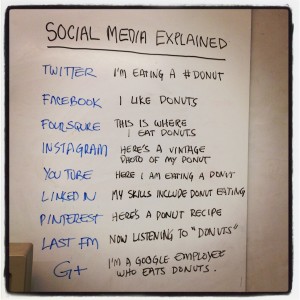
The Internet has shortened the use-by date of most content. Even our attention spans are getting shorter, in inverse proportion to the amount of content we consume and length of time we spend engaging in Social Media and other platforms. Paradoxically, some stuff grabs our attention, and goes viral as everyone posts, shares, likes, blogs and Tweets the same content. Which brings me to this infamous “infographic” on donuts as a signifier for Social Media:

Donuts_SocialMedia_ThreeShipsMedia

Content by Three Ships Media – Photo by Doug Ray

Recently, I saw this image appear as a status update and a “like” by the person posting it. There was no obvious acknowledgement, giving the impression it was an original piece of work. But I recalled having seen it before (more of which later), so I was intrigued as to the true source and provenance. On closer inspection, there was a reference to a third-party website, but this was a dead-end leading to an anonymous blog post.

After a brief search, I located what I believe is the original source for the infographic, Three Ships Media, as well as the photographer who captured the image, Doug Ray. Not that difficult to uncover, given that the post has been “liked” and Tweeted about well over 100,000 times, and written up in Three Ship Media’s own blog (about how this innocuous image had gone viral….).

Now, I don’t believe that the person who posted this image was trying to claim the content as their own work. And I doubt they were deliberately seeking to violate anyone’s intellectual property rights. Yet, the failure to acknowledge our sources (regardless of whether we are exploiting them for personal commercial gain or simply invoking the fair use provisions) threatens to undermine our credibility as commentators, critics and thought leaders. If we keep recycling other people’s work without attribution, the risk is that social media will simply implode as it chases itself in ever-diminishing circles.

Ironically, I realised that I had first seen this infographic at a seminar on the legal and practical aspects of Social Media. It was used by a lawyer to introduce his presentation on copyright issues and the Internet. All very well, except that he insinuated that he had come up with the infographic, and he certainly didn’t cite the original source….

Footnote: The title of this blog was inspired by the writer, David Quantick who coined the phrase “pop will eat itself” in the mid-1980’s, to describe the way modern music is self-referencing itself into oblivion.