RWAs and the next phase of tokenisation

In the blockchain and digital asset communities, there are currently three key topics that dominate the industry headlines. In the short term, the spot Ethereum ETFs are finally due to launch in the USA this week. Then there is the perennial long-term price prediction for Bitcoin. In between, much of the debate is about the future of asset tokenisation, specifically for real-world assets (RWAs). Add to the mix the cat and mouse game of regulatory oversight/overreach and the rapid growth of fiat-backed stablecoins, and there you have all the elements of the crypto narrative for the foreseeable future.

The general view is that tokenising traditional assets such as real estate, equities, bonds, commodities, stud fees, art and intellectual property, and issuing them as digital tokens on a blockchain has several benefits. Tokenisation should reduce origination and transaction costs (fewer intermediaries, cheaper technology); reduce settlement times (instant, compared to T+1, T+2, T+3 days in legacy markets); democratize access to assets (using fractionalisation) that were previously available only to wholesale investors; and give rise to further innovation. For example, imagine hybrid tokens that comprise equity ownership; a right to a share of revenue streams; and membership discounts. Think of a tokenised toll road, or a sports stadium, or an art work that gets hired out to galleries and is licensed for merchandising purposes.

There are still quite a few issues to iron out, such as: the technology standards and smart contract designs that will originate, issue, distribute, track, cryptographically secure and transfer the digital tokens, both on native blockchains and across multiple networks; the role of traditional players (brokers, underwriters, custodians, trustees, transfer agents, payment agents, and share registries), and whether they are needed at all once assets are secured on-chain; and verification, certification and chain of ownership (given that an asset expressed as a digital token is very similar to a bearer bond – my private keys, my asset).

Last week, Upside in Melbourne hosted a panel discussion entitled: “Tokenise This! Unlocking the Value of Real World Asset Tokenisation”. The speakers were:

Richard Schroder, Head of Digital Asset Services, ANZ Bank

Lisa Wade, CEO, DigitalX

Andrew Sallabanks, Head of Strategy and Operations, CloudTech Group

Alan Burt, Executive Chairman, Redbelly Network

Shane Verner, A/NZ Sales Director, Fireblocks

Each of these firms has been working on a number of tokenisation projects such as stablecoins, real estate, government bonds, credit portfolios, fund of funds, and even stud fees. The key message was “faster, cheaper” is not good enough – RWA tokenisation solutions must offer something that is much better than traditional processes, and does not add friction (if anything, it should reduce current friction).

There were frequent references to fiat-backed stablecoins. In some ways, the tokenisation of real estate, bonds and equities is an extension of the tokenisation of money (as illustrated by stablecoins). However, there was no specific mention for the role of stablecoins in RWA tokensiation, for example, as on/off ramps, and as settlement instruments for the pricing, transfer and valuation of RWAs.

From an Australian perspective, the prospect of regulation (particularly for custody, crypto exchanges and brokers, and payment platforms that use stable coins) looms large. Generally, this was welcomed, to provide clarity and certainty. But without some specific provisions for crypto platforms and digital assets, if everything is brought under the existing ASIC/AFSL regime it will exclude many startups and smaller providers due to exorbitant capital adequacy and insurances etc.

Finally, despite the nature of the organisations they work for, all of the panelists agreed that “cryptographic trust is better than institutional trust”.

The potential for tokenising traditional assets has been around for several years. And while it is still relatively early in its evolution, the few listing and trading platforms for tokenised assets that have already launched have struggled to gain traction. They have few listings, limited liquidity, and minimal secondary trading – so, lack market depth. It feels that while the market opportunity may be huge (and the enabling technology is already here), there needs to be a more compelling reason to adopt tokenisation. Hopefully, that will emerge soon.

Next week: Album Celebrations

 

Smart Contracts… or Dumb Software

The role of smart contracts in blockchain technology is creating an emerging area of jurisprudence which largely overlaps with computer programming. However, one of the first comments I heard about smart contracts when I started working in the blockchain and crypto industry was that they are “neither smart, nor legal”. What does this paradox mean in practice?

First, smart contracts are not “smart”, because they still largely rely on human coders. While self-replicating and self-executing software programs exist, a smart contact contains human-defined parameters or conditions that will trigger the performance of the contract terms once those conditions have been met. The simplest example might be coded as a type of  “if this, then that” function. For example, I could create a smart contract so that every time the temperature drops below 15 degrees, the heating comes on in my house, provided that there is sufficient credit in the digital wallet connected to my utilities billing account.

Second, smart contracts are not “legal”, unless they comprise the necessary elements that form a legally binding agreement: intent, offer, acceptance, consideration, capacity, certainty and legality. They must be capable of being enforceable in the event that one party defaults, but they must not be contrary to public policy, and parties must not have been placed under any form of duress to enter into a contract. Furthermore, there must be an agreed governing law, especially if the parties are in different jurisdictions, and the parties must agree to be subject to a legal venue capable of enforcing or adjudicating the contract in the event of a breach or dispute.

Some legal contacts still need to be in a prescribed form, or in hard copy with a wet signature. A few may need to be under seal or attract stamp duty. Most consumer contracts (and many commercial contracts) are governed by rules relating to unfair contract terms and unconscionable conduct. But assuming a smart contract is capable of being created, notarised and executed entirely on the blockchain, what other legal principles may need to be considered when it comes to capacity and enforcement?

We are all familiar with the process of clicking “Agree” buttons every time we sign up for a social media account, download software or subscribe to digital content. Let’s assume that even with a “free” social media account, there is consideration (i.e., there’s something in it for the consumer in return for providing some personal details), and both parties have the capacity (e.g., they are old enough) and the intent to enter into a contract, the agreement is usually no more than a non-transferable and non-exclusive license granted to the consumer. The license may be revoked at any time, and may even attract penalties in the event of a breach by the end user. There is rarely a transfer of title or ownership to the consumer (if anything, social media platforms effectively acquire the rights to the users’ content), and there is nothing to say that the license will continue into perpetuity. But think how many of these on-line agreements we enter into each day, every time we log into a service or run a piece of software. Soon, those “Agree” buttons could represent individual smart contracts.

When we interact with on-line content, we are generally dealing with a recognised brand or service provider, which represents a known legal entity (a company or corporation). In turn, that entity is capable of entering into a contract, and is also capable of suing/being sued. Legal entities still need to be directed by natural persons (humans) in the form of owners, directors, officers, employees, authorised agents and appointed representatives, who act and perform tasks on behalf of the entity. Where a service provider comprises a highly centralised entity, identifying the responsible party is relatively easy, even if it may require a detailed company search in the case of complex ownership structures and subsidiaries. So what would be the outcome if you entered into a contract with what you thought was an actual person or real company, but it turned out to be an autonmous bot or an instance of disembodied AI – who or what is the counter-party to be held liable in the event something goes awry?

Until DAOs (Decentralised Autonomous Organisations) are given formal legal recognition (including the ability to be sued), it is a grey area as to who may or may not be responsible for the actions of a DAO-based project, and which may be the counter-party to a smart contract. More importantly, who will be responsible for the consequences of the DAO’s actions, once the project is in the community and functioning according to its decentralised rules of self-governance? Some jurisdictions are already drafting laws that will recognise certain DAOs as formal legal entities, which could take the form of a limited liability partnership model or perhaps a particular type of special purpose vehicle. Establishing authority, responsibility and liability will focus on the DAO governance structure: who controls the consensus mechanism, and how do they exercise that control? Is voting to amend the DAO constitution based on proof of stake?

Despite these emerging uncertainties, and the limitations inherent in smart contracts, it’s clear that these programs, where code is increasingly the law, will govern more and more areas of our lives. I see huge potential for smart contracts to be deployed in long-dated agreements such as life insurance policies, home mortgages, pension plans, trusts, wills and estates. These types of legal documents should be capable of evolving dynamically (and programmatically) as our personal circumstances, financial needs and living arrangements also change over time. Hopefully, these smart contracts will also bring greater certainty, clarity and efficiency in the drafting, performance, execution and modification of their terms and conditions.

Next week: Free speech up for sale


My Four Years in Crypto

It’s four years since I began my career in Blockchain, crypto and digital assets. (I can’t claim to be an early adopter, although this blog first mentioned Bitcoin in 2013.) My knowledge on the topic was quite rudimentary at the time, and it was like jumping in at the deep end when I joined the small team at Brave New Coin. Apart from the 3 co-founders, there were 3 other core team members already on-board, so I was lucky 7.

My professional career has mainly been in law, publishing and financial services, plus a range of consulting, contract and freelance roles across various sectors. My point of entry into crypto was my experience with Standard & Poor’s and Thomson Reuters in market data, indices, analytics, content, research and portfolio tools – the basis of Brave New Coin’s business, and therefore an appropriate fit with my experience and skills set.

In the past four years, I have been privileged to witness at close hand the market exuberance of 2017 (fuelled by the ICO phenomenon and the incredible bull market), the regulatory backlash of 2018, the crypto winter of 2018-19, and the stop-start messages coming from regulators, markets, institutional investors, central banks and major corporations.

Getting to grips with some of the technical and other idiosyncrasies has been a steep learning curve – but I have tried to adopt a dual approach to expanding my own understanding. First, focus on the major components before getting to far into the weeds on any particular area of technical detail; second, create a personal framework of analogous concepts, and identify practical metaphors that you can also easily explain to others – self-education is critical to personal survival, but sharing knowledge is the path to wider adoption.

It’s also important to maintain an anchor based on your original point of entry – not only does that become a constant point of reference, it also enables you to build areas of personal expertise and domain knowledge. So, while many early proponents and adopters were drawn to crypto because of their underlying belief in Libertarianism, or their fascination with cryptography, or their distrust of centralised banking systems, my own points of reference continue to be around financial services (asset origination, tokenisation, digital wealth management), market data (indices, industry standards, benchmarks), regulations and analytics. While I am an advocate for Blockchain technology, I am not a hardcore technologist, but I realise that it will take time for issues such as scaling, interoperability and mass adoption to be fully resolved.

At the very least, a great deal of that market experience (especially driven by the decentralized, project-intensive and ICO-related activity of 2016-18) has demonstrated the following truths about Blockchain technolgy:

1. This is a new model of capital formation – just as companies no longer have a monopoly on human capital, banks and traditional intermediaries no longer have a monopoly on raising financial capital

2. This is a new means of asset creation, wealth distribution and market access – backed by Blockchain solutions, crypto is the first asset class that was retail first, in a distributed/decentralized bottom-up approach to issuance

3.This is a new platform for commerce – whether via tokenomics, network incentives, value transfer, smart contracts or programmed scarcity

4. This represents a paradigm shift in governance models – via the use of decentralized, autonomous, trustless, consensus and incentive-based operating structures and decision-making systems

5. This introduces new principles of distribution – assets are consumed closer to the source of value creation (fewer intermediaries and rent seekers)

6. But, it is not (and should never be) the solution for everything

Given what is happening at the moment around the COVID 19 pandemic, Blockchain, crypto and digital assets will prove to be perfect solutions to a number of problems such as: establishing the provenance of medicines; identity verification; managing supply chain logistics; enabling the distribution of assets; computing power for scientific modelling and testing; and providing alternatives to cash.

Next week: Social Distancing in Victorian Melbourne…


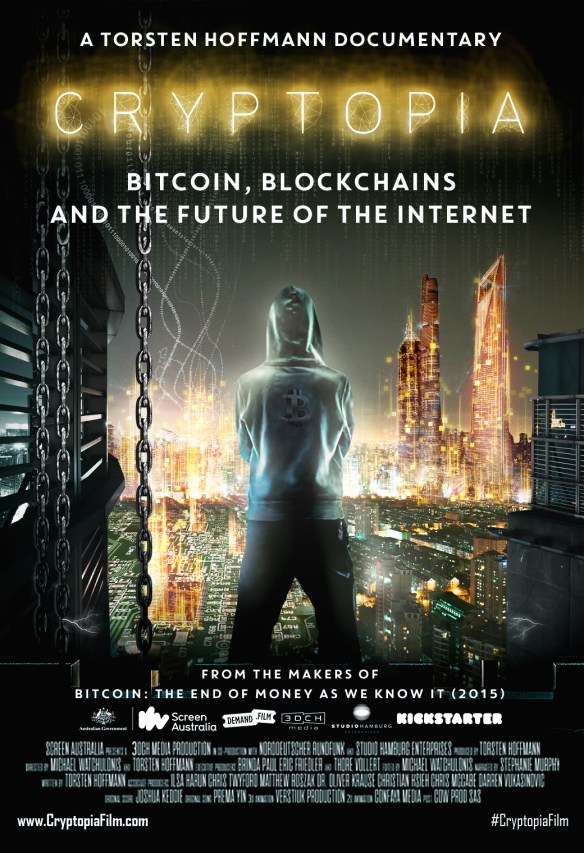
Cryptopia – The Movie

A quick plug for Torsten Hoffman‘s new documentary, Cryptopia: Bitcoin, Blockchains and the Future of the Internet. After a series of preview screenings around Australia and  New Zealand last last year, the film has its world premiere tonight in Melbourne.

Five years after producing Bitcoin: The End of Money As We Know it, the director has gone back and interviewed a number of key figures who appeared in the last film, to update their stories, and to dig deeper into the whole Blockchain, Bitcoin and crypto narrative.

I haven’t yet seen the latest film, but I first met Torsten when he was screening the previous documentary on the meetup circuit. He was kind enough to show me some early edits of Cryptopia, and I have to say the new content looks very promising.

Given the speed at which Blockchain and Bitcoin markets move (a week in crypto is often referred to as a year in any other asset class), it’s actually important that we stand back and take stock of where we are in this new paradigm for FinTech, decentralisation and distributed ledger technology.

Even if you can’t make it to the Melbourne premiere, look out for Cryptopia the movie as it tours globally.

Next week: Tarantino vs Ritchie