More on AI Hallucinations…

The mainstream adoption of AI continues to reveal the precarious balance between the benefits and the pitfalls.

Yes, AI tools can reduce the time it takes to research information, to draft documents and to complete repetitive tasks.

But, AI is not so good at navigating subtle nuances, interpreting specific context or understanding satire or irony. In short, AI cannot “read the room” based on a few prompts and a collection of databases.

And then there is the issue of copyright licensing and other IP rights associated with the original content that large language models are trained on.

One of the biggest challenges to AI’s credibility is the frequent generation of “hallucinations” – false or misleading results that can populate even the most benign of search queries. I have commented previously on whether these errors are deliberate mistakes, an attempt at risk limitation (disclaimers), or a way of training AI tools on human users. (“Spot the deliberate mistake!) Or a get-out clause if we are stupid enough to rely on a dodgy AI summary!

With the proliferation of AI-generated results (“overviews”) in basic search queries, there is a tendency for AI tools to conflate or synthesize multiple sources and perspectives into a single “true” definition – often without authority or verified citations.

A recent example was a senior criminal barrister in Australia who submitted fake case citations and imaginary speeches in support of a client’s case.

Leaving aside the blatant dereliction of professional standards and the lapse in duty of care towards a client, this example of AI hallucinations within the context of legal proceedings is remarkable on a number of levels.

First, legal documents (statutes, law reports, secondary legislation, precedents, pleadings, contracts, witness statements, court transcripts, etc.) are highly structured and very specific as to their formal citations. (Having obtained an LLB degree, served as a paralegal for 5 years, and worked in legal publishing for more than 10 years, I am very aware of the risks of an incorrect citation or use of an inappropriate decision in support of a legal argument!!!)

Second, the legal profession has traditionally been at the forefront in the adoption and implementation of new technology. Whether this is the early use of on-line searches for case reports, database creation for managing document precedents, the use of practice and case management software, and the development of decision-trees to evaluate the potential success of client pleadings, lawyers have been at the vanguard of these innovations.

Third, a simple document review process (akin to a spell-check) should have exposed the erroneous case citations. The failure to do so reveals a level laziness or disregard that in another profession (e.g., medical, electrical, engineering) could give rise to a claim for negligence. (There are several established resources in this field, so this apparent omission or oversight is frankly embarrassing: https://libraryguides.griffith.edu.au/Law/case-citators, https://guides.sl.nsw.gov.au/case_law/case-citators, https://deakin.libguides.com/case-law/case-citators)

In short, as we continue to rely on AI tools, unless we apply due diligence to these applications or remain vigilant to their fallibility, we use them at our peril.
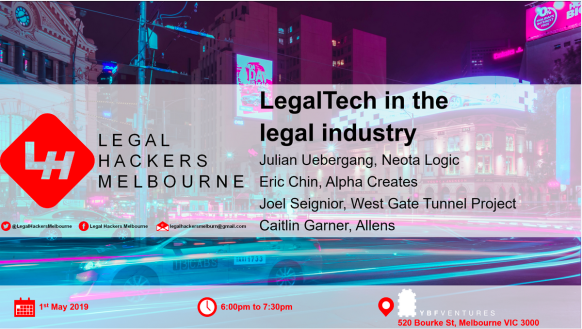

 

Melbourne Legal Hackers Meetup

Given my past legal training and experience, and my ongoing engagement with technology such as Blockchain, I try to keep up with what is going on in the legal profession, and its use and adoption of tech. But is it LawTech, LegalTech, or LegTech? Whatever, the recent Legal Hackers Meetup in Melbourne offered some definitions, as well as a few insights on current developments and trends.

The first speaker, Eric Chin from Alpha Creates, defined it as “tech arbitrage in the delivery of legal services”. He referred to Stanford Law School’s CodeX Techindex which has identified nine categories of legal technology services, and is maintaining a directory of companies active in each of those sectors.

According to Eric, recent research suggests that on average law firms have a low spend on legal technology and workflow tools. But typically, 9% of corporate legal services budgets are being allocated to “New Law” service providers. Separately, there are a growing number of LegalTech hubs and accelerators.

Meanwhile, the Big Four accounting firms are hiring more lawyers, and building our their legal operations, and investing in legal tech and New Law (which is defined as “using labour arbitrage in the delivery of legal services”).

Key areas of focus for most firms are Practice Management, Legal Document Automation,
Legal Operations and e-Discovery.

Joel Seignior, Legal Counsel on the West Gate Tunnel Project, made passing mention of Robert J Gordon’s economic thesis in “The Rise and Fall of American Growth”, which at its heart postulates that despite all appearances to the contrary, the many recent innovations we have seen in IT have not actually delivered on their promises. He also referred to
Michael Mullany’s 8 Lessons from 16 Years of the Gartner Hype Cycle, which the author considers to be past its use-by date. Which, when taken together, suggest that the promise of LegalTech is somewhat over-rated.

Nevertheless, businesses such as LawGeex are working in the legal AI landscape and other disciplines to deliver efficiency gains and value-added solutions for matter management, e-billing, and contract automation. Overall, UX/UI has finally caught up with technology like document automation and expert systems.

Finally, Caitlin Garner, Head of Innovation at Allens spoke about her firm’s experience in developing a Litigation Innovation Program, underpinned by a philosophy of “client first, not tech first”. One outcome is REDDA, a real estate due diligence app, that combines contract analytics, knowledge automation, reporting and collaboration. Using off-the shelf solutions such as Kira’s Machine Learning, Neota’s Expert System and HighQ, the Allens team have developed a transferable template model. Using a “Return & Earn” case study, the firm has enabled the on-boarding of multiple suppliers into a streamlined contract management, signature and execution solution.

Next week: Notes from New York Blockchain Week


Startup Vic’s Professional Services Pitch Night

For the first of Startup Vic’s monthly pitch nights for 2018, professional services were put under the spotlight. There is a public dialogue on the types and numbers of roles that will disappear due to automation (the professions are no different) and here were four startups seeking to engage in that conversation. Assuming that every industry and every occupation is vulnerable to disruption (and should be alert to the potential opportunities that presents), why should accountants and lawyers feel left out?

Image sourced from Startup Vic Meetup page

Myaccountant

With the promise of enabling users to lodge their BAS return from a smart phone, this app is aimed at micro businesses that struggle with bookkeeping and accounting tasks. Since accounting software packages do not support direct BAS lodgement (although expect this to change…), the app charges $39 per BAS, with no bookkeeping or accounting fees, and shares the fee with the accountants who do the lodgement.

The app is able to extract data from vendor APIs such as Expert360, Airtasker, Uber, etc., and connect to users’ bank accounts. Since launching in January, the app has generated 200 sign ups, with very little direct marketing or paid acquisition so far. The app is also aiming to achieve ISO 27000 (information security).

The panel of judges would have liked to have heard more about the acquisition strategy, and how the app deals with income and expense categorisation, different tax rates, zero rated items, and export sales etc. They also wondered about the competition, and overseas markets

Contractprobe

Developed by Neural Contract, this product uses machine learning to review contracts in 60 seconds. Using a scoring model, it rates documents according to established best practice and bench-marking, suggest sample text for missing clauses, and identifies problems found.

The service is available for ad hoc use, under a monthly subscription, or as custom packages.

According to the founders, the service can save 40% of the time usually spent on contract reviews. It offers a high level of privacy – the uploaded contract, report and transaction ID is deleted upon completion (although it wasn’t clear what records are retained for the purposes of clause analysis, data and analytics – including client profiling and user context.)

To reassure any lawyers in the audience, the product stills relies on human input to apply judgment to the choice of clauses, for example. However, a clear value of the review process is ensuring that phrases and key words are properly defined in the contract.

The judges wondered where this product fits in with open source documentation and pre-drafted documents, whether there are specific verticals more suited to this service, and what trust and liability issues might arise. Is it more of a “clause-spotter” rather than an expert system? How does it address statutory clauses, and the question of whether clauses are actually enforceable?

The service has about 40 clients, including law firms, and is now moving into corporate clients.

Businest

This product is designed to help with cashflow management, which the founders describe as an “iceberg” issue. They point to data that suggests 87% of SMEs have issues with cashflow.

Claiming to use AI to coach SMEs and accountants, the goal is to allow business owners to focus on what they do best, and move accountants from “compliance to advisory”. Applying its own algorithm to cashflow analysis, the service also provides training content to advisors.

Offering both SME and advisor pricing models, the founders have launched a pilot with MYOB. They also point to market research and commentary (CEDR, AFR, CPA, CA…) that indicates the market wants it.

The judges felt that the banks won’t rush to endorse the service (although under the open banking data protocol, they won’t be able to prevent customers linking their accounts) because they are used to the interest they charge on overdraft facilities and credit cards.

Brandollo

This is a marketing tech start-up, aimed at SMEs that struggle to access tailored advice. Targeting B2B clients, in the professional services sector,  with less than 80 staff.

Briefly referring to the use of AI and ML, the service claims to reduce marketing costs by 80%. It offers a brand gap analysis and makes recommendations, that can be implemented without external help. The process looks at execution issues, content requirements, and actual solutions.

Aiming for 200,000 clients in 5 years (currently standing at 200+), the main competitor is Benchmarketing. Brandello offers a freemium model, with a 3-tier paid-for service. They can connect clients to experts, provide a quote to execute and then take a commission on the resulting solution.


Based on the judges’ verdict, the winner was Myaccountant. While the people’s choice was a tie between Myaccountant and Contractprobe.

Next week: The General Taxonomy for Cryptographic Assets

Expert vs Generalist

My recent blog on the importance of experts prompted one reader to comment that he preferred the term “specialist” (in a non-medical sense) to “expert”. This got me thinking about the notion of “experts” as distinct from “generalists”, and whether we need to re-evaluate our assessment of skill, competence and aptitude when assessing someone’s suitability for a task, project or role. (And these days, is “generalist” itself something of a pejorative term?)

A few days later, I was having coffee with a strategic consultant who is known as a future thinker. He describes himself as an “extreme generalist” (with no hint of irony), because he has wide-ranging and multiple interests, some of which, of course, he has deep domain knowledge and experience. But because his work and his curiosity take him into different realms, he maintains a broad perspective which also allows for the cross-pollination of ideas and concepts. (I think we all recognize the value of analogy when problem solving – taking the learning from one discipline and applying it to a new scenario.)

Separately, but in a similar vein, I was discussing career options with a senior banking executive, who did not want to be pigeon-holed as a banker, because her core skills and professional experience would lend themselves to many industries, not just financial services. So in her case, this expertise would best be applied in a particular type of role, not in a specific domain, or a specialist capability.

And during an earlier discussion on leadership with yet another futurist, I found myself debating the notion of situational styles, as opposed to structural models – both of which require skill and expertise for CEOs and managers to be successful. But broad experience will be just as important as formal methodologies, and general business knowledge just as valuable as technical specialisation. (On reflection, as with so many constructs, it’s not a case of either/or – more a question of adaptation and dynamics.)

As a result of this ongoing dialogue, I was challenged to develop what I might describe as a 3-D model, comprising the following axes:

“Generalist”/”Specialist”: In product management terms, for example, the generalist understands the full end-to-end customer life cycle and the production process. Whereas, a specialist might know their particular part of the process extremely well, but has little to no awareness or understanding of what might come before or after. (Think of those frustrating customer calls to utility, telco and insurance companies – in fact, any business with highly siloed operations – where you get passed from one “specialist” to another, often revealing contradictory information along the way.) At the extremes, this dimension might be described as the difference between knowing a subject “a mile wide and an inch deep”, and knowing it “a mile deep and an inch wide”.

“Novice”/”Veteran”: This is probably obvious, but I don’t necessarily mean seniority, age or tenure in a specific role. When it comes to new technology, for example, someone who is new to the role, but who has just been trained on the latest software and equipment, may have better technical ability than someone who has been doing the same role for several years (and thus, has more knowledge and experience), but has not refreshed their skills. Although I concede that in many situations the incumbent veteran may have better developed problem-solving, trouble-shooting and decision-making capabilities. This axis is also really important to consider when transitioning older employees to new roles within the same organisation or team – if they were younger, they would probably be given more time to adjust, adapt and grow into the role. Whereas, an older employee may simply be expected to “pick it up” much more quickly, with less leeway for learning on the job, because of assumed expertise.

“Broad”/Narrow”: Here I am thinking about aptitude, rather than the degree of specialisation. Drawing on the idea of using analogies, someone with wide experience and a broad perspective (sees the big picture, displays both critical and design thinking) will have quite different qualities to someone with a very narrow focus (especially within a very specific domain or area of practice). Based on the particular context, do you need an all-rounder, or a placekicker? This axis also relates to the age-old issue of organisations only wanting to hire square pegs for square holes – it might make sense in the short-term, but risks stagnation and lack of fresh thinking over the long-term.

Assessed along these three dimensions, we might see that an “expert” could be qualified according to how highly they rate based on their overall “depth”, measured by criteria such as experience, knowledge and reputation, as well as formal qualifications.

Next week: Making an Impact at Startup Victoria’s Pitch Night