Banking Blues (pt. 481)

Last week, I attended a networking evening for Intersekt, Australia’s largest annual fintech conference. Billed as the “flagship event of the Digital Innovation Futures Victoria Festival”, the 2-day event is supposed to take the pulse of Australian fintech – by highlighting current industry trends, showcasing local success stories and identifying areas for future growth and collaboration. I wasn’t able to attend the 2-day conference itself, but based on the networking audience, and the program agenda, it feels like there is very little “innovation” these days, and certainly not among the major banks.

The fintech product focus is still very much on payment solutions and open data – even though we’ve had the NPP and Open Banking for several years – plus SME lending (since the major banks have largely abandoned cashflow lending, just as they have exited wealth management and financial planning). There was barely an hour of the conference given over to crypto currencies and digital assets, and from what I could see, no sessions dedicated to Blockchain technology.

Challenger or neo-banks have not managed to gain traction in Australia, mainly due to the dominance of the incumbent banks, especially the so-called Big 4, which continue to enjoy an entrenched oligopoly protected by regulation. Despite Financial Services (banks, diversified financials and insurance) forming the largest sector (27%) of the ASX 200, it is highly concentrated and appears structurally designed to keep out competition (and hence, stifle innovation).

Indeed, I cannot think of a single new product that my bank has introduced in the 20 years I have been a customer. Over that time, I have held both personal and business accounts with this bank – mortgages, investment loans, credit cards, transaction accounts and savings products. They no longer offer wealth management services under their own name, and the share trading account I hold with them is actually operated by a foreign financial institution. At the same time, the bank has been shuttering branches, and disbanding services, often without any notice or customer communication.

My frustration with this bank goes unheeded – if anything, the customer service has worsened, often under the guise of “the Royal Commission”. The latter has no doubt given rise to staff cuts to pay for greater compliance costs, and is used to justify over-bureaucratic customer processes. Meanwhile, every time I raise a complaint, I’m told it’s the bank’s “systems” that are to blame, or their third-party service providers – it’s never the bank’s own fault, and they never take responsibility or demonstrate accountability.

These are just the latest incidents in a litany of poor customer experience:

1. A simple title transfer involved me visiting three different branches (thanks to branch closures and rotating staff), plus e-mailing and phoning an interstate office (at least the settlement was probably executed on Pexa’s blockchain-enabled platform…)

2. A glitch in setting up a replacement bank-issued credit card in my digital wallet was blamed on the card provider’s technology (even though I had just successfully linked this same card to my smart watch). I hope the bank has robust SLAs with this third party…

3. Some unsolicited (and highly misleading) e-mail marketing sent out under the bank’s name was blamed on another third-party provider (surely the bank must authorise what communications are issued in its name?)

4. I spent over 2 hours in a branch to open some basic term deposits in the name of existing businesses that already have client profiles and accounts with this same bank – a combination of bureaucracy, slow technology and cumbersome processes which still involve wet signatures on hard copy documents.

5. In the process of setting up one of these business accounts, it turns out the bank had the wrong company details on their core records, even though the statements are sent to the correct address. I advised the bank of the change of address several years ago, but despite the findings of the Royal Commission, the bank has not bothered to run a check on the ABN register, which is free to use, to check the company details.

The really depressing thought is that even if I switch banks, I will probably run into similar problems elsewhere!

Next week: Non-binary Politics?

Digital Identity – Wallets are the key?

A few months ago, I wrote about trust and digital identity – the issue of who “owns” our identity, and why the concept of “self-sovereign digital identity” can help resolve problems of data security and data privacy.

The topic was aired at a recent presentation made by FinTech advisor, David Birch (hosted at Novatti) to an audience of Australian FinTech, Blockchain and identity experts.

David’s main thesis is that digital wallets will sit at the centre of the metaverse – linking web3 with digital assets and their owners. Wallets will not only be the “key” to transacting with digital assets (tokens), but proving “identity” will confirm “ownership” (or “control”) of wallets and their holdings.

The audience felt that in Australia, we face several challenges to the adoption of digital identity (and by extension, digital wallets):

1. Lack of common technical standards and lack of interoperability

2. Poor experience of government services (the nightmare that is myGov…)

3. Private sector complacency and the protected incumbency of oligopolies

4. Absence of incentives and overwhelming inertia (i.e., why move ahead of any government mandate?)

The example was given of a local company that has built digital identity solutions for consumer applications – but apparently, can’t attract any interest from local banks.

A logical conclusion from the discussion is that we will maintain multiple digital identities (profiles) and numerous digital wallets (applications), for different purposes. I don’t see a problem with this as long as individuals get to decide who, where, when and for how long third parties get to access our personal data, and for what specific purposes.

Next week: Defunct apps and tech projects


Startup Vic FinTech Pitch Night

The Australian tech sector, especially at the startup end of the industry, is having to grapple with what is fast becoming a major structural and operational challenge: how to hire, remunerate and retain staff. With closed international borders cutting off the supply of overseas students and graduates, and a lack of sufficient home-grown skills, it’s a problem that established businesses and startup ventures alike are having to address. Just last week, the AFR reported that some wages in the tech sector have gone up 30% in the past 12 months. Perhaps this issue was on the minds of the four founders who presented at the recent Startup Victoria FinTech Pitch Night.

The judges for this on-line event, sponsored by LaunchVic, were: Nicole Small, Investment Director at Rampersand; Kim Hansen, Co-founder and CEO of Cake Equity; Caitlin Zotti, Operations Manager at Pin Payments; and “the people’s judge,” Eike Zeller, Community Lead at Stone & Chalk Melbourne. Compered by Josh Sharma, Head of Labs & Startups at LUNA, the evening also featured a virtual fireside chat between Rebecca Schot-Guppy, CEO of FinTech Australia, Dom Pym, Co-Founder of Up, and Julia Bearzatto, Head of Technology for Financial Services at MYOB.

The four startups in order of presentation were (links in the names):

Elbaite

Claiming to be the “first non-custodial cryptocurrency exchange“, part of Elbaite’s mission is to prevent theft or misappropriation of crypto assets held in exchange wallets. What makes Elbaite different from other decentralized exchanges (DEXs) and peer-to-peer platforms is that they escrow the fiat involved in any transaction. While they may not be charging the fees of centralized exchanges (CEXs), they are charging a 1% on crypto purchases (although there is 0% commission on sales). Elbaite is hoping to target institutional clients who may not be as comfortable trading on “traditional” crypto exchanges – although in my experience, many institutional clients actually need third-party custody services as part of their governance and compliance obligations. The judges felt that this is a crowded space (there are more than 250 crypto exchanges globally, plus numerous fiat on/off ramps, brokers, OTC desks and P2P platforms).

Sequrr

Speaking of custody and escrow, who would have guessed that stolen house purchase deposits are such a major issue, unless the team at Sequrr had told us? Despite the use of Real Estate Trust Accounts within the industry, apparently there is not much to stop the account holders from walking off with the deposits. Which rather begs the question why the industry does not already use something like multi-signature digital wallets, which mean that the funds can only be moved once all parties to the transaction agree. Even though this is a tech solution using a 3-way verification model (innovation patent pending), the different real estate laws in each State means that it’s not that simple to roll out nationally. However, the team also see opportunities for other professional and commercial sectors: solicitors, builders, aged care. (Note to the founders: I know that invented brand names were once flavour of the month for tech startups, but I question the wisdom of adopting a word that reads like a spelling error, and sounds like someone coughing up phlegm – especially if you want to be taken seriously by banks and solicitors. Just a thought.)

Nextround

Another issue of trust exists between employers and employees when it comes to reward and recognition schemes. There’s always a risk that whatever structure and incentives companies use, someone will try to game the system (or collude with colleagues) especially if the stakes are high; or, if the rewards are simply handed out for turning up and doing your job, their currency becomes debased. Then there’s the (ill-advised) link between rewards and recognition on the one hand, and performance reviews (plus bonuses and salary adjustments) on the other. It’s a balancing act which Nextround are addressing by making it easier (and less expensive) to reward and recognise all of your staff, not just the usual top 5-15%. They do this by offering managers and team leaders access to rewards of a smaller (yet still meaningful) value, which can be easily redeemed by the recipients, for hospitality rewards, events and experiences. The commercial model relies on an annual corporate subscription fee, and taking a cut of the reward vouchers. Nextround consults with employers on their preferred merchants and suppliers, who don’t necessarily see the vouchers as eroding their margins – rather, it’s another sales channel. This is not a hospitality app (e.g., loyalty program), more of a procurement app. And although there are numerous competitors for reward and recognition schemes, the “smarts” are in the way managers and HR teams can budget and allocate accordingly, without the need for onerous expense form claims because the transactions can all be tracked from the point of redemption back to the point of issuance. The resulting data will also generate a further revenue stream from the valuable analytics, although would I want my employer to know how I used my vouchers (assuming they are not tied to a specific reward)? My other reservation is that if the rewards really are as small as a cup of coffee, or even a round of drinks at the pub, isn’t it a bit like tipping?

SpendAble

Letting people make their own financial decisions is also a form of trust. Most of us would feel we can be trusted to spend our own money how we like. But this assumption may be challenged when it comes to people with a disability. SpendAble is developing payment, saving and investment solutions for people who face physical, societal and intellectual barriers to managing the financial affairs. Starting with a budget-based spending app, SpendAble helps users to allocate, identify and track their purchases more easily, and with much of the payment friction removed. The team will also develop specific applications such as voice-controlled functions for the visually impaired. Largely reliant upon the NDIS for funding and end users to cover transaction costs, SpendAble will plug into existing banking platforms – which might be a better way to underwrite the app? However, some of the online chat on the night suggested that SpendAble could provide well-needed general financial education to school kids as part of its offering, as well as helping to address financial inclusion.

Such was the enthusiasm for SpendAble that they took out the Peoples’ Choice as well as the Judges’ Award.

Next week: Accounting for Crypto

Intersekt FinTech Pitch Night

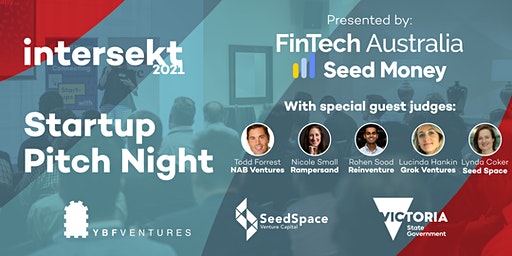
The opening event of the Intersekt 2021 Australian FinTech Conference was a startup pitch night, organised by FinTech Australia, hosted by YBF Ventures, and sponsored by Seed Money. The esteemed judging panel was drawn from a range of VC funds: Todd Forest (NAB Ventures), Nicole Small (Rampersand), Rohen Sood (Reinventure), Lynda Coker (SpeedSpace) and Lucinda Hankin (Grok Ventures).

The pitches in order of presentation (links are in the names):

Boulevard

A cloud-based share registry management platform for startups, founders and their employees. Designed to to be an exchange for unlisted securities, the platform also offers Investor Relations support and automated compliance solutions. Using Distributed Ledger Technology (which underpins Blockchain), the team are working with ASX DLT Solutions (responsible for the CHESS replacement) and deploying DAML, the programming language for modelling digital assets. They have also developed ASICLink, to automate company filings with the corporate regulator, plan to support corporate actions (including the verification of company financials), and are working with equity crowdfunding platforms. Boulevard has already on-boarded 30 companies, comprising 4,000 shareholders.

COGSflow

Describing itself as “Performance based finance”, this is essentially a merchant service offering cash-flow funding solutions for physical goods. This involves purchasing client inventory, and getting repaid on the sales performance. Using a funding ratio calculation as the basis of its credit risk model, the COGSflow will track sales data from the likes of eBay and Amazon (although both of these platforms, like PayPal, Alibaba etc. already offer SME financing of various forms). COGSflow will also analyze variable marketing and customer acquisition costs as inputs to its lending model, and plans to become a member of the Personal Property Securities Register (PPSR), as well as seeking B Corp certification.

Archa

Archa is solving the challenges many SMEs face when trying to access corporate credit cards – banks generally demand personal guarantees from owners or directors before they issue cards, and when they do the “product is awful”. As the pitch described it, many bank-issued corporate cards are really designed as “a line of credit to acquire air miles”. With a mobile app already in the market, Archa incorporates an administration and expense management solution. A major bug bear for many companies is managing corporate subscriptions – all those SaaS apps that are tied to individual employee cards; consolidating, renewing and cancelling those services can be time-consuming and painful. The account administrator can also manage each card’s credit limit. Archa itself has principal issuer membership with MasterCard. In addition to an equity raise, the team is seeking debt funding to offer lines of credit. Channels to market will include SME lenders, accountants and lawyers.

Sherlok

According to the founders, most people paying too much on their mortgages – based on their home loan rate. Because mortgage brokers have 60% of the market, and rely on trailing commissions, there is little incentive for brokers to help their clients find a better rate or provider. However, 15% of brokers’ clients are leaving each year. Sherlok is an SaaS platform that uses AI to help brokers reprice and refinance their existing mortgage book. Using a broker subscription model, Sherlok is aiming to offer “single click refinancing”, although there was some equivocation about becoming a virtual brokerage itself. The founders feel that mortgage broking is still a relationship based business, and requires a human touch.

Axichain

Axichain is building a blockchain-based agricultural supply chain – a digital trading solution for cross-border commodities trading, with an initial focus on red meat. The founders are addressing three main supply chain pain points – market access, paperwork and payment.
Axichain combines smart contracts, an escrow solution and traceability linked to legal processes. Overall, the platform envisages multiple products and revenue streams. The team are seeking both equity and debt funding, the latter to provide lines of credit lines.

Parpera

The meaning of “Parpera” is “fair wallet”. By that, the founders mean they want to offer a range of banking and related services aimed at SME owners, sole traders and freelances. This could include business registration and set-up, better financial insights, and access to smarter banking products etc. It will include card services, payments and invoicing. The plan is to target customers who are about to set up a business, and to promote the service at the start/end of the financial year, hence the intention to use accountants as a channel to market.

Next week: Monash University Virtual Demo Day