“Language is a virus” – a look at coding skills

We are fast-approaching the point when a lack of some basic coding skills will be likened to being illiterate. If you are unable to modify a web page or use an HTML text editor, it will be like not knowing how to create a Word document or edit a PDF file. Coding does appear on some school curricula, but it is primarily taught in the context of maths, computer programming or IT skills. Whereas, if we look at coding as a language capability (part of a new literacy), it should be seen as an essential communication tool in itself.

quote-William-S.-Burroughs-language-is-a-virus-from-outer-space-92713First, I am aware that a number of programs for children are trying to teach coding and maths in more relevant ways, and having talked to some of their creators, I admire their ambition to place these skills in a broader context. Coding might be described as the “4th R”: alongside reading, writing, arithmetic we have reasoning”. So a program like Creative Coding HK (as it name implies) focuses on students making things; in the USA, KidsLogic is placing as much emphasis on contextual learning as on robotics; while Australia’s Machinam is re-writing the maths curriculum to teach practical, everyday problem-solving skills.


Second, as we know, learning the foundations of coding is like learning the syntax of a foreign language. However, while Latin and Greek can provide the basis for learning the structure (and many words) of many European languages, it’s not much use when learning character-based languages (Chinese, Japanese) – although there are common grammatical elements. But if we understand that a line of any code has to be structured a certain way, contain essential elements, define key attributes and run in a particular sequence or order, we may come to “read” and interpret what the code is saying or doing.

As an aside, I’m struck by the comments made by the founder of AssignmentHero during a recent pitch night. Although he had studied computer sciences at Uni, he did not use any of the formal computing languages he had learned when building his product. This highlights the downside of learning specific languages, which can become obsolete, unless we have a better grasp of “which languages for which purposes”, or find ways to easily “interpolate” components of one language into another (just as languages themselves borrow from each other). Or do we need an Esperanto for coding?

Third, even if I don’t want or need to learn how to program a computer or configure an operating system, knowing how to define and sequence a set of instructions for running some software or a dedicated program will be essential as more devices become connected in the Internet of Things. For myself, I have dabbled with a simple bluetooth enabled robot (with the original Sphero), acquired a WiFi-enabled light bulb (the programmable LIFX) and experimented with an iOS music app that incorporates wearables (the MIDI-powered Auug motion synth).

Finally, just like a virus, coding is contagious – but in a good way. At a recent event on Code in the Cinema (hosted by General Assembly as part of the Melbourne International Film Festival), there were three demos which captured my attention, and which I will be investigating over the coming months:

I think they show why, where and how many of us “non-computing” types will want to learn the benefits of coding as a new language skill. If nothing else, getting comfortable with coding will help mitigate some of the risks of the “digital divide”.

Next week: The arts for art’s sake….

Update on the New #Conglomerates

My blog on the New Conglomerates has proven to be one of the most popular I have written. I’d been contemplating an update for a while, even before I heard this week’s announcement that Verizon is buying the bulk of Yahoo!. Talk about being prescient…. So, just over two years later, it feels very timely to return to the topic.

Image sourced from dc.wikia.com

Image sourced from dc.wikia.com

Of the so-called FANG tech stocks, when I was writing back in May 2014, Facebook had recently acquired WhatsApp and Oculus VR. However, apart from merging Beats Music into its own music service, Apple has not made any big name deals, but has made a number of strategic tech acquisitions. Meanwhile, Amazon has attempted to consolidate its investment in delivery company, Colis Privé, but got knocked back by the French competition regulators. Netflix finally launched in Australia in March 2015, and within 9 months had 2.7 million customers, a growth rate of 30% per month. Finally, Google has since renamed itself Alphabet, and purchased AI business Deep Mind.

Over the same period, Microsoft appears to have reinvigorated its strategy: back in May 2014, Microsoft had just completed its acquisition of Nokia. Since then, Microsoft has announced it is buying LinkedIn (following the latter’s purchase of Lynda.com in 2015), but has also shut down Yammer, which it had only bought in 2012. The acquisition of LinkedIn has been framed as a way to embed corporate, business and professional customers for its desktop and cloud-based productivity tools (and maybe give a boost to its hybrid tablet/laptop PCs). On the other hand, Microsoft has a terrible track record with content-based products and services, as evidenced by the Encarta fiasco, and the fact that Bing is an also-ran search engine. I think the jury is still out on what this transaction will really mean for LinkedIn’s paying customers.

So, what are the big tech themes, and where are the New Conglomerates competing with each other?

First, despite being the “next big thing”, VR/AR is still some way off being fully mainstream (although Pokémon GO may change that….). Apple and Google will continue to go head-to-head in this space.

Second, content streaming is not yet the new “rivers of gold” for publishing (and the sale of Yahoo! might confirm that there’s still gold in those advertising hills….). But music streaming (Apple, Spotify, Amazon and Google – plus niche services such as Bandcamp and Mixcloud) is gaining traction, and Amazon is building more content for SVOD (to compete with Netflix, Apple and Google). But quality public broadcasters such as BBC, ABC and NPR are making great strides into audio streaming (via native apps and platforms like TuneIn) and podcasting. One issue that remains is the fact that digital downloads and streaming still suffer from geo-blocking, and erratic pricing models.

Third, Amazon continues to build out its on-line retail empire, even launching private label groceries. Amazon will also put more of a squeeze on eBay, which does not offer fulfillment, distribution or logistics and is a less attractive platform for local used-goods sellers compared to say, Gumtree.

Fourth, Amazon is making a play for the Internet of Things (which, for this discussion, includes drones), but both Apple and Google, via their hardware devices, OS capabilities and cloud services, will doubtless give Amazon a run for its money. Also, watch for how Blockchain will impact this sector.

Finally, payments, AI, robotics, analytics and location-based services all continue to bubble along – driven by, for example, crypto-currencies, medtech, fintech, big data and sentiment-based predictive tools.

Next week: Another #pitch night in Melbourne…


Customer service revisited: Navigating The Last Mile

From time to time, I like to comment on the current state of customer service, because this is still one of the key areas where companies can differentiate themselves. So, based on recent experiences with a bank, an insurer, a telco and an e-commerce site, I’m sharing my thoughts on the Last Mile – where even great products and great companies can fall down due to their inability to truly understand the customer experience they create.

Image sourced from LinkedIn

Image sourced from LinkedIn

1. The Bank

After waiting over 30 minutes in a call-centre queue, I eventually spoke to someone who said she could help me with a query regarding the disparity in the amount and rate of interest earned on one of my savings accounts. But first, I was given a choice: either accept an instant $50 “goodwill” payment now, or wait for the outcome of her investigation. Because the amount I was querying was several times that offer, I requested she look into the matter further.

Leaving aside the fact that she failed to get back to me within her stated timeframe (I only managed to re-engage the bank when I queried the lack of response via their social media account…), it transpires that she gave me incorrect product information. This underscores one of my main complaints about customer service – inadequate product and process training. Her supervisor who picked up the query then offered me a $10 “goodwill” payment for my trouble (overlooking I had already been offered $50!).

It was only when I insisted that the amount I was potentially out-of-pocket was closer to $300, and following a protracted and somewhat terse negotiation did the supervisor choose to exercise her (undefined) discretion and settle for an amount in between $50 and $300. While the outcome was closer to what I had expected, the customer service process and experience were far from satisfactory.

2. The Insurer

My home and contents policy recently came up for renewal. I noticed that, even with a customer loyalty discount, the premium increase was far higher than current CPI. It seemed to me that a previous “special discount” I had been offered when I last updated my policy at a bricks and mortar branch, rather than by phone or online, was now being clawed back (and then some) with the latest premium increase.

So, I shopped around online and found a better deal. When I rang the original insurer to advise them I was cancelling and taking my business elsewhere, they said: “Is there anything we can do to keep your business?”. My response was, “Too late.”

I accept that premiums may have to increase. But rather than simply sending out a renewal notice asking for more money, I think the better strategy would be to provide an explanation for the increase, and demonstrate the additional value I would be getting for renewing my policy. I resent being taken for granted, because the insurer clearly assumed I would simply pay the increase on demand, and only attempted to offer a better deal when I rang up to cancel.

3. The Telco

Late last year, I switched telcos, because the service was increasingly reliable, and I had experienced poor customer service from the start of my contract. In the process of transferring my mobile, fixed line and internet accounts, I notified the telco that I was dissatisfied with their service, and was taking my business elsewhere. I also initiated the return of my telco-supplied modem, to avoid incurring any additional fees or expenses. 

However, the telco continued charging me for certain services, long after I had discontinued using them, and 2-3 months after they had been ported over to my new service provider.* I requested the refund of the overpayments. The telco refused, because they claimed they had not actually been formally notified that I wished to cancel the services. So I lodged a complaint via the TIO, but the telco still denied any liability, and refused to refund my money.

Eventually, a TIO Investigation Officer was assigned to my case, and he agreed that on any reasonable reading of my complaint, the telco should have concluded that I was cancelling the service. The telco continued to resist my request for a refund:

E-mail received May 31: “[We have] reviewed the complaint and have decided that we will not be changing our position on the matter.”

I believe that the Case Officer then suggested that the telco listen again to the calls I had made, and place them in the context of the other contemporaneous events and the full history of my contract. He also advised the telco that he was prepared to initiate a full and formal investigation of the complaint.

Only then (and in a remarkably speedy U-turn, worthy of a politician) did the telco respond:

E-mail received June 7: “Thank you for your time and patience throughout this case, it is really appreciated (sic). We apologise for the poor level of service you’ve received that led you to escalate to this point. This is not the kind of service we want our customers to experience and it’s very unfortunate that you have to go through this, especially after you cancelled as a result of the poor service.
 
We will be crediting the account with $XX for the period from the XXth December 2015 to the XXth February 2016 when the service was active after it should have been terminated.”

I’m clearly grateful to the TIO for their assistance, but frankly, it shouldn’t have to get to that point. For an organisation that prides itself on superior customer service, the telco in question clearly does not understand customer experience.

4. E-commerce

There are several reasons why I prefer to order online, rather than buy from local shops: convenience, choice, availability, service and often price as well. Speed of delivery is usually not a factor, especially when ordering from overseas (although in many cases, ordering from overseas can be quicker than buying from a local online store).

However, I’ve recently experienced some delays in overseas deliveries, and upon investigating the matter, discovered that, quite apart from a lack of knowledge on the part of some customer service reps (that old chestnut), the multiple links in the supply chain can result in mis-communication and mis-alignment of their respective operating systems.

For example, if the online retailer does not actually fulfill the order, or if they or their nominated carrier outsources customs clearance and/or the final delivery, there may be as many as 6 or 7 hand-off stages in the process. Unless all the back-end platforms talk to each other (and in the same language), the risk of stuff falling between the cracks is very high.  (The notion of same-day delivery by drone is probably some way off…)

What is particularly frustrating is when one part of the vendor’s website has the (overdue) ETA as one date, but another part of the same website shows a much later ETA – even within a single platform! Perhaps if retailers got their upstream systems in order, the Last Mile would be more likely to take care of itself?

*Footnote: My original provider is merely a re-seller, and therefore is subject to wholesale access provisions. According to some information I received from my new provider, it is illegal for a telco to charge for services over which they no longer have any control or access.

Next week: Field report from Melbourne #Startup Week

University Challenge – #Startup Victoria’s Student #Pitch Night

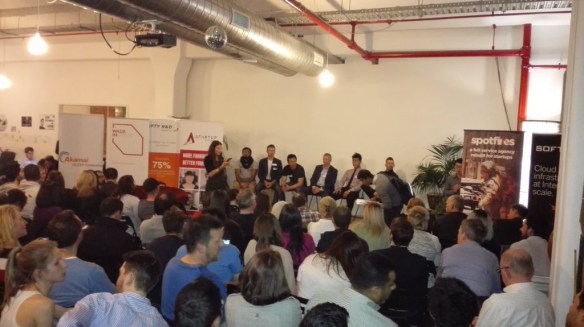
There were around 500 people in the audience for last week’s #StartupVic University Startup Battle, which either says there was nothing better to do on a chilly Melbourne evening, or that this new Meetup format is working – or that the students of today are less interested in finding a job, and more interested in building their own career opportunities that connect with their purpose. (Our political leaders should take note….)

A sell out audience for the University Startup Battle (Image by Stefan Welack sourced from Twitter)

A sell out audience for the University Startup Battle (Image by Stefan Welack sourced from Twitter)

After a series of campus competitions, the finalists on the night were representing 6 of Victoria’s universities, and revealed a wealth of talent, ideas, innovation and inspiration. In order of appearance, the pitches were:

InternMe – (Victoria University)

With a tagline of “Experience the Experience”, this is a 2-sided market for graduate recruitment, that revealed some interesting stats about the student employment market.

Revenue is expected to come from fees for successful placements, and job advertisements. The business plans to cover work experience, internships, part-time and temporary work during study, as well as permanent and full-time roles.

Currently sourcing leads via LinkedIn and social media (notably Instagram), the founders say they may include psychometric profiling tools for better matching applicants with opportunities.

The pitch was to raise $100,000 for website development, but as the judges commented during the Q&A, the biggest challenge is engaging employers. As regular attendees to these pitch nights will recall, this mismatch or disconnect between students/graduates and employers continues to provide startup opportunities.

Printabox – (Swinburne University)

This website is designed to reduce the time, cost and complexity of ordering short-run branded boxes. Basically a self-serve model, the founders have spent $500,000 in development costs, primarily on a proprietary design tool. The resulting products come in 3 standard sizes – perhaps more customisation will become available?

The target clients are the 44,000 online stores in Australia who often need small numbers of branded boxes for sending out customer orders. But as the judges noted (based on a quick online search) there does appear to be a lot of competition. And although Printabox claims that their source code is protected, they have not applied (or are unable to apply) for a design patent.

Mech X Innovation – Project Ora – (Deakin University)

The founders have developed a hardware device that fits on standard tablet computers, and is designed to help children reduce and prevent eyesight damage caused by too much screen time, and by being too close to the device.

Essentially a Bluetooth-enabled accessory linked to an app, Ora monitors the amount of user screen time, proximity to the device and ambient lighting, and can be used in conjunction with “time outs”, scheduled messages and reminders to “go and do something else”. It can be semi-customised, so that parents can create a reward system, for example.

According to the designers, the competitor products (Appomate and samtime) are app-based only, and focus on time and distance – not lighting. Ora may also integrate with other devices, e.g. FitBit, but the target market is children and teenagers up to age 18, and their parents.

Asked about their path to market, they are planning a crowdfunding campaign. The key to adoption, though, will be via schools (who either provide or prescribe what devices pupils use) and schools suppliers (e.g., digital text books and e-learning tools).

ICallDibs – (Monash University)

This idea grew out of direct user experience, namely how can overseas students coming to Melbourne buy and sell furniture? The business is aiming to provide a market place for “Second Hand Furniture, First Class Deals”.

The biggest challenges faced by international students when buying/selling furniture are transportation, timing and finding buyers/sellers. The business will offer bundled services, including storage and removals/delivery, via partnerships.

The company aims to target international student agencies, and will ensure better matching between buyers and sellers (although they may want to consider changing the name unless they can trademark it….).

Rather than an “Ask”, the team offered a “Give” in the form of a customer discount for the evening’s attendees.

When asked about logistics and insurance, the founders clarified that the counterparts (buyer and seller) bear the direct risk. The business takes their commission upfront, then release the order details to the customers.

Assignment Hero – (Melbourne University)

It felt that this app, a collaboration tool for group work (sort of Slack for education?) was speaking to the converted, given the audience response. In short, having access to lots of different collaboration tools sounds great, but they each only do one or two things (albeit, really well). And if you use more than one app, you end up with too many tools and too many notifications.

While students may hate group assignments, they’re an important aspect of learning how to work with other people and acquiring other soft skills. They also seem to comprise a greater component of student assessments – possibly because they require less direct teacher-student face time?

Rather than build a whole new system, the founders have opted for native integration with Google Docs, plus some dashboard reporting tools (including the amount of individual input to a project).

The app is free to end users, but will generate revenue from education providers (enterprise sales) and on-demand services and commissions. When asked about existing tools like Moodle and Blackboard, the founders noted that these were designed for teaching, not collaboration.

It was also noted that existing productivity apps are not easily accessible by students (although no doubt, as with education content providers, enterprise app vendors will make student versions and pricing available). Plus, the “edtech” sector is of particular interest when linked to life-long learning, professional development and self-directed study.

Eat Up – (RMIT)

Finally, Eat Up is a social enterprise trying to address the number of school children who turn up at school without anything for lunch – estimated to be as many as 1 in 8 schoolchildren. Personally, I find this an indictment on our society – why should anyone in Australia need to go without basic food? – but the causes/reasons are far too complex to address here.

Essentially a partnership for sourcing, assembly and distribution, Eat Up has created a service model which they hope to roll out in more and more schools. They tap into the established Food Bank network for supplies, engage TAFEs to prepare the lunches, and use OzHarvest and SecondBite for logistics. There has also been support from Virgin Australia, ygap, Karma Canteen and Education Changemakers.

Eat Up aims to avoid passing on the costs to kids, parents or schools, and in part takes inspiration from another social enterprise, Thank You Water.

During a panel Q&A, the founders were asked about the apparent lack of technical skills or resources on their teams. In response, it was noted that there are many open source apps, available templates and market places for code and plugins. One founder commented that despite studying computer science, he used very little of what he learned to develop his app.

Revealing another apparent weakness in their pitches, the founders were quizzed on their respective sales models, costs of acquisition and pathway to revenue. The responses suggested that the startups risk being limited by their own inexperience, and that they each need to do more market analysis, assessment of customer willingness/ability to pay, and identify the best ways to scale their businesses.

There was also a lack of clarity around near-term goals and milestone planning.

In the end, the winner was Assignment Hero, no doubt reflecting the needs of the audience, plus the fact that the business has gained traction with some universities.

Next week: ASIC’s new regulatory sandbox for #FinTech #startups