Will streaming kill the music industry?

The resurgence in vinyl sales is certainly not enough to save the music business. But will streaming finally cook the goose that once laid Gold Discs?
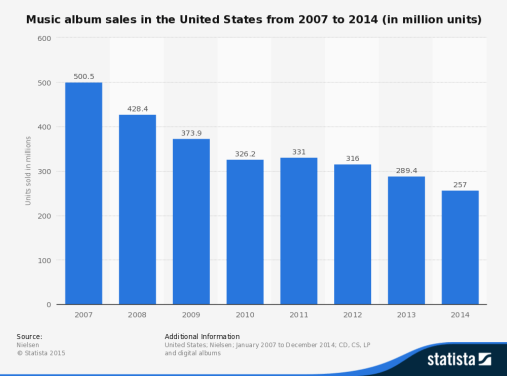
statistic_id273308_music-album-sales-in-the-us-2007-2014

US album sales (in all formats) are in decline. (Source:  Statista)

What can we learn from the music industry based on the apparent rebound of vinyl sales in recent years? Is streaming doing enough to halt the decline in total music revenue? Will CD’s soon disappear altogether? What future for LPs in a world of “Album Equivalent Sales”, “Track Equivalent Albums” and “Streaming Equivalent Albums”?

Are there parallels here with other content, publishing or entertainment sectors?

Back to Black

Last month the 8th annual Record Store Day was launched with a fanfare of upbeat data for vinyl sales. It was a good news story in an otherwise depressing saga of declining album sales, stagnating revenues, and mixed messages about the impact of digital downloads and streaming services on the music industry.

Coming off a very low base (like, near-extinction levels), the extraordinary sales growth of vinyl (especially in Australia) can be attributed to a combination of factors, although it is difficult to see how any single trend is responsible for this growth:

  • The growing popularity of Record Store Day itself (although it’s not without its problems – see below)
  • Baby boomers buying their record collections all over again
  • Hipster interest in analogue technology
  • Record labels mining their back catalogues
  • Niche market interest among audiophiles, collectors and the cool kids
  • New approaches to packaging vinyl with downloads and other bonus content
  • DJ culture
  • Secondary markets via E-bay and Discogs
  • Retailing switching from megastores to specialist shops

Infographic: Vinyl Comes Back From Near-Extinction (Source: Statista)

Where Is The Money Coming From?

Latest industry data suggests that digital sales (downloads and streaming) are now on a par with physical sales (CD, vinyl and the rest). Overall revenue has stabilised, having fallen from a peak in 1999. And streaming services are enjoying huge growth.

But the true picture is harder to establish:

First, while the IFPI provides global aggregated data, each local industry body (RIAA, BPI, ARIA etc.) likes to tell a different story from its national perspective. So it’s difficult to compare like with like. (For example, while Taylor Swift is supposed to be a worldwide phenomenon, she does not figure at all in the BPI data for 2014…..) One brave soul has tried to compile data for the past 20 years.

Second, because of the changes in distribution and consumption, music sales have to be counted in different ways:

  • Wholesale revenue vs retail sales
  • Physical sales vs digital sales
  • Per unit download sales vs streaming equivalents
  • Product revenues (e.g., album sales) vs licensing revenues (e.g., soundtracks)
  • Subscription fees (e.g., Spotify) vs per download revenue (e.g., iTunes)
  • Advertising income from video streaming vs royalties from broadcasting and soundtracks

Third, when more and more music is accessed via video platforms like YouTube, Vimeo, and Vevo, streaming platforms like Spotify, Pandora and Omny, or apps such as Bandcamp, Soundcloud, Mixcloud and Shazam, “sales” data starts to become less and less relevant. (And some people are still hanging on to the ailing MySpace platform….).

The bottom line is that despite the growth in streaming services, digital sales (in whatever format or media) are not yet enough to compensate for the continued decline in album sales in particular, and music overall:
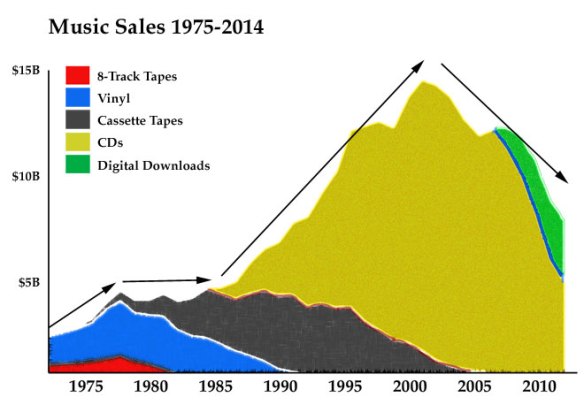
The peak era of CD sales is over. (Source: Talking New Media)

Record Store Day Woes

The success of Record Store Day has divided opinion as to whether it is actually a “good thing” for the industry. It started as a campaign by independent record labels, distributors and retailers to revive the habit of buying records in-store. Labels produce limited edition and often highly collectible items for the occasion, and there are rules as to how, when and where these releases can be made available to the public.

At first, it really was driven by the independent labels, many of whom brought out interesting product that otherwise wasn’t available, such as label samplers, unreleased material and one-off artist collaborations.

Now, the major labels have jumped on board, meaning the market is flooded with unnecessary re-releases (do we really need Bruce Springsteen‘s ’70s and ’80s albums reissued on vinyl?) drawn from their extensive back catalogues (no need to pay for recording costs or new artwork!).

This means that smaller labels who release new vinyl records on a regular basis (not just once a year) get bumped from the production line, as the major labels exert their purchasing power over the pressing plants.

In addition, some Record Store Day releases are so badly distributed that stores are unlikely to take delivery of the items in time for the event. Or bad decisions lead to over-supply of certain items, which end up in the bargain bins (major labels again especially guilty of this offence).

Some store owners appear reluctant to participate because they feel embarrassed about the prices they may have to charge for many of the limited releases, which get bought by speculative customers, rather than collectors, fans and enthusiasts – a fact borne out by the immediate listings and inflated prices on E-Bay and Discogs….

As one store owner I talked to commented: “Every day should be record store day…”

What Else Does The Data Reveal?

For all the new young pop stars that the industry keeps churning out, there’s nothing like longevity and back catalogue to prop up the sales numbers. For example, Barbara Streisand was in the Top 10 for US album sales (and with new material!), and the likes of Pink Floyd, Led Zeppelin, Miles Davis, Bob Marley and Oasis feature in the top-selling vinyl records. Will Record Store Day 2025 herald the vinyl release of Justin Bieber’s pre-pubescent “demos”?

The decline of album sales has been particularly steep in the genres of Hip-Hop and R&B, while rock and pop continue to dominate the market. Some industry commentators have suggested that music sales are merely “in transition” as consumers switch from buying CD’s and downloading music to subscribing to streaming services. Meanwhile, in the US, country music’s #4 position by overall consumption reflects substantial album sales, as streaming is still a small component for the genre.

And those vinyl sales numbers? They’re simply a blip on the chart and largely driven by avid fans willing to shell out for deluxe editions….

The future is streaming?

Apple and others certainly believe (or hope) that streaming will save the music industry. Having demolished the market for CDs, iTunes is in a battle for its own survival among competing streaming services, where Apple itself is about to lead the charge having acquired the Beats platform.

But others are not so sure, predicting that streaming is already in decline, along with download sales:

First, the streaming platforms are yet to make a profit. Part of this is due to the cost of content that has to be licensed from the record labels and artists. Part is also due to the cost of acquiring customers, even if this can be done via social media, because the decline in music buying has been so abrupt, so the industry may be permanently damaged that streaming cannot bring back paying customers.

Second, even though streaming may overtake downloads by next year, there’s still nothing certain that teen pop fans (the target audience) will pay $7.99 – $9.99 per month to listen to music via so-called “freemium” services. Evidence suggests that consumers are happy with the free services, even if they have to put up with ads.

Third, while I agree that the freemium model is a fixture in the digital economy, the problem with Spotify et al is that they are not growing the market for music, but simply cannibalising it by displacing existing platforms (commercial radio, digital downloads, physical sales), while being tied to third-party distribution channels (the internet) and devices (smart phones, tablets and computers).

Anyway, subscription-based music streaming is nothing new, and was first launched over 100 years ago (and thanks to Mark Brend’s “The Sound of Tomorrow”, I learned that Mark Twain was the first subscriber).

If the “old” record companies are charging streaming services too much to license their content, then the streaming services should just find other sources – there’s plenty out there – but then, just like the major record labels, they are not really interested in music, only in shifting product and promoting “artists” (even if they are still figuring out how to make digital pay). The record labels don’t help themselves with their reliance on back catalogue, and their archaic territorial licensing practices either – forcing customers to circumvent geo-blocking barriers (legally or otherwise…).

Unfortunately, file sharing, illegal downloads and “free” streaming have meant customers don’t feel compelled to pay for digital music content. Personally, I prefer to curate my own listening, and not let someone else dictate what I hear, even if the service “knows” my preferences…

And the moral of the story is…?

More distribution platforms, more formats and more content may not be enough to save ailing industries, whether it’s music or television, newspapers or movies. These businesses will have to learn to live with lower margins and/or smaller market shares. The quality of a home-made movie uploaded onto YouTube may not be anywhere near that of a Hollywood blockbuster, but if cat videos are what grab punters’ attention (and by default, pull in the advertisers), the studios may have to find alternative strategies. And if music fans prefer to use free streaming services, the industry has to do a better job of producing content that consumers may be willing to pay for.

Ironically, in publishing, one sector that has been written off ever since the arrival of CD-ROM’s and the internet, teen consumers are still happily buying and reading print editions, alongside e-books. More so than other content industries, publishing has rapidly adapted to the new user-defined model: aspiring authors find it easier to self-publish (e.g., via Tablo and dedicated crowdfunding platforms such as Pubslush and Unbound); they can easily connect with an audience (especially in the realm of fan fiction); and a platform like Wattpad allows writers to test material before they commit to formal publication, and lets readers vote for what they’d like to read more of.

Next week: Making connections between founders and investors


Paywalls go up – Staff numbers go down: a tipping point for Australian news media?

Ownership concentration dominates Australia’s Mass Media

The past 12 months have been a pivotal time for Australia’s mainstream news media. Having seen off controversial regulatory reforms that would have relaxed some cross-ownership controls (but also introduced more onerous oversight of press standards), harsh business truths and painful economic reality have returned, in the form of cost-cutting, new digital subscription models, and foreign competition.

The failed regulatory reforms generated public, industry and political debate around ownership concentration and the lack of media diversity; cross-ownership and the impact of media convergence; the need for revised rules around mergers and acquisitions; and calls for more control over media standards.

What does Australia’s Fourth Estate currently look like?

There are two daily national newspapers, and 10 daily capital city newspapers; all but one of these 12 titles are owned by just two companies: News Limited, and Fairfax Media. Only Sydney and Melbourne have more than one daily local newspaper. Together, News and Fairfax account for about 88% of print media. Both companies have significant interests in broadcast media. The sole “independent” daily newspaper is owned by Seven West Media, itself a major TV broadcaster. As further evidence of Australia’s concentrated content ownership, Seven West has a joint digital venture with Yahoo!, while its rival network broadcaster, Nine Entertainment has a similar joint venture with Microsoft. Prominent in the ownership mix are the names of Rupert Murdoch (News Limited), James Packer (Consolidated Press Holdings) and Kerry Stokes (Seven West Media) – each of whose companies have various interests in Australian pay TV. Meanwhile mining magnate and Australia’s richest person, Gina Rinehart has been buying into both Fairfax (along with John Singleton, a key figure in Australia’s advertising and radio industries) and Network Ten (along with James Packer and Lachlan Murdoch).

Another layer of complex media cross-ownership comes in the form of Australia’s regional TV networks. The main regional networks (WIN, Southern Cross and Prime) each have content affiliation agreements with one or other of the three metropolitan networks (Seven, Nine and Ten), and each have separate interests in radio. Just to confuse things even further, the owner of WIN, Bruce Gordon is a major shareholder in Network Ten, and in the past week it has been reported that he is open to merging WIN with either Nine or Ten. Not only would such a merger lead to further concentration (subject to regulatory approval), it would also see a re-alignment of the metropolitan and regional content agreements; and given past criticism of of reduced local and regional TV news content (and the closure or consolidation of local TV news rooms), I would imagine that without suitable regulatory provisions, local news content will be even further reduced.

What are the news media doing in response to current market challenges?

First, both News and Fairfax have announced staff cuts in an effort to offset declining circulation and advertising revenues from their print editions. The overall results have seen: departures by high-profile journalists; centralized news-gathering operations; outsourced sub-editing; re-alignment of print and on-line assets; and the closure of some local and regional titles. Most recently, Australian Associated Press (AAP) announced that newswire staff numbers are being reduced by 10%. AAP (whose largest shareholders are News and Fairfax) is a major provider of news content and sub-editing services to the mainstream media. The staff reductions among in-house editors and journalists have raised concerns about quality and diversity in Australia’s highly concentrated news media. Partly in response to this perceived decline in editorial standards, The Conversation (a not-for-profit venture, backed by a consortium of universities) was launched in 2011 as a platform for in-depth, objective and authoritative news analysis and commentary.

Second, both News and Fairfax are in the process of building subscription paywalls around their digital content. Fairfax has operated a paywall around its business title, the  Financial Review, for several years; but like News it is introducing freemium models for broader on-line news content. In their latest investor briefings, News and Fairfax have outlined a renewed strategic focus on digital platforms, although neither have given definitive timelines for sun-setting their print editions. Personally, I am somewhat confused by the different subscription models on offer (print, on-line and tablet editions) and what I can access as a subscriber to one or other platform (and as a domestic or overseas reader).

Third, UK publisher Guardian News and Media has launched an Australian edition of its online newspaper. Free to readers, the site is funded by local advertising, and supported by a combined UK/Australia editorial, production and commercial team. As with News and Fairfax, I’m confused by the commercial model for digital content – is there a dedicated Australian subscription within the tablet edition? – and I doubt whether the Guardian Australia can compete effectively with domestic news coverage. The Guardian claims that Australia is one of its largest markets outside the UK, but I wonder if that readership mostly comprises British backpackers wanting to check the latest results from the English Premier League… The Guardian Australia, along with The Conversation has benefited from the staff downsizing at News and Fairfax to co-opt some leading journalists and editors to its cause. Meanwhile, The Conversation has launched a beta site for the UK.

And the rest?

Elsewhere, News, Fairfax and other smaller publishers are building specialist digital content, particularly in business, finance, politics, property, motoring, careers and sport. Most of these assets are funded by advertising and sponsorship, or underwritten by cross-media promotion. A number of these outlets appear to source their content from unpaid bloggers and commentators, as a way of offering free marketing and audience exposure to their writers.

Despite the latest failed attempts at regulatory reform, I expect to see plenty of activity within Australia’s news media (once we get past the forthcoming federal election), fuelled by renewed debates over ownership concentration; the realignment of cross-media interests (especially among Australia’s media barons and billionaires); and the re-positioning of print vs online vs mobile.

Disclosure: the author does not hold a financial interest in, or have a commercial arrangement with any of the publishers mentioned in this article..

“I blogged the news today, oh boy…”

In the week when eyewitness photos posted on social media helped to break the story of an Indonesian aeroplane that landed in the sea off Bali, we cannot ignore the potency of Netizen journalism  to create the news (even if we have concerns about accuracy and quality). And in the same week when “The Voice” returns to our TV screens for a 3-month season, we cannot ignore the potency of audience voting via SMS and social media to create new pop stars (even if we have concerns about accuracy and quality….).

As The Beatles might have sung, “I blogged the news today, oh boy…”

News and music are now confirmed as the key social network content for attracting audiences, if recent market activity is any indication of where the competition for eyeballs and eardrums is being played out.

  • Google’s decision to close down its popular Reader service simply drove customers into the arms of the competition. Unless Google rethinks the service closure, or has another product in development for Google+, Readers will be switching to alternative solutions. The community backlash has been significant, which suggests the audience for news aggregation is large, passionate and willing to be loyal to services that meet their needs. (For reviews on a range of Reader substitutes, see the links below.)*
  • Just a few days ago, LinkedIn announced it has acquired Pulse, a news-aggregation app, as part of a strategy to enhance its news content and build on LinkedIn Today’s curated news feed. Pulse is promoting itself heavily as a Reader replacement, so I am curious as to when LinkedIn settled the purchase price for Pulse – was it before or after Google’s March 13 announcement about the closure of Reader?
  • At the same time, Twitter has followed up its recent announcement to introduce better contextualization for trending news stories with the curious (but not surprising) decision to acquire We Are Hunted, a service that helps users discover new music, based on internet-sourced analysis of what other people are listening to. Expect to see millions of Justin Bieber fans tweeting his #music as a way to influence what Twitter pushes to its audience… and then wait for the feedback
  • Meanwhile, the other Justin has been working on the relaunch of Myspace as a “free” streaming music library (because no-one actually buys this stuff anymore, do they….?) Based on personal attempts to explore the new Myspace and upload my own music to this platform, it would be fair to say this relaunch is an “extended beta” version
  • Oh, and in case you missed the story, Yahoo! bought Summly, another news aggregation app, developed by someone younger than Justin Bieber…

* Here is a non-exhaustive and random selection of blogs offering reviews of Reader substitutes:

Life Hacker: Five Best Google Reader Alternatives

Extreme Tech: Google Reader Replacements

Edudemic: Google Reader Alternatives

Digital Trends: Best Google Reader Alternatives

CNET TV: Alternatives to Google Reader


“If it’s not on Facebook, it didn’t happen…”

I truly fear the day, probably some time in the very near future, when the phrase, “If it’s on Facebook, it must be true…” is used in open court as factual evidence. Not because I especially distrust this particular social networking platform, but because it would imply that social media has become a document of record. This would mean that content from Facebook and other social networks could be cited in court as evidence of information being true, of an event having occurred, or of a person (or object) actually existing.

Many commentators have explored this question of social media and “did it really happen” either in the context of existentialism (“I Instragram therefore I am”), or in respect to social media etiquette (“just because you can, doesn’t mean you should”). I am more concerned with what happens when we start to place inappropriate reliance upon content and information published via social media?

It took a number of years for faxes and e-signatures to be accepted in court as evidence of a document having been executed or a legally binding agreement having been created. E-mail is now admissible as evidence that a formal notice has been served between parties to a contract.

In some situations, e-mails and text messages are cited in court proceedings as evidence of a person’s promises, denials, deeds, opinions, state of mind or intent. “Smoking gun e-mails” are not uncommon in major court cases, and many organizations are required to archive e-mails and instant messaging for the very purpose of maintaining a “paper trail” in the event of future legal proceedings.

But I think we are far from ready to recognize social media as an official document of record, even though many users treat these platforms as a primary source of news and information.

Recently I was speaking to a Gen Y acquaintance who admitted that she got much of her daily news via a group of Facebook friends, who each post stories or news items as they hear or read about them on Facebook and the media. Given the immediacy of such “news bulletins”, the fact that this might be second-hand news does not seem to matter – “peer recommended” or “peer referred” information is often deemed to be just as reliable as the official or primary source, even if the content is selected on the basis of the number of “Likes” or how prominent it appears in search engine results.

Of course, Facebook, Twitter, Google, Yahoo and their users are vulnerable to legal action if they propagate libelous or other offensive content; and as we know, this material can be used as evidence in criminal and other legal proceedings relating to cyber-bullying and hate speech, etc. That, I have no issue with.

Equally, I have no problem if social networks are used to announce births, deaths and marriages, or if companies want to communicate with their customers and suppliers via social media. If a customer seeks to rely upon the terms of an offer placed in a retailer’s Facebook page, that is no different to relying on a newspaper or broadcast advertisement. But let’s not equate publication on social media with our obligations to register or file certain events and official notices with the relevant authorities.

Social media allows each of us to be anonymous or hide behind assumed identities, and to publish what we want within the limits of free speech and other legally defined parameters.

But there is nothing to say that any of the stuff that we publish about ourselves has to be true or accurate, and I would be aghast if that was ever made a pre-condition for using social media. Social media is a wonderful platform for expressing opinions and exploring different aspects of our lives and our personalities, and it is precisely for this reason that social media is incapable of being regarded as a document of record.