Last year, as Melbourne was entering its second, lengthy lock-down, I listed some of the music that helped to sustain me during the endless days of working from home. Now, as the city faces another (twice-extended) 4 week lock-down, music is one of the few pleasures still available….
My updated list includes:
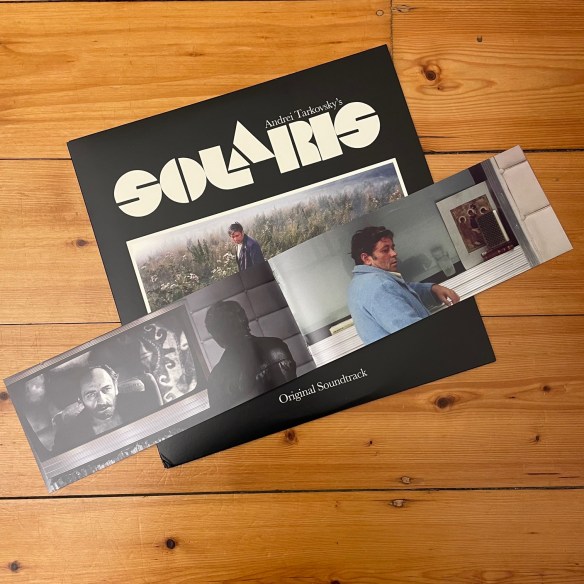
Eduard Artemiev – Solaris (Original Soundtrack) A science fiction film from 1972, and in the vein of JG Ballard or Brian Aldiss, it concerns the strange psychological illness that afflicts scientists on-board a space station orbiting the planet Solaris. The slightly claustrophobic electronic score is offset by a number of compositions by JS Bach. Note the early Zoom call and all-day PJs featured in the accompanying stills from the film.
Various Artists – Pacific Breeze: Japanese City Pop, AOR & Boogie 1976-1986 Perfect antidote to lock-down blues, this compilation of mostly up-tempo numbers reveals more depth below the shiny surface – the arrangements, choice of textures and compositional structures make this more than just easy listening. (Released by the excellent Light in The Attic label, there’s also a second volume, plus related compilations that focus on the more ambient and experimental end of the spectrum.) Definitely a mood-enhancer.
Hans-Joachim Roedelius – Drauf Und Dran The prolific Roedelius has released one of the most sublime albums of his lengthy career – which is saying something for an artist closely associated with ambient and minimalist styles. A piano-based album, with very few electronics or effects, the clarity of composition and playing make for a brief but welcome respite from the mental fug of lock-down. In a similar vein, I would also recommend Brian Eno’s soundtrack to the Dieter Rams documentary, and Eno’s recent work with his brother, Roger, the albums Mixing Colours and Luminous.
Mogwai – ZeroZeroZero Another soundtrack, for the TV series of the same name (which I have not seen). Like the Solaris soundtrack, the music is more about the atmosphere than the narrative, and all the more powerful as a result. Also worth mentioning is Mogwai’s recent studio album.
Khruangbin = クルアンビン* – 全てが君に微笑む Khruangbin are a band whose music I heard on a couple of sampler albums, without knowing anything about them. Playing an infectious blend of instrumental Funk, Psychedelia and Dub Reggae, this compilation brings together a number of their early singles (including inspired covers of Serge Gainsbourg and Yellow Magic Orchestra). Rather beautiful for these monochrome times.
Michel Legrand – La Piscine Yet more soundtracks, this deceptively lightweight but lush album, featuring just the right amount of economic violin solos by Stéphane Grappelli (who could let his virtuosity get the better of him), recently got a re-boot for Record Store Day, so it’s pretty hip at the moment. Other soundtrack and library music compilations I have been delving into include Adventures in Soundtracks, The Music Library and Unusual Sounds. Mostly reflecting the anonymous/unsung world of studio session composers and players of the 60s and 70s, most people would recognise at least one or two tunes, if only from their use as samples in other records.
Greg Davis – Somnia Finally, a work of stillness and contemplation – built on sustained drones and minimal instrumentation, this album nevertheless manages to generate immense depth and emotion. Again, perfect listening in this stilted yet listless environment of lock-down, curfew, social isolation and pent-up frustration and sorrow. (Also check out the Davis’ contemporaneous work, Diaphanous.)
Next week: Startupbootcamp Sports & EventTech Demo Day 2021
During the latest Melbourne lock-down, I have been revisiting the music of The Fall. A strange (or should that be Kurious?) choice, but at a time when you feel like ranting (or mithering) at the absurdity of it all, The Fall make perfect sense. It might not always be comfortable listening, but sometimes you need a bit of grit and gristle as a catalyst to move on.
When exploring The Fall, it’s hard to know where to begin (and, just as importantly, how to end). Although they emerged from the 70’s punk movement and were associated with the Manchester music scene, The Fall identified with neither. But if punk hadn’t happened, and without that link to Manchester, I doubt they would have got as far. They out-lived all of their contemporaries, without the tired reunions or desperate comeback tours of their peers. Perhaps only Wire or Gang of Four can claim a similar longevity, but they both had long periods of inactivity.
Named after an Albert Camus novel, The Fall were not afraid to acknowledge their influences and interests, in particular those of their core founder and only consistent member, Mark E Smith. Scattered across lyrics, album covers, sleeve notes, press interviews and side projects, it is possible to find references to literature, art, theatre, dance, philosophy, politics, psychology, spiritualism and the occult. Elements of Wyndham Lewis, Samuel Beckett, Edgar Allan Poe, Aleister Crowley, Jean-Paul Sartre, William Blake, H.P. Lovecraft, Luke Rhinehart, Bertolt Brecht, Alfred Jarry and Kurt Schwitters can be found strewn across The Fall’s output.
This should not be too surprising: during a 40-year recording career, The Fall released 30+ studio albums, 60+ singles and EPs, and more than a hundred live albums and compilations. Integral to their recording career are the two-dozen sessions The Fall recorded for John Peel’s BBC Radio 1 program. (Peel was an early champion, and often cited them as his favourite band – he is also credited with the quotation that provides the title of this blog.) It’s the sort of discography that will keep fans busy for years – and represents something of a licensing headache for record labels and music publishers alike.
The Fall’s prolific (and challenging) body of work only came to an end when Smith died in early 2018, although the posthumus re-issues and compilations have continued with almost indecent frequency – I hope his estate are keeping tabs.
Of course, with that sort of work ethic, quality control can suffer. Smith was equally feted and feared for his wilful determination and unwillingness to conform. His refusal to compromise or comply with current fads and fashion was certainly an admirable trait. But this steadfast and stubborn control over his content reveals a weakness – the absence of any discernible editorial oversight means that there is a law of diminishing returns, especially in the band’s later years. Although it must also be acknowledged that even on the last few albums, there was something of a return to form.
When Smith died, he was honoured with an obituary in the Washington Post, which must have had more than a few readers perplexed – (Mark E who? Marquis Cha-Cha of course!). Smith would have loathed/laughed at the attention. He had a love/hate relationship with journalists, but he also understood the value of the media to reach his audience, especially in the pre-internet heyday of the UK’s weekly music press (the NME, Melody Maker and Sounds). At the same time, he could be dismissive towards certain sections of his fans, although he saved most of his bile for other bands, especially those whom he felt were mere plagiarists.
Trying to summarise what The Fall represent musically is no easy task. Their antecedents can be traced to 1950’s rockabilly, 1960’s garage rock and 1970’s glam. In terms of outlook and attitude, it’s possible to discern similarities to American groups such as Captain Beefheart and Pere Ubu, and German bands such as Can and Faust. Yet another reference point might be their choice of cover songs, ranging from The Kinks to Sister Sledge, from Hank Mizell to Lee Perry.
Another way to approach their music is to break it down into chronological chapters: the post-punk and dense sounds of their first few albums, the rapid evolution into art rock and neo-pop in the mid-1980s, the brief period with a major label in the early-19990s that saw a transition to a more electronic sound (and mild flirtations with techno and big beat), the peaks and troughs of the middle-aged years, and then the erratic coda in their dotage that showed glimpses of former glories. But this hardly does their back catalogue justice. If you asked fifty fans to list their top 10 tracks by The Fall, you would get as many different compilation albums.
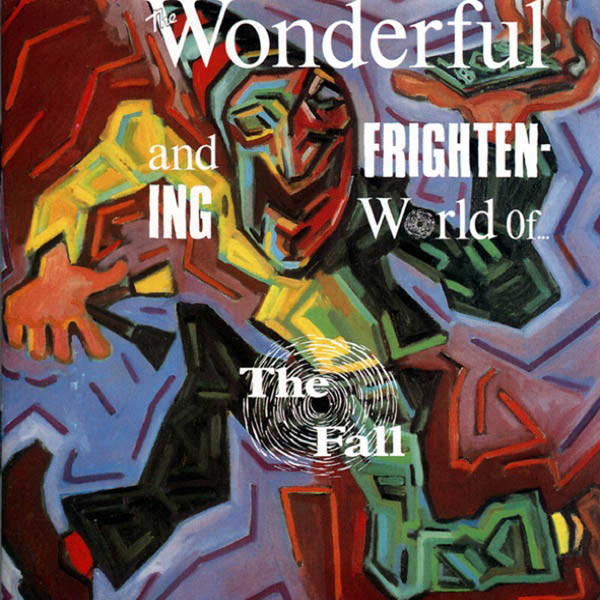
I was fortunate to see The Fall in their early- and mid-1980s peak – so my own preferences mainly stem from that era – the run of albums that comprises “Grotesque (After The Gramme)”, “Perverted by Language”, “Hex Enduction Hour”, “Room to Live”, “The Wonderful and Frightening World of The Fall”, “I Am Kurious Oranj”, “Bend Sinister”, “This Nation’s Saving Grace” and “The Frenz Experiment”, plus the myriad singles and EPs dotted around those releases.
If pushed, I’d have to say my favourite track is “Leave the Capitol”, from 1981 – to me, it sums up what The Fall represent.
As Melbourne returns to normal post lock-down, I’ve been attending some live music events around the city. The most recent was a performance of contemporary Australian compositions written mainly for percussion, including a piece entitled “When Only The Walls Can Sing”by Mark Pollard, performed by members of the Melbourne Conservatorium.
When introducing his work, the composer referenced the notion of “decay” in music, whereby sound waves continue to reverberate indefinitely, albeit in decreasing magnitudes of volume and resonance. Incorporating recordings of works previously performed by the Conservatorium, this 2020 composition is also a reference to our enforced isolation during the pandemic, when many people only had the four walls of their homes for company.
The concept of “musical decay” appears in many forms. Examples include:
For musical archeologists, look no further than Philip Jeck’s epic installation piece (and related albums), “Vinyl Requiem”….
… and compare this to similar works by L.Pierre on his final two albums, “Surface Noise” and “1948”
Given the melancholic nature of “decay”, the “final” word probably goes to the conceptual work by AM/PM, that samples and amalgamates “The Ends” of certain records, to great effect.
I’m not sure I fully subscribe to Jung’s theory of Synchronicity, where causally unrelated events occur at the same time, and seemingly take on a significant meaning; in many cases, a coincidence is just that. But recently I have been forced to consider the possibility that maybe Jung was right.
Over the past few months, I have been reading the 12 novels that comprise Anthony Powell’s “A Dance to the Music of Time”. Although I had never read them before, the books were familiar to me through a BBC Radio adaptation broadcast between 1979 and 1982, and a UK television mini-series from 1997.
Last weekend, and quite unrelated, a friend posted some music on-line – recordings made by the band we were in during the early 1980s. One of the tracks was a song I had written at that time, and whose title had been inspired by Powell’s magnum opus. But I hadn’t listened to or thought about this song for nearly 40 years.
Separately, and also by coincidence, in the last couple of days I have been listening to “The New Anatomy of Melancholy”, another BBC Radio series that draws its inspiration (and title) from Robert Burton’s 17th century tract on mood disorders. This series was first broadcast in May 2020 – no doubt prompted by the onset of the global pandemic, with its lock-downs, self-isolation and increased anxiety. And now the programme is being repeated, exactly 400 years after the publication of Burton’s original treatise – and at a time when we need his sage advice more than ever.
Until now, I hadn’t appreciated how self-absorbed (obsessed?) Powell’s narrator, Nicholas Jenkins, is by Burton – he even ends up publishing an academic text about this prescient Elizabethan writer. On one level, Jenkins is a proxy for his literary hero (as well as being Powell’s alter ego), and much of the 12-novel sequence is a response to Burton’s analysis on the causes of, and cures for, melancholia.
All of which may or may not prove Jung’s theory, but there is for me something of a personal thread between Powell, a song I wrote, and the BBC’s recent update on Burton.