Who needs banks? My experience of “We R One World”

This past weekend, I participated in the “We R One World” game hosted by Carolyn Tate on behalf of the Slow School of Business, and facilitated by Ron Laurie from MetaIntegral. The game is an immersive learning experience in the form of a simulated global strategy workshop, based on the work of Buckminster Fuller. I joined a team whose role was to represent the interests of the commercial banks. It was a rather sobering experience, because as the workshop unfolded, it soon became clear that in the context of the game the banks were almost redundant – which partly reflects what is going on in the real world, as banks face increased disintermediation and disruption by FinTech, crowdfunding and the shared economy.

The Fuller Projection or Dymaxion Map

The Fuller Projection or Dymaxion Map

The Premise – Earth as Spaceship

Without going into too much detail, “We R One World” mimics elements of the board games “Risk” and “Monopoly”, and takes the form of a narrative-based hackathon, combined with a meetup and an unconference. Played out on a floor-size version of the dymaxion map, the game also draws on Fuller’s concept that the Earth is a spaceship, of which the players are the crew, and the “fuel” is the inventory of global resources at the crew’s disposal, including people, technology, capital, food, energy, munitions, water, etc. The participants form teams to represent various geo-political regions, supranational NGOs, multinational corporations and banks. The goal is to achieve (through trade negotiations), the best socio-economic outcomes for everyone, with a few surprises along the way!

There is a lot of information to absorb, as well as the structure of the game. One challenge for the players is to not get hung up on the presented “data” (which is more representative, rather than precisely factual). Even though we live with access to real-time, on-line statistics and research, and despite the Internet and search engines, in real life we still experience considerable information asymmetry.

The Prelude – We Are Star Dust

As a prelude, we were shown the documentary “The Overview Effect”, which includes the comment by former Apollo astronaut Edgar Mitchell that we are made of star dust (a now common concept echoed in various songs such as Moby’s “We Are All Made of Stars” or Joni Mitchell’s “Woodstock”, depending on your musical taste/cultural perspective).

It was also a timely connection, given the increased media coverage of space exploration, and Hollywood’s renewed interest in space travel. The recurring theme (in reality as much as in fiction) is that human survival will depend on relocating to, or harnessing other planets.

As examples, in the real world, we have the latest discovery of an Earth-like planet, tweets from Philae on a frozen comet, and the remarkable images from Pluto. While the entertainment world is enjoying critical and popular success with films such as “Moon”, “Gravity”, “Elysium” and “Interstellar” (plus the forthcoming “The Martian”). Even veteran Sci-Fi writer Brain Aldiss has bowed out with his final space novel, “The Finches of Mars”.

The Banks – Increasingly dispensable

But back to the game, and what we might conclude from the outcomes.

From the start, in the role of the banks we had a strategy for encouraging “good” behaviour, and punishing the “bad”. We had a catalogue of regional problems, and a set of possible solutions. “Good” behaviour was predicated on regions finding creating solutions to their problems, based on partnering, prioritization, planning and promotion. “Bad” behaviour might include late or failed interest repayments, misuse of funds (e.g., deploying more military hardware ahead of feeding their population), or actions that led to worsening conditions (increased poverty, hunger and illiteracy, or depleted natural resources).

At the outset, the banks’ role was to manage existing loans (by collecting interest due), and to originate new loans for development and commercial projects. In the initial stages, despite Japan’s attempt to renegotiate its existing repayment terms on the fly, the commercial banks managed to collect all interest due, on time and in full (with a small surplus, thanks to some regions’ lax monetary management). One region paid up without much prompting, cheerfully (or ironically?) commenting that “we must keep the banks happy!”.

However, as the game progressed, the banks were basically ignored, as regions switched their focus to responding to new circumstances, such that the consequences of not servicing their debts seemed irrelevant. Even the risk/threat of bankruptcy did not carry much persuasion, as regions were more willing to find new ways to trade with each other, less reliant on bank capital, and more focussed on alternative value exchanges (part of the game’s secret sauce).

For example, we received only two loan applications throughout the game: one was for a worthy but ambitious development project, but when asked to resubmit the request with some further information, the loan did not materialise; and the other was more in the way of a short-term deposit with the bank, to generate interest income to buy food. Given that deposit rates are low, our response was to suggest using the capital (with additional bank funding) to increase food production, but our offer was declined, maybe because of the need to trade out of a short-term food shortage rather than investing in long-term supply.

Towards the end, the banks were almost mere spectators in the game, and were reduced to protecting their self-interests: namely their capital, and their stalled/stagnant loan assets. If borrowers don’t want the banks’ money, where and what will the banks invest in order to generate depositor, investor and shareholder returns? As one regional participant commented, “we are all bank shareholders”. Just as in real life, we deposit money with the banks, we invest in their financial products (especially through our superannuation and pension funds), and we may even buy their shares and bonds. And of course, following the GFC, many taxpayers found themselves indirect shareholders of banks that were bailed out by their respective governments.

The Conclusion – An alternative approach?

I’m not going to give the game away (you can experience it for yourself in September) but the conclusion and outcome reinforce the view that in order to tackle the world’s problems, we all have to take a different perspective – whether that is challenging existing structures, subverting traditional business models, or questioning our personal motives and objectives. For myself, I recognise that this means an increased awareness of “living lean” (mostly around personal preferences and lifestyle choices), and (multi-)lateral thinking.

For institutions like banks (as well as governments, corporations and NGOs) this alternative approach means re-assessing their roles and contribution (which can also be framed as re-connecting with their “purpose”), remodelling their processes and systems, and redefining the measures of their success. As my team member concluded, “the other players only see the banks as a source of capital, rather than a resource for knowledge, expertise and networks”.

Footnote

Declaration of interest: I participated in the game at the kind invitation of the Slow School of Business.

Next week: “I’m old, not obsolete”


How to Survive a #Startup Weekend

A rite of passage for any startup founder or budding entrepreneur is a weekend hackathon, and a Startup Weekend is probably the best way to throw yourself in at the deep end. As part of Startup Week, the York Butter Factory hosted Melbourne’s first fintech event. Here’s how I managed to survive the ordeal….

IMG_0210

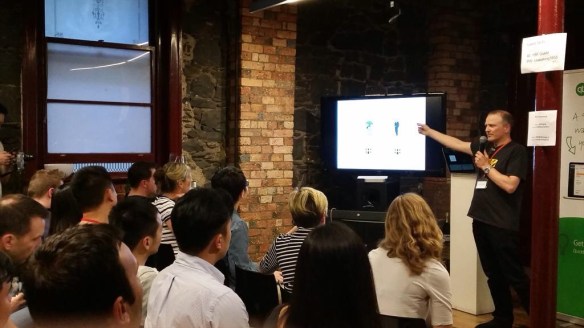
Your correspondent in full flow at the Final Pitch…

Rather than provide an hour-by-hour account of my experience (the schedule is on the website and you can read the Twitter feed), here’s my thoughts on what it takes to participate and get the most out of the experience:

Courage

Take a leap of faith, step up and pitch an idea at the open mike session on the first night. Not only does this force you to craft your message, it also helps overcome any nervousness or awkwardness in joining a room full of total strangers with whom you will be working for the next 54 hours. My idea didn’t get enough votes, but it did spark several interesting conversations with other participants, such that I will probably take it further.

Stamina

Pace yourself. Yes, you could spend every available hour on finishing that customer validation, or refining the pitch, or making sure your demo site is up and running – all of which are important – but you also need to make time for rest, sleep, eating (all catering is laid on) and exercise. Again, 54 hours is a long time to spend on a single activity.

Open Mindedness

I had some idea from the program notes what to expect, but I still didn’t really know what it would it be like. So it was great to just go with the flow, to see what would happen. The format, structure and schedule (as well as the rules and requirements for the Final Pitch competition), pretty much define what goes on. But your attitude and willingness to be open to new ideas determine how much you get out of the experience.

I should also mention the value in having direct access to so many experienced mentors throughout the weekend – although I know from the experience, it’s hard not to get too defensive when mentors find fault with your project, and difficult to remain true to the idea when some of the feedback is contradictory.

Teamwork

Building teams to collaborate on a startup idea forms the basis of the hackathon model. As my own idea did not get enough votes at the open pitch, I looked to join a team that was a good fit in terms of the idea, the mix of skills to complement my own, and the ability to execute. As a “non technical” participant, I was extremely fortunate to be part of team that had a great balance of back-end and front developers, design skills and mobile deployment. Plus, given the theme was fintech, it was fantastic working with people from a banking IT background. (It also helped that several team members were veterans of Startup Weekend.)

Defining Roles

Although we didn’t spend a great deal of time creating or defining roles within the team, each of us played to our strengths, by self-determining what we would work on, and what our contribution would be. The only tricky decision was choosing who would present the Final Pitch to the panel of judges – but a process of elimination, preference and negotiation resulted in yours truly taking on the role.

Tools

In addition to the various software, hosting and domain name resources provided to each team, I was impressed by how many other tools the team plugged into – such as Trello, GoogleForms, Hangouts, ThemeForest, CanvasModel Design and Launchrock – most of which were free. We also spent some time reviewing competing and complementary products as part our MVP validation.

Less Is More

We could have spent a lot of time on customer validation – but we chose instead to talk to 3 or 4 key target customers for the MVP (qualitative), and run an on-line survey (quantitative) which generated around 100 responses overnight (not bad considering it was a weekend…). We also had more content than we actually used: the lean canvas business model was used sparingly, as was a competitor heat map; but it also meant that when we came to developing our pitch presentation, we had the luxury of being able to take stuff out and only focus on the important and most relevant points. Thanks, also, to a presentation template that one of the team had just used at a recent management course!

Practise

Having been chosen to make the Final Pitch on behalf of the team, and despite quite a lot of experience in making business presentations and in public speaking, I was extremely grateful for the coaching, feedback and rehearsals the team put me through. Getting to know the material, understanding the anchor points and how to navigate from topic to topic, helped me to give a presentation that flowed logically and hopefully demonstrated that the team had met the competition brief.

The Result?

Unfortunately our team did not win, nor did it place in the top 3. The judges pinged our presentation for being “too confident”, and for not demoing our prototype (we did briefly put up our beta website) – but given the working prototype mostly comprised some backend coding, it wouldn’t have been that interesting from a visual perspective.

Notwithstanding our disappointment on the night, the team is planning to get together to see how far we can take the idea, and separately I’ve been asked to join a new team at an upcoming hackathon.

(If anyone is interested, we designed a P2P payments tool called PayMee)

Next week: 3 Ways to Fund Your #Startup

Personal vs Public: Rethinking Privacy

An incident I recently witnessed in my neighbourhood has caused to me to rethink how we should be defining “privacy”. Data protection is one thing, but when our privacy can be compromised via the direct connection between the digital and analog worlds, all the cyber security in the world doesn’t protect us against unwanted nuisance, intrusion or even invasion of our personal space.

Pressefotografen mit KamerasScenario

As I was walking along the street, I saw another pedestrian stop outside a house, and from the pavement, use her smart phone to take a photograph through the open bedroom window. Regardless of who was inside, and irrespective of what they were doing (assuming nothing illegal was occurring), I would consider this to be an invasion of privacy.

For example, it would be very easy to share the picture via social media, along with date and location data. From there, it could be possible to search land registries and other public records to ascertain the identity of the owners and/or occupants. And with a little more effort, you might have enough information to stalk or even cyber-bully them.

Privacy Law

Photographing people on private property (e.g., in their home) from public property (e.g., on the street outside) is not an offence, although photographers must not cause a nuisance nor interfere with the occupants’ right of quiet enjoyment. Our current privacy laws largely exclude this breach of privacy (unless it relates to disclosure of personal data by a regulated entity). Even rules about the use of drones are driven by safety rather than privacy concerns.

Since the late 1990’s, and the advent of spam and internet hacking, there have been court decisions that update the law of trespass to include what could be defined as “digital trespass”, although some judges have since tried to limit such actions to instances where actual harm or damage has been inflicted on the plaintiff. (Interestingly, in Australia, an act of trespass does not have to be “intentional”, merely “negligent”.)

Apart from economic and financial loss that can arise from internet fraud and identity theft, invasion of privacy via public disclosure of personal data could lead to personal embarrassment, damage to reputation or even ostracism. (In legal terms emotional stress falls within “pain and suffering”).

Data Protection Law

The Australian Privacy Principles contained within the 1988 Privacy Act apply to government agencies, private companies with annual turnover of $3m or more, and any organisations trading in personal data, dealing with credit information or providing health services. There are specific provisions relating to the use and misuse of government-derived identifiers such as medical records and tax file numbers.

The main purpose of the privacy legislation is to protect “sensitive” information, and to prevent such data being used unlawfully to identify specific individuals. At a minimum, this means keeping personal data such as dates of birth, financial records or hospital files in a secure format.

Some Practical Definitions

The following are not legal definitions, but hopefully offer a practical framework to understand how we might categorise such data, and manage our obligations towards it:

“Confidential”

Secret information that must not be disclosed to anyone unless there is a legal obligation or permission to do so. (There are also specific issues and exceptions relating to “classified information”, public interest matters, whistleblower protection and Freedom of Information requests.)

“Private”

Information which is not for public or general consumption, although the data itself may not be “confidential”. May still be subject to legal protection or rights, such as the right of adopted children to discover the identity of their birth parents, or the right of someone not to be identified as a lottery winner.

“Personal”

Data that relates to, or can specifically identify a particular individual. An increasing issue for Big Data, because data that otherwise resides in separate locations can now be re-connected using triangulation techniques – scrape enough websites and drill down into enough databases, and you could probably find my shoe size.

“Public”

Anything that has been published, or easily discoverable through open search or public database retrieval (but, for example, does not include my past transactions on eBay unless I have chosen to disclose them to other users). My date of birth may be a matter of record, but unless you have authorised access to the relevant database or registry, you won’t be able to discover it and you certainly shouldn’t disclose it without my permission.

Copyright Law

One further dimension to the debate is copyright law – the ownership and related rights associated with any creative works, including photographs. All original content is copyright (except those works deemed to be in the “public domain”), and nearly all copyright vests with the person who created the work (unless they have legally assigned their copyright, or the material was created in the course of their employment).

In the scenario described above, the photographer would hold copyright in the picture they took. However, if the photograph included the image of an artwork or even a framed letter hanging on the wall, they could not reproduce the photograph without the permission of the person who owned the copyright in those original works. In some (limited) situations, a photograph of a building may be subject to the architect’s copyright in the design.

Curiosity is not enough justification to share

My personal view on all this is that unless there is a compelling reason to make something public, protecting our personal privacy takes precedent over the need to post, share or upload pictures of other people in their private residence, especially any images taken without the occupants’ knowledge or permission.

Just to clarify, I’m not referring to surveillance and monitoring by the security services and law enforcement agencies, for which there are understandable motives (and appropriate safeguards).

I’m saying that if we showed a little more respect for each others’ personal space and privacy (particularly within our homes, not just in cyberspace) then we might show a little more consideration to our neighbours and fellow citizens.

Next week: It’s OK to say “I don’t know”

Lesson of the Day: Learning to Learn (Again)

Over the past 6 months, I’ve been privileged to be a participant in, and an adviser to, the Slow School of Business, founded by Carolyn Tate and supported by a team of expert facilitators. It has been an invaluable experience, as it has forced me to think about how I learn – not just my learning style, but what engages me to want to know more.

While Carolyn has articulated her own personal and professional reasons for starting Slow School, the initiative is attracting people who have a natural bias towards a certain type of learning environment. Overall, these people have a preference for education that is:

  • Peer-to-peer
  • Interactive
  • Collaborative
  • In person
  • Practical

That’s not to say participants aren’t also engaged by on-line courses, or pedagogic instruction, or even self-directed learning, but that’s not the full story – there has to be a personal connection as well.

A particular revelation for me was prompted by a question that Carolyn posed at a facilitators’ networking meeting a few weeks ago: she challenged each of us to identify one thing we had learned about learning over the past year. I had recently come across the work of William Cronon, historian, educator and environmentalist. In particular, a paper he wrote in 1998, entitled “Only Connect…” The Goals of a Liberal Education.

Professor Cronon’s article is such an eloquent description of the mindset, attitude and world view that the best students (and therefore, the best learners) should bring to any course of study or learning experience. Education is not simply about rote learning, or fact cramming, or even regurgitation of prescribed texts – although this is what most tests and exams are designed to assess and evaluate.

A better approach is to explore what we have learned through a process of enquiry that demonstrates comprehension, critical analysis, practical application and conceptual re-contextualistion – such as working out a given problem using basic first principles, or testing a stated theory via the use of analogous scenarios.

The benefits of this inquisitive approach to learning cannot be overstated, but here are two examples:

  1. The students of today need to be equipped for future careers that haven’t even been thought of yet – so we need to train them to be adaptive and resilient, not to be “square pegs in square holes”
  2. The true test of a “learning organisation” includes the willingness to embrace uncertainty, the temerity to ask the difficult questions, and the audacity to challenge the status quo – otherwise, businesses are doomed to stagnation and ossification.