A Tale of Two #FinTech Cities – Part 2

It feels like the inter-city #FinTech and startup rivalry between Melbourne and Sydney is starting to get personal. The blow-up between Victorian Small Business Minister, Philip Dalidakis and Freelancer CEO, Matt Barrie over StartCon is perhaps the most strident example, but other discontent is bubbling underneath the service.

screen-shot-2016-10-05-at-10-51-49-amLet’s take a look at what’s actually been happening around #FinTech in Melbourne, and try to understand what might be the cause of this apparent disquiet:

First, the recently announced LaunchVic grants have been met with a mix of gratitude, bewilderment and some sour grapes, based on the people I have talked to in the start-up community. There was a sense of “jobs for the boys”, “usual suspects”, “who?”, and “yeah, good on ya”. Nothing new there, then, when public money is being handed out. High-profile beneficiaries of the initial A$6.5m of grants include FinTech Australia (as part of a major FinTech Conference to be held in Melbourne), FinTech Melbourne (which is now the largest group of its kind outside the US and UK), inspire9, Startup Victoria and Collective Campus.

Second, Stripe‘s CEO, John Collison was in town to celebrate their 2nd birthday in Melbourne. (This is the 3rd time in 2 years Collison has been in Australia – he must love what we are doing here? Or maybe it’s the Victorian government incentives that attracted Stripe to set up in Melbourne: see below.) This time around, there were some major announcements among the celebrations, including:

  • 25% of Australians have paid for something online using Stripe
  • Stripe is launching “Connect” in Australia – making it easier for local businesses to roll out payment solutions in multiple markets overseas
  • Stripe continues to keep its APIs as simple and streamlined as possible – they even support Amazon’s Alexa voice recognition system

There was also a panel discussion with some of Stripe’s local clients, and a Q&A with Collison himself:

  • Andre Eikmeier from Vinomofo commented that payment solutions (like all technology) should be invisible, and just work in the background
  • Ben Styles from Xero explained that integration with Xero’s own APIs is critical, and that they have co-developed some products
  • Nicole Brolan from SEEK said that thanks to Stripe, her business is finally allowing clients to pay invoices on-line

Asked about innovation, Collison argued that mobile phone technology was the spur for services like Uber. However, he’s not especially engaged with Blockchain, as he does not see the use case. He thinks the next major innovation will be in medtech (telemetrics & wearables), and machine learning (speech and image recognition). As he said, “driverless cars are not just about the sensors but what the data is telling you. We know more about the health of your car than your own body.” He also had some words of advice to aspiring local entrepreneurs and startup founders:

  • Having a global or international perspective is determined by your markets, your competition, and access to specific talent pools.
  • It’s probably wrong to aspire to be like Atlassian – you need to understand WHY Atlassian has been successful, not WHAT it did or HOW it did it – which means getting back to core values and core purpose.

Third, as the Stripe celebrations started to kick off, across town FinTech Melbourne hosted an event starring Alex Scandurra, from Sydney’s Stone & Chalk FinTech hub. This was billed as a “pre-launch” for Stone & Chalk’s planned foray into Melbourne, and was part information session, part FinTech love fest, and part fan-boy hangout. Scandurra’s presentation was quick to point out that the “plan is not to bring Stone & Chalk to Melbourne, but to create Melbourne’s own Stone & Chalk”. (Spot the subtle difference?)

To its credit, Stone & Chalk is home to 300 people and 75 startups, has helped start 21 companies and create 150 jobs, and participants have collectively raised $100m in funding, although Stone & Chalk does not take equity. Scandurra also commented that FinTech is not an industry in itself – it is a horizontal that serves all industries.

There seems to be a lot of local clamouring for a FinTech hub in Melbourne. However, unlike the NSW government which has directly partnered with Stone & Chalk, I understand that the Victorian government is not prepared or able to “invest” in such a project – and certainly not before there is some private sector funding on the table.

Meanwhile, the founder of a rival payment system expressed his frustration that the Victorian government “sponsored” Stripe to come to Australia, but won’t offer similar support to local startups. Another FinTech CEO I spoke to was irked that Stone & Chalk would appear to be breaching its own mandate if it set up shop outside NSW.

In fact, could be argued that Stone & Chalk was established in Sydney to directly compete with Melbourne’s startup ecosystem. In large part, this is thanks to the huge success that the Victorian government continues to have in luring major tech companies and global startups to come to Melbourne. Names such as Zendesk, Eventbrite, Slack, Square, Stripe and now Cognizant.

If the debate over Stone & Chalk coming to Melbourne is about creating a local FinTech hub (whether or not the Victorian government tips in some money), we have to examine the need for such a hub. For example, is it simply a question of real estate, so that all the FinTech startups can be co-located in one place? If so, I would have thought that was easy to resolve: there’s a lot of empty office space, and Melbourne rents are cheaper than Sydney; also, a growing number of office landlords recognise the mutual benefits and knock-on effects of hosting co-working venues in their buildings.

We also have to consider if Melbourne’s existing FinTech startup eco-system/infrastructure is willing to come together to underpin such a hub. If so, what is the hub going to do? What is its purpose? What is the missing piece that the hub is designed to fill? And who/what/where is best placed to fill that need/gap?

Looking back, Melbourne has been the home of a number of FinTech businesses, that are now global public enterprises – IRESS, Computershare, Touchcorp, Novatti, for example – so there is obviously something in the local water (or coffee). For me, however, a key barrier for FinTech specifically, and startups more generally, is the inability to connect to institutional funds and investors (Clover being a notable exception?). Other obstacles include the stodgy procurement processes used by the public sector and many large corporations, which make it more difficult for startups to compete for work, and the reluctance by enterprise clients to try a local product or service unless it has been tested and proven elsewhere.

Finally, on a more positive note, it was very interesting to see that founders from Atlassian and Vinomofo are backing Spaceship, a new superannuation fund appealing to a younger, tech-savvy audience.

Next week: Bridging the Digital Divide
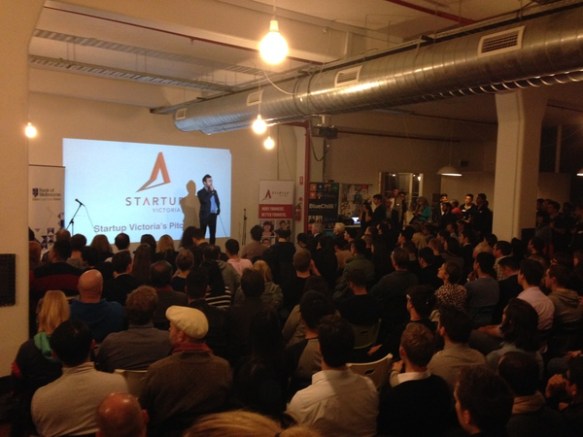
101 #Startup Pitches – What have we learned?

During the past 3 years of writing this blog, I have probably heard more than 100 startup founders pitch, present or share their insights. Most of these pitch nights have been hosted by Startup Victoria, with a few on the side run by the Melbourne FinTech Meetup and elsewhere.

Image sourced from Startup Victoria Meetup

Image sourced from Startup Victoria Meetup

Based on all these presentations, I have collated a simple directory of each startup or pitch event I have covered or mentioned in this blog, as well as a few key accelerators and crowdfunding platforms.

What have we learned over that time?

First, apart from the constant stream of new startups pitching each month, it’s been impressive to witness the Melbourne startup community collaborate and support one another.

Second, some of the international founders who have spoken are among the rock stars of startups – and we are fortunate that they have been willing to spend time in Melbourne.

Third, a number of the local startups who have pitched during this time have become well-established and well-known businesses in their own right.

This all means that besides creating great products and services, and being willing to share their experiences, the founders have helped aspiring founders and entrepreneurs to appreciate the importance of:

  • product-market fit;
  • working with agile processes and lean startup models;
  • tackling prototyping and launching MVPs;
  • learning what to measure via key metrics;
  • figuring out funding; and
  • knowing when to pivot or fold.

Looking at the cross section of pitch nights, panel discussions and guest speakers, there are some significant trends and notable startups to have emerged:

Industry focus: Not surprisingly, the pitches are heavily biased towards FinTech, MedTech, Education, Digital Media, Enterprise Services and Consumer Services. There are a some key startups focused on devices (e.g., SwatchMate and LIFX); a smattering in recruitment, fashion, gaming, health and well-being, property services, social media and even logistics. But there are surprisingly few in environmental technology or services.

Business models: Two-sided market places abound, as do customer aggregators, sharing platforms (“the Uber for X”, or “the AirbnB of Y”), freemium apps and subscription services (as opposed to purely transactional businesses). There are also some great social enterprise startups, but surprisingly no co-operative models (apart from THINC).

Emerging stars:  Looking through the directory of startups, some of the star names to have come through during this time, based on their public profile, funding success, awards (and ubiquity at startup events….) include:

CoinJar, LIFX, Tablo, SwatchMate, etaskr, DragonBill, Culture Amp, Eyenaemia, Timelio, Moula, nuraloop,  Konnective, OutTrippin and SweetHawk.

Acknowledgments: Some of the startups and pitches in the list are just ideas, some don’t even have a website, and some didn’t get any further than a landing page. However, I have not been able to include all the startups that turned up at Startup Alley, nor the many more startup founders I have met through these events (but whom I didn’t get to see pitch or present), nor the startup ideas that were hatched during the hackathons I have participated in. And there are a few startups that I could not include because I heard them pitch at closed investor events. Finally, I am and have been very fortunate to work with a number of the startups listed, in various capacities: Brave New Coin, Ebla, Re-Imagi, Slow School of Business and Timelio. To these startups and their founders, I am extremely grateful for the opportunities they have given me.

Next week: Putting a Price on Value


Re-Imagining Human-led #Innovation

Following my previous blog on Innovation, I recently participated in an on-line forum on the Future of Innovation, hosted by Re-Imagi, and facilitated by Jesper Christiansen from NESTA, a UK-based think-tank. You can read about it here, including the infographic output of the discussion. As a result of working with my fellow Re-Imagineers, I developed some ideas on what I call the “Innovation Dichotomy”, which I shared last week at an Re-Imagi event on the Future of Financial Services, hosted at NAB Village in Melbourne.

Screen Shot 2016-08-07 at 3.03.52 PMThe Innovation Dichotomy revolves around an over-emphasis on technology, as illustrated by the following:

  1. Innovation is heavily tech-led, but design thinking is very much human centred and is all about mapping people’s’ needs;
  2. Innovation is often based on digital disruption, and is mostly about devaluing existing processes, de-layering management levels, and increased automation; and yet human skills (cognition, empathy, client-facing, service delivery) are going to be in increasing demand;
  3. Innovation usually happens in tech-labs and silos (external and internal), but it will be people (employees, customers, stakeholders) who actually implement the changes – so there has to engagement through alignment of values and purpose.

And as one of our participants at NAB Village commented, if the organisational culture and communications are not right, any innovation-led change will be destined to fail.

Finally, Re-Imagi will be in Sydney this week, so get in touch if you’d like to find out more: rory@re-imagi.co

Next week: The Day of the Mavericks – the importance of intrapreneurship


Moving #innovation from “permitted” to “possible”

As the dust settles on the Federal election results, the Turnbull government has already been taken to task for failing to get one of its key messages across to the public: how to take advantage of the economic, technological, scientific, social and cultural opportunities inherent in the “Innovation Agenda”.  It seems that the so-called “Ideas Boom” failed to resonate with much of the electorate because, apparently, no-one has explained to them how innovation actually impacts their lives.

Screen Shot 2016-07-18 at 8.39.24 PMUnfortunately, I think it goes deeper than that: the recent campaign debates were limited to concepts of “traditional” job-creation; reliance on conventional relationships between the State, the private sector and individual citizens; and the priorities of (pre)serving the interests of public institutions such as 3-year Parliaments and even political parties themselves. The electorate may (perhaps rightly) feel short-changed by the level of the debate, but voters also need to take some responsibility for not challenging candidates to raise their game: where were the mainstream discussions on climate change, new technology, the future of “work”, digital disruption, scientific advances, and the changing attitudes towards end of life?

There is also a core misconception, that the government is responsible for fostering  innovation, that only public policy (and public resources?) can set the innovation agenda. I don’t believe it is the role of government to “make it happen”, and certainly, such an approach is not going to occur overnight. At best, government can create a framework, highlight best practice, and encourage appropriate activity. Just as I don’t think you can “teach” creativity (only identify, support and nurture it), I don’t think innovation is something to be determined from the outside. As with creative inspiration, innovation has to come from within: from employees, from customers, from suppliers, etc.

The risk of relying solely on governments or other vested interests to shape innovation is that our thinking becomes constrained by what is “permitted”, rather than what is “possible”.

On a related theme, it was refreshing to listen to a panel of speakers at a seminar on “Innovation from the inside out” held during Melbourne Startup Week. The key messages were:

  • how to instill purpose in any organisational change, business transformation or innovation project;
  • how to empower all levels of an organisation to make ideas happen; and
  • how to incentivize intrapreneurship?

This naturally leads to a discussion of developing more adaptable and resilient career paths. If you don’t have transferable skills, or if you not prepared to update your knowledge, or if you think of your career path as a straight linear projection, it will be much harder to cope with the demands of a flexible work environment. If you think of yourself as only ever performing a specific job function, or identify only as your profession or job title, or define yourself only by your formal qualifications, you will only ever think about what roles you may be “permitted” to perform, rather than seeing what career opportunities may be possible. As a careers adviser in the Victorian Government’s Skills and Job Centre network told his audience at a recent Small Business workshop: it’s not the responsibility of the government or your employer to manage your career. Notwithstanding upskilling initiatives and structured outplacement programs, we are each responsible for shaping our own destiny – especially in the increasingly on-demand economy.

Back to the main topic, I’ve been participating in a series of workshops on the Future of Work, Money, Ageing, Death, Democracy etc. hosted by the Re-Imagineers, an on-line ideas playground that builds co-created artifacts to support people-led innovation. The model is designed to help organisations draw on insights from their in-house knowledge and skills, customer experience and feedback, and external expertise to originate new ideas and innovative solutions from within their own resources, and which align with their values and those of their stakeholders. It’s still early days, but all of the discussions have identified some amazing ideas and possibilities.

The team from Re-Imagineers will be visiting Australia during July and August, so if you or your organisation would like to hear about the key learnings from these forums, especially as they impact sectors such as finance, health care and IT, please contact me via this blog, and I will make the relevant introductions.

Next week: Update on the New #Conglomerates