Federation. Is. Broken. Surely?

Why don’t we celebrate the Australian Federation? Logically, it would make more sense to mark the formation of the Commonwealth of Australia (January 1, 1901), rather than the highly contentious Australia Day (January 26). The former offers the notion of nationhood and a sense of progress; the latter is tainted with invasion and colonization.

Part of the problem is that we don’t really believe in the Federation (or more likely, we don’t understand or know enough about it). Queensland and New South Wales were initially cold to lukewarm about joining the Federation, and Western Australia only came around once the Constitution Act was passed in 1900. (There’s even a argument to suggest that New Zealand may have joined the Federation before or instead of Western Australia, but I’ll leave that to the historians.)

More significant is the fact that the past two years have revealed considerable cracks in the Federation. States have been taking very different approaches to the current pandemic, with both Western Australia and Queensland at times acting as if they had already seceded. We’ve seen huge inconsistencies in how each State and Territory has responded to Covid – there was little to no national consensus on defining “hot spots”, “red zones”, “clusters”, “complex cases”, “mystery cases” or “close contact”. The respective public health measures and administrative responses were also very different, leading to confusion, frustration and anger over external and internal border controls, hotel quarantine, home isolation, track’n’trace, density limits, social distancing and vaccine roll-out. Overlay that with cack-handed management by the Commonwealth itself, and it’s easy to see why many people feel no love for Federation.

The former Premier of NSW let the cat out of the bag when she referred to “our New South Wales citizens”. Last time I looked, Australian citizenship is conferred at the Federal level, not by individual States or Territories. This Freudian slip just confirms the many fault lines that exist as between the Commonwealth and the States, and as between the States themselves. About the only thing that unites Australians is when a national sports team is competing at international level…

In fact, there are many areas of public policy, administration and infrastructure where the States and Territories adopt different standards and models – for example, we don’t yet have a fully integrated national energy grid, daylight savings results in five different time zones during summer (as opposed to the three during winter), and there are differences in parliamentary structures (bicameral vs unicameral) and election cycles.

The issue of Federation is also fraught from a financial and budgetary perspective. States and Territories have limited options for raising their own revenue, namely payroll tax, land tax, stamp duty and licenses. While they can generate revenue from commercial ventures such as public-private infrastructure projects (and from mining and resources royalties), the bulk of their funding comes from the distribution of Federal income tax and GST (sales tax). (Or they borrow in the public debt markets.) And of course, there is always some aggro on these allocations at COAG meetings (now known as National Cabinet….).

It might also be the case that just as we have too many professional football codes (none of which are truly “national”), we have too many layers of government for a population of just 25 million people (Federal, State, Local). Given that Local Government is not actually provided for in the Constitution, and given the antagonism between States, perhaps there is a case to be made for change. Most people live within a few coastal conurbations. Moreover, many people identify closely with their city, region or rural locality, even more so than their State. Think of border twin towns such as Albury-Wodonga on the River Murray and Tweed Heads-Coolangata on the East Coast. So, why not abolish the States and Territories (as well as dismantling the current local government structure), and instead establish functional municipal, regional and rural governments that are more representative of their local communities, and which are charged with distributing resources and coordinating public services on behalf of the Commonwealth (especially in the areas of health, education, welfare and transport).

One thing is certain: Australia needs to sort out the Constitution before it can re-visit the idea of becoming a Republic. Apart from the issue of a Treaty for indigenous recognition and native title land rights (and resolving the anomaly that is Local Government), the structure of our political institutions also needs reforming. Having Federal elections every three years reinforces short-term policies. Consider also the negative impact the current state of the party political system has on the quality of policy debate and implementation. Look also at the wonky versions of proportional representation we have in the form of single transferable votes and dodgy preference deals, plus Senate party slates and “Captain’s picks”.

This all means that even though we may think we are voting for individual candidates to represent our interests in Parliament, we are in fact voting for party machines. Those party structures are rife with factional warfare, internecine disputes, branch stacking and shady backroom deals – hence, we don’t directly vote for the Prime Minister (who can be rolled by their own parties, as we know to our cost), and we can’t hold our constituent representatives accountable except at the next Federal election.

Even if we acknowledge that we are voting for a candidate based on their stated party allegiance, there is no guarantee that they will vote (or even stay) with that party, so we don’t get the representation we voted for. Add to the mix the continued problems with party donations, campaign funding, Parliamentary lobbying and electoral pork barrelling, and it’s no wonder we have given up on the party political system and have lost all respect for our elected representatives and their party leaders. Plus, the perpetual rent-seeking from entrenched vested interests (coupled with monopolistic institutions and cozy industry duopolies) means there is inertia in favour of this status quo.

The proposed model for a Republic seems to be predicated on having a President as the Head of State (to replace the British monarch and their local representative in the form of the Governor-General). Beyond that there seems to be little agreement on how the the President will be appointed, or what Constitutional and/or political powers will be vested in them. Recent proposals for a nomination and election process have been met with both support and opposition from former Prime Ministers. But until we define what role the President will perform, we can’t begin to think about the process for their elevation to the position.

For example, is the Presidency going to be a mere figurehead, with no decision-making authority apart from confirming the Will of Parliament? Should the President be directly elected via universal suffrage, under a single, popular vote and “first past the post” method (rather than via a fudged proportional representation model? If we have an electoral college system (as in the USA), who gets to participate, how are they appointed and how do they get to cast their votes? How long should the President hold office? Is the Office of President designed to “keep the bastards honest” in Parliament, or to intervene when the Parliamentary party system breaks down, or to sue the Commonwealth on behalf of affected citizens when the Constitution is breached? Will the President have any role in forming public policy, or negotiating international treaties? Or will the President be voted in under a popularity contest, and as a reward for past public service, kind of like a plebiscite for Australian of the Year?

Another thing may also be certain: the timing (and likelihood) of Australia becoming a Republic will depend on the politicians of the day, how they advocate for it, and the model they propose. Because wrongly or rightly, the form and substance of the Republic will be linked to the character of the Prime Minister who has to invoke the necessary Constitutional reforms, and the nature of the Government they lead to implement it. Which is a large reason why the Referendum on the Republic failed last time – the proposed model was not clear enough to the electorate, and Australian voters may have feared the outcome would result in a President who did not represent them, or who did not reflect the choice of the people. A bit like our recent run of Prime Ministers, and the revolving door at the Lodge!

Next week: Gratitude and the Great Recharge


Same, same – but different?

At the time of writing, Melbourne and the rest of Victoria are waiting to know when (if?) the current lock-down will be lifted.

Just to recap: Melbourne is presently in its sixth shut down since March of last year, and the fourth so far of 2021. All combined, Melbourne has now clocked up more than 200 days under lock-down. The present measures were introduced on August 5, originally scheduled to last one week, and came barely a week after the previous lock-down ended. Lock-down #6 was soon extended by another week, and then by another two weeks, and will now extend beyond September 2. This is not counting the “stay at home” directive that was in place for most of 2020, along with the various limits and restrictions on social interaction, workplace capacity, public gatherings, hospitality, events, sport, gyms, retail, schools, funerals and weddings. We also have a night-time curfew for good measure.

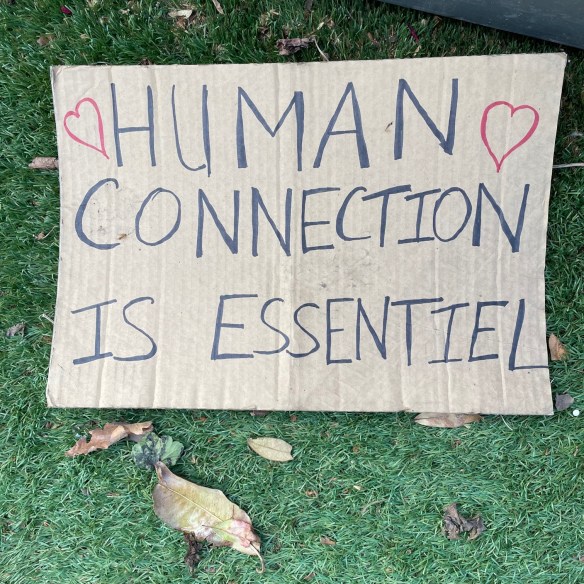
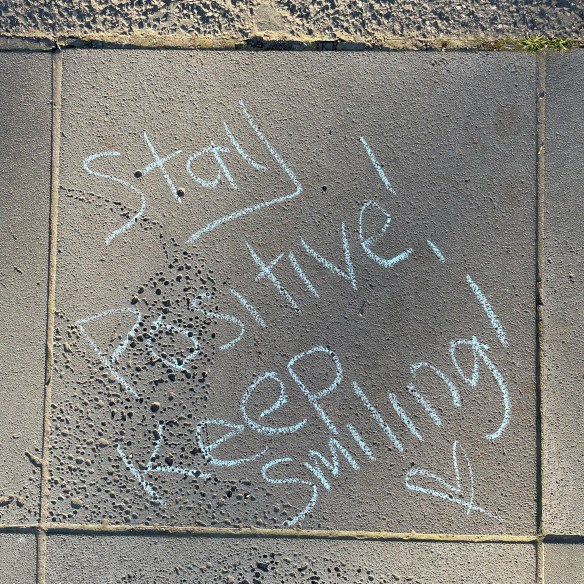
The following two pictures convey similar human sentiments, but they also represent very different responses to the situation we are living under. One is an example of the numerous messages of hope and encouragement that I see around my neighbourhood on my statutory daily walks. The other is a discarded placard seen a few days after an anti-lock-down protest.

The first reflects a “let’s grin and bear it” attitude – nobody likes being in lock-down, but we are all in this together, and if we can just remain positive, we will come through it OK.

The second is more reactive, and emotionally charged – the enforced isolation brought on by the lock-down is having an enormous effect on peoples’ mental health.

It’s hard to argue with either message….

I thought I would be able to cope better with each successive lock-down. Building a daily routine, maintaining some physical discipline (courtesy of the permitted daily exercise), managing at least 2-3 AFDs per week, treating myself to a nice restaurant-prepared meal now and then, catching up on films that I didn’t get to see at the cinema. But despite the recurring groundhog scenario, this lock-down seems different, and much harder to manage mentally.

First, the uncertainty of when it will end creates a sense of dread that we could be like this for 100 days or more (like lock-down #2). Second, the daily drip feed of data and the endless press conferences only reinforce the sense that we are not being given the full picture. Third, the sense of helplessness that for all our individual sacrifices of the past 18 months, we don’t seem to be any further ahead (if anything, we have gone backwards on so many counts). Fourth, State politicians seem to view this public health scare as a war of attrition between themselves and the voters (and their interstate and Federal counterparts). Gone is any sense that we are all in this together.

Quite apart from the cracks in Federation that the pandemic and its response has exposed, entire sections of the community are being driven apart and/or pitted against one another. Despite the so-called “National Plan” that the Commonwealth, State and Territory governments have all signed-up for, it’s clear that individual Premiers each reserve the right to interpret it differently, and will continue to impose internal border closures if they see fit. So, while Victoria and New South Wales seem aligned on this National Plan, Western Australia and Queensland in particular are more circumspect. Then there is the “race” to vaccinate their respective populations (or, as has been said a few times already, “our State citizens”, rather than “our Commonwealth citizens”).

At what point will the 70% and 80% vaccination levels be achieved to herald the promised social and economic freedoms? Is it the % of total population, or only the adult population, or only the eligible population, or only those between certain ages? Is it going to be calculated Federally, or at the State/Territory and/or LGA level? What about mandatory vaccinations for essential and front line workers, and those that have face-to-face dealings with the public? What about employers who require their staff to be fully vaccinated, but face resistance from unions?

Continued lock-down risks becoming a blunt instrument, and a tool of first (rather than last) resort. As such, it also risks alienating the majority of the population who are doing the right thing, in observing the public health directions and getting vaccinated (like, where’s the benefit?). And a prolonged lock-down risks undermining the efficacy of the vaccine, so we’ll need booster shots before we know it!

It seems that Covid19 is challenging our notions of the social contract between the government and the governed, and even testing the social license to operate we grant to big business (especially monopolies and cozy duopolies). The pandemic is also demonstrating the limits of individual responsibility and accountability, and potentially undermining the duty of care we owe to one another. If I knowingly, recklessly or carelessly (and as a result of breaching public health orders or OH&S measures) infect my family, my neighbour, my colleague or my customer, am I culpable? Does that mean I forfeit certain of my rights, especially if infection leads to death?

Just on the data, another reason the current lock-down seems different is because the information is being presented is not the same. Last year, everything was about the R0 number, flattening the curve, and “double-donut days”. There was also confusion over agreed terminology for “clusters”, “unknown cases”, “hot spots”, “red zones”, “complex cases” and “linked cases”. Politicians and bureaucrats talked about “settings”, “circuit breakers”, and “gold standards” for contact tracing. This year, it’s all about the “number of days infected”, “chains of transmission”, “mystery cases”, as well as the number of tests and vaccinations – much less analysis, it seems, on the number of confirmed cases per 1,000 tests or per 1,000 of the population, recovery rates or deaths as a percentage of cases.

From what I can glean, the stubborn levels of “mystery” cases can only be explained by the following:

  • more asymptomatic cases (are people building natural immunity?);
  • legacy cases shedding (a result of long Covid?);
  • longer incubation (and reporting) periods (less obvious initial symptoms?);
  • novel forms of transmission (or the virus is lingering longer on outdoor surfaces?);
  • QR codes and contact tracing not working (or the data is not usable?);
  • confusion over domestic/social/workplace/health/retail settings (e.g., extended families and multi-generational households?);
  • people being unclear about their movements (for fear of being victimised?).

Finally, I’m also not sure if lessons are being learned from elsewhere. We are still applying 14 day quarantine/isolation periods (albeit now with a day 17 test), yet in Hong Kong, for example, quarantine was extended to 21 days some time ago.

Next week: To be or NFT?


The Day That Can’t Be Named…

Today’s date, January 26th, has developed a deep identity crisis, much like the Australian psyche: who are we, how did we get here, and what does this day actually mean? A celebration of colonialism – or a day of indigenous mourning?

Leading up to this year’s public holiday, there has been: a muted response to suggested changes to the current National Anthem; a bewildering comment by the Prime Minister about finding equivalence in the circumstances of people sailing on the First Fleet and the impact those arrivals had on the indigenous population; constant bickering between the State and Federal governments about pandemic-related border controls (hardly an advertisement for Federation); renewed angst about the Australian cricket team (always a measure of the public mood); and an apparent drop in public support for an Australian Republic.

And there lies the nub of the issue. For some time now, it has felt that progress on a number of constitutional and cultural reforms has been hampered by the fact that Australia still hasn’t reached the maturity of declaring itself a Republic. The impediment to moving forward is the adherence to the post-colonial model of a Federation retaining the British Crown as the Head of State. The fact that we don’t formally recognise or celebrate Federation is in itself very telling.

Lack of maturity is endemic – from the habitual need to shorten words and phrases verging at times on baby talk (why on earth do the Prime Minister and the Leader of the Opposition choose to refer to themselves by their nicknames, “Scomo” and “Albo”?); to the suspicion of anything subtle, sophisticated or successful (the tall poppy syndrome).

Another foil to constitutional progression is the disproportionate influence (and position of privilege) that religious institutions retain in what is supposed to be a secular society.

Then there is the inability or reluctance to celebrate national success (apart from on the sporting field). Yes, Australia does “punch above its weight” in many areas, but there is so much inherent conservatism (small “c”) built into the system. The combination of 2-party politics, 3-tiers of government, cosy commercial duopolies, complex taxation, rigid regulatory frameworks, the laggardly trade union movement (not to say timid public policies on the environment, science, technology, education and the arts) inhibits innovation and experimentation. This institutional inertia (or conspiracy) all adds up to on overwhelming sense of acceptance, complacency and “she’ll be right”.

What if we had to work from the basis of some alternative histories? How would that change our views about January 26th? For example, what if either the French, Dutch, Spanish or Portuguese had colonised this land in the 17th or 18th century instead of the British arrived? What if the First Nations of Australia had developed metal tools and had fought back and won? What if Chinese fishing fleets or Indian trading vessels had established control of Australian waters and harbours long before the Europeans arrived? What if Indonesian or Malay tribes had settled here even further back than that? What if Japan had won the Pacific War?

This is not to excuse or justify the actions of the British in colonising the many nations that already existed in Australia, and all that followed from that. After all, the British Isles themselves had been invaded and conquered on many occasions over the centuries, so the First Fleet could be seen as a logical extension of that sequence of events. But perhaps this perspective can provide some additional context, helping us to reflect on the events and circumstances that have brought us to this point, and hopefully point to a way forward.

Next week: The Return of Cultural Cringe

Goodbye 2020

Just when we thought it was safe to go out and about, Covid19 has once again put much of Australia on high alert, following the latest virus outbreak in New South Wales. And with impeccable timing, this cluster has emerged only a few days before the Christmas holidays – peak super-spreader season. On top of the months of lock-down, working from home, toilet paper shortages, job losses, food deliveries, economic disruption, closed borders, non-stop streaming, social distancing, restricted movements, panic buying, mask wearing, night-time curfews, Zoom calls, on-line shopping, cancelled events and home-made entertainment, we now have the prospect of a muted festive period. Like most people, I will be glad to see the back of 2020 – not that 2021 will necessarily be a whole lot better, given the ongoing rates of infection around the world, and the other knock-on effects of the pandemic.

My holiday plans are all mapped out….

Overall, I can count myself fortunate to have had a “good pandemic” – I managed to keep working from home, I don’t work in any of the front line sectors (health, education, hospitality, logistics, tourism), I live close to public parks and open spaces for daily exercise, and none of my immediate family or circle of friends caught the virus (although I have spoken to a number of people who were not so lucky). However, my travel plans were severely disrupted, so I have been unable to see any of my family overseas, and the prospect of visiting them in 2021 still looks remote.

As I write, the Report into Victoria’s failed Hotel Quarantine Program has just been released. The findings conclude that no single person was responsible for the ill-fated decision to engage private security firms to enforce the quarantine restrictions (which in turn led to Victoria’s second wave and Stage 4 lock-down for over 100 days). Instead, the Report underscores the notion of “acquiescence” (and “creeping assumptions“) – and of course, the failure of governance and proper decision-making.

The significance of this Report is now being brought into stark relief in light of the latest NSW outbreak – which appears to be as a result of a breach in hotel quarantine measures. Having read the Executive Summary, it’s clear that respective Victorian government departments and agencies charged with implementing and managing the HQP did not understand their specific roles and responsibilities. Regardless of the decision to engage private security firms, it seems that the procurement process was seriously flawed; and even if the Department of Jobs, Precincts and Resources was not at fault in how it hired certain private-sector security firms, it’s a serious oversight (and failure of process) that neither it nor the Department of Health and Human Services were fully aware of who was accountable for monitoring these contractors.

Of course, the ramifications of the US Presidential Election and a no-deal Brexit are still playing out – and the New Year is unlikely to bring immediate closure. For myself, I am lying low and staying close to home during the Saturnalia celebrations. As the above photo suggests, my plans involve nothing much more than catching up on my reading, and exploring my wine collection. Consequently, this blog will be taking a break for a few weeks, but I trust that this holiday season will bring a welcome respite from the events of 2020 for you and yours. Thanks for reading.

Next: The NGV Triennial