#FinTech Melbourne’s latest #pitch event

The latest FinTech Melbourne meetup event was the second of their pitch nights. Co-hosted by NAB (at their Docklands Arena venue) and Capgemini (who were promoting the World Retail Banking Report 2016), the pitches were preceded by a panel discussion on a regulatory sandbox for Fintech startups.
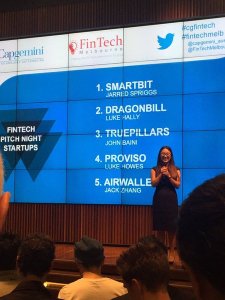
The list of contenders.... (Photo By Andrew Lai, sourced from Meetup)

The list of contenders…. (Photo By Andrew Lai, sourced from Meetup)

The panel was composed of Ben Heap from H2 Ventures, Deborah Ralston from the Australian Centre for Financial Services (who is also the inaugural Chair of ASIC’s Digital Finance Advisory Committee), Sudhir Pai (CTO at Capgemini), and NAB’s Todd Reichmann. This is a topic that FinTech Melbourne has aired before, but it seems despite much industry anticipation and some cautiously positive noises from government, bureaucrats and regulators, there are still, to date, no concrete developments or proposals.

I fully understand the need for formal regulation in financial services, and FinTech in particular, to support investor protection, foster market confidence and maintain industry stability. But the cost or burden of compliance can act as an inhibitor for innovation and entrepreneurship. And of course, regulation and compliance are no guarantees that nothing will ever go wrong, even among our established and highly regulated financial institutions. The debate needs to move on to some practical solutions – such as ring-fencing FinTech startups so that they can trial new products and services in the market, within a limited, defined and narrowly permitted scope and range of activity, under some sort of provisional permit prior to obtaining fully licensed status.

Some members of the panel were in favour of a principles-based regulatory framework (e.g., focus on outcomes and intentions, rather than a reductive model, where nothing is allowed unless it is expressly permitted). The problem with this is that the industry already has to work within a very broad definition of what constitutes “financial advice” that is subject to regulation. So there needs to be a further re-think about what “financial advice” means, especially as between retail, sophisticated and institutional investors; and in turn, I see an opportunity for a more variegated approach to licensing or regulating different advice models: e.g., face-to-face and custom financial planning; scaled and personalised robo-advice; or broader, generalised “class” or “category” advice (by product, platform or service type). (Analagous models to draw on already exist in the areas of therapeutic goods licensing and food labelling measures.)

The panel also thought that partnerships between FinTech startups and established licensees offer one way to navigate the regulatory regime. And I can see that the right type of roboadvice could bring truly independent and objective financial advice on product and brand selection.

There was also a suggestion that the sandbox model could act as an umbrella entity for FinTech innovation. While there may be some merit in the idea (e.g., for regulating the API’s that provide access to customer financial data and credit history – although these should already be adequately covered by data protection and privacy requirements), I am sceptical of regulators’ ability to innovate. Plus, the key retail investor failures during the GFC were about investor ignorance, not just “poor”advice; so the need for financial literacy cannot be overstated.

On to the pitches themselves, which were judged by Ben Heap, Deborah Ralston and Rohen Sood from Reinventure:

Smartbit

Offering an automated finance layer for the Internet of Things, Smartbit has already built a secure, Blockchain-backed price index. The goal is to enable automated, real-time payments, between any two devices connected to the internet. They see themselves as the “Blockchain of Things”, and proceeded to give a cute (if somewhat pointless?) live demo of switching on a LIFX bulb with a Bitcoin payment token.

The judges were curious to know what the actual use case was (apart from turning on light bulbs…). In reply, they were told that Smartbit can deliver real-time settlement (unlike the 15 minutes delay of an US competitor), and is designed to support micropayments. Personally, I think the technology is already proven, but the need less so, at least from a B2C perspective. The fact that so many banks, exchanges and clearing houses are exploring Blockchain solutions means that it’s day will soon come when it is not just a “Bitcoin thing”, but will be an integral part of financial services, data solutions and digital asset management.*

Dragonbill

This is a smart payments platform to reduce cashflow stress. The main benefit is to shorten the time SME’s have to wait before they get paid. It offers both a secured payment facility (escrow), and an express payment option (e.g., a tradie can get paid as soon as they finish a job).

The chosen paths to market are social media, accountants, business advisors and mentors, and (unusually?) sports clubs. But it becomes clearer when you consider that clubs need to manage multiple, small membership payments; and many members of sports clubs are SME owners, independent tradies and sole proprietors. Dragonbill are also setting up a partnership with Xero accounting software.

The main questions from the judges concerned the ability to scale the business, and whether Dragonbill generates interest on amounts in escrow.

Truepillars

Another version of the peer-to-peer lending platform for SME borrowers, the business model is based on an online auction system where, for as little as a $50 bid, investors can bid on specific loan requests, with risk-adjusted interest rates, that are also determined by the number and amount of competing bids.

Access to traditional SME loans under $500k is increasingly limited as banks need to allocate more risk-weighted regulatory capital to cover their SME exposures, making them an inefficient and expensive use of bank capital.

The Truepillars platform offers borrower and investor dashboards for tracking and portfolio reporting, but the panel were worried that it wasn’t a unique proposition. However, unlike some of their competitors, Truepillars offers loan terms out to 5 years. It would also be interesting if investors (lenders) could build proper fixed income portfolios (by loan duration, yield curve, exposure type, recourse/rollover etc.), and if borrowers could cap the number of, and limit their exposure to, individual bids or lenders/borrowers.

Proviso

Claiming to be transforming lending, Proviso work with lenders to streamline the submission of borrowers’ financial data and bank statements in support of their loan applications. The prospective borrower logs into their account and gives permission for the lender to access their banking information, but Proviso does not “see”, hold or store the customer data – it merely acts as a pass-through. The goal is to reduce borrower application abandonment, and the service is already being used by 180 financial institutions – generating 60,000 requests per month. The business is being driven by enhanced customer experience, and ASIC directives on more prudent lending processes. In short, they claim to offer better, faster data.

The judges wanted to know how Proviso compares to Yodlee: “we’re local, and less painful to use” was the response – meaning that proximity offers speed and local market knowledge. Finding a market among non-conforming customers, Proviso is also looking at providing validation services. But in my mind, there is a risk that Proviso could be displaced by an industry-owned or regulatory mandated platform or utility (such as the creation of PEXA for real estate conveyancing and settlement.)

Airwallex

With a tag line, “cross-border payments made easy“, this another solution aiming to  transfer money between people, regardless of location, bank, currency, etc. Currently, Airwallex is focussing on Asia Pacific, and is the only Australian holder of a cross-border license to transact in Chinese RMB. It has also integrated with the three largest payment platforms in China – AliPay, WeChatPay and UnionPay, and built an API for e-commerce solutions. Airwallex claims to be faster, cheaper and simpler than the competition, using real-time FX rates.

The panel was naturally curious about how the platform is addressing anti-money laundering concerns and complying with counter-terrorism legislation. In order to offer lower fees than PayPal, and by only taking fees from the FX spreads, Airwallex has to automate the transaction process to achieve mid-market prices – but does the increased automation heighten the risk that the platform can be used for nefarious purposes?

After their deliberations, the judges declared Proviso as the winner – hard to argue with that sort of market traction.

*Note: Declaration of interest – I have recently joined the team at Brave New Coin, a FinTech building market data and infrastructure solutions for Bitcoin and Blockchain.

Next week: #StartupVic showcases the next batch of startup hopefuls

 

Latest #FinTech Round-Up

The first quarter of 2016 has seen some significant FinTech developments in Australia. It feels the sector has finally “come of age”, at least in terms of government policy, as well as some significant deals. For anyone who may have missed the action, here is a very brief round-up:

FinTech_AustraliaThe formation of FinTech Australia as an umbrella group in late 2015 was seen as an important step in reducing inter-state rivalry. Following its first AGM in March, hopefully it will help the industry to attract further visibility, gain critical mass and co-ordinate the debate around legislation, funding, compliance and regulatory licensing, as well as fostering innovation and collaboration.

At the same time, the Federal Government has established the FinTech Advisory Group composed of some heavy hitters and key influencers. One of the first outcomes has been the Treasury’s response to a number of regulatory changes that the industry is prioritizing.

Having spoken to several members of both the Advisory Group and the FinTech Australia Committee, there is a clear sense that the industry has finally “broken through” to get on the ideas and innovation agenda.

FinTech Melbourne hosted a very interesting Meetup on Women in Fintech, set against the backdrop of the continuing gender diversity debate (in particular, across tech startups). An all-women panel comprising Charlotte Petris from Timelio and Jemma Enright from MoneyBrilliant, and facilitated by Anita Kimber from EY, explored some of the opportunities and challenges (and the struggles along the way) of being a startup co-founder, their experiences of launching new businesses and products, and how they go about hiring the right talent and building great teams.

Meanwhile, in London, The FINTECH Book was being launched, which includes a contribution written by DragonBIll‘s Melbourne-based CEO, Luke Hally.

Over at the MBTC , the Melbourne Bitcoin Meetup group hosted Brave New Coin‘s CEO, Fran Strajnar. Fran gave a detailed presentation on the market news, financial data and analytical infrastructure that Brave New Coin is building to support crypto-currencies and block chain technology, including the new Bitcoin Weighted Average Price (aka B-WAP). This new analytic will likely prove to be a key component for real-time and historical pricing data on specific bilateral transactions (e.g., calculating end of day evaluations or annual tax reconciliations), as well as providing underlying reference data (e.g., for index-linked instruments and associated derivatives, swaps, options and forwards). Exciting stuff indeed!

Finally, ASIC, as part of its work in building a more supportive regulatory environment (under its Innovation Hub) has announced a bilateral agreement with the UK’s FCA on greater co-operation between the respective market regulators, that may lead to mutual recognition for FinTech companies. Another similar deal is being explored with Singapore.

Next week: 4 more #startup hopefuls pitch at Startup Victoria


ANZ’s new CEO on #FinTech, CX and #digital disruption – 10 Key Takeaways

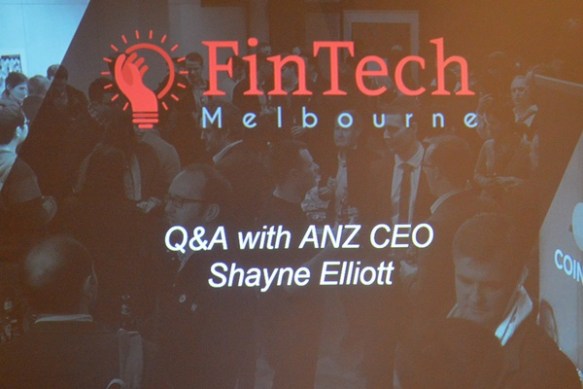
I went to the recent Q&A with the new CEO of ANZ, Shayne Elliott, organised by FinTech Melbourne. It was the first public speaking appearance by Shayne since becoming CEO (excluding his gig at the Australian Tennis Open), and followed a similar event last year with Patrick Maes, the bank’s CTO.

600_446693337The key themes were:

  1. Improving the customer experience (CX) is paramount
  2. Maintaining the high level of trust customers place in their banks is key
  3. Being aware of FinTech disruption is important, but remaining focused on core strategy is even more important
  4. FinTech can coexist with traditional banks, but the latter will win out in the end
  5. The bigger opportunity for FinTech is probably in SME solutions, rather than B2C
  6. Increased process automation is in support of CX, not about reducing headcount
  7. Big data and customer analytics are all very well, but have to drive CX outcomes
  8. Customers still see the relationship with their main financial institution in terms of basic transaction accounts, which is why payment solutions (a high volume/low margin activity) are vital to the banks’ sustainability
  9. ANZ is about to appoint a head of digital banking who will report direct to the CEO
  10. ANZ has been rated as one of the top global banks in terms of its use of Twitter and social media (but from what I have seen, much of the Big 4 banks’ social media presence can be attributed to their sports sponsorship…)

There was also some discussion around ANZ’s Asian strategy, and the statement last year that the “new” strategy is about becoming a digital bank. Shayne was quick to point out that they are not abandoning the Asian strategy (it’s not either/or) but because they embarked on Asia 8 years ago, most of the work has been done. Now they need to consolidate and expand the platform they have built. He also placed ANZ’s Australian business as being a comparatively small part of the group’s portfolio, and also took the view that despite ANZ’s size, resources and reach, digital products have to be developed market by market – it’s not a one size fits all approach. (Several FinTech founders in the audience took a very different perspective on this.)

And, in a bid to appear entirely approachable, both Shayne and Patrick were happy for people to contact them direct by e-mail… So if any budding FinTech founders have an idea to pitch to a major bank, you know who to contact.

Next week: Making the most of the moment…

A big year in #FinTech

Looking back over the past year, it’s easy to see that 2015 has seen a giant leap forward for #FinTech in the Melbourne #startup scene. Much of this progress can be attributed to the efforts of the FinTech Melbourne Meetup Group, which, in little over a year, has established itself as one of the leading local startup groups, culminating in its first pitch night last month.
logo

Backdrop

There have been some significant business developments this year, including the launch and expansion of new P2P lending providers, payment platforms, digital currency solutions and robo-advice services. And while Melbourne does not yet have an equivalent to Sydney’s Stone & Chalk (a dedicated FinTech hub), there is enough momentum across the network of co-working spaces and the startup ecosystem of founders, advisors, incubators and accelerator programs to ensure that the city is building on its status as a financial centre.

For myself, the year in FinTech really got going with the inaugural FinTech Startup Weekend, which for me was a steep learning curve. I not only learned how to survive a hackathon, but I also gained a much deeper understanding of FinTech itself. I had become increasingly aware of the topic, via other meetup events, business networking and through reading (and writing for) specialist trade publications.* But until you actually see some of the innovative and practical ideas on new technical solutions for financial services, FinTech can seem like a lot of vaporware.

Emerging Winners

At the recent FinTech Melbourne Pitch Night, five local startups presented to a panel of distinguished judges in front of a packed audience at Melbourne Town Hall. Representing core fintech sectors (and the key messages from their pitches) were:

  • Fuzo – mobile payments platform: “2.5bn people don’t have a bank account”
  • CoinJar – a Bitcoin exchange: “targeting digital nomads”
  • StockLight – investment research: “24% of investors want help with analysis”
  • Moula – SME lending: “not a lender of last resort”
  • Timelio – cashflow finance: “factoring has missed the internet generation”

In what is traditionally a bank-dominated area of trade finance, Timelio is challenging the usual models for invoice discounting, while offering a new asset class for selected investors. I’ve featured Moula in this blog before, but this time around, I felt the presentation was quite low-key, and rather coy about the business model and the financials – maybe that’s because things are moving very quickly, and Moula is in the process of building significant traction via key commercial partnerships. The Fuzo pitch was quite complex (and probably too much technical information to present given the format), but the SIM card-based technology looks very interesting. StockLight‘s proposition is quite simple, and with access to quality content and a range of commercial models, could be one to watch as every financial institution is having to rethink wealth management and personal advice. However, on the night, CoinJar took out the first prize, and not for the first time, demonstrated how a simple concept can actually make the complex more straightforward: if nothing else, it proves that “Bitcoin can be done”.

Backlash

Some comments in the specialist trade publications have been quite scathing about FinTech, in particular those few startups that have embarked on public listings and IPOs. Much of this backlash relates to governance, disclosure and transparency; fair enough, they are important issues. But these criticisms should not be used to undermine the innovative technology, new business models and strategic partnerships that FinTech startups are bringing to the market.

Going mainstream

When otherwise conservative institutions such as industry superannuation funds start to embrace FinTech (e.g., Equip’s tie-up with Clover), or if the ASX decides to deploy blockchain technology to replace the CHESS clearing and settlement platform, it means that FinTech is definitely on the map, and can’t be written off or even ignored as some sort of irritating, disruptive upstart.

Next Steps?

In the wake of announcing the Victorian Government’s $60m LaunchVic startup initiative, the minister for small business, innovation and trade, Philip Dalidakis has been on a flurry of highly visible public speaking engagements, networking events and social media posts. Keen to get the message out there that his government intends to make Victoria a startup success, the minister is certainly generating considerable goodwill in the community.

I’m yet to understand fully the actual remit and stated goals of this new Quango. For example, what does “investing in core infrastructure” mean? Do we really need another bureaucratic body? Couldn’t the initiative have been better structured as a peak body to represent and support the private sector activities already underway?

If the minister is going to be true to his introductory remarks at the recent #hscodefest hackathon, the government needs to create the right environment for startups to flourish, not try to pick winners – leave that to the investors, entrepreneurs and industry experts. As an example, run a FinTech-themed hackathon to improve the Myki system…..

The Last Word…

Finally, for anyone needing an overview on crypto-currency and the future of money, I highly recommend Torsten Hoffmann‘s award-winning 2015 documentary, “Bitcoin: The End of Money as We Know It”, which received its Melbourne premiere last week at Collective Campus.

FOOTNOTE:

* I can’t claim any credit, but a few months after my Trade Finance blog, ICICI and Alibaba announced a new partnership – in part proving my theory that collaboration soon follows in the wake of disruption

Next week: Crate-digging in Japan