ANZ’s new CEO on #FinTech, CX and #digital disruption – 10 Key Takeaways

I went to the recent Q&A with the new CEO of ANZ, Shayne Elliott, organised by FinTech Melbourne. It was the first public speaking appearance by Shayne since becoming CEO (excluding his gig at the Australian Tennis Open), and followed a similar event last year with Patrick Maes, the bank’s CTO.

600_446693337The key themes were:

  1. Improving the customer experience (CX) is paramount
  2. Maintaining the high level of trust customers place in their banks is key
  3. Being aware of FinTech disruption is important, but remaining focused on core strategy is even more important
  4. FinTech can coexist with traditional banks, but the latter will win out in the end
  5. The bigger opportunity for FinTech is probably in SME solutions, rather than B2C
  6. Increased process automation is in support of CX, not about reducing headcount
  7. Big data and customer analytics are all very well, but have to drive CX outcomes
  8. Customers still see the relationship with their main financial institution in terms of basic transaction accounts, which is why payment solutions (a high volume/low margin activity) are vital to the banks’ sustainability
  9. ANZ is about to appoint a head of digital banking who will report direct to the CEO
  10. ANZ has been rated as one of the top global banks in terms of its use of Twitter and social media (but from what I have seen, much of the Big 4 banks’ social media presence can be attributed to their sports sponsorship…)

There was also some discussion around ANZ’s Asian strategy, and the statement last year that the “new” strategy is about becoming a digital bank. Shayne was quick to point out that they are not abandoning the Asian strategy (it’s not either/or) but because they embarked on Asia 8 years ago, most of the work has been done. Now they need to consolidate and expand the platform they have built. He also placed ANZ’s Australian business as being a comparatively small part of the group’s portfolio, and also took the view that despite ANZ’s size, resources and reach, digital products have to be developed market by market – it’s not a one size fits all approach. (Several FinTech founders in the audience took a very different perspective on this.)

And, in a bid to appear entirely approachable, both Shayne and Patrick were happy for people to contact them direct by e-mail… So if any budding FinTech founders have an idea to pitch to a major bank, you know who to contact.

Next week: Making the most of the moment…

Technology vs The Human Factor

Several times over the past month I have been reminded that the pursuit of technology for its own sake can give rise to misguided innovation; so-called solutions that are divorced from real world problems cannot justify the effort or resources. It feels like we are entering a new phase of the post-industrial revolution era, where a lack of “the human touch” will render many new inventions as worthless, irrelevant or redundant.

Street scultpure, Nagoya. Photo © Rory Manchee (all rights reserved)

Street sculpture, Nagoya. Photo © Rory Manchee (all rights reserved)

In no particular order:

  • At the second Above All Human conference in Melbourne, there was a consistent theme: how do we make sure there is a real connection between human needs and bleeding edge technology?
  • A Slow School of Business excursion to an eco-friendly homestead in rural Victoria offered a practical lesson on how to create harmony between technology and nature, and still achieve a modern (but modest), highly personal and comfortable home.
  • The economic debate about whether technology is improving our standard of living (as reported in the latest CPA magazine), which also echoes a recent CEDA report on automation and the implications for job losses.
  • A Q&A with Shayne Elliott, the new CEO of ANZ Bank, which prompted the observation that big data analytics, process automation and digital disruption are all very well, but will prove meaningless unless they can improve the customer experience. (But Elliott also conceded that the likes of Uber and Airbnb have succeeded because of complacency among industry incumbents.)

Advances in technology don’t have to lead us to the dystopian worlds of “Modern Times” or “Metropolis” (or any of the other post-apocalyptic visions that cinema and literature like to give us). However, the understandable focus on innovation must take the “human factor” into greater account when making design decisions, undertaking cost-benefit analysis and opting for one technology format over another.

Conclusion? It’s not totally clear whether we are entering another dot.com market correction, but there is a case to be made for whether or not we are seeing enough of a “technology dividend” from the current digital disruption and economic displacement centred on the use of cloud, social and mobile platforms; and whether we need a new methodology to measure the impact of the Internet of Things, robotics, AI, nano-technology, AR/VR, cognitive apps, wearables, 3-D printing, etc.

Next week: It’s never too late to change….

Why The Service Sector Lacks Self-Awareness

If you did a root cause analysis of companies that rate poorly for customer service, I predict it would reveal one or more of the following:

  • Outdated processes
  • Inadequate staff training
  • Poor product knowledge
  • Operational silos

What it usually comes down to is a chronic lack of self-awareness. (This is not helped if there is a failure of leadership, or a toxic culture within the organisation.) Despite all the customer feedback forms, platitudes such as “your call is important to us”, and the regular customer advocacy reports, unless service providers can truly put themselves in the shoes of their customers, they will never have sufficient knowledge or self-awareness with which to fully evaluate the “customer experience”.
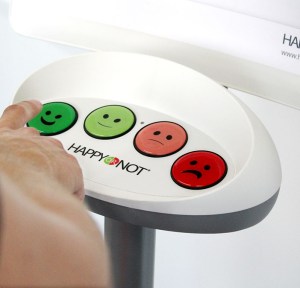
Image: Customer Feedback Device (Source: Smarte Carte)

Image: Customer Feedback Device (Source: Smarte Carte)

Today’s customers are more knowledgable (because they have access to more information, they can shop around, and in some cases, they have more choice). Today’s customers are also actively encouraged to engage with corporate social media (by following, liking and sharing, and by becoming surrogate brand advocates). However, the increased levels of expectation that this “engagement” creates are not always matched by the post-sales customer experience.

I have written before about how companies can improve their customer service, using a practical 7-point scheme. I would challenge any organisation that rates itself highly for customer service, to assess its performance against those criteria, as well using the ubiquitous customer satisfaction scores (CSAT, NPS®, CES, etc.).

Nearly every time I have an interaction with a telco, utility, bank or other service provider, I receive an immediate follow-up customer feedback request. Once upon a time, I would have been quite willing to provide constructive feedback, as I used to believe that it was important for the voice of the customer to be heard. Nowadays, I am more hesitant, because I don’t believe this feedback is ever properly acknowledged, analyzed or acted upon.

So many of these feedback request forms are self-serving, because the person you dealt with is in effect soliciting personal feedback on their individual performance. And while that is important, it is rarely done in the specific context of the customer’s own experience, and is more concerned with the company’s internal policies and procedures.

I am also increasingly sceptical about feedback processes that are ostensibly used for staff training. First, time is valuable, so it would be nice if companies could reward their customers for making the effort to engage. Second, on the rare occasions where a company has contacted me in response to a complaint submitted online or via a feedback form, I never learn what specific steps the company is taking to rectify problems caused by operational or policy failings. Thirdly, why should I be responsible for telling you how to train your staff or improve your service – surely that’s your job!

In many cases, it is not the performance of an individual customer service representative that is the problem. More likely, it’s poor customer service training, inadequate product knowledge or a myopic perspective, reinforced by silo operations. When even the most pleasant and competent service rep tells me, “I’m sorry, but it’s the way the system is designed…”, they probably don’t realize what a disservice they are doing: a “system” is only as good as the people who design it, and the people who implement it. So, they are in effect criticising their own colleagues, and the organisation they work for.

This lack of self-awareness by customer service staff is reinforced by the limited discretion in trying to resolve customer problems. Along with the use of internal jargon and bewildering acronyms, there is nothing worse than having to complain long or loud enough in order to escalate a problem. It would be wonderful if companies could empower their staff by giving them (well-defined) individual discretion on problem solving, and incentivize them for taking responsibility for the end-to-end resolution process.

In addition, it’s really infuriating being handed from one specialist, team or department to another, especially due to labyrinthine help line service menus. Telco on-boarding processes are particularly notorious for having complex operational procedures, multiple hand-offs and ring-fenced communications. I recall one large service provider who told me that in-bound call-centre staff were unable to speak directly to their own web support teams, and even if they communicated via internal e-mail, they could not guarantee a response.

If I am beginning to sound a bit like a broken record, it’s because recent experiences only reinforce my belief that many companies still don’t understand what it’s like to be one of their customers. But there’s a huge paradox here: on the one hand, companies are trying to reduce customer churn, increase “stickiness”, and improve the share of wallet or lifetime customer value; on the other, the cost of new customer acquisition appears to be cheaper (thanks to social media tools and web analytics), so it doesn’t matter if they lose a few customers, because it’s not that difficult or expensive to find new ones.

If it’s no longer true that “the customer is always right”, because profit margins are being squeezed and companies are being told to “stop delighting your customers”, then service providers have to do a much better job of managing customer expectations. They also need to demonstrate genuine empathy and concern if things go wrong (which is difficult if they don’t have sufficient self-awareness). And if things do go wrong, they need to ask the customer “what could we have done differently to provide you with better customer service?”.

In my professional experience of product management and business development, understanding customer needs and identifying ways to improve service delivery (along with customer-centric perspectives rather than product-led processes), are genuine sources of competitive advantage. But it takes considerable self-awareness to engage customers beyond the level of a single transaction, to develop genuine rapport, and to build sustainable long-term relationships. If your organisation is challenged by poor customer service, and if you recognise this is in part due to a lack of self-awareness, please get in touch – I’d be very interested to understand your problem.

Next week: Idea over Form – Gehry vs Ando
Another weekend, another hackathon….

Last month, I competed in my second hackathon of the year, the #HSCodeFest sponsored by the Herald Sun and News Corp, and hosted by Melbourne University’s Carlton Connect. I’m pleased to say that our team of four, which was only formed on the first night, came 3rd in the pitch competition – with an idea for a news quiz app.

Screen Shot 2015-12-18 at 3.44.56 PMThat particular weekend was quite an eventful one for local startups – not only were there at least two other hackathons being held in Melbourne at the same time, but the State Government also announced its LaunchVic initiative. Small Business Minister, Philip Dalidakis found time in his busy schedule to address the #HSCodeFest participants, which was a great incentive. The previous weekend saw another Startup Weekend event, and last weekend Carlton Connect hosted yet another industry hackathon sponsored by the GE Industrial Challenge. And of course, since then we have had the Prime Minister announce the National Innovation and Science Agenda. To paraphrase Mr Turnbull, there’s never been a more interesting time to be a startup….

Having participated in Startup Weekend’s first #FinTech hackathon back in March this year, I was a lot more prepared, and had a much better idea of what to expect. Even though I didn’t pitch a specific idea on the opening night, I used my previous team-building experience to make sure we had a balanced mix of skills and expertise. I was also clear to make sure that once we had agreed on the project idea, everyone had specific roles, and we constantly checked in on progress and next steps.

As usual, the team generated far more content, data and ideas than we actually used in the pitch presentation. We also kept it very simple, by focusing on the key concept, demoing an MVP, outlining the commercial strategy, describing the business plan, and establishing just enough knowledge and awareness about the market opportunities, even though it had not been possible to fully scope them. For an insider’s view, check out my team-member Nathan’s blog.

We have seen over the past 12-18 months that the hackathon model is being deployed in many different ways to try to stimulate innovation and generate new business ideas. Even government departments and public utilities are getting in on the act, by enabling participants to access data sets, software, technology and APIs to see what they can come up with. Large corporates, who struggle to embed innovation into their organisations, are also holding internal competitions drawing on the experience of meetups, hackathons and pitch nights.

I only see this as a positive development, as long as the energy, enthusiasm and experience can be channelled into meaningful outcomes, which enable in-house talent and external expertise to combine to build great products and services that customers want, and/or identify and deliver significant process improvements and efficiency gains.

However, part of me is sceptical – as someone who is probably much older than the average age of a hackathon participant, I’m still amazed how many of my contemporaries either have no idea or simply don’t “get” the hackathon or meetup concept. They seem astonished that anyone would want to get together with total strangers, and spend their evenings let alone a whole weekend working with them, for “free”. To those of my peers who may see it that way, I would point out that participating in these events is a cheap and effective way of accessing new ideas and skills, meeting talented people, and acquiring new skills and knowledge.

Finally, if your organisation is thinking about running a hackathon or similar event for the first time, I’m more than happy to share my insights – contact me via this blog.

Since the holidays will soon be upon us, Content in Context is taking a short break. Normal service will be resumed on January 5. To my many regular readers and followers, I wish you all a safe and peaceful New Year.

Next: Surrealism, Manifestos and the Art of Juxtaposition