“Why? Because we’ve always done it this way…”

A couple of blogs ago, one of my regular correspondents kindly laid down a challenge. He suggested that part of the answer to the problem I was writing about (i.e., how to manage data overload) could be found within Simon Sinek’s “Start With Why”.
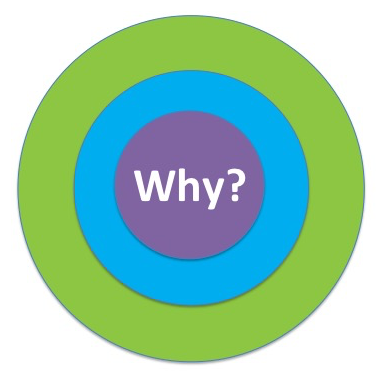
Why?I’m quite familiar with Sinek’s investigation of “Why?”, but I wasn’t sure it was applicable in the context of my topic. Don’t get me wrong – the “Golden Circle” is a great tool for getting leadership teams to explore and articulate their purpose, and it can help individual business owners to re-connect with the reasons they do what they do.

It can even facilitate new product and service development.

But, I believe it’s harder to apply at an operational or processing level, where the sorts of decisions I was referring to in my blog are typically being made: what tools to use, what systems to adopt, what software to deploy etc.

There are several reasons why organisations do things the way they do them. When undertaking a business process review, I frequently ask the question, “Why are you doing this?”

Here are some typical responses I’ve received (and my conclusions in parentheses):

  • “Because we have to” (compliance)
  • “Because we’ve been told to” (command and control)
  • “Because we’ve always done it like this” (inertia)
  • “Because everyone else is doing it” (cheap/easy/popular)
  • “Because our consultants recommended it” (cop-out)

In one experience, I had to implement a process change within a publishing team, comprising experts (writers) and technicians (editors). The problem was, that even though the content was published on-line, most of the production processes were done on hard copy, before the final versions were uploaded via a content management system. The inefficiencies in the process were compounded by a near-adversarial relationship between writers and editors, at times bordering on a war of attrition.

When I asked the team why they worked this way, their responses were mainly along the lines of “command and control” and “inertia”. Behaviours were reinforced by some self-imposed demarcation.

The writers felt it was their role as experts to demonstrate everything they knew about the topic (without necessarily saying what they actually thought); while the editors felt they were required to work within a rigid house style (to the point of pedantry), maintain writing quality (at the expense of timeliness), and to maintain content structure and format (over context and insight).

  • Both sides felt they were meeting the organisation’s purpose: to deliver quality information to their customers to help them make informed decisions.
  • Both believed they were following clear operational guidelines, such as production, technical, and compliance.
  • Both were passionate about what they did, and took great pride in their work.

Unfortunately, the procedures which they had each been told to follow were inefficient, at times contradictory, and increasingly out of step with what customers actually wanted.

Based on market feedback clients told us they:

  • favoured timeliness over 100% perfection;
  • preferred insights over data dumps; and
  • really wanted “little and often” in terms of content updates

Thankfully, the voice of the customer prevailed, and the introduction of more timely content management processes resulted in frequent updating (via regular bulletins) backed by the “traditional” in-depth analysis.

When starting a change management project, conducting a process review, or undertaking a root-cause analysis, if asking “Why?” doesn’t get you very far in getting to the bottom of a problem, I find that it can help to pose another question: “What would your customers think about this?” For example, if customers knew how many times a piece of data was handed back and forth before their order/request/enquiry was processed, what impression might that give about an organisation?

For most companies, their sense of purpose is driven by a strong or underlying desire to serve their customers better – it’s as simple as that.

Next week: The 3L’s that kill #data projects

The Great #Data Overload Part 2: Is #Digital Making Us Dumber?

The pursuit of digital (and by implication, many data-related activities) is making us dumber. Whether it’s constant multi-tasking, the need for instant gratification, the compulsion to always be “on”, or the ease of access to content and connections, there’s actually a law of diminishing returns in trying to capture and engage with all this “stuff”.

Screen Shot 2015-02-02 at 10.24.54 am

Image © 2014 Universal Pictures

Consequently, our decision-making is increasingly governed by a hair-trigger mechanism – a single-click here, a right-swipe there, a “Like”/”Share” here, there, everywhere – which makes the outcome far less important than the instantaneous and self-validating process (“I Tweet therefore I am”). The quality of our interactions and relationships risks being reduced to a single lowest common denominator of the “fear of missing out” (#FoMo).

Current business practises focus on lean, agile and flexible – meaning that we have to get used to operating in a rapidly moving environment. However, agility is not helped by either procrastination or rash calls.

Faced with these demands on our attention, how can we come to a truly informed opinion or considered conclusion? The trick is knowing whether or not you are required to respond (not everything is relevant, vital or critical that it needs your constant or immediate participation – sometimes silence is golden). If you must make a call, then know when you have enough (hopefully, the “right”) data to make a rational and reasonable decision.

How do we build a capacity for calm, considered and constructive engagement with the digital world?

Part of the challenge is changing our (recently acquired) habits and behaviours. Speaking to friends and colleagues, there is a growing realization that reaching for your smart phone just before going to sleep (or as soon as you wake up), or constantly checking for status updates, is a noxious habit. Apart from the impact it has on our brain activity, it is also reinforcing our belief that this is normal, that we are somehow subservient to these devices, and that interacting with the digital environment takes priority over everything else. I know, I’m as guilty as the next person (watching the tennis on TV while checking the cricket scores on my iPhone…), but I am also trying to be more critical of my own digital consumption:

  • Not responding immediately to every e-mail – this is about time management skills as much as anything else; the faster you respond, the more you raise expectations that you will always answer straightway
  • Unsubscribing to mailing lists – in recent weeks, I have been unsubscribing to various newsletters because I was simply no longer interested in them or because they were no longer useful; if something’s important enough, I’ll no doubt find out about it from another source
  • Being selective about social media – I’ve written about this before in the context of authenticity and personal branding; in short, I find it essential to use different social media tools for different purposes (and to use each tool differently). That way, I manage to keep some separation between various parts of my professional and personal lives – at the very least, it acts as a helpful filter between the public and private
  • Choosing on-line connections carefully – this is another topic I have covered in a previous blog; not all our interactions are equal, and other than some basic relationship filters, most social network platforms don’t allow us to distinguish between friends, colleagues, acquaintances, and someone we met at a conference.* So, I generally decline unsolicited “friend” requests if I have not actually met or interacted with the person previously, or if I cannot find relevant mutual connections, or if I do not see what value I can add by being connected to this person.
  • Limiting notifications and status updates – similar to managing in-bound e-mail, I tend to switch off/ignore real-time notifications and updates. Instead, I prefer to check-in no more than once or twice a day, rather than always being logged in.

Finally, I’m hoping to develop a status setting for my smart phone that responds to all incoming notifications with messages such as: “Neither on nor off, merely resting”, “taking a mental pause”, “out to lunch”, or “making time for reflection before I respond”.**

Next week: Differentiating in a digital world

Notes:

* I recently heard about Humin, which is sort of moving in this direction, but it’s really a personalised CRM tool for your smart phone

** Apple’s “Do Not Disturb” function only supports “on/off” with respect to phone calls, and with a limited scope to filter contacts

The Great Data Overload Part 1: Meaning vs Megabytes

Data storage is big business, and research suggests we currently spend 30% more per annum on buying additional capacity. Interestingly, a significant part of that growth is being met by the use of tape storage – which is far more energy-efficient than traditional hard drive arrays.

Screen Shot 2015-02-01 at 4.17.07 pm

Image © 1943 Universal Pictures Co., Inc.

No doubt, this storage demand is being driven by data automation, cloud technologies, mobile transactions, social media and the desire to know everything about everything. But why do we really need to store so much data? Although we have the ability to store exponentially increasing numbers of terabytes, and even though the management costs are stabilising, what are we really doing with it all? Aside from meeting legal and compliance obligations, what are we hoping to achieve with all this data? How much of it is actually contributing to improving our knowledge, increasing our understanding or helping us to uncover valuable insights?

First a slight detour. A few days ago, I was watching a DVD of “Sherlock Holmes in Washington” (1943). Holmes is investigating the disappearance of a top-secret document, which he deduces has been transferred to microfilm “the size of a postage stamp”. He further explains to Dr. Watson that microfilm enables carrier pigeons to transport the equivalent of 18,000 letters*. I was surprised, because I hadn’t been aware that microfilm was in use in the 1940’s (but a quick check of this article soon clarified the issue).

Anyway, to return to my original theme: have we lost sight of meaning in our pursuit of megabytes?

The issue of contextualisation is central to much of my work, and increasingly I am finding that while companies (especially those engaged in data analytics, content marketing and social media) understand the mechanics of Big Data, SEO, blogging, channel management etc., they are less able to understand the “why?” of what they are doing, or cannot articulate what their goals are or what their expectations might be in trying to capture ever-increasing amounts of data, or deploying new content generation and management tools.

It seems to me that they haven’t clearly framed the context for the tools they are using, nor have they anticipated what results they should expect to see from these efforts. Rather, they focus on capturing more data and generating more content; instead of stepping back and asking “if we do this, what might the outcome be?”, and then clarifying whether that is a good use of their resources.

A small example: the use of “smart” content management tools means that companies can automate the sharing of third-party posts, headlines, Tweets, news and blogs. One of my clients is a career management consultancy, whose content was recently referenced by another career information service. Which was flattering, until I investigated further and discovered that this latter company had simply chosen to share any content with the words “career” or “careerchange” in the headline – which included news items about cars crashing into buildings and athletes achieving PB’s….

If only they had bothered to think ahead about what content they were likely to end up sharing, rather than trying to maximise their output, they wouldn’t have risked confusing their audience.**

Next week: Is Digital Making Us Dumber?

Notes:

* Watch here from about 20:15 onwards. For comparison, it prompted me to estimate how many 3.5″ floppy disks you would have needed to store that many documents, given their meagre 1.44MB capacity. (The answer is 48.) For further comparison, the computer aboard Apollo 11 had 36KB of ROM, and 2KB of RAM. Nowadays, we won’t leave home without a minimum 16GB smart phone.

** See my related analysis which led me to conclude that context is all about the difference between “data” and “knowledge”.


Lesson of the Day: Learning to Learn (Again)

Over the past 6 months, I’ve been privileged to be a participant in, and an adviser to, the Slow School of Business, founded by Carolyn Tate and supported by a team of expert facilitators. It has been an invaluable experience, as it has forced me to think about how I learn – not just my learning style, but what engages me to want to know more.

While Carolyn has articulated her own personal and professional reasons for starting Slow School, the initiative is attracting people who have a natural bias towards a certain type of learning environment. Overall, these people have a preference for education that is:

  • Peer-to-peer
  • Interactive
  • Collaborative
  • In person
  • Practical

That’s not to say participants aren’t also engaged by on-line courses, or pedagogic instruction, or even self-directed learning, but that’s not the full story – there has to be a personal connection as well.

A particular revelation for me was prompted by a question that Carolyn posed at a facilitators’ networking meeting a few weeks ago: she challenged each of us to identify one thing we had learned about learning over the past year. I had recently come across the work of William Cronon, historian, educator and environmentalist. In particular, a paper he wrote in 1998, entitled “Only Connect…” The Goals of a Liberal Education.

Professor Cronon’s article is such an eloquent description of the mindset, attitude and world view that the best students (and therefore, the best learners) should bring to any course of study or learning experience. Education is not simply about rote learning, or fact cramming, or even regurgitation of prescribed texts – although this is what most tests and exams are designed to assess and evaluate.

A better approach is to explore what we have learned through a process of enquiry that demonstrates comprehension, critical analysis, practical application and conceptual re-contextualistion – such as working out a given problem using basic first principles, or testing a stated theory via the use of analogous scenarios.

The benefits of this inquisitive approach to learning cannot be overstated, but here are two examples:

  1. The students of today need to be equipped for future careers that haven’t even been thought of yet – so we need to train them to be adaptive and resilient, not to be “square pegs in square holes”
  2. The true test of a “learning organisation” includes the willingness to embrace uncertainty, the temerity to ask the difficult questions, and the audacity to challenge the status quo – otherwise, businesses are doomed to stagnation and ossification.