Doctrine vs Doctrinaire

The recent “debate” surrounding the Federal Government’s proposed Religious Discrimination Bill was a staggering example of political overreach combined with poor policy management. It was also a stark reminder that although we live in a secular, pluralistic and liberal democracy, some politicians cannot refrain from bringing religion into the Parliament and on to the Statute Books, even where there was neither a strong mandate nor an overbearing need to change the existing law in the way the Government attempted.

As far as I can tell, the Bill was originally intended to give people of faith additional protection against discrimination on the basis of their religion. But when linked to related Sex Discrimination legislation, it would likely have given religious institutions some degree of protection against claims of discrimination in the areas of gender and sexual orientation, particularly in respect of children’s access to education and in relation to employment by faith-based organisations.

If that wasn’t worrying enough, the Bill was underpinned by a controversial “statements of belief” provision. As drafted, this would have granted a person immunity from prosecution for the consequences of their words or actions if such deeds were based on a “genuine” religious belief. I find this particularly troublesome, not because I think people should be vulnerable to persecution for their faith; rather, it sets a dangerous precedent for what religiously-motivated people may feel emboldened to do in the name of their particular faith, especially where their actions cause actual or genuine apprehension of harm (the “God told me to do it” defence).

The shift from doctrine to doctrinaire is all too palpable. It’s one thing to believe in Transubstination, yet another to use a public platform (including social media) to proclaim that “gays will burn in hell”  unless they renounce their ways. The problem with a very literal application of ancient religious texts (most of which are open to wide and sometimes contradictory interpretation) is that this approach does not allow for any concept of progress (scientific, cultural, societal). It also gives rise to extreme forms of fundamentalism, such as banning music or refusing to ordain women priests. History has also shown us that people purportedly adhering to the same religion frequently disagree, leading to turbulent schisms, violent sectarianism and untold bloodshed. Then there are the religious death cults that kill themselves and their children for the sake of achieving their own “beliefs” (in which their offspring surely couldn’t have been compliant or willing participants).

As Luke Beck wrote recently in The Conversation, “There is broad agreement a person should not be discriminated against on the basis of their faith or lack of faith. However, the extent to which religion should be a licence to discriminate against others remains enormously contentious.”

This putative “license” may be an unintended consequence of the Bill, but the implications, should it be enacted, could be far-reaching: archeologists being sacked for saying the earth is older than 6,000 years; anthropologists for saying that the first humans were living 2 million years ago; astronomers for saying the earth orbits around the sun…. And that’s just in the area of science.

I understand that a person of faith may have a deep-seated belief against birth control, or pre-marital sex, or alcohol, or tattoos, or marriage equality – but that doesn’t mean their faith should impose their choices on the rest of the population. (Just as people of faith aren’t being forced to consume booze or get inked against their will.) As it is, religious institutions enjoy significant tax benefits, public funding and legal exemptions, and this current “debate” is bringing some of these discrepancies into sharp focus.

The last time I looked, here in Australia we aren’t living in a theocracy, people of faith aren’t being fired from their jobs because of their religion, and secularists, agnostics and atheists aren’t calling for places of worship to be demolished. What the latter do expect is people of faith not to use their beliefs either as a pretext to justify any form of discriminatory, pejorative or harmful acts or statements, or as a protection against being accountable for their words and deeds.

Next week: When is a print not a print?
Gratitude and the Great Recharge

As I ease myself back into regular blogging following a summer hiatus, I’d like to begin by expressing an enormous sense of gratitude.

Last November, when I mentioned I was taking a break from blogging, I was pleasantly surprised by the number of readers who contacted me to check I was OK, several of whom let me know how much they appreciate reading my posts. To each of them (and they know who they are) I am extremely grateful. It’s that level of connection and feedback that helps to make the effort worthwhile.

One of my objectives in going offline for a few weeks was to take stock after nearly two years of disruption, and come back refreshed and re-energised. Like many other people, I was feeling drained and demoralised after multiple lockdowns, extended social disconnection, pitiful political failures, and increasing verbal (and physical) assaults on our notions of liberal democracy. I badly needed a change of perspective.

I was trying to come up with a suitable tag to summarise this goal, and realised that so many terms I thought of have come to be associated with pejorative meanings: the Great Reset, the Great Awakening (or Awokening, depending on your viewpoint), and the Great Resignation were among them.

So instead, I landed upon the Great Recharge.

For me, it evokes a physical energy boost, as well as a mental reframing on how to reflect on the past two years, and identify a way forward. The latter is about more than developing a coping mechanism. It is about retuning my responses to the information we are bombarded with – daily news, social media, advertising, propaganda, mis- and dis-information – and not letting it annoy me or provoke me. Because that is the reaction that the protagonists are looking for, and many of them are not being honest about their agenda, their vested interests, or their sponsors and backers.

As a result, I am trying to block out what is unimportant (not worth the effort of engagement), and not worry about those things I don’t have any immediate control over. By prioritising what really interests me, I feel I can be more creative, positive, enthusiastic and energising. Hopefully, I can be more connected to what really matters (and in the end, focus on what gives me joy). That way, I believe I can create less stress and inflict less emotional damage by not perpetuating the negative energy generated by protagonists who only want their audience to rise to the bait.

If I don’t like something, and as long as I’m not being forced to watch, read or listen to it, then I can simply choose not to give it air time. (“If you can’t say something constructive, it’s better to say nothing.”)

It’s not always easy  – look at all the trash talk, sledging and character assassination that permeates politics, sport, academia, culture and media. It’s pervasive, corrosive, and debilitating – and what makes it worse is that most times, the perpetrators are being paid to bad mouth the targets of their bile. Perhaps we can take a lead from Rafael Nadal, and let the ball do the talking….

Next week: Startupbootcamp Virtual Demo Day – Decarbonize

Dead Pop Stars

Back in the 1960s, rock stars weren’t expected to have long careers. “I hope I die before I get old,” sang The Who. Soon after, the likes of Hendrix, Jones, Morrison and Joplin joined the 27 club. Nobody associated pop music with longevity, let alone a pension fund. But now we have octogenarian rockers releasing new albums and even touring (health permitting). It’s almost indecent….

Of course, most musicians don’t go out in a blaze of glory, at the height of their career. Instead, they fade away gracefully after their 15 minutes of fame (or pursue a career in reality TV). With better management of their back catalogues (and thanks to streaming services, box-set reissues, band reunions and come-back package tours), a decent living can even be had by artists from the second and third divisions.

As we ourselves age, we may measure our own mortality against the stars we were fans of. I’m not quite old enough to remember (or register) the passing of Hendrix or Joplin, but I certainly remember where I was when Elvis Presley, Keith Moon and Sid Vicious each left this mortal coil. For various reasons, none of these untimely deaths were totally unsurprising, based on their lifestyles. I was somewhat shocked when I heard about the death of Ian Curtis – I was still a teenager, he was only a few years older than me, and I’d even spoken to him, albeit briefly, at one of his last ever gigs. But again, not totally unexpected in the circumstances.

Understandably, John Lennon’s murder was pivotal in popular culture (due both to the manner and timing of his demise), but otherwise, major rockers from the 60s & 70s have reached old age intact (but not always with dignity). Sure, there have been many exceptions, mostly thanks to lifestyle choices or misadventure. But it’s not uncommon for pop, rock and jazz musicians to live (mostly happily) to a ripe old age – in recent times, we have lost Harold Budd, Jon Hassell, Lee Perry, McCoy Tyner and Charlie Watts, who each enjoyed more than their three score years and ten. Bob Dylan and Ringo Starr are still troubling the charts in their 80s (and what about Sir Elton!), while the remaining members of the Beatles and The Stones are close to joining octogenarian rock royalty.

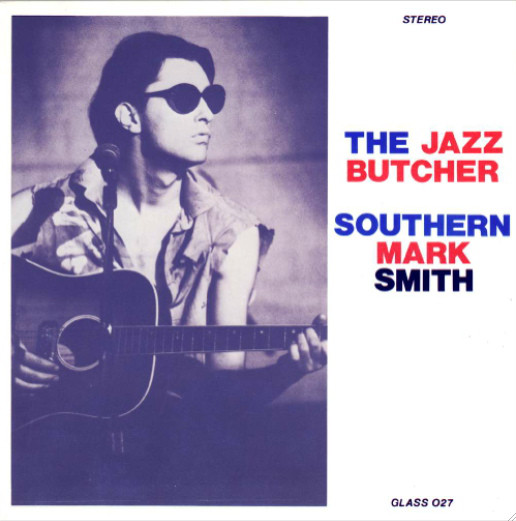
So it was with some sadness that I read about the recent death of Pat Fish, aka The Jazz Butcher. Not only was he just a few years older than me, but I’d enjoyed seeing his band play several times around London (most memorably, supporting R.E.M. in late 1985). I’d also met Pat a few times via a mutual friend, and he was always charming and entertaining.

Pat was one of the last “gentleman rock and rollers” – he wasn’t just in it for the money or glory (although both help to sustain a long music career). He was a chronicler of the absurd, the whimsical and the eccentric (in the nature of other English songwriters such as Ray Davies, Syd Barrett, Robyn Hitchcock and Julian Cope), and as epitomized by “Mr. Odd” and the self-referential “Southern Mark Smith”. Yet, despite this, he found loyal audiences across North America and Europe, where he was probably more appreciated than in the UK. (For example, a Paris-based American musician I knew at the time only became aware of The Jazz Butcher thanks to a tribute to Olaf Palme they recorded after the Swedish prime minister’s murder.)

If the calibre of a band can be measured by the songs and artists they cover, The Jazz Butcher made some interesting choices, revealing their influences and personal tastes: “Road Runner” (Jonathan Richman), “Sweet Jane” (Velvet Underground), “Take The Skinheads Bowling” (Camper Van Beethoven) and “Spooky” (Dusty Springfield). And Pat was also supportive of other bands that were associated with his home base in the East Midlands, or signed to the same labels he was. In this way, and at various times, he was connected to the likes of Bauhaus, Spacemen 3, Eyeless in Gaza, In Embrace, The Pastels, Teenage Fanclub, Bron Area and The Woodentops.

Finally, in keeping with the times, The Jazz Butcher have been the subject of a recent reissue campaign, and there may be a posthumous album released shortly.

Cheers, Pat!

Next week: Opening Up…


Telstar!

The quality of a song can often be reflected in the number and variety of cover versions it prompts. Think of tunes that have become jazz standards, or key songs like “Yesterday” or “My Way” which have become some of the most covered compositions in the pop canon. Sometimes, the original can be overshadowed by a later interpretation, to the point where it becomes the definitive recording. (For me, John Cale’s version of Leonard Cohen’s “Hallelujah” outclasses both the original and later, more popular renditions). Too often, though, cover versions are pale imitations, mere pastiche or karaoke cannon fodder for TV talent shows.

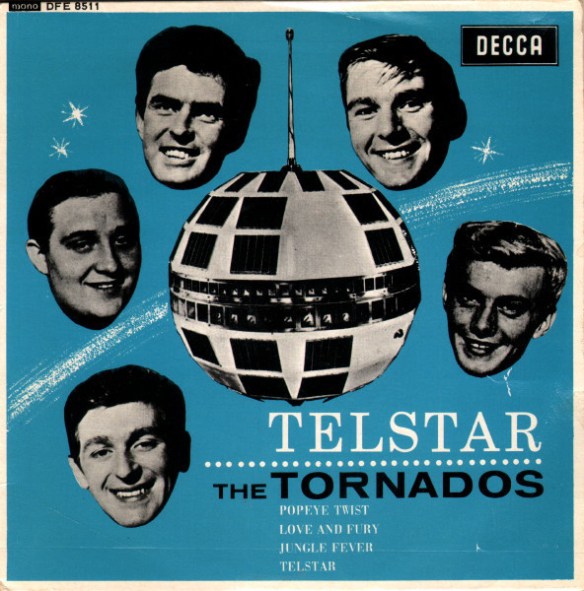
One of the first records I am conscious of hearing at home and playing on the family Dansette is “Telstar” by The Tornados (the 7″ version with the deep blue Decca label, and distinctive striped orange and white sleeve). Although the main melody is quite simple (and total ear-worm), the original 1962 version features strange noises and curious effects, while the overall instrumental tone is appropriately other-worldly. Both of its time (reflecting the emerging space age) and timeless, “Telstar” has given rise to numerous versions, and thanks to the current lock-down in Melbourne and the wonders of YouTube, last week I killed a few hours searching and compiling this playlist.

I’m sure there are many more tributes out there, but this list comprises 20 or so key recordings I came across during my internet trawl:

Chronologically, the first couple of tracks on the playlist are quite faithful renditions by The Tornados’ contemporaries, The Ventures and The Spotnicks. (Strangely, the latter put out a later, and rather pointless “updated” version.)

The record’s initial success led to a vocal version by Bobby Rydell which has a certain naive charm. This in turn inspired (directly or indirectly) a couple of wonderful European vocal recordings – by Slovenia’s Marjana Deržaj and Finland’s Laila Halme. They both stay just the right side of kitsch, and bring some unique elements of their own.

These vocal recordings are followed by a cluster of orchestral/easy listening renditions, typical of the time both in style and context: there’s Billy Vaughn‘s big band recording, featuring sax and guitar; The Hawaiians‘ exotica; and James Last‘s cheesy string arrangement. All great examples of the hits of the day played in styles to suit all tastes…

We shift gears for The Pyramid‘s ska take, followed by Al Casey‘s faithful version from the early 70’s, that features an interesting opening. Also around this time came Hot Butter‘s sanitized synths, that feels like a missed opportunity to go further out in space…

If we take “disco” to be a broad church, then the oddities by Venus Gang and Ovni would just about qualify in that category – while The Shadows‘ early 80’s take sounds like those awful Stars on 45 records.

Also in the 80’s, we find a couple of versions that are either ironic, or so post modern it hurts. The Models‘ 1981 recording attempts to add some new wave atmosphere, while Ad Infinitum‘s 1984 effort is notable for coming out on Manchester’s very hip Factory record label. (It also features a tongue-in-cheek piano bar version on the b-side.)

Finally, a couple of more recent versions that each add another dimension. First, from 1997, Takako Minekawa‘s neo-loungecore interpretation (very on message for the time), which would appeal to fans of Saint Etienne and Stereolab alike. Lastly, from 2014, Bill Frisell‘s restrained but lush slide guitar that presents a fitting tribute to this classic space age instrumental.

[“Telstar” cover versions that I wish existed: the outake from Bowie’s “Low” sessions; Kraftwerk’s 1975 sound check from London’s Festival Hall; Esquival’s bachelor pad stylings; Jacques Loussier channelling Bachian counterpoint; and Marlene Dietrich’s vocal rendition…]

Next week: Living in limbo