The “new, new normal” post-Covid-19

After the GFC of 2007-8, we were told to get used to the “new normal” – of low/slow/no growth, record-low interest rates, constant tech disruption and market dislocation as economic systems became increasingly decoupled from one another. And just as we had begun to adjust to this new reality, along comes Covid-19 and totally knocks our expectations sideways, backwards and upside down, and with it some negative long-term consequences. Welcome to the “new, new normal”.
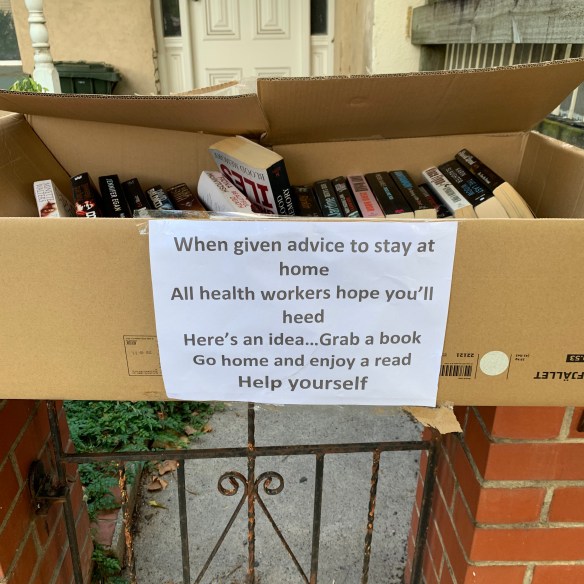
Just what the doctor ordered: “Stay home and read a book!”

In the intervening years since the GFC (and don’t those days seem positively nostalgic from our current vantage point?), we have already seen ever lower interest rates, even faster disruption in business models and services, and a gradual dismantling of the trend towards a global economy. The pre-existing geopolitical landscape has either exacerbated this situation, or has been a prime beneficiary of the dismantling of the established structures of pluralistic, secular, non-sectarian, social-democratic and liberal societies.

First, relations between the Superpowers (USA, Russia and China) have not been this bad since the Cold War. Second, nationalism has not been as rife since the 1930s. Third, political leadership has tended toward the lowest common denominator of populist sloganeering. Not to mention the rise of fundamental religious sects, doomsday cults and tribal separatist movements. Let’s agree that even before the current pandemic, our resistance was already low….

Whatever your favourite conspiracy theory on causes and cures for Covid-19, it’s increasingly apparent that populist leaders of both the left and the right will use the pandemic as vindication of their policies – increased xenophobia and tighter border controls, increased centralisation of power and resources, greater surveillance of their citizens, a heightened intolerance of political dissent, a continued distrust of globalisation, and a growing disregard for subject matter experts and data-driven analysis.
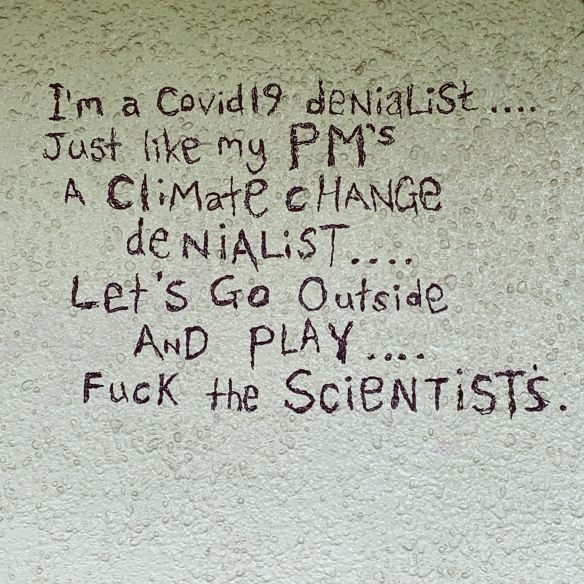
The writing’s on the wall? Message seen in East Melbourne

There are obviously some serious topics up for discussion when we get through this pandemic. Quite apart from making the right economic call (“printing money” in the form of Quantitative Easing seems the main option at the moment…), governments and central banks are going to have to come to grips with:

  • Universal Basic Income – even before Covid-19, the UBI was seen as a way to deal with reduced employment due to automation, robotics and AI – the pandemic has accelerated that debate.
  • Nationalisation – bringing essential services and infrastructure back into public ownership would suggest governments would have the resources they need at their disposal in times of crisis – but at the likely cost of economic waste and productivity inefficiencies that were the hallmark of the 1970s.
  • Inflation – as business productivity and industrial output comes back on-line, the costs of goods and services will likely increase sharply, to overcome the pandemic-induced inertia.
  • Credit Squeeze – banks were already raising lending standards under tighter prudential standards, and post-pandemic defaults will make it even harder for businesses to borrow – so whatever the central cash rates, commercial lenders will have to charge higher lending rates to maintain their minimum risk-adjusted regulatory capital and to cover possible bad debts.
  • Retooling Industry – a lot of legacy systems might not come out of the pandemic in good shape. If we have managed to survive for weeks/months on end without using certain services, or by reducing our consumption of some goods, or by finding workarounds to incumbent solutions, then unless those legacy systems and their capacity can be retooled or redeployed, we may get used to living without their products all together.
  • Communications Technology – government policy and commercial settings on internet access, mobile network capacity and general telco infrastructure will need to be reviewed in light of the work from home and remote-working experience.
  • The Surveillance State – I’m not going to buy into the whole “China-virus” narrative, but you can see how China’s deployment of facial recognition and related technology, along with their social credit system, is a tailor-made solution for enforcing individual and collective quarantine orders.

Another policy concern relates to the rate at which governments decide to relax social-distancing and other measures, ahead of either a reliable cure or a vaccine for Covid-19. Go too early, and risk a surge or second wave of infections and deaths; go too late, and economic recovery will be even further away. Plus, as soon as the lock-downs start to end, what’s the likelihood of people over-compensating after weeks and months of self-isolation, and end up going overboard with post-quarantine celebrations and social gatherings?

Next week: The lighter side of #Rona19


Fitting your own oxygen mask first

Before I get into this week’s article, I want to stress that my reason for posting it is not intended to be self-serving, or self-aggrandising – I’m fully aware of such pitfalls, as captured wonderfully in The State of LinkedIn on Twitter. Instead, I hope it’s received as an example of paying it forward. And all starts with some advice I heard a number of years ago.

My erstwhile colleague, Dale Simpson, likes to use the following analogy when coaching his clients on career development, leadership and directorship:

“Be sure to fit your own oxygen mask first”

The reason being, how can you help others if you don’t take care of your own needs first? It’s not about being selfish, but about being present and able to serve others. It also recognises that in order to be useful, we need to work from a position of stability and resilience ourselves.

Dale also likes to use Maslow’s Hierarchy of Needs in his work. Both Maslow and the oxygen mask have clearly entered my own vernacular. A couple of weeks ago, I was listening to a neighbour at my co-working space talking about the work he was trying to do to help others become more resilient and overcome trauma. As the conversation went on, it was clear that his own circumstances were challenging, due to insecure accommodation, erratic income and other factors. He had also had to overcome a great deal of adversity and other challenges in his life.

I asked him if he had heard of Maslow – he hadn’t. I suggested that he consider what his own needs were, so that he would be better able to help others. A little while later, I went back to my desk and found the above note he had left for me.

I’m sure once he manages to sort out his own circumstances, he will be a fine coach and excellent mentor, because he was very certain of his purpose – he just needed to adjust his own oxygen mask first.

Next week: Steam Radio in the Digital Age

Recap on the New Education

My series late last year on the New Education (Agility, Resilience and Curiosity) prompted several comments from friends and acquaintances, a number of whom work as teachers or in the broader education sector.

Some of the feedback expressed frustration with the rigid structure and expected learning outcomes of current curricula – some teachers feel constrained by what/how they can teach. Rather than taking into account the holistic learning needs of students, most primary, secondary and even tertiary education is fixated on quantitative results, much of it geared towards formal STEM subjects. Whereas, in early childhood education, there is more of a focus on well-being and resilience, along with core learning and life skills. (But of course, if that resilience, agility and curiosity is not re-enforced at home or sustained beyond the classroom during those formative years, it may be a wasted effort….)

No doubt STEM subjects are important (to build the core technical skills we need for the future). Just as important is the inclusion of the arts (STEAM), for without creative skills, it becomes harder to interpret and then apply our technical learning to new situations. And let’s not forget the importance of play, even in a learning environment. A friend of mine provides extra-curricula classes in coding and robotics to primary school children. She finds that once the students have grasped the basics, unless they remain curious and are willing to explore what they have learned through play, they can’t progress to adaptive tasks such as creative problem-solving or identifying bugs in their programs. So they get bored and frustrated. The situation is not helped by many parents who want to know when their 10-year old “genius” is going to get to degree level computer science….

At the other end of the age spectrum, it’s clear that if we stop learning, and if we stop being curious, our agility in adapting to the career demands of the new world of work will be seriously depleted. The need to pursue our goals, passions and interests was explored in a recent discussion about late stage career transition on ABC Radio National. A major point being that if don’t put effort into managing our career, someone else will decide our future for us. Or we end up resenting the work we do. Similarly, I get frustrated by some former colleagues, who reach out to me for advice on how they can find their next work opportunity. When I explain my own recent journey, how I participated in a number of weekend hackathons, joined various meet-up groups, and attended numerous networking events, they say things like, “That sounds like hard work” – well, of course it is, otherwise it wouldn’t be worth doing.

The final word on curiosity should go to style icon, Iris Apfel. She maintains that being curious, and having a sense of humour, are vital to our existence. In fact, she goes as far as suggesting that she doesn’t have time for people who are not curious.

Next week: Manchester, so much to answer for…


The new education #3: Curiosity

Week 3 (and final part) of “What they should be teaching at school” – Curiosity.

If curiosity is supposed to have killed the cat, then in my case, curiosity probably changed my life. Earlier in my career, I was offered the opportunity to relocate overseas. When I asked my manager why I had been chosen, he replied that I had “asked the right questions” to justify my selection. In fact, I had no idea that I was in contention for the role – I was simply interested in the new project from a business perspective. I hadn’t even considered whether I wanted the role itself – but my questioning apparently displayed the right amount of curiosity, and I was seen as the right fit for the job.

Being curious means you are less willing to simply accept something as “received wisdom”. It shows that you want to make sense of things for yourself. It helps you ask why things are done a certain way (especially if the answer is “because they’ve always been done this way…”). It demonstrates you want to find out how things work for yourself.

The downside is you may be more disbelieving, more sceptical, and prone to being suspicious. It can also mean you distrust certainty. But I would gladly take a level of ambiguity over a sense of complacency any day. A questioning nature can act as a defence mechanism against hype, cant and bullsh*t.

I hope kids learn how to take their early curiosity (and not just their knack for asking “but, why, mummy, why?”) into later life. Curiosity is how we learn to find our passions and interests outside the formal school curriculum and the set learning model. Our natural curiosity helps us to make sense of the world. I don’t think I would have developed any real critical thinking if I hadn’t strayed “off piste” and explored books that were not on the list of set texts.

Recently, I explained to a former colleague how I had participated in a number of startup and tech hackathons, even though I’m not a coder or programmer. My ex-colleague asked, almost in disbelief, “why would you do that?” Apart from being part of my journey into a new career path, my answer was simple: “Because I was curious, because I wanted to learn something, because I wanted to network and make new connections, and because I also wanted to get out of my comfort zone.”

In my view, if you stop being curious, you stop growing as a person, you stop developing your mental faculties, and metaphorically, you stop breathing.

Next week: Looking back on 6 years of blogging