My Extended Gap Year

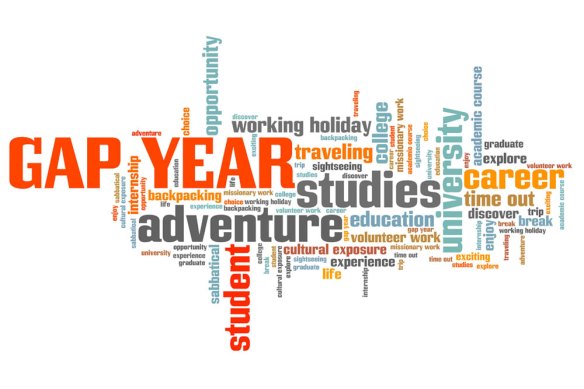
I was recently interviewed for a story about the Future of Work. One of the questions asked how I had arrived at my current portfolio career. As I reflected on the past few years of my working life, I realised that my ongoing journey resembled something of an extended gap year, because of the wide range of interests I have been exploring and the variety of projects I have been working on.

gap-year

Image sourced from Ivy League Admissions Club

During my “original” gap year between school and university, I was a postman, I volunteered at a community law centre, I worked in a bread factory, on a building site and at a law firm, and travelled abroad. My primary goals then were to get some “real” life and work experiences and think about what I might like to do as a career once I graduated. If nothing else, it showed me how to work with other people, develop some resilience and resourcefulness, and discover what I might be passionate about. And while my career went in quite a different direction to the one I had imagined, the gap year experience was an invaluable part of the learning process.

Since my last corporate gig, I have embarked on what feels to be a continuous personal development programme. Aside from undertaking some professional development, participating in hackathons, serving on advisory boards, guest blogging, co-presenting numerous radio shows, developing a prototype HR app, joining various Meetup Groups, and working with a number of startups and entrepreneurs, most recently I have been working in the digital asset space (Bitcoin, Blockchain etc.) and in innovation using design thinking and collaboration models.

As part of my extra-curricular activities, I have continued to explore various digital tools and platforms for composing, recording and distributing my music – I even wrote a piece for Melbourne’s Federation Bells which is on semi-regular rotation – and I have learned some practical skills in picture framing and constructing display boxes out of Perspex.

What this all adds up to is a continuous desire to keep learning, to keep exploring interesting stuff, maintaining a sense of curiosity and not standing still – stagnation is the death of creativity! And while I may not have imagined embarking on such a career path after working in senior corporate roles for many years, the current journey is varied, seldom boring, and frequently rewarding.

For anyone who may feel they are stuck in their current work, or cannot see where there career is going, I would encourage you to think about taking a “gap year” – to explore, experience and experiment with your career options, to challenge your current perceptions, to take yourself out of your comfort zone, and above all to embrace the potential for change. Even if this does not feel like re-inventing yourself, it should be an invigorating and rewarding experience – and I’m more than happy to share some of my own insights if you want to contact me via this blog.

Next week: Spaghetti in the Cloud


Bridging the Digital Divide

Is there still a digital divide in Australia? If so, how do we bridge that gap? If not, how do we address the apparent chasm that is leaving some “digital have-nots” behind? Is it as simple as rolling out the National Broadband Network and equipping every school child with their own tablet device? Or is it also about creating a digital mindset to ensure everyone can take advantage of the educational, social and economic opportunities that the range of digital technologies has to offer?

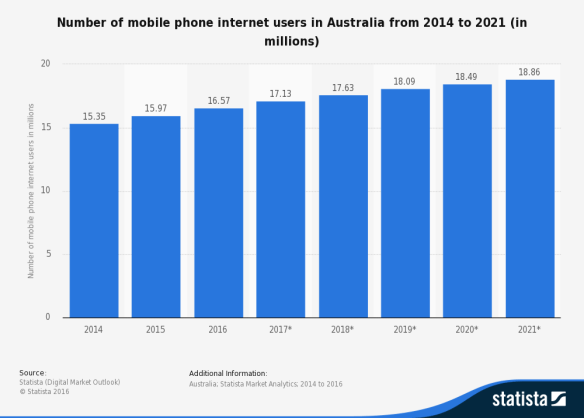
Mobile phone internet usage is projected to keep growing. Source: Statista

Mobile phone internet usage is projected to keep growing. Source: Statista

Based on consumer research, we would appear to be a well-connected country, with a high concentration of PC, smart phone and tablet devices, if data from Roy Morgan is any indicator. However, some recent research by Scott Ewing of Swinburne University based on ABS data has suggested that despite the narrowing of the divide, there is a deeper disconnect among those who do not have internet access.

There are multiple factors contributing to this disconnect: socio-economic, age, location and education. I would expect that within 5-10 years, age will be a far less relevant factor in who does or doesn’t have access to the internet. You could also argue that with more people accessing the internet via mobile devices, and with the increasing number of free WiFi zones across our cities (cafes, shopping centres, office buildings), public institutions (libraries, museums and galleries) and transport infrastructure (plus the reducing price of data and storage), cost may not be as much of an issue either. And once the NBN is complete, the percentage of the population without physical access to the internet should likewise be much smaller.

So that leaves education – according to the ABS-derived data, the more educated you are, the more likely you are to access the internet. Should this infer that we aren’t doing enough to teach digital skills in the classroom? Or are we teaching the wrong set of skills? Or is it a bit like learning English grammar or applied mathematics – unless you use them in your everyday life, you soon forget them, and never remember why it was important to learn them in first place?

Computer science, programming and coding courses are increasingly being taught in schools, either as part of the core syllabus or as extra-curricular activities. Many pupils have to use tablets as an integral part of their school lessons. And some schools are also running hackathons and entrepreneurial projects to help students navigate the new world of work shaped by innovation, digital disruption and the “gig” economy.

The changing nature of work is challenging schools and parents to think about how we should be preparing pupils for the future. It’s not just learning about the technology (important as it is to study data analytics, automation, robotics, AI etc.), it’s also about understanding the context and the potential for what it can do. It’s also increasingly apparent that more and more of today’s students want to do work that is meaningful, rewarding, challenging and which helps connect them to their values and “purpose”.

I like to think that as part of a well-rounded liberal education, today’s pupils will receive:

  • a solid grounding in digital literacy (as important and as vital as the 3 R’s)
  • an awareness of how “digital displacement” (through automation etc.) may impact their chosen career path (even in ways which we cannot yet predict – we must assume it will happen, as no profession, trade or vocation will be totally immune)
  • an appetite for lifelong learning (as one of the ways to cope with the inevitable changes they will face)
  • a set of life skills that instill self-awareness, curiosity, resilience, empathy, flexibility and adaptability.

Finally, if we are to truly grasp why this ability to adapt and change is important, we only need look beyond the digital debate and ask why the National Innovation and Science Agenda is failing to cut through. In large part, the NISA message failed to connect with the general electorate because many people could not identify with it, and therefore it did not resonate with them. Just as “necessity is the parent of invention”, so adversity often needs to be the catalyst for embracing change.

Notwithstanding the economic, environmental and societal challenges we face, there is considerable complacency and acceptance that “she’ll be right” – especially within the political, institutional and corporate elites that claim to lead us. As long as so few of the main actors among these bastions of power and influence decline to change their own culture, behaviours and ways of doing business, then it’s not surprising that the public feels unwilling or unable to change.

So our only real hope is to empower the next generations to shape their own future, not to be constrained by our traditional notions of “job” (in my view, an increasingly outmoded economic unit of value….) and think for themselves as to what change they want to create with all the technology, resources and opportunities at their disposal.

Next week: My Extended Gap Year

“Language is a virus” – a look at coding skills

We are fast-approaching the point when a lack of some basic coding skills will be likened to being illiterate. If you are unable to modify a web page or use an HTML text editor, it will be like not knowing how to create a Word document or edit a PDF file. Coding does appear on some school curricula, but it is primarily taught in the context of maths, computer programming or IT skills. Whereas, if we look at coding as a language capability (part of a new literacy), it should be seen as an essential communication tool in itself.

quote-William-S.-Burroughs-language-is-a-virus-from-outer-space-92713First, I am aware that a number of programs for children are trying to teach coding and maths in more relevant ways, and having talked to some of their creators, I admire their ambition to place these skills in a broader context. Coding might be described as the “4th R”: alongside reading, writing, arithmetic we have reasoning”. So a program like Creative Coding HK (as it name implies) focuses on students making things; in the USA, KidsLogic is placing as much emphasis on contextual learning as on robotics; while Australia’s Machinam is re-writing the maths curriculum to teach practical, everyday problem-solving skills.

Second, as we know, learning the foundations of coding is like learning the syntax of a foreign language. However, while Latin and Greek can provide the basis for learning the structure (and many words) of many European languages, it’s not much use when learning character-based languages (Chinese, Japanese) – although there are common grammatical elements. But if we understand that a line of any code has to be structured a certain way, contain essential elements, define key attributes and run in a particular sequence or order, we may come to “read” and interpret what the code is saying or doing.

As an aside, I’m struck by the comments made by the founder of AssignmentHero during a recent pitch night. Although he had studied computer sciences at Uni, he did not use any of the formal computing languages he had learned when building his product. This highlights the downside of learning specific languages, which can become obsolete, unless we have a better grasp of “which languages for which purposes”, or find ways to easily “interpolate” components of one language into another (just as languages themselves borrow from each other). Or do we need an Esperanto for coding?

Third, even if I don’t want or need to learn how to program a computer or configure an operating system, knowing how to define and sequence a set of instructions for running some software or a dedicated program will be essential as more devices become connected in the Internet of Things. For myself, I have dabbled with a simple bluetooth enabled robot (with the original Sphero), acquired a WiFi-enabled light bulb (the programmable LIFX) and experimented with an iOS music app that incorporates wearables (the MIDI-powered Auug motion synth).

Finally, just like a virus, coding is contagious – but in a good way. At a recent event on Code in the Cinema (hosted by General Assembly as part of the Melbourne International Film Festival), there were three demos which captured my attention, and which I will be investigating over the coming months:

I think they show why, where and how many of us “non-computing” types will want to learn the benefits of coding as a new language skill. If nothing else, getting comfortable with coding will help mitigate some of the risks of the “digital divide”.

Next week: The arts for art’s sake….

The Day of the Mavericks – the importance of intrapreneurship

As part of my notes on Melbourne’s recent Startup Week, I mentioned an interesting discussion on “innovation from within”, and the importance of intrapreneurship. There has been a steady stream of articles on the rise of intrapreneurship, an often overlooked skill set or resource that all organisations need to tap into, harness and deploy successfully. But what does it take to be an intrapreneur, and where can we find them?

Idea Machine - image sourced from Vocoli

Idea Machine – image sourced from Vocoli

The panel discussion on “Innovation from the inside out” was mostly about what leaders are doing to foster entrepreneurial-thinking from within their own organisations, featuring Janet Egber (NabLabs), Phil Harkness (EY), Martin Kennedy (GE) and Liza Noonan (CSIRO). Much of this effort revolves around connecting individual purpose with collective purpose (team, organisation, society). For example, at EY, there is a program to “promote purpose-led transformation, grounded in humanity and a call to action”, while GE also places importance on purpose. CSIRO, meanwhile, is clearly undergoing some huge transformational change of its own, with a key focus on “making the treasure chest of ideas happen.” (For a couple of related blogs, see here and here.)

When asked about how to incentivize intrapreneurship, and how to prioritise efforts, Liza Noonan was of the view that the “grass-roots” of the organisation “give us permission” to pursue particular projects. While Phil Harkness talked about the need to develop appropriate career paths, and the importance of change management engagement.

In my own experience, intrapreneurs are likely to display a healthy mix of the following characteristics:

Curiosity – This is critical. If you don’t display any interest in what is going on around you;  if you don’t think about how things could be done differently, better or more effectively; or if you don’t care about how things work, you are unlikely to discover anything new or uncover new business opportunities. This is not only about formal technical skills, this is also about personal outlook. It’s not intended to be disruptive, but maverick thinking is often what gets results.

Creativity – While I am not a big fan of formulaic management methodologies, I do see some value in certain aspects of the Six Hats model – of which Green for Creative Thinking is key here. As well as being a vital part of ideation and innovation, having a creative mindset (coupled with innate curiosity) is essential to problem solving – especially when it comes to “what if?” scenarios, and joining the dots between seemingly disparate data.

Commercial – Intrapreneurs don’t need to be financial wizards, or be the best sales people – but they need to be grounded in the commercial realities of how businesses work, how markets develop, what customers think, and what it takes to launch a new product or service. Being open and receptive to customer feedback is essential, along with an ability to manage solution sales and consultative selling.

Uncertainty – Being comfortable with uncertainty, and learning to be resilient, flexible and adaptive are essential to the intrapreneurial mindset. This may include a different approach to risk/reward models, as well as being able to look beyond the normal business plan cycle into the “unknown” of the future.

Scepticism – Having a healthy degree of doubt and not falling prey to over-optimism can help to manage expectations and enthusiasm built on irrational exuberance. We know most new ideas never get off the whiteboard (which is OK!), so the skill is to challenge everything until proven, but in a constructive, pro-active and collaborative way.

The key to intrapreneurship is being able to find your role or niche in the organisation, from where you can develop your expertise, establish your influence and build a foundation for solid outcomes. While at times it can feel a bit like “right person, right place, right time”, there are strategic steps you can take to manage your own career as an intraprenuer, including networking, self-directed learning, volunteering for new projects and taking responsibility for fixing things when they go wrong, even if they are outside your immediate responsibilities. It’s these sorts of behaviours that get noticed.

I know from personal experience that being curious and asking the right questions can lead to exciting new opportunities (in my case, six years in Hong Kong to establish a greenfield business). I also value the advice of a senior colleague soon after I joined an organisation: “You need to be part of the solution, not be part of the problem” when it comes to organisational change. And some of the best indirect feedback I ever received was from a colleague who introduced me to a new hire: “This is Rory, he’s our lateral thinker”.

Finally, it’s not always easy or comfortable to challenge the status quo from within (which is what a lot of intrapreneurship involves). Intrapreneurship can also feel lonely at times, which is why it’s vital to make the right connections and build sustainable relationships because, in army terms, you don’t want to get a reputation for being part of the “awkward squad”.

Next week: “Language is a virus” – a look at coding skills