4 more #startup hopefuls pitch at Startup Victoria

Is it just me, or are we seeing more and more B2B startups and 2-sided market makers, rather than consumer/retail opportunities? Based on the latest pitch night hosted by Startup Victoria it feels like B2C and “pure” app plays are in the minority. (Enterprise solutions are gaining traction, especially among portfolio companies.) Of the four latest hopefuls that pitched at inspire9, half were straight B2B, the other half were aiming at 2-sided markets.

Screen Shot 2016-04-11 at 11.16.52 AMFirst, I should declare that I know one of the teams who pitched, and I also know one of the advisors working with the other startups. But I have not let that influence my comments.

Second, the comments are taken from my contemporaneous notes, and appear in the order in which the teams pitched. That way, I hope to convey more accurately how the night evolved from the spectator’s point of view.

Third, the format was as follows: pitch, followed by comments and questions from the panel of judges, plus if time permitted, some audience Q&A – all ably compered by Monsieur French.

Pundit Connect

The goal is to streamline the recruitment of professional consultants. Currently at the pre-commercialisation stage. Building a 2-sided digital market place – a platform for posting project briefs and allowing consultants to bid on them.

Part of the current challenge is the lack of transparency/visibility on new projects – but there is also a lack of trust online.

Platform components include:

  • Member Connect – P2P, nested, trusted networks, with a particular focus on local government and local procurement (they see a growing need among regional economies)
  • Pundit Score – ranking tool built with help from Deakin University
  • Professional Services market place
  • Revenue model – subscriptions, fee for service, commission, data sales
  • LinkedIn integration – including individual consultant accounts

When asked about building critical mass, the team pointed to the fact that they are seeing 3 or more quotes for some projects posted in the market.

There was a suggestion that the platform could be reverse engineered, to enable clients to target niche talent, plus an option to work with professional associations.

When asked about Expert360, they felt it’s not really a competitor.

Angel Auctions

To paraphrase, this is like “Gumtree with a social conscience“. People can sell unwanted items online, the proceeds are donated to a charity of their choice, and the seller can claim a tax deduction against their donation. Meanwhile the site deducts a commission before distributing the proceeds to the charities.

The so-called “parallel economy” (charities and NFP) is considerable – 55,000 entities with DGR status, and 600,000 registered NFPs: 9 new charities are registered each day in Australia.

The “alternative” options for fund-raising are spam, telemarketing or street sign-ups.

Angel Auctions provides a private branded application for each charity. However, despite some active charity partners who have already signed up, the platform needs both traction and critical mass to develop multiple single-sided markets.

Meanwhile, there is some controlled leakage to aggregate auction sites.

The judges were somewhat critical of the relatively high commission rate – what value does this represent? They also asked about the integration with social media, and were probably a bit concerned by the team strength – it was clear this is something of a personal pet project.

When asked about the seller’s eligibility for a tax deduction, apparently there is an ATO ruling that the sale proceeds are treated as cash when donated by the seller. There was also a related question about transaction verification which I’m not sure was fully addressed.

Product Lighthouse

This is a content management and distribution platform for product information. It’s designed to make product info more accessible – content which is the lifeblood of consumer electronics retailing between manufacturers and retailers.

Currently, content is managed and posted manually, leading to data inconsistencies, errors, and inefficient distribution. According to the team, their “unified approach works for all”. They plan to further monetize the business (“pay to publish” model?) and add value through a standardised CMS and distribution platform. In particular, they are reducing the  time to load individual SKUs onto the system.

One of the key universal benefits to equipment manufacturers, distributors, wholesalers and retail clients is the accuracy and integrity of the data input loaded by manufacturers, a process which will increasingly be automated and backed by a data dictionary.

So far, The Good Guys are using the platform as a channel to market, and Samsung is starting to load inventory.

Currently seeking capital of $300k.

The judges wanted to know more about the customer discovery process, and felt that the pitch perhaps contained too much information. In response, the team said their focus was  based on actual industry experience and the known need.

MyMic

This is an app/software solution that turns smart phones into live communication devices at events, such as conferences and seminars.

Born out of necessity, the team has addressed the “dilemma of the last mile of delivery”. Anyone with the app loaded onto their smart phone and a connection to the event’s PA system running the installation can submit content via their device. (Apparently, audio-visual can represent up to 40% of event costs.)

The app can be used to broadcast live voice, capture text and comments, as well as audience polling. The system is platform agnostic, and the IP is being registered.

Asked about monetizing the technology, the team are proposing a mix of per event, per month and per user licensing models. At this stage, the product is still in beta, but the team were alert to the opportunities in Asia. (Sadly, due to the Pitch Night’s “No demo” rule, we were unable to see the system in action. Pity!)

Finally, there were some technical questions on latency and live operation. It can run on a WiFi network, and can be controlled by a moderator. Other connectivity options may be available, including Bluetooth and wireless.

Later, as part of an open Q&A with the audience and the teams, the judges gave some general feedback to the teams:

  • focus on a single purpose or proposition;
  • don’t forget to introduce yourselves properly;
  • get appropriate tech skills on the team; and
  • be positive (as well as authentic)

On the night, Pundit Connect came first based on audience votes.

Next week: “I’m reframing, the situation….”
Making the most of the moment…

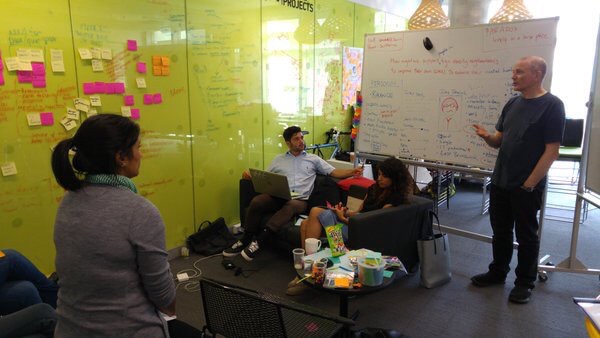
I’m the first to admit that I am not very good at practising meditation. It’s not that I don’t aspire to a state of mindfulness, but I sometimes find it hard to “be in the moment”. It does not come easily or naturally to me, because I’m often too busy thinking about the objective context, rather than the subjective conscious experience. So it was really interesting to see this photo of myself at last weekend’s Global Service Jam, organised by the Melbourne Jam Team at Swinburne Design Factory, and supported by Deloitte Digital, the School of Design Thinking and Huddle.

“This is where the magic happens…” (Photo by Johan Pang – image sourced from Twitter)

This photo was probably taken about halfway through the 48-hour event. Our team had got to the stage where we had articulated our problem statement (after much ideation…), scoped a solution model, done some validation through research and field interviews, and refined our key persona, all supported by some feedback from role-play and scenario testing. We had also just completed a lightning prototyping workshop, so the team needed to decide the overall form of our proposed service design solution, and reach agreement on the presentation format. Although there was so much still to do, we were at risk of revisiting things that had already been decided, because it felt like there was some remaining uncertainty about our prototype and some of the choices we had made along the way.

I don’t recall the exact “moment” (how imprecise a measure of time is that word?) but without realising it I found myself almost urging the team to stick with our existing decisions, and work through the remaining tasks based on the information we had to hand. It was a subconscious reaction to the message we had been given in the prototyping workshop about making decisions based on “the authority of the moment”. (Thank you, Rez Ntoumos!)

Sure, we weren’t having to make split-second, life-or-death decisions under enormous pressure, but if there was any “magic” here, it was probably about being able to be in the zone – the willingness to submit to the situation, to go with the flow. Throughout the weekend, we were advised not to fall in love with a particular idea or solution, but at the same time we were encouraged to get behind the team decisions and the options we chose – partly to sustain momentum, and partly to make sure we met the project deadlines!

There is a huge lesson here, because it goes some way to addressing the dilemma that many organisations face in making and implementing decisions (be they boards, policy makers, executive teams, startups, project managers, entrepreneurs, product developers or designers….). While it’s important to have robust decision-making processes, and it’s vital to consider all available data, the quality of any decision may not rest on whether it was the “best” choice to make, because usually only the benefit of hindsight can tell you that. If, however, at the time, it seemed like the right or appropriate choice, then in that moment it has to be the best-available decision.

Of course, there needs to be governance, transparency, authority and information to support, justify and legitimise the decision. Good decisions are usually those which can be fully articulated, the reasons easily communicated, and the implications clearly understood. Then once a choice has been made, the organisation or team that gets right behind the decision is more likely to succeed in the execution. All organisations at some point make “bad” decisions or inappropriate choices, but I think more often, even good decisions can suffer through poor implementation.

I acknowledge the need to get better at meditating, to enhance mindfulness for both personal reflection and clarity of thinking. Above all I recognise the enormous value of making the most of the moment when it comes to decision-making.

Next week: Startup Victoria’s latest pitch night

ANZ’s new CEO on #FinTech, CX and #digital disruption – 10 Key Takeaways

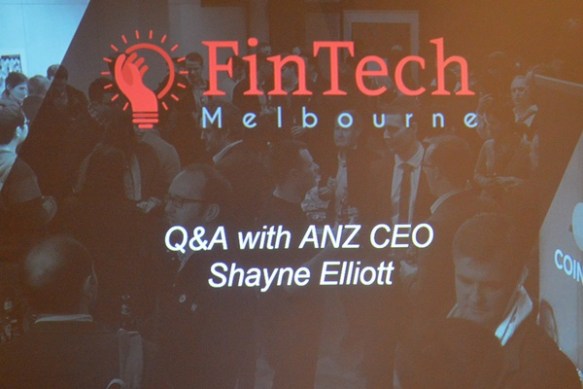
I went to the recent Q&A with the new CEO of ANZ, Shayne Elliott, organised by FinTech Melbourne. It was the first public speaking appearance by Shayne since becoming CEO (excluding his gig at the Australian Tennis Open), and followed a similar event last year with Patrick Maes, the bank’s CTO.

600_446693337The key themes were:

  1. Improving the customer experience (CX) is paramount
  2. Maintaining the high level of trust customers place in their banks is key
  3. Being aware of FinTech disruption is important, but remaining focused on core strategy is even more important
  4. FinTech can coexist with traditional banks, but the latter will win out in the end
  5. The bigger opportunity for FinTech is probably in SME solutions, rather than B2C
  6. Increased process automation is in support of CX, not about reducing headcount
  7. Big data and customer analytics are all very well, but have to drive CX outcomes
  8. Customers still see the relationship with their main financial institution in terms of basic transaction accounts, which is why payment solutions (a high volume/low margin activity) are vital to the banks’ sustainability
  9. ANZ is about to appoint a head of digital banking who will report direct to the CEO
  10. ANZ has been rated as one of the top global banks in terms of its use of Twitter and social media (but from what I have seen, much of the Big 4 banks’ social media presence can be attributed to their sports sponsorship…)

There was also some discussion around ANZ’s Asian strategy, and the statement last year that the “new” strategy is about becoming a digital bank. Shayne was quick to point out that they are not abandoning the Asian strategy (it’s not either/or) but because they embarked on Asia 8 years ago, most of the work has been done. Now they need to consolidate and expand the platform they have built. He also placed ANZ’s Australian business as being a comparatively small part of the group’s portfolio, and also took the view that despite ANZ’s size, resources and reach, digital products have to be developed market by market – it’s not a one size fits all approach. (Several FinTech founders in the audience took a very different perspective on this.)

And, in a bid to appear entirely approachable, both Shayne and Patrick were happy for people to contact them direct by e-mail… So if any budding FinTech founders have an idea to pitch to a major bank, you know who to contact.

Next week: Making the most of the moment…

Technology vs The Human Factor

Several times over the past month I have been reminded that the pursuit of technology for its own sake can give rise to misguided innovation; so-called solutions that are divorced from real world problems cannot justify the effort or resources. It feels like we are entering a new phase of the post-industrial revolution era, where a lack of “the human touch” will render many new inventions as worthless, irrelevant or redundant.

Street scultpure, Nagoya. Photo © Rory Manchee (all rights reserved)

Street sculpture, Nagoya. Photo © Rory Manchee (all rights reserved)

In no particular order:

  • At the second Above All Human conference in Melbourne, there was a consistent theme: how do we make sure there is a real connection between human needs and bleeding edge technology?
  • A Slow School of Business excursion to an eco-friendly homestead in rural Victoria offered a practical lesson on how to create harmony between technology and nature, and still achieve a modern (but modest), highly personal and comfortable home.
  • The economic debate about whether technology is improving our standard of living (as reported in the latest CPA magazine), which also echoes a recent CEDA report on automation and the implications for job losses.
  • A Q&A with Shayne Elliott, the new CEO of ANZ Bank, which prompted the observation that big data analytics, process automation and digital disruption are all very well, but will prove meaningless unless they can improve the customer experience. (But Elliott also conceded that the likes of Uber and Airbnb have succeeded because of complacency among industry incumbents.)

Advances in technology don’t have to lead us to the dystopian worlds of “Modern Times” or “Metropolis” (or any of the other post-apocalyptic visions that cinema and literature like to give us). However, the understandable focus on innovation must take the “human factor” into greater account when making design decisions, undertaking cost-benefit analysis and opting for one technology format over another.

Conclusion? It’s not totally clear whether we are entering another dot.com market correction, but there is a case to be made for whether or not we are seeing enough of a “technology dividend” from the current digital disruption and economic displacement centred on the use of cloud, social and mobile platforms; and whether we need a new methodology to measure the impact of the Internet of Things, robotics, AI, nano-technology, AR/VR, cognitive apps, wearables, 3-D printing, etc.

Next week: It’s never too late to change….