Token Summit II San Francisco

While in the US this month, I attended Token Summit II in San Francisco, courtesy of Techemy, the parent company of Brave New Coin.

Apart from Bitcoin’s latest all-time highs (and of course, CryptoKitties), the main topics on Blockchain solutions, cryptocurrency trading, token issuance programs and digital asset management were:

Governance – bringing transparency, oversight and standards
Scalability – how to grow the technology in a sustainable way
Interoperability – compatibility and connectivity between chains
Regulation – especially of securities as tokens, and vice versa
Decentralized exchanges – making P2P trading truly viable
Metronome – the “first cross-blockchain cryptocurrency”
Messari – “EDGAR for cryptocurrencies”
Transaction computation vs verification – getting the balance/distinction right
Custody – what the institutional markets are looking for in this new asset class

Demonstrating the demand for access to industry thought leaders and information about the best and brightest projects, Token Summit could have filled a venue twice the size – a growth trajectory befitting the asset class.

Next week: MoMA vs SFMOMA


Consensus: Invest and Blockchain Expo

This week, some brief notes from the USA, where I am currently attending some blockchain and cryptocurrency events, courtesy of the team at Brave New Coin.

The first event was Consensus: Invest in New York. As one of my colleagues commented, every person and their lawyer seems to be doing an ICO – even while in the washroom, a hopeful issuer tried shoving a pitch deck into his free hand. This despite the ongoing regulatory questions surrounding, and noticeable investor indifference towards, some of these token sales.

The CME was prominent among the exhibitors, given their forthcoming Bitcoin futures. Not to be left out, NASDAQ managed to generate some noise in the Wall Street Journal about their own proposed Bitcoin derivatives. Separately, Bitcoin itself attracted headlines in the Journal and the Financial Times – on the back of fresh new trading highs.

Other exhibitors comprised cryptocurrency research providers and custodian services. More evidence that this new asset class is entering a new phase of maturity.

Across the country, in Silicon Valley, Blockchain Expo put on a major trade show and conference, in conjunction with the IoT and AI Expos. (If a similar event had been held say, 20-25 years ago, instead of Blockchain, IoT and AI the themes might have been servers, network connectivity and desktop productivity tools.)

A number of upcoming ICOs gamely pitched their wares, while several new flavours of distributed ledger projects were on display. Several of the latter claim to be addressing issues of scaling, interoperability and security – all topics that continue to keep blockchain experts busy.

Of course, in common with other FinTech and startup events of late, there was the usual smattering of presentations aiming to leverage AI, peer-to-peer, big data, distributed technologies, machine learning and decentralized solutions.

Next week: Token Summit II San Francisco


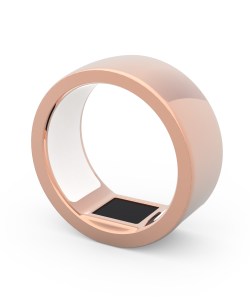
Token ring – a digital ID solution

The latest event organized by DIG ID (the Melbourne Digital Identity Meetup) featured a Q&A with Steve Shapiro, CTO of Token, moderated by Alan Tsen, General Manager of Stone & Chalk Melbourne. Given the current level of interest in solutions to address online fraud, ID theft, data protection, privacy and personal security, the discussion covered a lot of conceptual and technical topics in a short space of time, so here are some of the key points.

First off, Steve spoke about his start-up and tech journey, that took him from IM (Digsby, Tagged, Bloomberg IB), to cryptocurrency and digital wallets (Case), to digital ID with the Token ring. The pivot towards an ID solution came about after working on Case, where he realized that most consumers don’t understand private key management and the issue of permanence (as compared to the internet, where password re-sets are relatively easy, and often regularly enforced upon users).

If the goal is to provide fool-proof but highly secure end-user authentication, the solution has to focus on the “signing device”, by making it much easier than the status quo. Hence the combination of two-factor authentication (2FA) and bio-metrics to enable Token ring users to live key-less, card-less and cashless, and without having to constantly remember and update passwords. In short, the Token ring works with anything contactless, as long as the relevant permission/authentication protocol layer (challenge and response process) is compatible with the ring’s circuitry.

In assessing the downside risk, gaining consumer adoption is critical, to ensure that users see the benefits of the convenience combined with the credentialing power. Equally, success will depend on the ability to scale as a hardware manufacturer, and the potential to drive traction through virality.

There is still a lot of design work to do on the hardware itself (to enable assembly, customization and distribution as locally as possible). And the platform needs to bring on more partner protocols, especially in key verticals. At the end of the day, this is still a Blockchain solution, with a UX layer for the cryptographic component.

When asked about the future of ID, Steve felt that in the medium term, consumers will no longer have to carry around multiple cards or have to remember multiple passwords. Longer term, governments will no longer be the central authority on managing ID: unlike today, a driver’s license will no longer be the gold standard – instead, solutions will be based on decentralized, contextualized and user-defined ID.

This led to a discussion about Sovereign IDe-government and digital citizenship (e.g., Dubai and Estonia) – and the break up of big government in favour of more city-states. (Which could result either in a “small is beautiful” approach to self-governing and sustainable communities, or a dystopian nightmare of human geo-blocking, as in a film like “Code 46”).

For the tech buffs, the Token ring’s IC hosts a total of 84 components, including the main secure element (as with mobile phones and other devices), finger print reader, optical scan, Bluetooth, NFC, accelerometer, MCU, Custom inductive charging etc.

Finally, there was a discussion about the risk of cloning, mimicking or breaching the unique and secure ID attributes embedded in each Token ring. While it is possible for users to encrypt other knowledge components as part of their individual access verification and authentication (e.g., hand gestures), there is still a need to rely upon trusted manufacturers not to corrupt or compromise the secure layer. And while the public keys to core protocols (such as credit cards and swipe cards) are maintained by the protocol owners themselves and not stored on the device or on Token’s servers, it will be possible for other third parties to on-board their own protocols via a SDK.

Next week: Startup Vic’s EdTech Pitch Night


Bitcoin – Big In Japan

I spent the past week in Tokyo on behalf of Brave New Coin, meeting with various participants in the cryptocurrency industry – from exchanges to brokers, from industry bodies to information vendors, from connectivity providers to technology platforms. Given its share of Bitcoin trading volumes, and the legal developments currently in motion, Japan is now the focus of attention as it navigates towards a fully regulated and orderly cryptocurrency market.
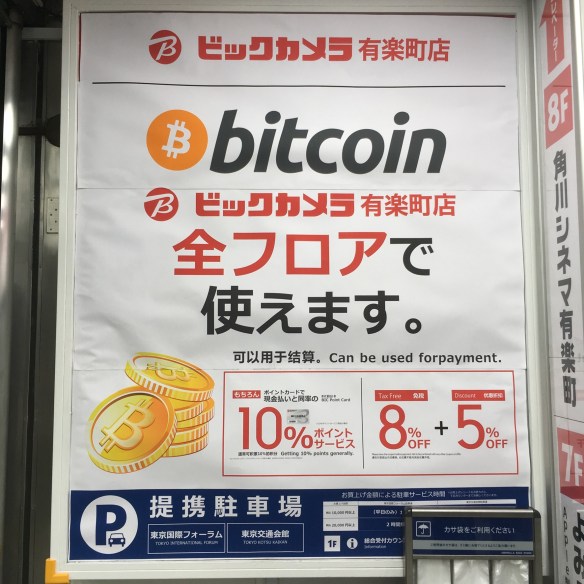
Bitcoin is now accepted in Bic Camera stores in Japan (Photo: Rory Manchee – all rights reserved)

On my previous visit to Japan, I commented on the extent to which it was still a cash economy – even major museums and galleries don’t accept plastic, and my pre-paid foreign currency card issued by a major Australian bank was only accepted at a limited number of ATMs: 7-Eleven, and Japan Post. But according to expats I spoke to last week, this situation has changed over the past couple of years.

One of the reasons I was given as to why Japan is taking a lead in regulating cryptocurrencies is its previous perception of having a somewhat lax approach to money laundering. Part of this might be explained by the limited technical integration and interoperability with the global banking system (somewhat akin to Japan’s approach to telecoms, where in the past, it was impossible for overseas visitors to use their mobile phones on the domestic network).

In addition, as China has cracked down on most things crypto, so has Bitcoin trading activity shifted to Japan. This growth in Bitcoin trading volumes can also be linked to Japan’s passion for retail forex trading, now expanding into crypto.

Earlier this year, the Japanese government passed legislation that recognises bitcoin as a legal form of payment. (Note: this does not mean that bitcoin is legal tender – shops do not have to accept it; but if they choose to take it as payment for goods and services, then it is no different to paying in cash or by credit card when it comes to things like consumer rights, for example.)

Later this month, the main regulator, the FSA is expected to announce new regulations to govern cryptocurrency exchanges and brokers. Currently, exchanges that accept Yen deposits for cash trading of crypto must be licensed as payment institutions. By the end of March 2018, my understanding is that all exchanges and brokers must be fully licensed to operate – for both cash trading, and futures and margin trading. Anywhere between 20 and 50 exchanges have applied for a license.

Currently, participants in the “legacy” securities and futures industry are either registered with the JSDA or the FFA. Likewise, it is expected that the FSA will appoint a similar self-regulating entity to have official oversight of the cryptocurrency markets, under the overarching authority of the FSA. However, there are two rival blockchain and cryptocurrency industry associations that are vying for this role – which is where things become a little political. One group claims to represent the “pure” crypto world, whereas the other might be seen to represent more of the traditional market. No doubt the FSA would prefer not to have to choose…

Key considerations for the FSA are retail investor protection, and market stability. The total market cap of all cryptocurrencies is now around US$150bn. If we assume that 10% of these assets are held in Japan, when compared to the total capitalisation of the cryptocurrency exchanges themselves, this creates a significant risk for the FSA should there be a market collapse or a run on Yen-based crypto deposits.

Equally, the FSA does not want to stifle innovation in an area of financial services where Japan is keen to take the lead. For example, Japan has witnessed a couple of bitcoin-denominated corporate bonds (more like privately syndicated short-term commercial paper) that demonstrate an investor appetite for this new asset class.

Meanwhile, in preparation for this new regulatory environment, and in anticipation of the increased interest by major banks and asset managers, there is a project underway to create an institutional-strength order management platform connecting banks, brokers and exchanges. I also heard of offshore fund managers looking to launch a crypto-based ETF for distribution in Japan.

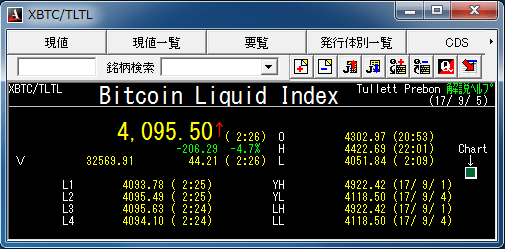
Finally, at the risk of blowing our own trumpet, Japan’s leading financial vendor, Quick is now quoting the Bitcoin Liquid Index (BLX) alongside other FX data it distributes from around the world:
 

NOTE: The comments above are made in a purely personal capacity, and do not purport to represent the views of Brave New Coin, its clients or any other organisations I work with. These comments are intended as opinion only and should not be construed as financial advice.

Next week: Tech, Travel and Tourism