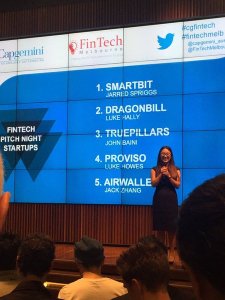
The latest FinTech Melbourne meetup event was the second of their pitch nights. Co-hosted by NAB (at their Docklands Arena venue) and Capgemini (who were promoting the World Retail Banking Report 2016), the pitches were preceded by a panel discussion on a regulatory sandbox for Fintech startups.
The panel was composed of
Ben Heap from
H2 Ventures,
Deborah Ralston from the Australian Centre for Financial Services (who is also the inaugural Chair of ASIC’s Digital Finance Advisory Committee),
Sudhir Pai (CTO at Capgemini), and NAB’s
Todd Reichmann. This is a topic that FinTech Melbourne has aired
before, but it seems
despite much industry anticipation and some
cautiously positive noises from government, bureaucrats and regulators, there are still, to date,
no concrete developments or proposals.
I fully understand the need for formal regulation in financial services, and FinTech in particular, to support investor protection, foster market confidence and maintain industry stability. But the cost or burden of compliance can act as an inhibitor for innovation and entrepreneurship. And of course, regulation and compliance are no guarantees that nothing will ever go wrong, even among our established and highly regulated financial institutions. The debate needs to move on to some practical solutions – such as ring-fencing FinTech startups so that they can trial new products and services in the market, within a limited, defined and narrowly permitted scope and range of activity, under some sort of provisional permit prior to obtaining fully licensed status.
Some members of the panel were in favour of a principles-based regulatory framework (e.g., focus on outcomes and intentions, rather than a reductive model, where nothing is allowed unless it is expressly permitted). The problem with this is that the industry already has to work within a very broad definition of what constitutes “financial advice” that is subject to regulation. So there needs to be a further re-think about what “financial advice” means, especially as between retail, sophisticated and institutional investors; and in turn, I see an opportunity for a more variegated approach to licensing or regulating different advice models: e.g., face-to-face and custom financial planning; scaled and personalised robo-advice; or broader, generalised “class” or “category” advice (by product, platform or service type). (Analagous models to draw on already exist in the areas of therapeutic goods licensing and food labelling measures.)
The panel also thought that partnerships between FinTech startups and established licensees offer one way to navigate the regulatory regime. And I can see that the right type of roboadvice could bring truly independent and objective financial advice on product and brand selection.
There was also a suggestion that the sandbox model could act as an umbrella entity for FinTech innovation. While there may be some merit in the idea (e.g., for regulating the API’s that provide access to customer financial data and credit history – although these should already be adequately covered by data protection and privacy requirements), I am sceptical of regulators’ ability to innovate. Plus, the key retail investor failures during the GFC were about investor ignorance, not just “poor”advice; so the need for financial literacy cannot be overstated.
On to the pitches themselves, which were judged by Ben Heap, Deborah Ralston and Rohen Sood from Reinventure:
Offering an automated finance layer for the Internet of Things, Smartbit has already built a secure, Blockchain-backed price index. The goal is to enable automated, real-time payments, between any two devices connected to the internet. They see themselves as the “Blockchain of Things”, and proceeded to give a cute (if somewhat pointless?) live demo of switching on a LIFX bulb with a Bitcoin payment token.
The judges were curious to know what the actual use case was (apart from turning on light bulbs…). In reply, they were told that Smartbit can deliver real-time settlement (unlike the 15 minutes delay of an US competitor), and is designed to support micropayments. Personally, I think the technology is already proven, but the need less so, at least from a B2C perspective. The fact that so many banks, exchanges and clearing houses are exploring Blockchain solutions means that it’s day will soon come when it is not just a “Bitcoin thing”, but will be an integral part of financial services, data solutions and digital asset management.*
This is a smart payments platform to reduce cashflow stress. The main benefit is to shorten the time SME’s have to wait before they get paid. It offers both a secured payment facility (escrow), and an express payment option (e.g., a tradie can get paid as soon as they finish a job).
The chosen paths to market are social media, accountants, business advisors and mentors, and (unusually?) sports clubs. But it becomes clearer when you consider that clubs need to manage multiple, small membership payments; and many members of sports clubs are SME owners, independent tradies and sole proprietors. Dragonbill are also setting up a partnership with Xero accounting software.
The main questions from the judges concerned the ability to scale the business, and whether Dragonbill generates interest on amounts in escrow.
Another version of the peer-to-peer lending platform for SME borrowers, the business model is based on an online auction system where, for as little as a $50 bid, investors can bid on specific loan requests, with risk-adjusted interest rates, that are also determined by the number and amount of competing bids.
Access to traditional SME loans under $500k is increasingly limited as banks need to allocate more risk-weighted regulatory capital to cover their SME exposures, making them an inefficient and expensive use of bank capital.
The Truepillars platform offers borrower and investor dashboards for tracking and portfolio reporting, but the panel were worried that it wasn’t a unique proposition. However, unlike some of their competitors, Truepillars offers loan terms out to 5 years. It would also be interesting if investors (lenders) could build proper fixed income portfolios (by loan duration, yield curve, exposure type, recourse/rollover etc.), and if borrowers could cap the number of, and limit their exposure to, individual bids or lenders/borrowers.
Claiming to be transforming lending, Proviso work with lenders to streamline the submission of borrowers’ financial data and bank statements in support of their loan applications. The prospective borrower logs into their account and gives permission for the lender to access their banking information, but Proviso does not “see”, hold or store the customer data – it merely acts as a pass-through. The goal is to reduce borrower application abandonment, and the service is already being used by 180 financial institutions – generating 60,000 requests per month. The business is being driven by enhanced customer experience, and ASIC directives on more prudent lending processes. In short, they claim to offer better, faster data.
The judges wanted to know how Proviso compares to Yodlee: “we’re local, and less painful to use” was the response – meaning that proximity offers speed and local market knowledge. Finding a market among non-conforming customers, Proviso is also looking at providing validation services. But in my mind, there is a risk that Proviso could be displaced by an industry-owned or regulatory mandated platform or utility (such as the creation of PEXA for real estate conveyancing and settlement.)
With a tag line, “cross-border payments made easy“, this another solution aiming to transfer money between people, regardless of location, bank, currency, etc. Currently, Airwallex is focussing on Asia Pacific, and is the only Australian holder of a cross-border license to transact in Chinese RMB. It has also integrated with the three largest payment platforms in China – AliPay, WeChatPay and UnionPay, and built an API for e-commerce solutions. Airwallex claims to be faster, cheaper and simpler than the competition, using real-time FX rates.
The panel was naturally curious about how the platform is addressing anti-money laundering concerns and complying with counter-terrorism legislation. In order to offer lower fees than PayPal, and by only taking fees from the FX spreads, Airwallex has to automate the transaction process to achieve mid-market prices – but does the increased automation heighten the risk that the platform can be used for nefarious purposes?
After their deliberations, the judges declared Proviso as the winner – hard to argue with that sort of market traction.
*Note: Declaration of interest – I have recently joined the team at Brave New Coin, a FinTech building market data and infrastructure solutions for Bitcoin and Blockchain.
Next week: #StartupVic showcases the next batch of startup hopefuls
 The summit was programmed around key FinTech themes of payment services, alternative funding, robo-advice, Blockchain, data and regulation. Participation by some key industry figures from Asia, Europe and the USA (both founders and investors) also provided some international perspective.