Ballarat International Foto Biennale (BIFB)

This past weekend saw the opening of the 10th Ballarat Internationale Foto Biennale. The overarching theme this year is “The Real Thing”, recognising the impact that digital, AI, NFTs and image manipulation are having on the visual arts in general, and the photographic medium in particular.

The highlight of the first weekend was the keynote presentation by Platon, one of the most high-profile and prolific portrait photographers of our age, famous for his images of political figures, popular icons, and social activists. Given that Platon works mostly with traditional 35mm film and captures living subjects, his work certainly deals with the “real” thing.

At the end of the first day, visitors were also treated to a Victorian magic lantern presentation, combining authentic analog apparatus, multi-media components and live performance. For audiences of the day, such events would have been their first encounter with moving images and projections – which we take for granted in our screen-obsessed culture.

As with any festival on this scale and duration, there is a wide range of work on display. This is especially so outside the Core Program, with the Outdoor and Open Programs taking on the challenging task of representing different aesthetics, styles, techniques, subject matter, and as such they reflect varying levels of quality and competence.

It wasn’t possible to see all of the exhibitions in the first two days – and some works don’t go on display until later in the program – but for me, the highlights beyond the major Platon show included: Stephen Dupont‘s happy accidents; Jon Setter‘s stunning abstract images of Ballarat; several of the works by regional photographers curated by Jeff Moorfoot; the scattered works by the Oculi Collective; and the display presented by the Australian Association of Street Photographers Inc.

Some exhibitions were less successful: I really wanted to engage with William Yang‘s work, but the unfocused curation and haphazard presentation undermined any appreciation of the images and their underlying narrative; Erik Johansson‘s highly stylised images are humorous and surreal, but they can also come across as very superficial, so we are left marvelling at the surface technique rather than any depth behind the work; and while it was nice to see some of Andy Warhol‘s original Polaroids, they were presented with very limited context, as if they were an afterthought (the fact that they are probably the earliest works in the whole festival may have something to do with them feeling out of place, as well as out of time).

It is easy to see how some photographers could get constrained, either by their subject matter, or by their technique. Working with self-imposed limitations should be positive. Using fewer tools can drive creativity (“less is more”). Having less time can result in better outcomes (“the first take is usually the best take”). Innovation comes from exploring our curiosity. Inventiveness is the result of challenging ourselves through problem-solving. However, an artist can reveal themselves to be a one-trick pony, or their technical expertise overwhelms the output (“form over substance”). Sometimes, the narrative or subject matter is more important than the quality of the image, but just as a crappy technique can impair a great image, a perfect technique cannot compensate for a poor composition.

The notion of “reality” prompts us to consider what is a photograph? The fact that most modern photos are captured on a smart phone rather then a camera simply confirms that not all photographic images need to be created using a dedicated physical device (think of photograms). And since most photos are digital rather than on film means we are not limited to think of photography as a combination of manual, chemical and mechanical processes.

However, some of the work on display does challenge the definition of “photography”, especially in the context of art. For example, an image can be surreal or satirical, but when does that stray into being fake news? Equally, even though professionals like Platon render their work in a digital environment during the post-production process, should a composite of stock images manipulated using Adobe Photoshop qualify as a work of photographic art (or is it a mere illustration)? And with the growth of AI tools to generate images (which raises questions of authorship, copyright and attribution), should their use be disclosed and identified (just as paintings, sculptures and other art works are catalogued by their materials, processes and editioning)?

In the early days of music CDs, the recording industry developed the “SPARS code”. Letter combinations such as “AAD”, “ADD”, and “DDD” are intended to inform listeners that the music has been recorded, mixed and mastered using either analog or digital processes and equipment. Perhaps something similar should be considered for photography and digital art?

Next week: Banking Blues (pt. 481)
American Art Tour

A list of art galleries and museums visited on my recent trip to the USA, and all of which come highly recommended:

Denver Art Museum

Clyfford Still Museum

Georgia O’Keeffe Museum

New Mexico Museum of Art

Meow Wolf Santa Fe

New Mexico Capitol Art Collection

Santa Fe SITE

De Young Museum

San Francisco Museum of Modern Art

Next week: The Social License to Operate

Picasso and his circle

The problem with a prodigious talent like Pablo Picasso is: how or where do you begin to make any sort of meaningful assessment of his work? He lived to a ripe old age; he was extremely prolific across multiple media; he befriended so many artists and writers; and he had numerous wives and mistresses, his personal life is a rich subject all on its own. Every few years, a new insight comes into focus, via major retrospectives or academic studies. The closest we have to an official biography extends to 4 volumes, and has so far only reached 1943 (Picasso died in 1973). Then there are the record-breaking art auctions

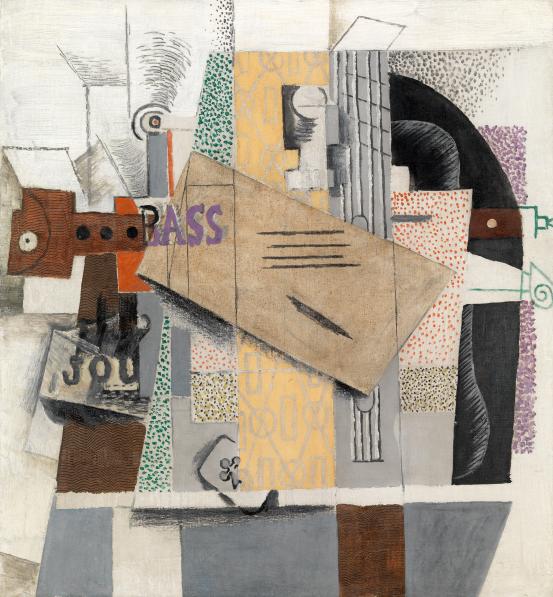
Pablo Picasso: “The violin (Le violin)” (1914) by Pablo Picasso © Succession Picasso/Copyright Agency, 2022; Photo: © Centre Pompidou, MNAM-CCI/Georges Meguerditchian/Dist. RNM-GP; Image sourced from NGV

So it must be with some trepidation that visitors approach the latest example of “making sense of” Picasso – the NGV’s current blockbuster exhibition, ominously titled “The Picasso Century”. The sheer volume of his output, the breadth of techniques and the range of styles can be overwhelming. This major exhibition (drawing mainly on the collections held in the Centre Pompidou and at the Picasso Museum, Paris) is arranged fairly conventionally, in chronological order, and reflecting the major periods of Picasso’s work.

There are glimpses of the post-impressionist Blue Period, the flirtation with Primitivism and Fauvism (which sparked a life-long rivalry with Matisse), and his dominance of Cubism (although both Braque and Gris gave him a run for his money). Plus the importance of people like Gertrude Stein who, initially through her brother, became an early admirer, friend and collector.

Then there is his association with the Surrealists, although I’ve never felt he fully embodied their movement. Sure, he was instrumental in furthering their aims, he counted many of its practitioners as close friends and associates, and he participated in many of their exhibitions, manifestos, happenings and publications. But Picasso did not really pursue the juxtaposition and sub-conscious of major Surrealists such as Dali, Magritte or Ernst. That’s not to say Picasso didn’t reveal his sense of humour or his liking for fantasy – but unlike some of his peers, he was always in control, nothing was left to chance, and even his re-telling of ancient myths and legends was self-serving and relatively orthodox.

First and foremost, Picasso was an excellent draftsman, and his lines and mark-making were always deliberate, distinctive and revealing – as seen in some of the archive footage of Picasso at work in his studio. (I think the dismissive argument that “any 3 year old could have drawn that” has long been debunked.)

Of course, when there are so many works to choose from, the curators are spoiled for choice, and narrowing down this selection must have been challenging – even though they stick gamely to their particular narrative(s), resulting in a balanced and consistent presentation. There are a couple of insights which I did find refreshing – Picasso’s association with Wilfredo Lam, and his dabbling in political themes (mainly stemming from his membership of the Communist Party in France). The one weakness in this exhibition is the extensive display of ceramic plates from Picasso’s later years. I’ve never been a fan of these pieces, as I don’t think they add much to his body of work. There is a sense that he would make these almost on demand, and had them at hand for when visitors and souvenir hunters tracked him down to his studio.

Nonetheless, this exhibition is highly recommended, and provides yet another excuse to admire the work of Picasso’s peak artistic years, from 1909 to 1949. Prior to that period, he was still finding his artistic voice (and creating his own myth); and after that, he found himself having to live up to (and even exaggerating) the myth he had built up for and around himself. Whatever else this exhibition may reveal about his life, the work is still what counts.

Next week: An AI Origin Story

Lightscape

Melbourne is a well-known destination for the arts – with its major festivals, winter blockbuster exhibitions, and live music scene. The city itself is often the setting, not just the host – witness Open House, White Night, and more recently RISING. As the backdrop, canvas or screen for these events, Melbourne largely draws on its built environment. In contrast, and as the latest example to join Melbourne’s art calendar, the Royal Botanic Garden is currently hosting Lightscape, a major exhibition that literally sheds new light on its historic collection of flora, and allows us to enjoy the city’s lungs at night, when the gardens are usually closed.

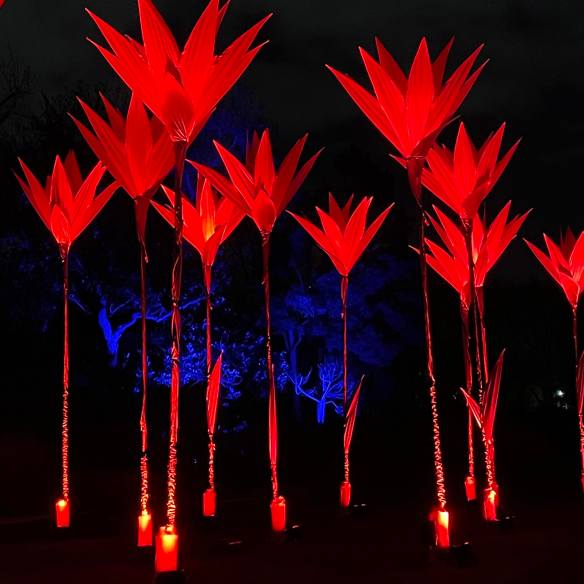
“Flower Lawn” by Jigantics (photo by Rory Manchee)

The key pieces as you tour the installations are:

1. Sea of Light by ITHICA Studio – the sequence of programmed lights create an impression that the lawns are moving, rather like waves on the shore

2. Liquid Sky by Genius Laser Technology – lasers reflect on layers of mist sprayed among the foliage, creating psychedelic clouds in the night air

3. Winter Cathedral and Laser Garden, both by Mandy Lights – the former is a series of illuminated arches made from strings of fairy lights, that give the impression of a more solid structure; while the latter projects lasers into the depths of the fern gully, that flicker like fireflies.

4. Flower Lawn by Jigantics – enormous “plants” that are lit up by a changing sequence of colours

Throughout the gardens, there are a range of animated lights, illuminated displays and projections. I’m sure everything has been carefully designed and planned, but there are some happy accidents: the lasers from Liquid Sky extend beyond their misty clouds to flicker amongst the foliage of surrounding trees; many lights reveal the natural iridescence of flowers that we are unable to see by day; and the reflection of the Winter Cathedral on the nearby lake suggests the climactic scene in Peter Carey’s novel “Oscar and Lucinda”, when the crystal chapel sails down the river.

The only disappointment about Lightscape is the choice of audio to accompany the installations. The sound quality is fantastic, but the actual music is quite conservative, even pedestrian – at times, I was expecting a David Copperfield reveal. I wonder what artists such as Oren Ambarchi or Lawrence English would have done instead – a missed opportunity?

Next week: Dud Housing