The recent Australian federal election campaign renewed discussion about financial support for the domestic car industry. The political debate on government subsidies is usually couched in terms of job creation, productivity and industry efficiencies, along with the wider social, economic and technological benefits of having a domestic car manufacturing capability. However, these arguments tend to overlook some of the other costs of our car culture.
 To begin with, here are the some of the “key facts” that are usually trotted out:
1. The government subsidy currently costs about $1bn per annum – but the industry is far from alone in receiving direct or indirect government subsidies, and on a per capita basis, the subsidy is somewhere between comparable support for the US and German car industries.
2. Manufacturing as a whole contributes 7.4% of GDP, and 8.3% of employment. (In comparison, mining is 9.6% and 2.4%, while services account for 66% and 86% respectively.)
3. The industry employs 50,000 people in vehicle and parts manufacture, but this is only 5.4% of total manufacturing employment. However, vehicle servicing and repairs, and wholesale and retail activities account for a further 280,000 jobs.
4. There are now only three domestic car manufacturers (Ford, Toyota and General Motors Holden), all of which are foreign-owned; despite ongoing government subsidies, Ford has already decided to cease local manufacturing within a few years – so there are some voices that say we need to protect what we have left.
5. The car industry generates significant benefits through R&D – the sector contributes about 15% of total manufacturing R&D investment. This allegedly has benefits for other sectors, such as delivering improved production processes, and developing new technologies.
Australians have a hard-wired love affair with the car – some would say it’s an inalienable right to own a vehicle, and to drive it wherever and whenever one chooses. Certainly, the development of Holden as a domestic car manufacturer (subsequent to its acquisition by General Motors in the 1930s) is as much a part of the Australian psyche as Federation was in 1901. Cultural and iconic references to the car can be found everywhere – from Peter Carey’s short story (and film) “The Cars That Ate Paris”, to the apocalyptic images of “Mad Max”; from The Triffid’s song “Wide Open Road” to the ABC’s TV documentary of the same name. Cars denote freedom and independence, and are as much a geographic necessity as they are a symbol of economic success. But now that over 80% of the population live in the major cities or in major regional centres, the level of urbanisation would suggest that the car is not the most efficient form of transportation, especially given the increasing road congestion and accompanying levels of road rage.
In his recent book, “End of the road”, Gideon Haigh seems to argue that the only choice for the local car industry lies between subsidies and/or protectionism on the one hand, and a demoralised and unemployed workforce on the other. But regardless of which side of the policy divide you sit, the true cost of our car culture should be measured by a broader set of indicators such as health, infrastructure and energy consumption.
First, few people would argue against the social and economic benefits of meaningful and gainful employment; and domestic car manufacturing has, until its accelerating decline over the past decade or more, provided regular, stable training and employment opportunities. But where and how else could this talent be deployed, and probably to the greater good of the community and the economy? Instead of trying to hold on to a declining sector, should we be encouraging people with design, production, engineering and manufacturing expertise to apply their skills in more high-tech and high-value industries?
Second, despite all the talk about the R&D contribution made by the domestic car industry, I don’t know that we are actually seeing the benefits. For example, average car fuel efficiency has not improved over the past 50 years – because even as engines get more efficient, they become more powerful, and the cars themselves are heavier, leading to higher overall fuel consumption. Australia is the 6th biggest consumer of petrol in the world – and our car emission levels are way above Europe, mainly because we favour larger vehicles with automatic transmissions over smaller, manual models. Cars in Australia are generally marketed on the basis of size, power and price. Thanks to higher average wages and relatively low fuel costs, Australians have a very high petrol purchasing power, so fuel efficiency is less about reducing consumption and emissions, and more about getting the maximum bang for your buck.
Third, despite private sector funding, a number of major Australian toll road projects – e.g., Sydney’s Cross-City and Lane Cove Tunnels, and Brisbane’s Airport Link – have struggled because the developers always over-estimate projected traffic volumes and under-estimate motorists’ willingness to pay tolls. Could that private capital be put to better use by being invested in more integrated transport solutions? The public bus system in Santiago, London’s programme of road-pricing and public transport reinvestment , and the Velib public bicycle service in Paris each suggest there are more imaginative solutions to alleviating vehicle congestion than simply building more roads. Favouring private cars above all other forms of transport is a short-sighted strategy, because either the new roads quickly fill up or toll revenues fail to meet their expected targets. (In London, 25% of all rush-hour vehicles are bikes.)
Finally, increased levels of obesity and diabetes cannot be unrelated to our car culture – a higher concentration of household car ownership has led to more car usage, but for shorter average journeys (47% being less than 2.5km), with each trip conveying fewer people. Could we encourage people to use their cars for fewer short trips (in favour of walking, cycling or taking public transport), and back this up with better urban infrastructure for pedestrians, rail passengers and cyclists?
Unfortunately, our political leaders continue to frame the debate on transport policy around the following mantras:
- we just need to build more roads to ease car congestion (implying that “only losers take the bus”)
- we need more toll systems to pay for the new roads (since such projects gain public support because of the anticipated job creation and knock-on economic benefits)
- we don’t need more trains and especially not high-speed inter-city trains because nobody will use them (even though they would also create jobs and have even greater economic benefits…)
- meanwhile, we need to keep subsidising the car industry to fill the new roads we are going to build….
Declaration of interest: although I hold a driver’s license, I do not own (and have never owned) a car. If I need to, I hire one. Personally, I’d rather walk or take public transport.
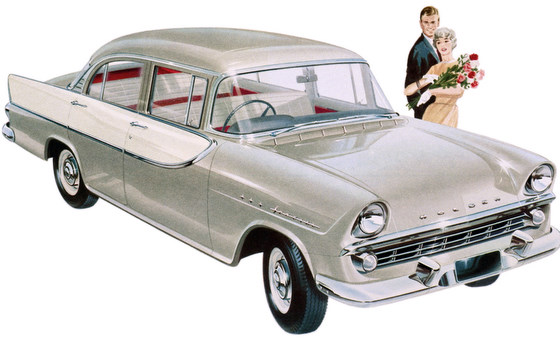
Further declaration of interest: our family had an FB Holden, like the one in this picture, in the early 1970s. I became very familiar with its engine, transmission, differential and brake system as I helped my father rebuild or replace most of the mechanics during that time. For a 3-speed manual vehicle powered by a straight 6 cylinder engine, it drove like a tank and cornered atrociously. But the door windows were ideal for holding the speakers at the drive-in cinema, and it could climb most hills in 2nd gear.

 Content in Context