Content Marketing and the “New Hierarchy of Needs”

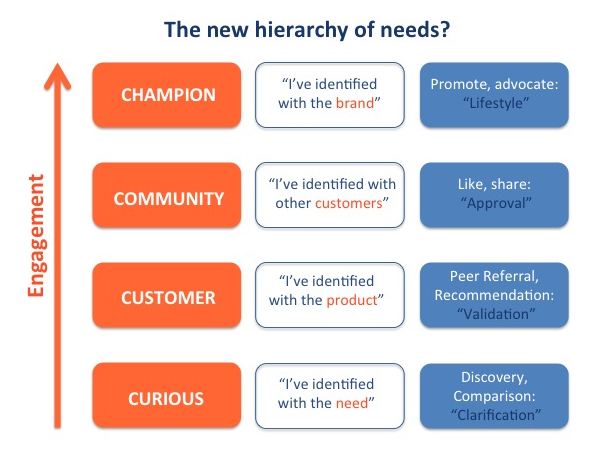
Maslow’s theory on the “Hierarchy of Needs” has become shorthand for explaining human behaviour and motivation – primarily in our personal lives, but increasingly in our working lives. At the risk of offering an answer to yet another first world problem, it seems to me that many social media platforms and content marketing solutions are trying to recalibrate Maslow for generating deeper (and sometimes more meaningful) engagement with consumers. So, by way of a simple infographic, I am offering my own theory on the new hierarchy of needs:
New Hierarchy of Needs


When we are looking for a product or service to meet a need, we are usually in “discovery mode” – we are searching for content that helps us by offering suggestions, comparing products and prices, and clarifying the precise need. So, we are either browsing, curious, or looking for assistance.

Having found some possible solutions, we seek reassurance via informed recommendations, peer referrals and published reviews. We may place different weight on this information depending on the source, but we are seeking justification for our reason to buy, or validation for becoming a customer.

If we are happy with our choice, and given the right opportunity and encouragement, we may be willing to tell our friends and anyone else who’s interested via Likes and social media posts and reviews. This is an interesting point in the engagement transaction – going from peer-to-peer sharing, to looking for approval for our decision from the wider community.

Finally, if we are so enamoured with the product, and we enjoy sharing our experiences, we may be flattered into making a lifestyle statement about our preferences; we could become a self-identified “voice of authority” through blogging and endorsements, or we might be willing to be closely identified with a brand as an advocate or champion (the sort of customer beloved of Net Promoter Scores).

The ultimate consumer-turned-champion was, of course Victor Kiam, the customer who liked the product so much, he bought the company….

C-Suite in a quandry: To Blog or Not To Blog…

Should CEO’s be on social media? That is the question many boards, PR advisers, marketeers and C-Suite occupants are faced with these days. Partly driven by existentialist angst (“I Tweet therefore I am”), partly a desperate act of “me too”, many CEOs are in a dilemma about how to engage with the new media.

While it might sound like a good idea to have a CEO blog, in the wrong hands or used inappropriately, it can come across as inauthentic, too corporate, or just crass.

The use of CEOs as “personal brands” is nothing new – think of Richard Branson, Anita Roddick, Steve Jobs, Jack Welch etc. And while social media has the potential to extend the CEO’s reach to customers, shareholders and employees, it also abhors a vacuum. If companies do not take control of their public persona, their customers and employees (supporters and detractors alike) will fill the void for them.

I am seeing this debate play out in different ways:

First, there is a difference between a personal brand and a business brand, so it is important to establish boundaries while recognising how the CEO’s personal standing can be used effectively to complement the corporate presence.

Second, having the CEO recognised as an expert can enhance personal influence but may not directly benefit the company if it is not relevant to the business – does Warren Buffet’s prowess on the ukulele boost instrument sales, or help the share price of Berkshire-Hathaway?

Third, if CEOs do choose to outsource their blog content, make sure it is genuine and aligns not only with the CEO’s personal values but also with those of the company, customers, shareholders and employees.

Finally, CEOs or Boards struggling with this topic, or those worried about whether to take the plunge into social media would be advised to consult Dionne Kasian Lew‘s new book, “The Social Executive”, which is sure to become an essential guide on the subject.


Defining the Prosumer product

This week, Do.com announced it will be closing down in January. It may simply be the latest in a string of social networking apps to call it quits, but it also highlights the difficulty in developing Prosumer products that generate market traction.

do-com-logoPositioned as a productivity solution, Do.Com was also viewed as an app that straddles the work/personal divide, to be a veritable Prosumer product.

The problem is, it did not have a clear vision of what defines the “Prosumer” market, and it did not adequately redefine workflow needs in a permeable environment that increasingly blurs the dividing line between the personal and the professional.

As a result, Do.com probably missed an opportunity to craft a new perspective on the elusive Prosumer demographic. For example, as a Prosumer, my primary need is to consolidate all the social networking and collaborative platforms I use. At the same time, I need to manage the different types of connections and co-ordinate the different degrees of sharing that these tools offer, but not based on “projects” or “transactions” – rather, based on “relationships” (which are not the same as “connections”).

Despite their attempts to capture “3-dimensional” linkages amongst my networks, most collaborative tools and social networking platforms are limited by their 2-dimensional perspective of linear connections, rather than multi-dimensional relationships.

Until tools like Do.com do a better job of managing the qualitative and contextual nature of professional and personal relationships (and offer better ways to manage the different facets of these connections), they will be interesting, but not essential.

POSTSCRIPT: Here’s why Facebook can never be taken seriously as a productivity or professional tool – when editing my “official” Facebook page the day, I was prompted to add my “likes” for music and films – why would I want to share that sort of information with my professional contacts (unless it was really relevant to our relationship – client karaoke night, perhaps?).

Has web-traffic analysis just got better or worse thanks to Google search encryption?

Last month, WordPress informed its customers that Google has expanded search encryption to cover any search except for clicks on ads. The impact will mean less detail about which keyword searches are driving traffic to your website. Debate among industry observers suggested that this was done either in response to security-related issues, or simply to maximise ad revenue.

I’ll leave you to decide what the real motive is, and to determine what your own response should be around SEO strategies. My sense is that content owners and social marketers will sharpen their use of keywords, and devise new tactics to maximise the value of web traffic analytics. As one commentator has observed, Google has a near monopoly on search – but in the end, it’s their platform and they’ll do what they want with it.

From my own analysis here at Content in Context, the number of “unknown search terms” far outweighs precise keyword or search strings, but thanks to the WordPress stats, I am still able to get a reasonably informed sense of what drives traffic to this blog:

  • Social networks (Twitter, LinkedIn, Facebook, etc.) account for about half of all referrals to Content in Context (including 10% from Reddit, even though I do not actively participate on that platform)
  • Search engines comprise about one-third of referrals (with Google Search accounting for over 90%)
  • Meetup is an increasingly important source of referrals
  • Embedded links (used selectively) can also be a useful source of referrals

I have found some interesting citations to my blog (including undergraduate study forums), and I figure I must be doing something right when third parties approach me to write about their products or to include advertorial content in my blog – and of course, I would declare any such interest when it arises!

Even though I do not pay for Google ad words, or undertake any paid-for SEO, this blog comes up 2nd (after paid results) when using Google search for “Content in Context”.

One outcome from Google search encryption will undoubtedly be a renewed focus on providers offering contextual search solutions, because keyword search relies primarily on frequency, proximity and assumed relevance of search terms, rather than actual contextual meaning.

So, in some ways Google’s decision to encrypt all search will make everyone else lift their game, which can only be positive.