App Overload

Following a recent upgrade to Apple’s iOS software, I found myself forced into some serious housekeeping on my iPad. I hadn’t realised how many dormant apps I had accumulated over the years, so I took the opportunity to do some culling.

First, there were apps that could no longer be accessed from the app store. These are programs that have been removed by their developers, or are no longer available from the Australian app store (yes, even in this digital day and age, geo-blocking still exists). I estimate that these accounted for about 20-30% of the total apps I have ever downloaded.

Second, apps that are not supported by the current version of iOS, because they have not yet been updated by their developers. (Luckily, I keep an older version of iOS on a separate iPad, which can allow me to retrieve some of these apps via some digital archeology.) These represented another 15-25% of my apps (a variable number, given that some of them may get upgraded).

Third, apps that I seldom or never use. Thankfully, the iPad Storage settings provide the “Last Used” date, but don’t enable users to rank by chronological use (or by frequency of usage; the “Search” function within Storage only lists apps alphabetically). Perhaps Apple can refine the Storage Management to help users better manage over-looked/under-used apps? Anyway, these forgotten or neglected apps accounted for another 25-30%.

In total, I estimate that up to 75% of my iPad apps were redundant, through disuse, obsolescence or inaccessibility. Research shows that 25% of apps we download are only used once, so unless these are free products, it feels like a large chunk of the US$900+ bn in app purchases could be going to waste…

Next week: Apple, iOS, and the need for third-party innovation


No-code product development

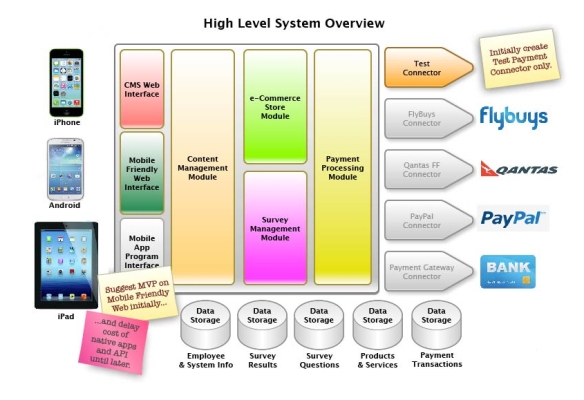
Anyone familiar with product development should recognise the image below. It’s a schematic for a start-up idea I was working on several years ago – for an employee engagement, reward and recognition app. It was the result of a number of workshops with a digital agency covering problem statements, user scenarios, workflow solutions, personas, UX/UI design and back-end architecture frameworks.

At the time, the cost quoted to build the MVP was easily 5-6 figures – and even to get to that point still required a load of work on story boards, wire frames and clickable prototypes….

Now, I would expect the developers to use something like a combination of open-source and low-cost software applications to manage the middle-ware functions, dial-up a basic cloud server to host the database and connect to external APIs, and commission a web designer to build a dedicated front-end. (I’m not a developer, programmer or coder, so apologies for any glaring errors in my assumptions…)

The growth in self-serve SaaS platforms, public APIs and low-cost hosting solutions (plus the plethora of design marketplaces) should mean that a developer can build an MVP for a tenth of the cost we were quoted.

Hence the interest in “low-code/no-code” product development, and the use of modular components or stack to build a range of repetitive, automated and small scale applications. (For a dev’s perspective check out Martin Slaney’s article, and for a list of useful resources see Ellen Merryweather’s post from earlier this year.)

There are obvious limitations to this approach: anything too complex, too custom, or which needs to scale quickly may break the model. Equally, stringing together a set of black boxes/off-the-shelf solutions might not work, if there are unforeseen incompatibilities or programming conflicts – especially if one component is upgraded, and there are unknown inter-dependencies that impact the other links in the chain. Which means the product development process will need to ensure a layer of code audits and test environments before deploying into production.

I was reflecting on the benefits and challenges of hermetically sealed operating systems and software programs over the weekend. In trying to downgrade my operating system (so that I could run some legacy third-party applications that no longer work thanks to some recent systems and software “upgrades”), I encountered various challenges, and it took several attempts and a couple of workarounds. The biggest problem was the lack of anything to guide me in advance – that by making certain changes to the system settings, or configuring the software a certain way, either this app or that function wouldn’t work. Also, because each component (the operating system, the software program and the third party applications) wants to defend its own turf within my device, they don’t always play nicely together in a way that the end user wants to deploy them in a single environment.

App interoperability is something that continues to frustrate when it comes to so-called systems or software upgrades. It feels like there needs to be a specialist area of product development that can better identify, mitigate and resolve potential tech debt, as well as navigate the product development maintenance schedule in anticipation of future upgrades and their likely impact, or understand the opportunities for retrofitting and keeping legacy apps current. I see too many app developers abandoning their projects because it’s just too hard to reconfigure for the latest system changes.

Next week: Telstar!


“There’s a gap in the market, but is there a market in the gap?”

As a follow up to last week’s post on business strategy, this week’s theme is product development – in particular, the perennial debate over “product-market fit” that start-up businesses and incumbents both struggle with.

Launch it and they will drink it….. (image sourced from Adelaide Remember When via Facebook)

The link between business strategy and product development is two-fold: first, the business strategy defines what markets you are in (industry sectors, customer segments, geographic locations etc.), and therefore what products and services you offer; second, to engage target customers, you need to provide them with the solutions they want and are willing to pay for.

The “product-market fit” is a core challenge that many start-ups struggle to solve or articulate. A great product concept is worth nothing unless there are customers who want it, in the way that you intend to offer it, and which aligns with your go-to-market strategy.

I appreciate that there is an element of chicken and egg involved in product development – unless you can show customers an actual product it can be difficult to engage them; and unless you can engage them, how can they tell you what they want (assuming they already know the answer to that question)? How often do customers really say, “I didn’t know I needed that until I saw it”? (Mind you, a quick scan across various crowd-funding platforms, or TV shopping channels, can reveal thousands of amazing products you didn’t know you couldn’t live without!) Of course, if your product development team can successfully anticipate unmet or unforeseen needs, then they should be on to a winner every time! In fact, being ahead of the curve, and understanding or even predicting the market direction is a key aspect of business strategy and product development for medium and long-term planning and forecasting.

Then there is the “build it and they will come” strategy. A bold move in most cases, as it involves upfront deployment of capital and resources before a single customer walks through the door. The image above is the only visual record I can find of a soft drink marketed in South Australia during the late 1960s and early 1970s. And you read the label correctly – a chocolate flavoured carbonated beverage (not a chocolate milk or soy concoction). It was introduced when the local manufacturer faced strong competition from international soft drink brands. No doubt it was designed to “corner the market” in a hitherto under-served category and to diversify against the competitor strongholds over other product lines. Likewise, is was launched on the assumption that people like fizzy drinks and people like chocolate, so hey presto, we have a winning combination! It was short-lived, of course, but ironically this was also around the time that soft drink company Schweppes merged with confectionery business Cadbury, and commentators joked that they would launch a chocolate soda, or a fizzy bar of chocolate….

With data analysis and market research, it may be possible to predict likely successes, based on past experience (sales history), customer feedback (solicited and unsolicited) and market scans (what are the social, business and technology trends). But obviously, past performance is no guarantee of future returns. In my early days as a product manager in publishing, we had monthly commissioning committees where we each presented our proposals for front list titles. Financial forecasts for the new products were largely based on sales of relevant back catalogue, and customer surveys. As product managers, we got very good at how to “read” the data, and presenting the facts that best suited our proposals. In fact, the Chairman used to say we were almost too convincing, that it became difficult to second guess our predictions. With limited production capacity, it nevertheless became imperative to prioritise resources and even reject some titles, however “convincing” they seemed.

Then there is the need to have a constant pipeline of new products, to refresh the range, retire under-performing products, and to respond to changing market conditions and tastes. In the heyday of the popular music industry from the 1960s to the late 1990s, the major record labels reckoned they needed to release 20 new song titles for every hit recording. And of course, being able to identify those 20 releases in the first place was a work of art in itself. For many software companies, the pipeline is now based on scheduled releases and regular updates to existing products, including additional features and new enhancements (particularly subscription services).

An important role of product managers is knowing when to retire an existing service, especially in the face of declining or flat sales. Usually, this involves migrating existing customers to a new or improved platform, with the expectation of generating new revenue and/or improving margins. But convincing your colleagues to give up an established product (and potentially upset current customers) can sometimes be challenging, leading to reluctance, uncertainty and indecision. In a previous role, I was tasked with retiring a long-established product, and move the existing clients to a better (but more expensive) platform. Despite the naysayers, our team managed to retire the legacy product (resulting in substantial cost savings), and although some clients chose not to migrate, the overall revenue (and margin) increased.

Finally, reduced costs of technology and the abundance of data analytics means it should be easier to market test new prototypes, running proofs-of-concept or A/B testing different business models. But what that can mean for some start-ups is that they end up trying to replicate a winning formula, simply in order to capture market share (and therefore raise capital), and in pursuit of customers, they sacrifice revenue and profit.

Next week: Who fact-checks the fact-checkers?


Startup Vic’s EdTech Pitch Night

EdTech or EduTech? Even Startup Vic can’t seem to decide. Whatever, this education-themed pitch night was the latest event in their highly popular monthly events, held in conjunction with Education Changemakers, and EduGrowth.

Apart from the naming convention, there is also some clarification needed around the scope and definition of “education(al) technology”. First, because it’s a very broad spectrum (does it include e-learning, e-books, MOOCS, LMS?). Second, is it more about the “delivery” than “outcomes”? Third, is it only about formal pedagogy, or does it also include discretionary, self-directed and non-curriculum learning?

And so to the pitches, in the order they presented:

Become

With the aim of “teaching kids to explore, design and navigate their future“, Become is essentially a platform for early-stage career coaching. While their app is still in development (although there is a bot in use already?), Become has been running in-person workshops and other programs to test and validate the concept. The solution uses AI and machine learning technology, but it wasn’t very clear how this will actually work – maybe there are some core profiling and preference tools, some career mapping based on proprietary algorithms, and recommendation engines drawing on the data analysis?

Using a freemium model, the full service will cost $40 per student per annum. The core audience are years 5 to 8, and part of the schools adoption strategy will focus on getting high school career advisers on-board, with additional parent advocacy.

I’ve no doubt that career advice is an important part of the syllabus, but just as important are life-long learning, resilience, adaptability, and developing self-awareness and a sense of purpose. But if nothing else, in the words of the founder, Become puts the “why” back into learning.

MoxieReader

This digital reading log is all about “inspired independent reading“. Supplementing the paper-based records widely in use, the app enables children to record their reading activity, and helps teachers to assess pupils’ reading progress, based on the titles and numbers of books read, and their associated word counts and vocabulary. (In future, the app may deliver content and instructional aids.)

Using a machine learning algorithm (“like a fitness tracker”), the app can set reading challenges, and measure reading growth. Tests may be another add-on, but from what I can see, the app does not test for comprehension or context-based reading and interpretation skills. (After all “reasoning” is the 4th “R” of education – along with reading, writing and arithmetic.)

Currently launching with an ambitious social media and outreach campaign, MoxieReader already has paid sign ups from teachers, many of whom are paying with their personal credit card, and is enjoying a 30% conversion rate, and 30% referral business.

Priced at $7 for teachers per class per month, plus $100 per school/building per month (individual teachers who already subscribed will get a rebate), there is also an opt-in donation model for parents to recycle used books.

Cogniss

This is a development platform and market place for education apps. Built on game based learning and rewards packages, it also makes use of analytics and data insights to help teachers and designers build their own products.

Having seen a demand among health and well-being users, the platform is also suited for apps designed to support behavioral change, workplace learning and social learning.

Access to the platform involves a $500 set up fee, plus $50 per month per app (plus scale rates by number of users and advanced add-ons).

The platform also supports micro-transactions, for downloaded content and apps. At present, there is no formal process for teachers to embed pedagogy into the game structure. Content vetting is also a manual process, combined with experience sharing and peer ratings – but a content certification process is in the pipeline.

Revision Village

Helping students to prepare for external exams (specifically, the IB maths) this product replaces traditional in person and in class programs, with an online resource.
Also, although revision practice largely relies on past test papers, the founders have identified a chasm between the concepts taught, and the questions asked.

Developed in response to teacher demand, this subscription-based learning resource has
translated into higher results and fewer fails.

The platform is looking to extend the curriculum beyond maths, but this will largely depend on being able to license content from the relevant examination boards and syllabus providers, such as the IB.

Access is not dependent upon being logged into a school network or intranet, as it is only a web app (with individual and site licenses).

The Revision Village website claims the product is used by “More than 32,000 IB Students and 710 IB Schools”. However, it would seem that not all of these are paid-for subscriptions, as the pitch mentioned a critical mass would be 100 schools (out of a total of 2,500 IB schools) paying $2,000 each (although this is separate to the parent market).


Overall, I liked the tone and format of the pitches –  the products all seemed worthy endeavours, and the founders are no doubt passionate about education and learning. But I was left feeling underwhelmed, by both the content and the tech being deployed. (I guess I needed more than just passing references to “AI, machine learning and algorithms”.) All of these products rely on significant adoption rates among schools – which are some of the hardest institutional customers to sell to – and to be successful in international markets presents a further challenge, given differences of language, content and educational systems.

In the end, even the judges found it hard to pick a winner, as there was a tie for 1st place, between Become and MoxieReader. I would probably concur, as they had the edge in terms of both individual learning outcomes, and broader educational benefits.

Next week: Copyright – Use It Or Lose It?