Ageing Rockers

A few years ago, I mentioned the phenomena of ageing pop stars, that bunch of musicians from the 60s and 70s still recording and touring in their 70s and 80s – retrospective proof that for some, rock was a viable career move after all. Since their professional longevity has extended way beyond anyone’s original expectations, it does mean for us music fans we should make an effort to go and see their live shows, especially as more of these artists shuffle off this mortal coil – because we may never get the opportunity again.

Michael Rother – a sprightly 73-year old continues to record and tour (picture sourced from Melbourne Recital Centre)

A case in point is Kraftwerk, who visited Melbourne last December. The only original member, Ralf Hütter is now in his late 70s, but he stood and led his team of younger musicians for a 2-hour performance that was almost like a tribute show to themselves. Kraftwerk has not released any new music for more than 20 years, but continue to harvest their legacy via regular live shows and careful curation of their back catalogue. I hope they do continue touring but I suspect the chance to see them again in Melbourne may have passed (at least in human form, and not as resurrected VR projections or avatars, although Kraftwerk clearly anticipated this many, many years ago… ).

Last week, a one-time member of Kraftwerk, Michael Rother performed at the Melbourne Recital Centre, to celebrate 50 years of his old band Neu! A fit and sprightly-looking 73-year old, he looks like he still enjoys touring, and seemed very happy to be back in Melbourne. However, this concert was re-scheduled from a couple of years ago, when Rother experienced some health issues that prevented him from travelling to Australia. And the last time he was here, in 2012, he was joined by another stalwart of the German music scene of the 70s and 80s, Dieter Moebius (of Cluster and Harmonia) – who passed away in 2015. Given Rother’s connection to Kraftwerk and his key role in forming the sound of “kosmische Musik” (plus his work with Brian Eno, and the tantalising prospect that he might have played on David Bowie’s “Heroes” album if things had gone differently…) his continued presence on the live circuit is most welcome, especially as very few of his German contemporaries are still with us as going concerns.

Later this month, I’m going to see Laraaji, octogenarian jazz, ambient and new age musician who is coming to Melbourne to perform for the first time in his career (I believe). Another former collaborator of Brian Eno, this promises to be a very special concert.

Meanwhile, Eno himself still shies away from live performance, but an interesting documentary about him has started touring the world – and which, in typical Eno-esque fashion, is never the same film twice. And another documentary showing this month in Melbourne is “Opus”, the final recorded performances of the late Ryuichi Sakamoto (whom I was fortunate to see on his last visit to Melbourne in 2018).

The moral of the story? Get ’em while you can….

Next week: The Grey Ceiling


The Mercurial Music of Calexico

In addition to Taylor Swift and Katy Perry, Melbourne recently played host to US band Calexico. Given the hype surrounding those pop divas, you’d be forgiven for not noticing the latter’s sell-out concerts at the Recital Centre.

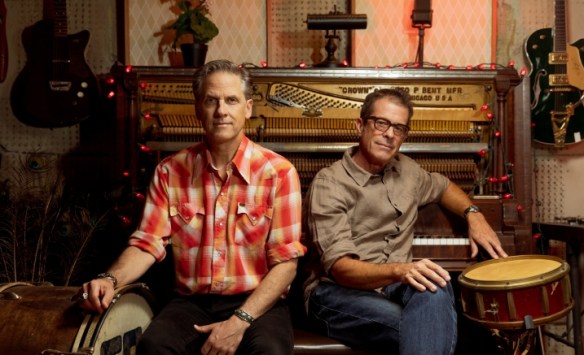
Calexico photo sourced from Melbourne Recital Centre

After nearly 30 years and as many albums, Calexico have a deep back catalogue to draw on, but the focus on the current tour is their 2002 album, “Feast of Wire”, featured in full alongside a few of their greatest hits and a couple of inspired cover versions.

My interest in Calexico stems from the late 1990s, via their involvement with a couple of other bands, Giant Sand and The Friends of Dean Martinez. Alongside these and other groups such as Lambchop and Wilco, Calexico brought a fresh perspective to Americana – that strand of North American music that has its roots in Alt Country, but which eschews many of the conservative (even regressive) styles and values of mainstream country and western music. What sets these bands apart is their willingness to embrace other musical influences, and explore more experimental sounds.

Calexico themselves have collaborated with a range of DJs and producers for some inspired remixes, and have featured on compilation albums alongside their US post-rock counterparts as well as European electronic artists. So quite eclectic company. In fact, Calexico’s own music incorporates Tex-Mex, Mariachi, dub and electronica, Morricone’s spaghetti western soundtracks, Tortoise-style instrumental arrangements, Tindersticks’ atmospherics, and Tijuana trumpets. Having been to California a few times myself (including a road trip from LA to northern Mexico), and having visited Colorado and New Mexico last year, Calexico’s music readily evokes memories of the Anza-Borrego desert, the border town of Tecate, the Skytrain from Santa Fe to Lamy, and the hills of the Tejon Pass.

Live, the core duo of Joey Burns and John Convertino handle vocals/guitar and drums respectively, while a team of four multi-instrumentalists take care of bass, guitar, keyboards, vibes, trumpets and accordions. The technical production is great, and like many visiting musicians, the band enjoy playing with the superb acoustics of the Recital Hall itself.

As for the night’s cover versions, there were two: Love’s “Alone Again Or”, a minor hit for Calexio when first released as a non-album single, and which perfectly suits their “Sounds of the South-West”; and Joy Division’s “Love Will Tear Us Apart”, a song I hadn’t heard played live since one of Joy Division’s last gigs in 1980, and which prompts some emotional audience participation – a brave choice!

Next week: Ageing Rockers


Defunct apps and tech projects

In the early days of this blog, I featured many new tech projects and start-ups that I came across by attending pitch nights and meet-ups in Melbourne. I also signed up to beta test numerous apps, and I contributed to quite a few crowd-funding exercises. In doing some research for a recent blog on music streaming, I realised that many of these ventures are no longer with us.

Here’s a random selection of projects and products that I either used, subscribed to, funded, or covered in my blog:

1. Klout – launched in 2008, this app used data from social media profiles to create individual “Klout Scores”, designed to calculate how “influential” your content was. Nice idea, but there was probably no money in the business model, because as far as I can recall, it was a free service. It was purchased in 2014 for $200m by the company that eventually became Khoros, who then closed Klout in 2018, as it was not seen as core business. Khoros itself is a customer engagement, social media and content management solution for corporate clients and consumer brands – obviously, there is more money to be made from capitalising on customer behaviour…

2. Do.com – founded in 2014 as a productivity tool, focused on making meetings more efficient. Acquired by Amazon Web Services (amount undisclosed) and folded into its Chime web-meeting and conferencing application. From my personal experience, the only company using Chime for external-facing calls is Amazon itself, but perhaps it’s more of a white label solution, or it’s mainly used by internal teams to communicate among themselves (especially if these teams are using AWS?).

3. Paper.li – launched in 2010, and grew to 2 million users within 6 months, this was a neat product that enabled users to curate their own “newspapers” from Twitter and other online content. Closed in April 2023 – probably too much noise and competition in this space, and too hard to monetise?

4. Pandora – one of the earliest internet radio and music streaming services, Pandora launched in 2000 – and as recently as 2019, had a market valuation of US$3.5bn, based on a stock acquisition by SiriusXM. But by 2017, Pandora had already decided to exit the Australian market, so I have no idea about the current content or service quality.

5. Twitter Music – as featured in my previous blog, this “service” was launched in 2013, and closed within a year. But watch this space – since re-branding his new toy as “X”, not only has Elon Musk taken back the @X handle from a Twitter user, he’s also just claimed @Music from another customer.

6. 8tracks – another early-ish player in the internet radio and music streaming service (launched in 2008), 8tracks is primarily a social media app that allows users to share their favourite playlists. Despite industry accolades, and various integrations with Android, Windows and Soundcloud, 8tracks ran into problems, including a copyright and licensing issue which meant it could no longer stream music outside of the US and Canada (instead, having to rely on content from YouTube). In 2019, the company announced it was shutting down. Then, in early 2020, the brand was relaunched under new ownership, but is only available in the USA.

7. Sensel Morph – this tech business began life as a Kickstarter project in 2015. The product was a touch-sensitive computer interface that allowed users to run various applications, such as graphic design, video editing, gaming, digital audio workstations, MIDI devices and coding (e.g., for Arduino and Raspberry Pi). Despite a successful funding campaign, the Morph devices did not start delivering until 2017 – and some of the promised features never appeared, or were scaled back (or support was dropped soon after development). In early 2022, Sensel announced it was discontinuing support for Morph – instead, the company is focused on providing touch-sensitive and pressure pad technology to third party developers and OEMs. I can’t help feeling that the Kickstarter campaign was really a way for Sensel to fund its early R&D (especially given the 2-year time line to deliver the first physical devices).

8. Swatchmate – a Melbourne-based startup, this optical device for scanning colours, surfaces and patterns had a big future when it launched in 2011. Aimed at designers, illustrators, printers, textile manufacturers and paint companies, initially, there appeared to be significant interest from major brands. Yet, within a few years, and following a name-change to Palette, the product (and the company behind it) have disappeared – although the device can in theory be ordered online. I suspect that as mobile phones’ own optical quality has improved (along with AI-trained apps to handle colour-matching), the standalone Swatchmate cube was doomed to failure.

9. Broadcastr – this was an interesting angle on audio content creation and curation. It was designed to bring location-based stories, travelogues and events to remote audiences and visitors via streaming. It only ran for 2 years (2011-13), and simply ran out of money, in the face of Soundcloud and the emerging podcast industry.

10. iTunes Ping – a cross between a social media platform and a playlist sharing app, this was Apple’s attempt to help fans discover/recommend new music, and for artists to engage with their fans. Launched in 2010, it survived for 2 years, before Apple decided to integrate iTunes within Facebook and Twitter…

11. MySpace – despite reaching its 20th birthday earlier this month, and after much hype and a one-time over-inflated price tag, MySpace has failed to deliver on so many counts. It’s a wonder how it has survived, although I’m not sure how “active” this former darling of social media actually is. Scrolling through it’s clunky UI, it’s easy to get the impression MySpace is nothing more than a digital scrapbook of a by-gone era, forever preserved in virtual aspic (and slowly decaying for lack of attention or maintenance). Nothing works on this platform, so it was interesting to see a recent fan message on Justin Timberlake’s page: “1.Get off TikTok. 2.Fix MySpace. 3.Launch App.”

12. Friends Reunited – finally, the OG of SoMe, which launched in 2000 (4 years before Facebook, 6 years before Twitter, 3 years before LinkedIn, 10 years before Instagram…). Designed to help people re-connect with their schoolmates, work colleagues, college friends and other community groups, it was actually more of a research resource, and ended up like a huge directory of your past associations. Gave up the ghost in 2016, just as TikTok was unleashed on the world (although I’m sure that was purely a coincidence).

Next week: Ballarat International Foto Biennale (BIFB)

More on Music Streaming

A coda to my recent post on music streaming:

Despite the growth in Spotify‘s subscribers (and an apparent shift from free to paid-for services), it seams that the company still managed to make a loss. Over-paying for high-profile projects can’t have helped the balance sheet either….

Why is it so hard for Spotify to make money? In part, it’s because streaming has decimated the price point for content. This price erosion began with downloads, and has accelerated with streaming – premium subscribers don’t bother to think about how little they are paying for each time they stream a song, they have just got used to paying comparatively little for their music, wherever and whenever they want it. So they are not even having to leave their screen or device to consume content – whereas, in the past, fixed weekly budgets and the need to visit a bricks and mortar shop meant record buyers were probably more discerning about their choices.

Paradoxically, the reduced cost of music production (thanks to cheaper recording and distribution technology) means there is more music being released than ever before. But there is a built-in expectation that the consumer price must also come down – and of course, with so much available content, there has to be a law of diminishing returns – both in terms of quality, and the amount of new content subscribers can listen to. (It would be interesting to know how many different songs or artists the average Spotify subscriber streams.)

While some artists continue to be financially successful in the streaming age (albeit backed up by concert revenue and merchandising sales), it means there is an awfully long tail of content that is rarely or never heard. Even Spotify has to manage and shift that inventory somehow, so that means marketing budgets and customer acquisition costs have to grow accordingly (even though some of the promotion expenses can be offloaded on to artists and their labels).

Not only is streaming eroding content price points, in some cases, it is also at risk of eroding copyright. Recently it was disclosed that Twitter (now X) is being sued by music companies for breach of copyright.

You may recall that just over 10 years ago, a service called Twitter Music was launched with much anticipation (if not much fanfare…). Interestingly, part of the idea was that Twitter Music users could “integrate” their Spotify, iTunes or Rdio (who…?) accounts. It was also seen as a way for artists to engage more directly with their audience, and enable fans to discover new music. Less than a year later, Twitter pulled the plug.

One conclusion from all of this is that often, even successful tech companies don’t really understand content. The classic case study in this area is probably Microsoft and Encarta, but you could include Kodak and KODAKOne – by contrast, I would cite News Corp and MySpace (successful content business fails to understand tech). I suppose Netflix (which started as a mail-order DVD rental business) is an example of a tech business (it gained patents for its early subscription tech) that has managed to get content creation right – and its recent drive to shut down password sharing looks like it is paying dividends.

Of all its contemporaries, Apple is probably the most vertically integrated tech and content company – it manufactures the platform devices, manages streaming services, and even produces film and TV content (but not yet music?). In this context, I would say Google is a close second (devices, streaming, dominates on-line advertising, but does not produce original content), with Amazon someway behind (although it has had a patchy experience with devices, it has a reasonable handle on streaming and content creation).

All of which makes it somewhat surprising that Spotify is running at a loss?

Next week: Digital Identity – Wallets are the key?