And the public gets what the public wants?*

Another Australian General Election comes and goes – although with a mere 3 years between federal polls, our politicians and their parties seem to be in constant campaign mode. Certainly, the formal election campaign lacked any significant new policies, so it felt like the leadership “debates” were simply a continuation of the stale language, petty point-scoring and tedious soundbites we hear day in, day out.

Cue the constant and familiar references to crises in housing, the cost of living and climate change. Both major parties tried to build platforms promising financial incentives for first-time home owners, with policies that were expensive, ill-conceived (albeit well intentioned), and with little regard for the consequences on the housing market or the broader economy. There was a failed attempt to have an informed debate about nuclear power, and tons of the usual pork-barrelling for pet industries and favoured constituencies. Even a major credit rating agency suggested that the Commonwealth’s coveted AAA status could be at risk as a result of all the campaign largesse. And of course, any lowering of the AAA rating would likely see an increase in interest rates, which would largely defeat the object of the first-time home owner policies.

At the time of writing, the Australian Labor Party has retained power with a significantly increased parliamentary majority, based on the projected number of seats it will win. But while the seats total may look like a landslide, it’s clear that a significant portion of the electorate voted tactically to either: a) keep the Liberal Coalition out of power; b) increase the chance of a minority Government and/or hung Parliament; or c) maintain the current status quo in a turbulent and uncertain world.

Based on the counts so far, both the ALP and Liberals have each only managed to garner about one-third of the total primary votes (4,678,061 – 34.81% and 4,315,961 – 32.1% respectively). While the national swing to Labor was around 2.3% since 2022 (with the Liberals seeing an opposite swing of -3.6%), this is enough to give them a large majority in the House of Representatives, thanks to the preferential voting system.

By contrast, in 2022, the ALP secured fewer primary votes than the Liberals (4,776,030 – 32.58% and 5,233,334 – 35.70% respectively), but managed to secure government with a slim majority. The point is, that the two major parties combined face a continued decline in their share of the primary vote. Given the performances by the Greens and Independents in recent elections, there could be a case for adjusting the current system of preferences to include a weighting or allocation based on the total primary vote by party. This might seem fairer in those constituencies with very marginal results, or where parties draw a significant share of primary votes nationally, but not enough to win (m)any seats, even with preferences. But given that most independent candidates (by their very nature) are not affiliated to any party, and usually focus on local issues (and often on single policy platforms), that allocation would be very difficult to calculate on a federal scale.

Meanwhile, it felt like the number of early-voting facilities was limited compared to previous elections, and there was little or no promotion of postal vote applications. This could have been due to the relatively short campaign period (although it always feels much longer…) combined with the large number of public holidays during that time. Cynics might suggest that this was a deliberate tactic by the incumbent government as early voting and postal votes are traditionally considered to favour the Liberal Coalition. I can’t find any compelling evidence for this theory. Partly, I suspect, because the major parties recognise that undecided, wavering and swing voters make a huge difference to the final results, so encouraging people to cast their ballot on election day helps them in that regard, even though more and more voters opt to vote before the big day itself. Whether the promise of an election sausage is sufficient incentive, I’d rather not speculate!

I experienced a huge feeling of disengagement with this latest election, mainly because I didn’t identify with any policies, parties or candidates that I could really get behind. When it came to voting for the Senate, I couldn’t see 6 parties (above the line) let alone 12 candidates (below the line) that I considered deserving of my vote. But we are forced to express our preferences for a minimum number of parties/candidates, hence the candidate lists are usually very long. I always think the large Senate voting slips are problematic, especially if you want to complete the full “below the line” choices, as we don’t really know what preference deals have been done behind the scenes.

Like many voters, I had issues with the unsolicited text messages I received, on behalf of candidates and/or parties. Apart from not disclosing how they obtained my number, some of the SMS did not carry the relevant authorisation statement; the sender’s number was anonymous (presumably they use automated systems); and blocking the sender had little or no effect – they still kept sending them! Since political parties are deliberately exempt from complying with laws against spam and invasion of privacy, the Australian Electoral Commission is relatively powerless to act. Presumably it’s in the parties’ interests to keep the status quo?

I was also surprised that polling stations still use a paper-based system to tick off who has turned up to vote. (I was using the same system when I was a polling clerk back in the 1980s in London.) Although the polling officers are required to ask me if I have already voted in another location, there is no immediate way to cross-check the electoral rolls. Surely an electronic tracking system would be a better solution? And on that note, I’ll end with a suggestion that it’s about time we put voter registration, voting and campaign donations on a blockchain to support voter ID and verification with privacy, secure proof of polling and force campaign funding transparency… as well as a speedier vote count!

*(with apologies to The Jam)
Fact v Fiction in Public Discourse

In an era of fake news, alternative facts, deep state conspiracy theories, absolutists and populists, “political truths” are wielded like linguistic weapons. Any form of dissent (or contrary evidence) is branded as “unpatriotic”, “undemocratic”, “unconstitutional”, “disloyal”, “treasonous”, “elitist”, or “subversive”.

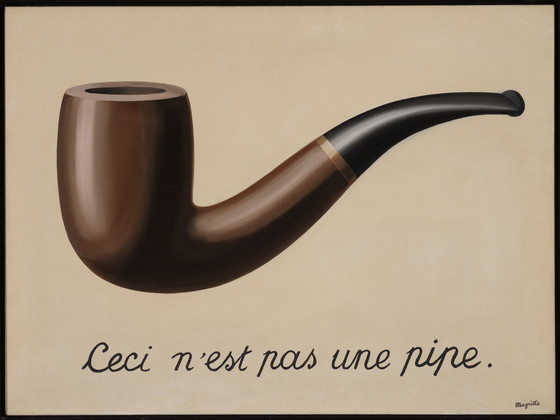
“The Treachery of Images” (Painting by Rene Magritte, image sourced from Los Angeles County Museum of Art)

Experts are treated with scepticism, scientists with suspicion, relativists with disdain, pluralists with apoplexy. Anyone seen to be challenging the status quo is dismissed as an “enemy of the people”. The public is being co-opted/coerced into buying wholesale certain political claims and party agendas (often hidden), without any opportunity to subject them to independent scrutiny or fact-checking.

Facts and logic are often the first victims in this abuse of language in the exercise of public discourse. Political slogans don’t even bother to avoid or deny accusations of propaganda: “Yeah? So what?” is often the response.

With that in mind, let’s play semantics and semiotics! To begin with, some opening statements:

1. This is a red car. (Observation, and a Fact if we agree on what is “red”) *

2. Red is the most popular colour of car. (Statement of Fact, if proved statistically) **

3. Red cars hold their value more than green cars. (Opinion, but also a Fact if it can be proved statistically, and we agree on what “value” means in this context)

4. Red cars are better than green cars, but blue cars are better than red cars. (Judgement tending towards a display of bias and prejudice)

Depending on the positioning and messaging, #1-#4 could be used in various marketing and advertising campaigns to sell red cars (or in the case of #4, sell blue cars).

Now, here are two reasonably uncontroversial propositions:

  • “Traffic laws are important to the functioning of society.”
  • “Good government relies on the democratic will of the electorate, and adequate funding of public services via taxation.”

We can see from the way language and truth are mangled in the service of current political debate and social commentary, that “statements of fact” can be easily positioned as “expressions of opinion” (and from there manipulated into pejorative and derogatory accusations or subtexts):

1. Red cars are involved in more road accidents than any other colour of vehicle
(Anyone who drives a red car is more likely to drive recklessly.)

2. People who drive red cars don’t observe the speed limit.
(Anyone who drives a red car is either a libertarian or an anarchist.)

3. People who drive red cars fail to pay their taxes.
(Anyone who drives a red car is anti-government.)

4. People who drive red cars are subversives.
(Anyone who drives a red car is a terrorist.)

5. People who drive red cars are law-abiding citizens.
(Anyone who drives a red car is a conservative. OR: Anyone who doesn’t drive a red car is a criminal.)

6. People who drive red cars give to charity but people who drive blue cars give more.
(Anyone who drives a red car is a better person than someone who drives a green car but not as good as someone who drives a blue car.)

The combination of sweeping generalisations and over-simplification in public discourse can obviously distort meaning and generate distrust. For example:

1. What if all taxis are red? That might mean they spend more time on the road, and therefore are more prone to be involved in traffic accidents.

2. What if more sports cars are red than any other colour? That might mean their drivers are more likely to speed. Or that their owners have more money. Or they are status conscious.

3. What if people who drive red cars come from a specific socio-economic, sectarian or ethnic demographic? Even then, they won’t all agree on the same issues, and they will likely display a similar range of divergent, opposing and contradictory views as the drivers of any other colour of car.

Unfortunately, the current environment for political debate and public commentary is being reduced to a binary state, where nuanced and subtle argument is being sidelined in favour of polarised and partisan politics, where facts are not allowed to get in the way of some convenient diatribe. If only politicians were accountable to voters under the Trade Practices Act – although we may soon see election campaigns subject to misleading and deceptive conduct legislation.

* Colour can also depend on context, as these experiments demonstrate: https://www.youtube.com/watch?v=FFC7EyR1lhU

** It’s not actually true: https://www.whichcar.com.au/car-news/most-popular-car-colours

Next week: Business as Unusual  

Pre-election Musings

At the time of publication, Australia is four days out from a General Election. At the time of writing, I have submitted my postal vote, as I will be overseas on polling day (May 18). I am certainly not going to call the result or predict the outcome, except to say it will probably be far closer than most people would have expected, maybe even a hung Parliament, with an even more fractious Senate. But I have to say that this has probably been the most difficult ballot I have had to complete.

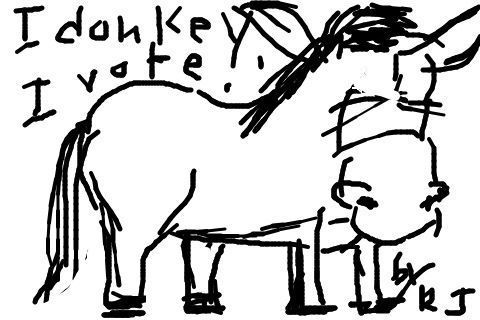
Image sourced from The Donkey Vote

For one thing, I can’t see why either of the major parties deserve my vote. Plus, in my own constituency for the lower house, the ALP candidate has been disendorsed, so as a result, I have been denied the option of voting for the official opposition. (More on this disendorsement later.) (Meanwhile the only Green Party MP who sits in the lower house and who represents my constituency, labelled himself an “independent voice”. Does that mean he no longer represents the views of the Green Party?)

Why do I feel this way about the two major parties?

First, neither party leader inspires me – they are purely products of their political organisations and their respective factions, and display very few leadership qualities other than they probably know how to stitch together half-baked policy deals in their party meeting back rooms. I doubt they have ever had an original idea, and certainly not since they became the leaders of their particular factions, let alone leaders of their parties.

Second, both parties have simply been sloshing around tax payers’ cash – funding here, pork barrels there, sleights of hand all over the place. I agree that most areas of public services and infrastructure demand a rethink on their current funding models, and some deserve more money. But from what I have been able to glean so far, most of these funding commitments and/or budget re-allocations are mostly about headline amounts, and not measurable outcomes, assuming they have been properly costed in the first place.

Third, despite all the money on offer, there have been few, if any, announcements on more fundamental issues of economic and structural reform such as competition policy, productivity measures, innovation, startups, etc. Yes, there have been some financial and tax incentives thrown out to small businesses who take on more staff, or who invest in new equipment, but these are just the usual tweaks. And there has been very little debate about the need to review the design, delivery, quality and accountability of public sector services.

Fourth, and the one main thing that the major parties have in common, is that the only policy levers they seem willing to push/pull are continued fiddling about with tax rates, superannuation and industrial relations. All of which is counterproductive, as it just means the focus is on winners and losers, and the resulting class-war based “politics of envy” and crass take-downs of the “big end of town”.

So let’s talk about jobs.

Much of the money ear-marked for particular industries or service sectors is intended to support job creation. Where are most people employed in Australia? By industry category, the top sectors are: Health Care; Retail; Construction; Professional, Scientific and Technical Services; and Education. Most of which are destined to be the recipients of tax payer-funded largesse after the election. And while I agree that Health, Education and Public Infrastructure need to be adequately and properly resourced, innovation and the high-tech jobs of the future will more likely come from the Professional, Scientific and Technical Services sector. (And $3m for a “Blockchain Academy” is woefully inadequate for long-term thinking and vision.)

But as should be obvious to anyone, industries don’t create jobs, companies do. And most people in Australia (70% of the working population) are employed by small to medium-sized businesses. Of the nearly 2.2m registered businesses, 60% have zero employees (mostly they are owner-operated sole traders, including self-employed tradespeople), more than a quarter of businesses employ fewer than 5 people, nearly 10% of businesses employ between 5 and 20 people, 2.4% employ between 20 and 200 people, and only 0.2% of businesses (c. 3,800 companies) employ more than 200 people. In addition, only 100,000 businesses have an annual turnover of $2m or more. Welcome to the long tail of the Australian economy.

As for the election outcome itself, it will largely be determined by swing voters in marginal seats. Five of the 10 most marginal seats are in Queensland. And with the Adani mine project being such a divisive topic, this one item could determine who takes government. And even if Labor wins a majority in the House of Representatives, the Senate will be even more split between minor parties, and whoever wins government will find it difficult to navigate the upper chamber. In my own state of Victoria, there are something like 30 party groupings and around 80 individual candidates standing for just 6 seats. Trying to research the minor parties and their candidates or their labyrinthine preference deals is virtually impossible, which cannot be healthy for the democratic process under the proportional representation system of the single transferable vote model.

The real issue, though, is that with 3-year Federal Parliaments, parties are in perpetual campaigning mode. There is very little long-term thinking or vision, while short-term compromises are the order of the day. All of which results in either total inertia when it comes to making any real structural change, or constant policy tweaking to keep ahead in the polls. All hot air and no momentum.

Finally, coming back to the disendorsed Labor candidate for the lower house in my constituency of Melbourne. The party was forced to act (albeit somewhat reluctantly and almost equivocally) when the candidate’s social media past caught up with him. At first, the party and its Leadership suggested that the 29-year old candidate should be forgiven his indiscretions because he was “only” 22 at the time said offensive remarks were posted. I think that argument is total hogwash. If you are not going to be held responsible or accountable for the consequences of your actions at the age of 22, then you should not have the right to vote, get married, have children, stand for election, serve on a jury, sign a contract or take out a mortgage because clearly you have not fully developed as a mature adult, and your capacity to think and make important decisions is obviously impaired, such that you cannot be relied upon to exercise reasonable judgement.

Next week: Trends in LegalTech


Revolving Doors At The Lodge

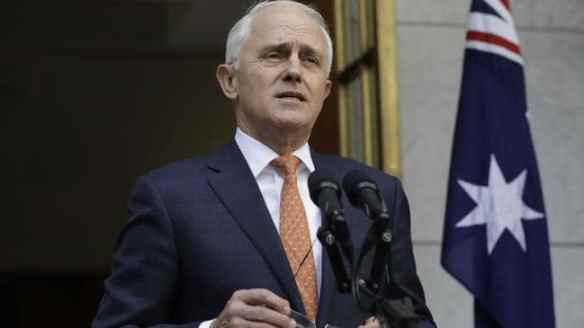
Since his unceremonious dumping as leader by his colleagues in the Parliamentary Liberal Party, former Prime Minister Malcolm Turnbull must be wondering why the party that spat him out twice (despite benefiting from his personal donations) accepted his membership in the first place. So adamant were his conservative enemies that Turnbull was “not one of us”, they were willing to sacrifice not only Turnbull’s status as preferred Prime Minister, but also his popular deputy, Julie Bishop, and their own preferred leadership candidate, Peter Dutton.

Turnbull’s farewell speech – image sourced from The Australian

All of which suggests Australian democracy (or at least, the version played out by our political parties) is seriously damaged, if not actually broken.

Turnbull is the fourth sitting Prime Minister to be dumped by his or her own party in less than 10 years (and let’s not forget he himself ousted his predecessor). This latest incident suggests that the problem is not with the electoral system, but with the party system that controls the management and exercise of political power – and with scant regard for the voters who directly elect their constituency representatives.

Here’s why I think party politics are the root cause of Australia’s current leadership malaise:

1. No legal or constitutional basis

Quite simply, political parties are neither mentioned in the Constitution, nor formally defined in any Act of Parliament. Their role in our democracy is entirely by custom and convention – in a way, we tolerate them as a “necessary evil”, because we are led to believe that Parliament cannot function without them. At best, Parliamentary parties operate under a license, one which should not be seen as a right, but as a privilege. And like all such licenses, this privilege should be subject to being revoked at the will of those who granted it – the electorate.

2. If our political parties were treated like corporations….

…. they would likely be hauled before the ACCC every time they broke an electoral promise, for misleading, unconscionable or deceptive conduct. Sure, circumstances can change once governments are elected – but should it be a requirement for governments to re-establish their political mandate before they make a significant u-turn? In fact, political parties are exempt from a number of legal provisions that apply to companies. Political parties may have a paying membership that determines policy, candidate selection and other procedural matters – but they are not directly answerable to the customers they purport to serve: the general electorate.

3. Our elected representatives are not even accountable to their electorates….

…. except at election time. The notion that voters elect parties into power needs to change. Voters elect individual candidates who stand for office. Even if a candidate aligns with a specific political party, there is no binding obligation on them to sit as a member of that party once they are elected. By switching party allegiance, elected representatives who cross the floor are being disrespectful of the same (flawed) party system that saw them selected to stand for election. But they are also disregarding the wishes of their electorate, who may have been convinced or persuaded to vote for them on the basis of their stated party allegiance.

4. Voters are increasingly excluded from choosing their Prime Ministers (and their governments)

Of course, we do not directly elect our Prime Ministers. The parliamentary convention is that the elected member who commands a majority in the house of representatives is invited by the Governor General to form government. The parliamentary custom and practice is that the leader of the parliamentary party that holds most seats becomes the de facto leader of the government, and hence Prime Minister. Increasingly, the largest party bloc may not command a majority. So formal and informal coalitions have to be formed, often between competing political parties, to enable minority government to function. Such alliances may be politically expedient, but they cannot be said to represent the will of the people, if we assume that the electorate is expected to vote along formal party lines. Besides, if the party system is to retain any credibility, shouldn’t voters be entitled to expect that the leaders of the parliamentary parties, which they have (indirectly) elected to lead that party, should continue to lead unless and until they have been voted out by that same electorate?

5. Voters are not even consulted when Prime Ministers are rolled mid-term

Since Prime Ministers are not directly elected, voters have also been excluded from the process when political parties choose to roll their own Prime Minister (and effectively change the government without having to call a general election). Do the party factions who seek a leadership change bother to directly consult their paid-up local party members, or their own party voters, or the local constituents they purport to represent (regardless of which way they voted at the previous election)? To me, this represents a huge fraud on the population – and the party system is at the heart of this “madness”.

6. The failure of (party) political leadership

During the 2013 general election I commented on the lack of public support for the then leaders of both major political parties – part of what I saw as a broader failure of leadership across multiple public institutions that claim to represent our interests. Regardless of their party allegiances, the electorate seems increasingly disillusioned, if not repelled, by the party back-stabbing, treachery and disloyalty. The result is, we are poorly served by our elected representatives and the governments they form along supposed party lines.

7. Politics is not binary….

…. but the party system forces us to think this way. On most party-driven policy questions, the answer cannot be reduced to “for” and “against” – there are just too many shades of grey. This is especially true of the key policy area that seems to have brought down the last four Prime Ministers – climate change, energy and the environment.

First, Kevin Rudd abandoned the ETS, a decision which he later regretted. He claimed that the main actors in his own demise were the ones who agitated for this policy u-turn.

Second, Julia Gillard avowed that she would not introduce a carbon tax – and the electorate never forgave her for her later u-turn, resulting in her being dumped by Rudd.

Third, Malcolm Turnbull was unhappy at the direction Tony Abbot was taking the Liberal Party on climate change.

Fourth, Turnbull came a cropper on energy policy (linked to climate change), even though he had decided to capitulate to the right-wing views in his own government and Party.

You have to think that something as important as climate change demands a bipartisan solution – but the party system just keeps getting in the way.

8. “Power, corruption & lies”

Finally, in recent years we have seen a litany of corruption and other cases involving our major (and some minor) parties, and the factions within – a further cause of the lack of public trust and respect for parties, politicians and power-brokers. Add to this mix the relatively small numbers of directly paid-up members of political parties, issues of party funding and campaign donations, the party stuff-ups on disqualification due to dual citizenship, and the ongoing saga of MP’s expenses, a key conclusion is that the political party system is not conducive to modern democracy or the electoral, parliamentary and government processes. And while it is sometimes said that we get the type of governments we deserve, I don’t think any member of the general electorate would say they voted for the current situation.

Next week: Separating the Truth from the Facts