The future of #FinTech is in Enterprise Solutions

Talk to anyone involved in FinTech, and apart from telling you the sector is “hot”, there’s little consensus on what happens next. Despite positioning itself as a disruptive force within financial services, much of what goes on in the sector is either driven by regulatory reform, or by technological developments in allied fields. Most of the disruption so far is in retail and B2C services, yet the more significant opportunities are likely to be found in enterprise and B2B solutions. But as The Economist commented recently, “The fintech firms are not about to kill off traditional banks.”

The Current State

In broad terms, FinTech is working in four main areas:

  • Cryptocurrencies
  • Payments
  • P2P lending
  • Financial Advice and Planning

The first two are responding to dual technological advances – namely, the use of block chains and cryptography; and increased sophistication around mobile and GPS. Patrick Maes, CTO of ANZ Bank, has stated that “Bitcoin and block chain are the first payments innovations in 2,000 years.” He also has a FinTech “wish list”.

The second two (at least, within Australia) are benefitting from regulatory changes, such as the new positive consumer credit reporting regime, and the Future of Financial Advice reforms. And when the National Payments Platform scheduled for 2017 mandates real-time settlements, everyone will have access to immediate inter-bank payment services.

Of course, there is some overlap among these categories, which in turn are also benefitting from developments in big data analytics, mobile solutions, social media platforms, and consumer trends like crowdsourcing and the shared economy.
CCE2z9TVIAENCcE

It may be interesting – but it’s not whole picture

Disintermediation May Not Be Enough?

Most of the FinTech disruption has been in the nature of disintermediation – displacing the role of traditional banks and merchant services in providing payment solutions, point-of-sale facilities and personal loan products. But given the relatively small margins on these services, you either need to have a totally different cost structure, or a significantly large market position to achieve scale and volume.

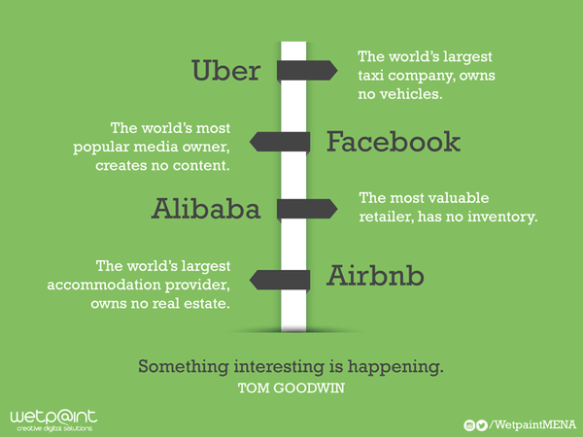
You will have seen the above infographic, often quoted with a sense of wonder at how these companies have built huge businesses seemingly without having to own any physical assets. Well, yes, but dig deeper, and what do we find? The banks have always worked on the same principle – they take customer deposits (which they don’t own), and then lend them to borrowers (whose secured assets they don’t own unless there is a default).

The main difference is that banks are highly regulated (unlike most of these digital market disruptors), and as such they have to hold sufficient capital assets to cover their exposures. Meanwhile, the banks finance the car loans taken out by Uber drivers, they provide credit facilities and export guarantees to Alibaba traders, they underwrite the mortgages on properties used for Airbnb, and will likely provide e-commerce services to advertisers who use Facebook.

For me, probably the last major FinTech disruptor was Bloomberg (founded back in 1981), because it changed the way banks and brokers accessed news and information to support their trading activities, by introducing proprietary analytics and data tools via dedicated terminals, screens and datafeeds. So successful has Bloomberg been that it now owns about one-third of the global market for financial data, and is the single-largest player (albeit by a very small margin over main rival Thomson Reuters – itself, a merger of two key data vendors). Plus Bloomberg is still privately held.

The Future State

I don’t believe FinTech can truly come of age until a major enterprise solution appears. For different reasons, Stripe and BlueDot could be on their way, but both are primarily operating in the consumer payments sector.

I have written previously on the areas where FinTech could impact institutional banking and securities trading, including loan origination, data analytics and risk management. I’ve also reported on the opportunity to disrupt traditional market data vendors by changing the pricing and consumption models. And elsewhere, I have hypothesized on how banks’ trade finance services could be disrupted.

The areas where “Big FinTech” could truly make a difference are:

  • Counterparty Risk Management
  • Predictive Credit Risk Analytics
  • Loan Pricing Models
  • Unit Pricing Calculations
  • Collateral Management
  • Portfolio Performance Attribution
  • Sentiment-based Trading and Risk Pricing

However, the final word should go to Patrick Maes, who suggested that a huge opportunity exists in deposit products linked to customer loyalty programs and frequent flyer points – what if your credit card points could be used to finance a car lease or as part of the deposit on your first home?

Next week: Change Management for Successful Product Development

Stripe’s John Collison: “Better to be #disruptive than incumbent”

In a Melbourne fireside chat with Paul Bassat (hosted by NAB and Startup Victoria) Stripe‘s co-founder and President, John Collison offered the insight that “it’s better to be disruptive than incumbent”.

Incumbency comes with all the baggage of legacy data, semi-redundant systems, siloed business operations, and customers with long memories.

Whereas, a nimble and agile startup like Stripe can cut out inefficient and lazy business processes – especially in areas like online and mobile payment systems. And in doing so, a disruptive service can make us think, “how did we ever manage before this was invented?”

Collison was careful, though, to point out that Stripe is working with the banks, not against them, in case anyone thought his company has designs on becoming a fully fledged financial institution. “We simply want to make the payments business more efficient.”

Stripe’s approach is to leverage engineering skills and solutions “to fix first world and middle class problems”. Precisely so – why would you want to undermine the system (payments and transfers between banks and their customers) that gives rise to your very existence?

Collison also reflected that never before has it been possible for such a small number of people to create such enormous value, very quickly – citing the fact that WhatsApp had a mere 55 employees when it was acquired by Facebook earlier this year for $19bn. (Stripe itself, founded in 2010, had about 100 employees when it was valued at $1.75bn around the same time.)

While WhatsApp does not yet generate revenue, its valuation as a disruptive IM platform is largely based on a notional value per user, and what that may represent in terms of data from customer analytics or premium pricing for add-on services.

But you don’t even need to be a startup business to disrupt an existing market, as the music industry continues to discover to its cost – you simply need to be part of the demographic that is used to “free” stuff, has no real concept or appreciation for IP, refuses to pay for anything on the internet, and develops brand loyalty based on likes, shares and number of views. Even Stripe would be out of business if everyone switched to peer-to-peer money transfers without wanting to pay commissions or transaction fees.


Oxygen Ventures brings some fresh air to Australia’s #Startup Community

Last week, Larry Kestelman’s new investment vehicle, Oxygen Ventures gave 5 local startups the opportunity to bid for a share of A$5 million in funding at the inaugural Big Pitch night in Melbourne (#thebigpitchAUS).

item_034_s

The Judges at the Big Pitch


The #Startup Contenders

Drawn from over 300 applicants, the hopeful candidates (in alphabetical order) were:

Bluesky  Shopping portal for leading fashion and lifestyle brands.

ECAL On-line event and brand marketing calendar launched by E-DIARY.

etaskr Enterprise productivity solution that allows employees to ‘bid’ for in-house projects based on their expertise.

KartSim New go-kart game for PCs, from developer Black Delta.

WeTeachMe Booking platform for short-courses and special interest classes.

After each contestant made a short presentation, they were questioned by a panel of judges, comprising CEOs, entrepreneurs, corporate advisers and business development experts from a range of well-known organizations. Most of the questions related to the startups’ revenue projections, funding requirements and growth opportunities – but some were grilled in more detail about their business models and financial performance to date.

How did the participants fare on the night?

The Joint Winners were ECAL and WeTeachMe – with the People’s Choice Award (based on audience votes) going to KartSim.

My sense is that ECAL came out on top (with A$2.5m of funding) on account of their early success in signing up a number of high-profile sporting franchises in the USA and Australia, demonstrating their growth potential – otherwise with 1 million users, but only $440,000 in revenues, you’d have to think the business model would struggle.

WeTeachMe was successful in attracting A$2m in funding because the business model is simple, it falls into the growth category of lifelong learning, and the platform had already achieved significant productivity gains for its commercial clients. Plus it has the potential to scale up and go international.

With KartSim, I admit I have no interest in computer games, but it would seem to me that with a headful of (virtual) Steam behind it, the developers might be better off tapping into crowdfunding opportunities, as the early interest suggests ready and eager buyers out there, enabling a successful commercial launch without giving up any of the equity.

Feedback from the panel on Bluesky suggested that despite offering a ‘one-stop-shop’ for consumers, the margins generated from the sales commission model would be insufficient to cover fulfilment costs (so it would only ever be a transactional purchasing platform); nor would the retailer aggregation model ever be allowed to encroach on brand or retailer loyalty schemes, thereby limiting the options to develop added-value services for customers.

As for etaskr (which I have featured before), it is still one of the few B2B startups that I have seen, which may make it appear less attractive to potential investors, since there seems to be some wariness around anything that is not consumer-focussed, or that does not play in a 2-sided market. Personally, I think this type of productivity tool is just the sort of tech startup that we need as it taps into the technological, organisational and demographic changes facing the modern workplace, and current attitudes towards job structures, collaboration and employee engagement and retention.

Footnote: What is ‘Disruptive’?


Interestingly, one of the Big Pitch sponsors was Uber (current darling of the startup community – if not of taxi drivers) which has been making presentations around town on what it takes to market a disruptive startup.

For me, there are three key attributes to a #disruptive startup:

  • Technology
  • Business model
  • Market engagement

A business like Uber ticks all three boxes – its proprietary technology comes in the form of the algorithms that track things like customer usage and vehicle capacity (not so much the apps which are similar to other peer-to-peer and #sharedeconomy solutions); the business model is rather like a network of city franchises (a common global platform with local autonomy); and the disruptive market entry strategy is designed to by-pass highly regulated industry structures – although Uber also likes to stress that it is working with taxi regulators.

Of the five startups that competed at the Big Pitch, only etaskr brings an element of disruption, because it is using a technology solution to challenge traditional notions of what a job is, and allows companies to tap into in-house resources that they might not otherwise be aware of. KartSim has some proprietary programming, but at the end of the day is just another computer game. WeTeachMe and Bluesky are trying to bring operational efficiencies to disparate markets, but they are both broker-aggregators, and don’t appear to have proprietary technology or unique business models. And ECAL is a neat content management solution to a problem that companies have been aiming to solve in other sectors – such as travel, education and health services – although it is not trying to break the existing market nexus between suppliers and customers.

But full marks to Oxygen Ventures, its partners, sponsors and the participants themselves for bringing a fresh perspective to the startup pitch night experience.