Music streaming is so passé…

Streaming services have changed the way we listen to music, and not just in the way the content is delivered (primarily via mobile devices), or the sheer number of songs available for our listening pleasure (whole catalogues at our fingertips).

These streaming platforms (which have been with us for more then 15 years) have also led to some more negative consequences: the deconstruction of albums into individual tracks (thereby undermining artists’ intention to present their work as a whole, rather than its component parts); shifting the relationship we have with our music collections from “ownership” to “renting”; paying paltry levels of streaming fees compared to royalties on physical sales and downloads; pushing suggested content via opaque algorithms and “recommender engines” rather than allowing listener self-discovery; squashing music into highly compressed audio formats, thus impairing the listening quality; and reducing album cover art work and design into tiny thumbnail images that don’t do justice to the original. (If you can’t appreciate the significance and importance of album art work, this forthcoming documentary may change your mind.)

Of course, streaming is not the only way to consume music – we still have vinyl, CDs and even cassettes in current production. (And let’s not forget radio!) Although optimistic numbers about the vinyl revival of recent years have to be put in the context of the streaming behemoths, there is no doubt that this antique format still has an important role to play, for new releases, the box-set and reissue industry, and the second-hand market.

For myself, I’ve largely given up on Spotify and Apple Music: with the former, I don’t think there is enough transparency on streaming fees (especially those paid to independent artists and for self-released recordings) or how more popular artists and their labels can pay to manipulate the algorithms, plus the “recommendations” are often out of kilter with my listening preferences; with the latter, geo-blocking often means music I am looking for is not available in Australia. (As I am writing, Spotify is playing a track which has been given the wrong title, proving that their curation and editorial quality is not perfect.)

Streaming can also be said to be responsible for a type of content narrowcasting – the more often a song is streamed (especially one that has been sponsored or heavily promoted by a record label) the more often it will appear in suggested playlists. Some recent analysis by Rob Abelow suggests that fewer than 10% of songs on the Spotify billion stream club were released before 2000. This may have something to do with listener demographics (e.g., digital natives), but it also suggests that songs only available as streams (i.e., no download or physical release), or songs heavily marketed by labels wanting to promote particular content to a specific audience, will come to dominate these platforms.

Further evidence of how streaming is skewed towards major artists is a recent post by Damon Krukowski, showing how independent musicians like him are being “encouraged” to be more like megstars such as Ed Sheeran. Never mind the quality of the music, just think about the “pre-saves” and “countdown pages” (tools which are not yet available to every artist on Spotify?).

I’ve been using both Bandcamp and Soundcloud for more than 10 years, to release my own music and to discover new content. I began with Soundcloud, but soon lost my enthusiasm because they kept changing their business model, and they enabled more popular artists to dominate the platform with “premium” services and pay-to-play fees that favour artists and labels with bigger marketing budgets. Whereas Bandcamp appears to be doing a better job of maintaining a more level playing field in regard to artist access, and a more natural way for fans to connect with artists they already know, and to discover new music they may be interested in.

But all of this simply means that streaming has possibly peaked, at least as an emerging format. The industry is facing a number of challenges. Quite apart from ongoing disputes about royalty payments and album integrity, streaming is going to be disrupted by new technologies and business models, thanks to blockchain, cryptocurrencies and non-fungible tokens. These startups are going to improve how artists are remunerated for their work, create better engagement between creators and their audiences, and provide for more transparent content discovery and recommendations. Elsewhere, the European Union is considering ways to preserve cultural diversity, promote economic sustainability within the music industry, remove the harmful effects of payola, make better use of content metadata for things like copyright, creativity and attribution, and provide clear labeling on content that has been created using tools like AI.

Just for the record, I’m not a huge fan of content quotas (a possible outcome from the EU proposals), but I would prefer to see better ways to discover new music, via broadcast and online media, which are not dependent on regimented Top 40 playlists, the restrictive formats of ubiquitous TV talent shows, or record label marketing budgets. Australia’s Radio National used to have a great platform for new and alternative music, called Sound Quality, but that came off air nearly 10 years ago, with nothing to replace it. Elsewhere, I tune into BBC Radio 6 Music’s Freak Zone – not all of it is new music, but there is more variety in each 2 hour programme than a week’s listening on most other radio stations.

Next week: More Cold War Nostalgia
 

Digital Perfectionism?

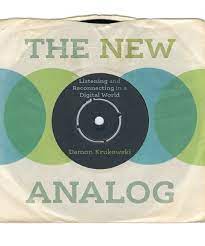
In stark contrast to my last blog on AI and digital humans, I’ve just been reading Damon Krukowski‘s book, “The New Analog – Listening and Reconnecting in a Digital World”, published in 2017. It’s an essential text for anyone interested in the impact of sound compression, noise filtering, loudness and streaming on the music industry (and much more besides).

The are two main theses the author explores:

1. The paradoxical corollary to Moore’s Law on the rate of increase in computing power is Murphy’s Moore’s Law: that in striving for improved performance and perfectionism in all things digital, equally we risk amplifying the limitations inherent in analog technology. in short, the more something improves, the more it must also get worse. (See also my previous blogs on the problem of digital decay, and the beauty of decay music.)

2. In the realm of digital music and other platforms (especially social media), stripping out the noise (to leave only the signal) results in an impoverished listening, cultural and social experience; flatter sound, less dynamics, narrower tonal variation, limited nuance, an absence of context. In the case of streaming music, we lose the physical connection with the original artwork, accompanying sleeve notes, creative credits and even the original year of publication.

Thinking about #1 above, imagine this principle applied to #AI: would the pursuit of “digital perfectionism” mean we lose a large part of what makes analogue homo sapiens more “human”? Would we end up compressing/removing “noise” such as doubt, uncertainty, curiosity, irony, idiosyncrasies, cognitive diversity, quirkiness, humour etc.?

As for #2, like the author, I’m not a total Luddite when it comes to digital music, but I totally understand his frustration (philosophical, phonic and financial) when discussing the way CDs exploit “loudness” (in the technical sense), how .mp3 files compress more data into less space (resulting in a deterioration in overall quality), and the way streaming platforms have eroded artists’ traditional commercial return on their creativity.

The book also discusses the role of social media platforms in extracting value from the content that users contribute, reducing it to homogenised data lakes, selling it to the highest bidder, and compressing all our personal observations, relationships and original ideas (the things that make us nuanced human beings) into a sterilsed drip-feed of “curated” content.

In the narrative on music production, and how “loudness” took hold in the mid-1990s, Krukowski takes specific aim at the dreaded sub-woofer. These speakers now pervade every concert, home entertainment system, desk-top computer and car stereo. They even bring a distorted physical presence into our listening experience:

“Nosebleeds at festivals, trance states at dance clubs, intimidation by car audio…. When everything is louder than everything else, sounds lose context and thus meaning – even the meaning of loud.”

The main issue I have with digital music is that we as listeners have very little control over how we hear it – apart from adjusting the volume. So again, any nuance or variation has been ironed out, right to the point of consumption – we can’t even adjust the stereo balance. I recall that my boom box in the 1980s had separate volume controls for each speaker, and a built-in graphic equalizer. To paraphrase Joy Division, “We’ve Lost Control”.

Next week: I CAN live without my radio…

The Current State of Popular Music

Over the holidays, during a family get-together, two younger relatives mentioned what their favourite pop song was. I did not know the song by title or artist, and until very recently I actually I thought it was an advertising jingle. I now understand that the combination of the song’s novelty factor and its ubiquitous appearance had helped to make it very popular. I can see why it may appeal to kids – but I doubt it will become an evergreen classic….

The song they mentioned incorporates a number of musical tropes very prevalent in many current pop songs, especially as regards the vocal styling and lyrical phrasing. But like much of the music being produced these days, it will likely be forgotten within a couple of years at most. The inherent “novelty” of the vocal could render the song a one-hit wonder, and the artist a one-trick pony.

I have nothing wrong with pop music per se, but if “we are what we eat”, surely we can become what we listen to. An unending and unvarying diet of mainstream pop music (as defined by commercial radio playlists, as measured by self-serving charts compiled by streaming services, and as financed by major record label marketing budgets and promotional tie-ins) is the equivalent of eating nothing but fast food and processed snacks.

So, at the risk of being labelled a grumpy old man, here is a list of things that are mostly wrong with contemporary pop music:

1. Vocals that feature one (or more) of the following:

  • the sound of cutesy chipmunks on helium
  • forced falsettos, cracked breathlessness and over-emoting warbling
  • singing from the back of the throat (as if constipated)
  • singing through the nose (as if congested)
  • whining, strained upper registers  (as made infamous by a certain tantric pop star)
  • auto-tune effects (especially those in search of a melody…)
  • shouting in place of projection
  • turning vowels into consonants, and consonants into vowels
  • adding syllables that don’t exist, and leaving out ones that do
  • over-stressed sibilants

2. Lyrical phrasing, scansion and rhyming schemes courtesy of Dr. Seuss,

3. Slogans, nursery rhymes and shouty phrases in place of lyrics

4. Drum and percussion tracks either programmed by ADHD, or inflicted with St. Vitus’s Dance

5. Boring, boxy and plodding 4/4 rhythms, with no syncopation or variation

6. Same set of production techniques and sound effects as used by every other producer or DJ

7. Samples based on the nastiest ringtones available (or programmed on the cheapest synths around)

8. Never mind a lack of key changes, or an absence of chord progressions, songs that revel in one-note vocal lines

9. An absence of interesting melodic or harmonic structures

10. Sound compressed into the smallest available bandwidth so it is easier to stream, but which ends up sounding flat and claustrophobic, and with exactly the same sound dynamics as every other song

11. No space to let the music breathe – every available beat and bar has to be filled up, especially with vocalese stylings

12. Too many cooks – songs by “X feat. Y with Z” are usually contrived concoctions dreamed up by the record company (“hey, we can flog this song to fans of all three of them!”) that end up as filler tracks on their respective solo albums

13. Kitchen sink productions (as in everything BUT the…) – you can almost imagine the producer in the studio shouting, “cue flamenco guitar, cue rapping, cue 80’s sample, cue metronomic rimshot, cue call and response vocals, cue detuned kick drum….!”

Part of the problem is that with the cheaper costs of recording, and the wider access to the means of production, anyone can make music, and release it direct to the public online. Meaning there is just so much more new music to listen to. However, the major record labels and their media partners still control most of the marketing budgets and distribution costs, that largely decide the songs we tend to hear, and that ultimately determine which songs become “hits”. By default, this process prescribes much of what is deemed “popular taste”. With the increased use of algorithms and other techniques, artists, producers, labels and media platforms can increasingly predict what songs will be successful, in a self-fulfilling prophesy of what will “sell”. it’s like punk never happened….

Next week: Sola.io – changing the way renewable energy is financed

Geo-blocking: the last digital frontier?

Last month, senior executives from AdobeApple and Microsoft were summoned to appear before an Australian Parliamentary inquiry into IT pricing policies. It was alleged that Australian consumers can pay up to 70% more for comparable products and services sold in other markets.

Leaving aside the additional costs of distributing and shipping physical goods to Australia, at the heart of the pricing disparity is the practice of “geo-blocking” whereby customers in one location cannot purchase digital or physical products direct from vendors outside their country of residence. It’s the sort of industry practice that prevents Australian consumers buying some print books and CD’s from Amazon.com or Amazon.co.uk (and neither store sells MP3’s to Australian customers).

When asked to explain the apparent disparity in market pricing, the tech execs responded with comments such as, “the inclusion of Australian sales tax in the retail price is confusing”, “it’s a reflection of the cost of doing business in Australia” and “it’s all because of the content owners’ and copyright holders’ archaic territorial licensing practices”.

Their answers were variously described as “evasive“, “unbelievable” and “failed to impress“. The suggestion by one CEO that Australian consumers should fly to the USA to buy cheaper products overseas, was frankly ludicrous, especially as sales warranties given in America would likely be invalid once the goods were brought back to Australia.

When it can be cheaper to buy a CD copy of an album from an on-line music retailer in the UK rather than download the MP3 version from a vendor in Australia, clearly there is something wrong with this picture.

Parallel imports” and “grey goods” are terms used in the fashion, cosmetic and other retail sectors to describe situations where wholesalers and distributors import branded goods that are technically subject to strict territorial sales and distribution licenses held by third parties. Alternatively, consumers in one country purchase goods direct from a retailer or distributor located in another country, who does not have the rights to sell or export the products to the consumer’s country of residence. The license holders can seek to block these unauthorized imports/exports, but in cases where the license holder has chosen not to distribute those specific goods, these “grey” imports could possibly be deemed legitimate (under the “use it or lose it” principle).

Whatever the legal interpretation of territorial licensing, when it comes to digital content, is geo-blocking still appropriate? Let me offer an illustration:

Imagine you are an Australian traveller on a business trip to New York. You visit a local book shop, to pick up a copy of the latest novel by your favourite author.

Unfortunately, the salesperson tells you the book is not in stock, because the publisher does not distribute that particular title to independent stores; instead, you have to go to the mega book store across town.

After making your way to the mega store, you find out that before you can make any purchase, you have to open an account, submit your credit card details and other personal information (and sign a contract that says things like “you must always keep books bought from our store in our proprietary and specially designed book shelves”).

Just as you are about to make your purchase, the shop assistant asks you for your passport. “Oh, I’m sorry, we don’t sell our books to people from Australia. You have to go to our mega store in Sydney.”

On the way back to your hotel, you phone the publisher (whose office is on your route) to see if you can buy a copy direct from their sales department. The conversation goes something like this:

“You sound Australian. Sorry, but we can’t sell it to you. You have to buy it from our Australian distributor.”

“OK, can you tell me who the Australian distributor is, or which shops stock your titles?”

“I’m not sure. I think it depends on who the author is. Or whether it’s the hardback or paperback edition. Or whether our distributor is importing that particular title. Maybe we only sell it through the Australian branch of the mega book store that wouldn’t sell you it to you while you were in town. Have a nice day.”

Great. With nothing to read on the 20-hour flight back to Australia, you catch up on a lot of episodes of “Bored to Death”, because you don’t expect them to be shown on Australian TV for at least a year. (But that’s another industry scenario…)

Back home in Australia, you visit the Sydney branch of the mega book store. “I’m sorry, we don’t have that title in stock, because we haven’t had enough customer requests to justify importing any copies…..”

Is it any wonder, with these sorts of restrictive commercial practices common in the software and digital content industries, that Australia has the highest level of illegal music downloading by capita, not because all Australian consumers are unwilling to pay for content, but often because customers cannot legitimately buy it.