Crypto Regulation in Australia

You wait ages for a bus, then several come along at the same time. The past week has seen three major developments in Australia regarding the regulation of cryptocurrencies, digital assets and the industry in which they operate.

First, there was the Final Report of the Senate Select Committee on Australia as a Technological and Financial Centre. Among other things, the Committee has recommended a specific regulatory framework for Digital Currency Exchanges, a formal custody regime for digital assets, a classification (or “token mapping exercise”) for the various types of digital assets, and a legal framework to recognize Decentralised Autonomous Organisations as a form or company structure.

Second, AUSTRAC issued a Statement on De-banking, that urges banks and financial institutions to take a case-by-case approach when reviewing potential risks associated with clients engaged in Blockchain and cryptocurrencies. Rather than applying a blanket ban or refusal to deal with Blockchain and crypto businesses, banks and other providers should exercise more discretion, and adopt workable and practical solutions to meet their risk management and KYC/AML obligations. Echoing the overarching theme of the Senate Select Committee, AUSTRAC recognises that de-banking crypto risks stifling innovation, and/or forcing crypto businesses to resort to less than ideal alternative service providers.

Third, ASIC released its Response to submissions made under the recent consultation on Crypto-assets as underlying assets for ETPs (aka Report 705 on CP 343). While there is some overlap with the scope and terms of reference of the Senate Select Committee, ASIC maintains its position that it does not want to be responsible for developing policy on regulating digital assets (that’s the role of Government); while at the same time stating in very clear terms how it believes cryptocurrencies should or shouldn’t be classified (and regulated). For example, ASIC did not accept the view of many respondents that crypto-assets which are not deemed financial products should be treated as commodities. In part, because there is no definition of “commodity” in the Corporations Act; but also because the discussion has been more about market operators, rather than the specific nature of the assets themselves.

Meanwhile, ASIC remains very prescriptive about the criteria for approving certain cryptocurrencies as the underlying assets for exchange traded products (ETPs) – including criteria which received push back from the industry as being too restrictive or inflexible. On the other hand, ASIC does appear to accept that if crypto-assets cannot be defined as financial products (or commodities), then a distinct category is required. This is the case that has often been put forward by the industry, namely the need to define instruments commonly known as utility tokens. To its credit, ASIC has made a fair stab at coming up with a workable definition of crypto-asset as:

“a digital representation of value or rights (including rights to property), the ownership of which is evidenced cryptographically and that is held and transferred electronically by:
(a) a type of distributed ledger technology; or
(b) another distributed cryptographically verifiable data structure.”

While the overall tone of these developments is encouraging, they still reveal a need for greater consistency (and inter-agency co-ordination), and the lack of a well-articulated policy on this fast-growing FinTech sector.

Next week: Is crypto finally going mainstream?


To be or NFT?

If there’s one consistent lesson to be learned from Blockchain and crypto is that the enabling technology often outpaces our understanding of the viable use case, commercial application or sustainable business model. For example, smart contracts have only recently proven their value with the rise of decentralized finance (DeFi). Even then, they are not perfect and if not well-coded can result in hacks, losses or other damage. Plus, until scaling (transaction throughput) and gas fees (transaction costs) are properly resolved, mass adoption is still some way off.

CryptoPunk #7523 (Image sourced from Reuters)

The latest crypto phenomenon is the market for NFTs (non-fungible tokens). Artworks in the form of digital files are being created, auctioned and traded for serious (or very silly?) amounts of money – just Google EtherRock, Beeple, CryptoPunk or Rare Pepe for recent examples.

NFTs are not just confined to digital art – animation, video, music and text are all being created in the form of NFTs. In addition, NFTs are being minted to represent ownership or other IP rights for physical artworks, real estate assets, collectibles and luxury goods.

Why would anyone pay the best part of US$12m for the original digital file of CryptoPunk #7523, a copy of which I have displayed above?

Perhaps we need to consider the following:

First, the image above is simply a low-res web image, easily reproduced via copy and paste – it’s not the “real” image as represented by the code or digital file embedded in the NFT. The original file is owned by the NFT buyer, and if it is an edition of one, then that is the only authentic version. Scarcity (as well as kudos) is a key market driver in NFTs – but only if someone else attaches financial value to the work (just as in any art market).

Second, owning the NFT does not necessarily mean you own the copyright or other rights associated with the art work. (I may own a Picasso painting, but I don’t own the image contained in the work.) So, apart from holding an NFT in your digital wallet or displaying it in a virtual art gallery, the only right you have is to re-sell the work. This means you can’t commercialise the image for t-shirts, on-line redistribution or reproduction (unless the owner has agreed to grant such rights within the NFT). (My use of the image here would be covered by the “fair use” principle, for the purposes of illustration and/or critical analysis.)

Third, unless you are able to export the NFT from the marketplace or platform that sold it, the NFT may “vanish” if the platform goes offline for any reason. (Doubtless, platforms need to enable token transfers to other market places and to users’ own digital wallets, otherwise there could be a lot of stranded and/or worthless NFTs in years to come.)

Fourth, the creator of the original work may be entitled to a % of the resale value of the NFT. This is obviously an important consideration for artists and other content creators, and I see this as a positive development. By extension, musicians, authors, film-makers and designers can more easily track and control the downstream revenue generated by the use and licensing of their works by third-party marketplaces, streaming platforms or 3D printing and fabrication services.

Fifth, NFTs support improved authentication, provenance and chain of ownership, as well as bringing more transparency to the world of art auctions – valuations, bidding and prices could all be hashed on the Blockchains that track the NFTs.

Finally, if NFTs are seen as a form of bearer bond (linking ownership to whomever controls the token), they could also be used to package up a portfolio of different crypto or digital assets, and auctioned as a single lot. The buyer could then unlock the disparate assets, and combine them into subsequent bundles – bringing a new dimension to block trades and the transfer of large bundles of stocks.

Next week: I got nothing


Notes from Blockchain Week

Blockchain Australia, the national industry body, recently organised the first National Australian Blockchain Week – a mix of on-line and in-person events, hosted in Sydney and Melbourne. Overall, it was an impressive line up of speakers and topics, featuring key local figures and presenting some intriguing announcements from politicians, regulators and practitioners alike.

The recurring themes were: Regulation, Tax and Innovation.

Despite past pronouncements about adopting a light-touch regulatory regime when it comes to Blockchain technology, the absence of definite regulation risks stifling innovation and/or driving projects overseas to more receptive jurisdictions. (Irony of the week #1: contrast this with the early and positive regulatory engagement with Digital Currency Exchanges (DCE) and other market participants in Australia, not to mention previous progress in removing the absurd GST treatment on the purchase and sale of cryptocurrencies).

Now, the industry is (once again) asking policy makers: to clarify the law as it relates to decentralised protocols, digital assets and utility tokens; to streamline the confusing and over-complex tax system as it applies to DeFi: and to define a specific regulatory boundary (rather like the UK’s FCA perimeter) within which crypto assets need to be regulated. Sadly, the latter is extremely hard to acheive thanks to the very broad definition of “financial product” within the Australian Corporations Act.

Throughout the four days, there were several highlights: Senator Bragg’s keynote speech on driving the policy agenda to bring clarity to regulators and markets alike; a progress report on the National Blockchain Roadmap; tax and legal updates from Joni Pirovich and Michael Bacina; a showcase of local Blockchain start-up projects (more on that next week); and a couple of enterprise presentations on the ASX’s DLT replacement for CHESS and the Blockchain-based insurance project between the R3 consortium and Grow Super. But apart from a couple of other Blockchain-in-business sessions, there was a noticeable absence of corporates, major banks, traditional financial services and institutional investors.

There was a lot of commentary around the fact that many Blockchain businesses and crypto projects still find it challenging to access regular banking facilities in Australia (Irony of the week #2: Westpac’s windfall from the recent Coinbase IPO). There was also a lot of discussion about the need for investor education before crypto and digital assets can go “mainstream” – which I find surprising when plenty of people seem to be finding their way without any help from traditional financial advisors, and yet no-one is required to educate themselves before their money is put into compulsory superannuation or real estate assets. Even where crypto assets are being included in retail investor products, the allocation is very modest and is being transacted offshore (see Raiz’s 5% allocation via the US-based Gemini Trust). Why not use one of the several established and well-run exchanges, crypto funds and OTC providers here in Australia?

Regarding the potential offshore brain drain, much was made of the work that Singapore is doing to attract Blockchain and crypto businesses. But I think the focus on Singapore risks overstating the situation there, and overlooks what is actually happening (and could happen) in Australia. For example, while Singapore may have more favourable tax arrangements for new Blockchain projects, I understand that ordinary retail investors don’t have access to crypto funds (not even ETPs). The Singaporean issuance of digital assets via tokenisation has to be done via an SPV structure. And while many ICOs have been issued from Singapore, they could not be marketed to local investors. At least Australia has a robust DCE sector, e.g. Independent Reserve, BTC Markets, and Bit Trade (now part of Kraken); early on we saw some very successful retail products such as CoinJar; and the local industry continues to nurture innovative decentralisation projects – we just need to sort out those “policy settings”, and give more encouragement to local entrpreneuers and innovation. (Irony of the week #3 – when former ALP politician and self-styled crypto OG, Sam Dastyari, was asked if the private equity fund he works for was investing in Blockchain or crypto, there was a deafening silence…)

Finally, one of the main benefits of Blockchain Week has been to entice people out of hibernation, and to attend in-person events after months of lock-downs and restricted movement. It felt good to be back.

Next week: Blockchain Start-up Showcase

The Bitcoin halving – what happened?

Last Monday, May 11, at around 19:23 UTC, the third Bitcoin halving occurred. This event is currently scheduled to happen approximately every four years, and is a core mechanism in Bitcoin’s protocol. In short, combined with the finite supply of bitcoin (BTC), the halving acts as an anti-inflationary measure by reducing the number of BTC payable to the miners who confirm each block of transactions, and maintain the integrity of the blockchain ledger. By using dedicated, high-powered computers to solve Bitcoin’s complex algorithms, the miners earn BTC as rewards for their efforts (and to help recoup their energy costs). As a result, the halving is an integral component in measuring key metrics in BTC’s performance, including pricing, supply and mining profitability. What happened around the time of the halving provides for some interesting analysis before and after the event.

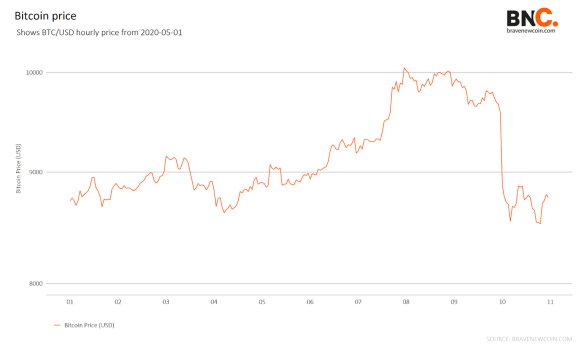
BTC price dropped dramatically just prior to the latest halving event – the above graph is plotted using the hourly closing value of Brave New Coin’s Bitcoin Liquid Index.

The halving is programmed to occur after every 210,000 blocks, which themselves are “mined” approximately every 10 minutes. Last week’s third halving was triggered when block number 629,999 was confirmed – from block 630,000 onward, the block reward reduced from 12.5 BTC to 6.25 BTC per block, and is designed to continue halving until the block reward reaches 1 Satoshi (0.00000001 BTC).

Usually, financial markets have already priced in events such as the halving, so traders don’t expect the event itself to have an immediate impact on price. (Think of the halving as just one type of “corporate action” that is peculiar to cryptocurrencies and digital assets. Others might include hard forks, coin burns, and token lock ups.) As with company results and profit announcements, traders and analysts are usually prepared for the best (or worst).

However, leading up to the latest halving, BTC briefly touched a 3-month high of US$10k, before going through an almost typical “market correction” of a 20% decline immediately prior to the halving event. BTC has since recovered some of those losses, and in any case, the price performance before and after each halving event has become yet another indicator of long-term price movement, as the following chart illustrates:

Other metrics to watch include: “hash rate” (the degree of difficulty, and therefore the amount of computing power, to solve the algorithms and mine each block); transaction fees (if miners can’t earn as much from mining activity, they are expected to start increasing their network fees); the price of electricity (as an input cost to mining); and even the cost of computing power itself (as older machines become less efficient and therefore less profitable, while newer, more powerful and more expensive processors come to market).

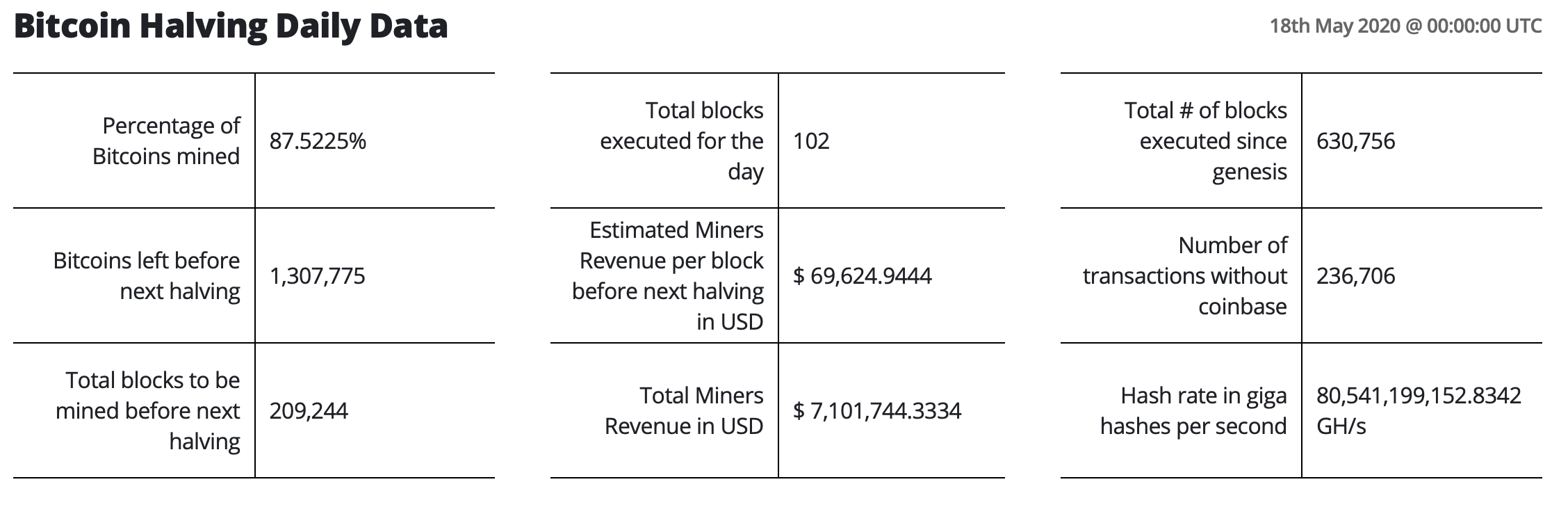
Indeed, different scenarios used to predict the exact date of the next halving are largely based on the hash rate, which has been relatively volatile before and since the halving, and transaction fees likewise escalated (and then settled down again) around the time of the halving. Key data to track as part of halving analysis and forecasting can be seen in the table below from Brave New Coin:

Other interesting developments around the time of this latest halving include a legendary hedge fund manager reported to be buying BTC as a hedge against inflation; an increase in open interest on CME’s BTC futures contracts (assumed to be coming from institutional clients); and an intriguing message attached to block 629,999 (“NYTimes 09/Apr/2020 With $2.3T Injection, Fed’s Plan Far Exceeds 2008 Rescue”). Given the recent quantitative easing measures pursued by many governments and central banks in response to the Covid-19 pandemic, this choice of headline echoed the message attached to the genesis or very first Bitcoin block, mined in 2009, soon after the GFC (“The Times 03/Jan/2009 Chancellor on brink of second bailout for banks”).

Finally, as more data and analysis attaches to the halving events, they form the basis of a fundamental aspect of understanding how financial instruments perform over time – giving rise to the BTC equivalent of a 1, 5 or 10 year yield curve, which in turn will create more sophisticated derivatives and hedging tools, and another level of comfort for traditional and institutional investors.

(My thanks to friends and colleagues at Brave New Coin and Apollo Capital.)

Next week: “How do I become a business strategist?”