Perfect Days – and the Analogue Life

Last week I watched “Perfect Days”, Wim Wenders’ lyrical film about a gentle soul who diligently goes about his daily labour accompanied by a soundtrack of classic songs. Most of the featured music is 50-60 years old, and all of it heard via cassette tapes – no radio stations or internet streaming services were harmed in the making of this film!

Not only does our hero cling to cassettes, we never see him use the internet, e-mail or a smart phone. We don’t even know how he accesses his money – presumably he gets a weekly wage packet containing cash, so no need to visit an ATM or pay with a credit card. To cap it all, he doesn’t own a TV, and his hobbies include reading second hand paperback books, taking photos with a 35mm film camera, and cultivating plants from cuttings he finds in the course of his daily routine.

We don’t really need to know his backstory, although we get the occasional glimpse. What we are presented with is someone who is living an outwardly simple life, almost exclusively analogue, and with very little technology involved. (In fact, the public toilets he cleans for a living are far more hi-tech than anything in his personal world.) I suspect for many people, our empathy for the character’s disposition may easily become envy at how stripped down and uncluttered a life he leads. The fact that he doesn’t appear to have any family or other obligations (and doesn’t have to spend hours in pointless team meetings or on endless Zoom call) no doubt help facilitate this state of being – yet we suspect there is a lot going on in the inside.

But it is certainly a parable in favour of all things analogue.

In fact, as I write this I am listening to a recent album by Tarotplane on a cassette player. He is one of many contemporary musicians who choose to release their work in this format, and along with the recent vinyl revival, they are helping to keep analogue alive. It’s a trend we can see in events like Record Store Day (and it’s younger sibling, Cassette Store Day), books by Damon Krukowski and Robert Hassan, and symbolic vinyl moments in recent film and TV shows such as “Leave the World Behind” and “Ripley”. In the former, the absence of internet and streaming brings a turntable into play; in the latter, a clutch of 7″ records (in picture sleeves!) are among the few possessions the eponymous hero chooses to take with him. Elsewhere, Lomography continues to find new fans of film photography, and on a recent visit to Hong Kong, I was surprised at the huge display of Polaroid cameras and film at Log-On department store.

Not all this fascination with analogue is about nostalgia, fashion, or fadism (or even fetishism). In some quarters, people are becoming concerned that their favourite films, TV programmes, music and video games may disappear from hosting services and streaming platforms, or their cloud storage may get wiped. So they are keeping analogue versions and hard copies as a back-up.

Finally, and picking up a thread from “Perfect Days” itself, I’m not entirely convinced that a 1975 Patti Smith cassette is worth $100, but I do own an original copy of a very rare cassette that has sold for as much as $180… probably because it has never been reissued, is not available to stream or download, and is a great example of early, DIY electronic music made on basic synths in the early 1980s. You couldn’t imagine an mp3 ever commanding that sort of price, unless it was in the form of an NFT, of course.

Next week: False Economies – if it’s cheap, there must be a reason!
Ballarat International Foto Biennale (BIFB)

This past weekend saw the opening of the 10th Ballarat Internationale Foto Biennale. The overarching theme this year is “The Real Thing”, recognising the impact that digital, AI, NFTs and image manipulation are having on the visual arts in general, and the photographic medium in particular.

The highlight of the first weekend was the keynote presentation by Platon, one of the most high-profile and prolific portrait photographers of our age, famous for his images of political figures, popular icons, and social activists. Given that Platon works mostly with traditional 35mm film and captures living subjects, his work certainly deals with the “real” thing.

At the end of the first day, visitors were also treated to a Victorian magic lantern presentation, combining authentic analog apparatus, multi-media components and live performance. For audiences of the day, such events would have been their first encounter with moving images and projections – which we take for granted in our screen-obsessed culture.

As with any festival on this scale and duration, there is a wide range of work on display. This is especially so outside the Core Program, with the Outdoor and Open Programs taking on the challenging task of representing different aesthetics, styles, techniques, subject matter, and as such they reflect varying levels of quality and competence.

It wasn’t possible to see all of the exhibitions in the first two days – and some works don’t go on display until later in the program – but for me, the highlights beyond the major Platon show included: Stephen Dupont‘s happy accidents; Jon Setter‘s stunning abstract images of Ballarat; several of the works by regional photographers curated by Jeff Moorfoot; the scattered works by the Oculi Collective; and the display presented by the Australian Association of Street Photographers Inc.

Some exhibitions were less successful: I really wanted to engage with William Yang‘s work, but the unfocused curation and haphazard presentation undermined any appreciation of the images and their underlying narrative; Erik Johansson‘s highly stylised images are humorous and surreal, but they can also come across as very superficial, so we are left marvelling at the surface technique rather than any depth behind the work; and while it was nice to see some of Andy Warhol‘s original Polaroids, they were presented with very limited context, as if they were an afterthought (the fact that they are probably the earliest works in the whole festival may have something to do with them feeling out of place, as well as out of time).

It is easy to see how some photographers could get constrained, either by their subject matter, or by their technique. Working with self-imposed limitations should be positive. Using fewer tools can drive creativity (“less is more”). Having less time can result in better outcomes (“the first take is usually the best take”). Innovation comes from exploring our curiosity. Inventiveness is the result of challenging ourselves through problem-solving. However, an artist can reveal themselves to be a one-trick pony, or their technical expertise overwhelms the output (“form over substance”). Sometimes, the narrative or subject matter is more important than the quality of the image, but just as a crappy technique can impair a great image, a perfect technique cannot compensate for a poor composition.

The notion of “reality” prompts us to consider what is a photograph? The fact that most modern photos are captured on a smart phone rather then a camera simply confirms that not all photographic images need to be created using a dedicated physical device (think of photograms). And since most photos are digital rather than on film means we are not limited to think of photography as a combination of manual, chemical and mechanical processes.

However, some of the work on display does challenge the definition of “photography”, especially in the context of art. For example, an image can be surreal or satirical, but when does that stray into being fake news? Equally, even though professionals like Platon render their work in a digital environment during the post-production process, should a composite of stock images manipulated using Adobe Photoshop qualify as a work of photographic art (or is it a mere illustration)? And with the growth of AI tools to generate images (which raises questions of authorship, copyright and attribution), should their use be disclosed and identified (just as paintings, sculptures and other art works are catalogued by their materials, processes and editioning)?

In the early days of music CDs, the recording industry developed the “SPARS code”. Letter combinations such as “AAD”, “ADD”, and “DDD” are intended to inform listeners that the music has been recorded, mixed and mastered using either analog or digital processes and equipment. Perhaps something similar should be considered for photography and digital art?

Next week: Banking Blues (pt. 481)

Digital Perfectionism?

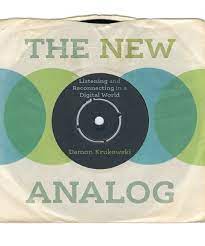
In stark contrast to my last blog on AI and digital humans, I’ve just been reading Damon Krukowski‘s book, “The New Analog – Listening and Reconnecting in a Digital World”, published in 2017. It’s an essential text for anyone interested in the impact of sound compression, noise filtering, loudness and streaming on the music industry (and much more besides).

The are two main theses the author explores:

1. The paradoxical corollary to Moore’s Law on the rate of increase in computing power is Murphy’s Moore’s Law: that in striving for improved performance and perfectionism in all things digital, equally we risk amplifying the limitations inherent in analog technology. in short, the more something improves, the more it must also get worse. (See also my previous blogs on the problem of digital decay, and the beauty of decay music.)

2. In the realm of digital music and other platforms (especially social media), stripping out the noise (to leave only the signal) results in an impoverished listening, cultural and social experience; flatter sound, less dynamics, narrower tonal variation, limited nuance, an absence of context. In the case of streaming music, we lose the physical connection with the original artwork, accompanying sleeve notes, creative credits and even the original year of publication.

Thinking about #1 above, imagine this principle applied to #AI: would the pursuit of “digital perfectionism” mean we lose a large part of what makes analogue homo sapiens more “human”? Would we end up compressing/removing “noise” such as doubt, uncertainty, curiosity, irony, idiosyncrasies, cognitive diversity, quirkiness, humour etc.?

As for #2, like the author, I’m not a total Luddite when it comes to digital music, but I totally understand his frustration (philosophical, phonic and financial) when discussing the way CDs exploit “loudness” (in the technical sense), how .mp3 files compress more data into less space (resulting in a deterioration in overall quality), and the way streaming platforms have eroded artists’ traditional commercial return on their creativity.

The book also discusses the role of social media platforms in extracting value from the content that users contribute, reducing it to homogenised data lakes, selling it to the highest bidder, and compressing all our personal observations, relationships and original ideas (the things that make us nuanced human beings) into a sterilsed drip-feed of “curated” content.

In the narrative on music production, and how “loudness” took hold in the mid-1990s, Krukowski takes specific aim at the dreaded sub-woofer. These speakers now pervade every concert, home entertainment system, desk-top computer and car stereo. They even bring a distorted physical presence into our listening experience:

“Nosebleeds at festivals, trance states at dance clubs, intimidation by car audio…. When everything is louder than everything else, sounds lose context and thus meaning – even the meaning of loud.”

The main issue I have with digital music is that we as listeners have very little control over how we hear it – apart from adjusting the volume. So again, any nuance or variation has been ironed out, right to the point of consumption – we can’t even adjust the stereo balance. I recall that my boom box in the 1980s had separate volume controls for each speaker, and a built-in graphic equalizer. To paraphrase Joy Division, “We’ve Lost Control”.

Next week: I CAN live without my radio…

How digital brands are advertising

During a recent visit to the cinema, I was surprised to see adverts for major digital brands on the big screen, ahead of the main feature.

I’ve always thought of cinema advertising as falling into one or more of the following categories:

  • ads you don’t see on TV (often longer than their small screen counterparts)
  • luxury names and aspirational brands (travel, spirits, fashion, financial services)
  • local businesses (the pizzeria “just a short walk from this theatre…”)
  • movie tie-ins (highlighting the product placement in the film you are about to see)
  • seasonal themes (especially Christmas)

What struck me on this occasion were the ads by three DNBs (digitally native brands), featuring LinkedIn, Tik Tok and Audible. Despite the disparate nature of their businesses, I realised that there was a common element.

As the above-linked McKinsey report states, successful DNBs are really good at connecting with (and understanding) their audience, identifying and fulfilling very specific needs with unique solutions, and leveraging the very technology they are built on to promote their services and engage with their customers. Witness the well-timed “alerts” from food-delivery platforms in the early evening, the viral campaigns designed to enforce brand awareness, and the social media feeds designed to build customer engagement and loyalty. (Note that the report features Peleton as a poster child for its thesis, before the personal exercise brand ran into recent difficulties.)

If you look at most DNB campaigns, they are primarily generating demand via very specific human drivers:

1. Aspirational – the pure FOMO element (not unique to DNBs, of course, but they do it more subtly than many consumer brands)
2. Experiential – highlighting the tangible benefits (of mostly intangible products)
3. Socialisation – the paradox of building a trusted relationship through hyper-personalisation and constant sharing…

These three cinema ads each contained implicit “story-telling“. LinkedIn positioned itself as a platform for establishing our own narrative (telling our own truth?); Audible promoted its audio content (books and podcasts) as a means to find authentic stories that resonate with us (and this was long before the recent shenanigans over at Spotify); and Tik Tok used a well-known viral video as the basis for building community around shared stories.

Of course, story-telling is hardly a new concept in brand marketing, and has been eagerly adopted by digital brands (think of campaigns during the pandemic which have featured on-line connectivity and remote working). However, it has become an over-used technique, and is often cynically exploited in the service of corporate green-washing, jumping on social bandwagons, and blatant virtue signalling.

Call me jaded, but I’m old enough to remember the fad of consulting firms pitching their clients on building a “corporate narrative“, drawing on employee stories and customer experiences, as the foundation for those anodyne mission/vision “statements” – but they typically ended up as exercises in damage control in case the truth got out.

These particular cinema ads managed to use story-telling to create a human dimension (authenticity, connectivity, community, sharing, etc.) that is more than simply “buy our product” or “use our tech” (although obviously that’s the ultimate goal). It would be very interesting to read the briefs given to their creative agencies, given that the ads were all in the service of corporate branding.

Next week: Doctrine vs Doctrinaire