Will Social Media Eat Itself?

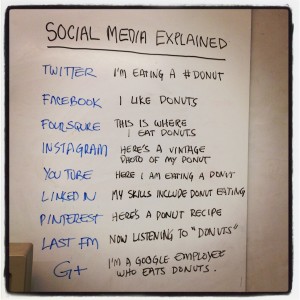
The Internet has shortened the use-by date of most content. Even our attention spans are getting shorter, in inverse proportion to the amount of content we consume and length of time we spend engaging in Social Media and other platforms. Paradoxically, some stuff grabs our attention, and goes viral as everyone posts, shares, likes, blogs and Tweets the same content. Which brings me to this infamous “infographic” on donuts as a signifier for Social Media:

Donuts_SocialMedia_ThreeShipsMedia

Content by Three Ships Media – Photo by Doug Ray

Recently, I saw this image appear as a status update and a “like” by the person posting it. There was no obvious acknowledgement, giving the impression it was an original piece of work. But I recalled having seen it before (more of which later), so I was intrigued as to the true source and provenance. On closer inspection, there was a reference to a third-party website, but this was a dead-end leading to an anonymous blog post.

After a brief search, I located what I believe is the original source for the infographic, Three Ships Media, as well as the photographer who captured the image, Doug Ray. Not that difficult to uncover, given that the post has been “liked” and Tweeted about well over 100,000 times, and written up in Three Ship Media’s own blog (about how this innocuous image had gone viral….).

Now, I don’t believe that the person who posted this image was trying to claim the content as their own work. And I doubt they were deliberately seeking to violate anyone’s intellectual property rights. Yet, the failure to acknowledge our sources (regardless of whether we are exploiting them for personal commercial gain or simply invoking the fair use provisions) threatens to undermine our credibility as commentators, critics and thought leaders. If we keep recycling other people’s work without attribution, the risk is that social media will simply implode as it chases itself in ever-diminishing circles.

Ironically, I realised that I had first seen this infographic at a seminar on the legal and practical aspects of Social Media. It was used by a lawyer to introduce his presentation on copyright issues and the Internet. All very well, except that he insinuated that he had come up with the infographic, and he certainly didn’t cite the original source….

Footnote: The title of this blog was inspired by the writer, David Quantick who coined the phrase “pop will eat itself” in the mid-1980’s, to describe the way modern music is self-referencing itself into oblivion.

Building a Personal Brand via Social Media – or the AAA Guide to Blogging

I’ve been working with content since I was a teenager – from writing articles for school magazines, to contributing gig reviews to a leading Manchester music magazine; from working for global media and information brands, to freelance editorial and writing projects.

Even now, as a business coach and consultant, I continue to focus on my clients’ content strategies – whether developing new products and services, managing IP, or capturing and commercialising in-house knowledge.

I have to admit to being an early sceptic about Social Media – but I soon recognised its importance, especially when building a personal brand on-line. Now it’s just another communication channel. I sometimes reflect on our ancestors who resisted the telephone, radio and television, and wonder if my own suspicions about Social Media will seem unfounded in retrospect.

About a year ago, I started this blog as a personal brand for my consulting work, as well as giving me a license to write about “Exploring the Information Age”, however tangential it might be to my professional work.*

After 12 months, I think I have found the essence to building a personal brand through social media – otherwise known as the AAA Guide to Blogging. Those elements are: Authenticity, Awareness and Attribution.

Authenticity

In an on-line environment where people hide behind avatars and aliases, you need to find the appropriate level of authenticity if you are going to be taken seriously by or establish trust with your audience. Being authentic means finding your “voice” to express yourself in any given situation, and to be true to yourself in that particular context.

I will admit to having several on-line profiles. For example, when connecting with my family and close friends, I am very circumspect about which Social Media platforms I use, and how I use them. My profile is extremely locked down and tightly controlled – you won’t be able to find me because I won’t let you in.

For my activities as a musician, I have another profile for self-promotion, sales and distribution, community engagement and beta testing new apps. You probably won’t find me because I use an alias, unless I am inviting you in.

Finally, in my professional life, I am very pro-active, interacting via an increasingly interconnected multi-channel strategy.

Does having multiple profiles mean I am being inauthentic? I would say no, because I am being authentic to who I am in those particular situations, and I don’t believe it is unreasonable to keep my private life, my personal interests, and my professional profile separate from one another. That’s why, even though I have a public profile on Facebook as part of my professional brand, I won’t be sharing my musical tastes because it’s not relevant (unless I might be going to a karaoke sessions with my clients?).

Awareness

Just as you need to be aware of the possibilities and limitations of different Social Media tools, you also need to understand your “character” when blogging, sharing and providing status updates. I see this as a natural extension to being authentic – in my professional life, should I really be sharing selfies (especially not at the client karaoke night…)?

There are 4 main categories of Social Media protagonists and bloggers:

1) Enthusiasts – personal stuff, “what I ate for breakfast”, no real purpose
beyond “sharing” or “look at me

2) Broad Experts – know their Yammers from their Spammers, their Blogrolls from their Facebook Trolls – understand how and where they need to engage, they know what works for them (they have found their own level)

3) Niche Specialists – the Twitterati (Stephen Fry), the star fashion bloggers, the political and media pundits, viral cat videos, and the quirky (@God) – NOT Katy Perry – she probably has people to do that for her, namely….

4) Professionals – so-called “prosumers” who use Social Media as part of their job or about their work, or it’s part of their public and personal profile, and the boundaries are increasingly blurred.

Attribution

As far as possible, I always attribute third party content or references I use in my blogs, even if they are deemed to be in the public domain, and I endeavour to acknowledge the original sources as far as possible.

Not only can this create reciprocal links and traffic to my blog, I just believe it is more ethical, rather than “sharing” content with no attribution. It’s not just about copyright law, or respecting IP, I happen to think it is more intellectually honest to acknowledge original ideas, rather than imply they are our own.

I came across a good example recently on LinkedIn, where a connection “shared” an infographic on social media, without providing the original source. In fact, it almost looked as if it was an original post. However, I was sure I had seen the same content elsewhere, and after a short Internet search, I was able to locate the original post and the author very easily. Maybe it’s laziness, or lack of consideration, but this common failure to attribute sources risks undermining your work and devaluing your creativity.

Final thoughts on blogging and Social Media

• No-one gets it right 100% of the time – and even when we do, we don’t always know why
• Conversely, everyone gets it a little bit wrong, so the real learning is in that collective experience
• Prospective employers, clients, customers all expect to find evidence of your Social Media and online presence – even if you are only engaged in Social Media in a professional/work capacity, you still need to develop a personal profile

*See previous blog 10 Rules for Effective Blogging. I recently did some analysis of my blog traffic, to see where my readers are coming from. I don’t use Google Adwords, and I don’t have any paid-for SEO – so I rely on my WordPress stats:

  • Nearly half of all traffic is coming from social networks
  • One third comes from search engines (of which Google accounts for 90%)
  • 10% comes from Reddit

Search results for my blog always come in the top 10 (plus it helps to have an unusual first and last name – always #1 search result!)

Footnote A slightly different version of this article was given as a presentation at the Australian chapter of PR over Coffee earlier this month
YouTube and guilty pleasures…

My local gym has recently installed new cardio equipment with touch screen monitors and internet access. So I find myself indulging in what some musicologists call “guilty pleasures” on YouTube – music that was so naff or cheesy when it first came out that no serious music lover would ever admit to liking it, but now it’s OK because retro is cool.*

Dollar-Hand-Held-In-Blac-116568

However, when I stumbled upon a couple of unauthorised YouTube posts featuring my own band, it got me thinking about all the “unofficial” uploads, and the impact that digital technology and social media are having through the increasing disregard for copyright and the rapid erosion of traditional business models by which content creators commercialize their intellectual property.

As more companies use digital media to support sales and marketing, brand management, customer engagement and market analysis, it becomes a valuable product or asset in its own right.

Even if you don’t believe your business is concerned with either content creation or commercializing intangible assets, there are implications for how you protect your business against commoditization or disintermediation.

What are the implications of new delivery channels for contemporary content creators, and what lessons does this offer to other businesses? 

For example, how can artists earn adequate fees from music streaming services? What do broadcasters gain from personalised radio apps? Who is making sure authors and publishers get their fair share of royalties from “curated” and aggregated content services?

The truth is, I don’t think anyone really knows the answers to these questions.

Some musicians may feel they are not adequately compensated by commercial streaming services; others recognise that the game has changed, that releasing recorded music is no longer enough to provide them with a living. In the past, musicians toured to promote their latest albums; now they release music to promote their next concert tour. They also know they must take more direct control over their income sources and revenue streams from music sales, live performance, merchandising and publishing.

For broadcasters, traditional content syndication models may no longer work if content can be disaggregated and re-aggregated without them really knowing about it. Internet streaming and web broadcasting are wonderful things, but how will advertisers react when broadcasters have limited ways of measuring the audience, because nobody knows where they are, or who they are, or when they are listening/watching?

Even authors and publishers, with a long and established history of licensing systems such as public lending rights, are wary of schemes to digitize their back catalogues. They are in a bind, because they know some income from these programs is better than none, but does it justify losing a high degree of control over the commercialisation and distribution of their copyright material?

Which brings me back to YouTube, one of the “best” examples of commercialised copyright infringement that the internet and social media have created. Even if file sharing services such as Megaupload are no longer with us, or controversial music re-sellers like LegalSounds have shut down, with very little effort anyone can extract content posted to YouTube, despite the fact that the latter does not actually support a download function.

For my part, I’ll happily admit to accessing YouTube content which is subject to copyright infringement – so much material on YouTube appears to have been posted without the prior consent (or knowledge) of the copyright holder. I’m actually very pleased that someone has posted it because I enjoy watching long-forgotten documentaries and TV interviews, out-of-print live recordings and broadcasts, and stuff that is unavailable commercially. But my consumption of this content is largely predicated on unauthorised uploading.

Although much of this “re-cycled” content is tagged with a “Standard YouTube License” (which simply means the viewer cannot record, download, monetize or claim ownership over the content), many people posting and uploading 3rd party content don’t have permission to do so in the first place. (Even a broad interpretation of “fair use” exemptions would not justify the wholesale uploading of complete albums which are still commercially available.)

I acknowledge that YouTube provides a copyright infringement process, and a Content ID system designed to help content owners assert copyright over material that has been unlawfully uploaded. But personally, I can’t help feeling that this is a rather disingenuous arrangement. YouTube stresses it is not in a position to determine copyright status – but it is more than happy to create opportunities for generating advertising revenue as part of the dispute resolution process (revenue which it presumably shares with the aggrieved copyright holder?).

YouTube started out as a platform for user-defined and user-contributed content. It does not create its own content – although it invests in original content for its “channels”,  and supports curated and personalised content (“recommendations”). This means YouTube attracts everything from amateur cat videos to professionally produced music promos, as well as highly original, creative and informative content uploaded by the independent musicians, artists, designers, educators and film-makers who create it and who choose to upload it.

And yet I keep coming back to the fact that YouTube is also full of “shared” content – content which is not owned by or licensed to the people uploading it. This is where the real commercial value of YouTube was always going to be found: in 3rd party content, however dodgy the provenance, because this reveals what might be popular and therefore, what can be monetized.

As a result, it could be argued that YouTube has been a considerable beneficiary of  copyright abuse – by using its analytics and other data mining, it can identify potential revenue “hotspots”, even if the content has not been legitimately uploaded in the first place.

So, while YouTube is very useful as an archive resource, its future is written in the terms of its commercial alliance with Vevo. This deal is designed to promote popular artists through the distribution of their music and video content via highly controlled sales and marketing channels.

On one level, it’s merely the latest attempt by major record labels to reclaim their market dominance over a music industry that is increasingly subject to vertical re-integration. On another, it will inevitably lead to an uneven playing field: some (a very few?) content producers will generate huge revenues from mobile and on-line platforms through their share of the advertising (rather than from traditional airtime and mechanical royalties); others (the majority?) will neither be able to collect royalties (because the model is broken), nor attract advertising (because they don’t have the marketing budgets to spend on buying an audience big enough to be of interest to advertisers).

What is happening in the content and media industries today will likely happen to other industries tomorrow, especially in the services sector; but we can already see that the development of domestic 3-D printers creates the possibility of “open source” designs for producing our own consumer products – so what impact will this have on manufacturing, for example?

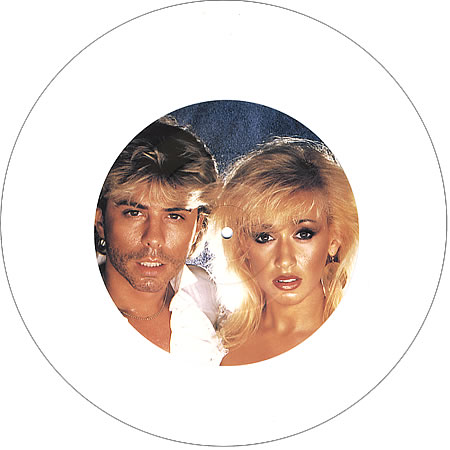
*Confession: Yes, I admit that Dollar’s “Hand Held in Black and White” is one of the “guilty pleasures” in my record collection. It’s big on cheese and none of my friends would ever admit to liking it, but it features some classic ’80s synth arpeggios and electronic drum programming, and was produced by Trevor Horn as he transitioned from the bubblegum synth pop of the Buggles to the splendour that was Art Of Noise….

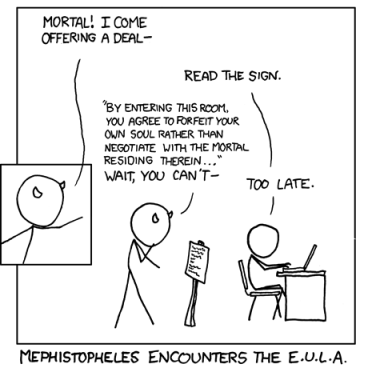
Whose content is it anyway?

Faust 2.0

Every social media and digital publishing platform is engaged in a continuous battle to acquire content, in order to attract audiences and bolster advertising revenues.

Content ownership is becoming increasingly contentious, and I wonder if we truly appreciate the near-Faustian pact we have entered into as we willingly contribute original material and our personal data in return for continued “free” access to Facebook, YouTube, Google, Flickr, LinkedIn, Pinterest, Twitter, MySpace, etc.

Even if we knowingly surrender legal rights over our own content because this is the acceptable price to pay for using social media, are we actually getting a fair deal in return? The fact is that more users and more content means more advertisers – but are we being adequately compensated for the privilege of posting our stuff on-line? Even if we are prepared to go along with the deal, are our rights being adequately protected and respected?

In late 2012, Instagram faced intense public backlash against suggestions it would embark upon the commercial exploitation of users’ photographs. While appearing to backtrack, and conceding that users retain copyright in their photographs, there is nothing to say that Instagram and others won’t seek to amend their end-user license agreements in future to claim certain rights over contributed content. For example, while users might retain copyright in their individual content, social media platforms may assert other intellectual property rights over derived content (e.g., compiling directories of aggregated data, licensing the metadata associated with user content, or controlling the embedded design features associated with the way content is rendered and arranged).

Even if a social media site is “free” to use (and as we all know, we “pay” for it by allowing ourselves to be used as advertising and marketing bait), I would still expect to retain full ownership, control and use of my own content – otherwise, in some ways it’s rather like a typesetter or printer trying to claim ownership of an author’s work….

The Instagram issue has resurfaced in recent months, with the UK’s Enterprise and Regulatory Reform Act. The Act amends UK copyright law in a number of ways, most contentiously around the treatment of “orphan” works (i.e., copyright content – photos, recordings, text – where the original author or owner cannot be identified). The stated intent of the Act is to bring orphan works into a formal copyright administration system, and similar reforms are under consideration in Australia.

Under the new UK legislation, a licensing and collection regime will be established to enable the commercial exploitation of orphan works, provided that the publisher has made a “diligent” effort to locate the copyright holder, and agrees to pay an appropriate license fee once permission to publish has been granted by the scheme’s administrator.

Such has been the outcry (especially among photographers), that the legislation has been referred to as “the Instagram Act”, and the UK government’s own Intellectual Property Office was moved to issue a clarification factsheet to mollify public concerns. However, those concerns continue to surface: in particular, the definition of “diligent” in this context; and the practice of some social media platforms to remove metadata from photos, making it harder to identify the owner or the original source.

Meanwhile, the long-running Google book scanning copyright lawsuit has taken another unexpected twist in the US courts. From the outset, Google tried to suggest it was providing some sort of public service in making long-out-of-print books available in the digital age. Others claim that it was part of a strategy to challenge Amazon.

Despite an earlier unfavourable ruling, a recent appeal has helped Google’s case in two ways: first, the previous decision to establish a class action comprising disgruntled authors and publishers has been set aside (on what looks like a technicality); second, the courts must now consider whether Google can claim its scanning activities (involving an estimated 20 million titles) constitute “fair use”, one of the few defences to allegations of breach of copyright.

Personally, I don’t think the “fair use” provisions were designed to cater for mass commercialization on the scale of Google, despite the latter saying it will restrict the amount of free content from each book that will be displayed in search results – ultimately, Google wants to generate a new revenue stream from 3rd party content that it neither owns nor originated, so let’s call it for what it is and if authors and publishers wish to grant Google permission to digitize their content, let them negotiate equitable licensing terms and royalties.

Finally, the upcoming release of Apple’s iOS7 has created consternation of its own. Certain developers with access to the beta version are concerned that Apple will force mobile device users to install app upgrades automatically. If this is true, then basically Apple is telling its customers they now have even less control over the devices and content that they pay for.