In the wake of allegations and revelations concerning election shenanigans, branch stacking, dodgy donations, and other improper behaviour by MPs, our trust in the democratic process is being severely challenged.
At the heart of the democratic process are the core principles of universal suffrage, and the open nomination and free election of individual candidates. However, in reality, it’s the party system that gets people elected, even though political parties are not mentioned in the Australian Constitution.
Thanks to factional disputes, evidence of corruption and general party machinations, I don’t believe voters are being well-served by their elected representatives. The highly partisan nature of party politics is making it increasingly difficult to build consensus or build inclusive, progressive and sustainable policy outcomes – even within the same party!
At the risk of making a huge generalisation, the problem I have with most politicians is that they have to play the party game in order to get selected, elected and re-elected. Thus they are overly beholden to the party that “backs” them (factional elements and all) rather than the electorates they purport to represent.
Look what happened to both Kevin Rudd and Malcolm Turnbull during their (brief) terms as Prime Minister: neither had a sufficient power base in their respective parties that they could rely on for support. (Both essentially came unstuck on energy and climate policies. And interesting to note that despite their differences whilst in office, they seem to have found a modicum of mutuality around media ownership – and I’m sure they agree on a whole lot more, they just aren’t allowed to admit it in public.)
Also, it’s a paradox that once elected (especially to leadership roles) most politicians seem to lose the power of natural speech. Instead, they feel compelled to use tortuous and convoluted verbiage to avoid saying what they actually think, because the internal logic and policy constraints of party-think over-rules common sense.
Over the years, I’ve heard various politicians speaking at first hand at non-party and non-Parliamentary events, including Keating, Hockey, Tanner, Turnbull, and Morrison. As a general observation, they are far more engaging, authentic and sincere when they are away from the hustings, pressers or dispatch boxes. It seems as if they all appear to lose a huge part of their humanity as a result of elected office, and the strictures of the party machine.
So has the political party had its day? Increasingly, that feels to be the case. Which is a dangerous thought, given the fundamental requirement to build policy platforms to take to the electorate, and the essential nature of Parliamentary democracy to have a functioning opposition to hold the Government accountable. Plus, we need a healthy democracy to ensure a pluralistic, inclusive, secular and liberal (small ‘L’) society. Dictatorships thrive in one party states, theocracies and autocracies alike.
Unfortunately, the media finds itself having to pander to the increasingly shrill, strident and destructive discourse of party politics. The press has to play along with “gallery briefings” and “doorstops” (i.e., selected disclosure at best, selected leaking at worst). I also hate the whole process of policy testing via party focus group soundbites rather than considered debate in Parliament.
I have seen some recent suggestions that political parties should be banned (dangerous precedents there…) or that election candidates shouldn’t reveal in advance their party affiliation. Whilst the latter idea has some appeal, how would we know where their backing comes from if they don’t disclose their party membership? Perhaps we should also ban all political donations, campaign funding and paid-for ads (and/or introduce stringent “truth in advertising” laws). Or, what if every candidate can only spend an equal amount, whose budget is drawn from Government funds, and only once they have secured the minimum amount of voter support to stand for election in the first place?
I don’t have the answers, and even with “non-party affiliation”, candidates would self-identify or be tagged as belonging to a particular vested interest. But the party system looks increasingly broken, and the nature of binary politics is not helping us to address or solve the enduring problems of our age.
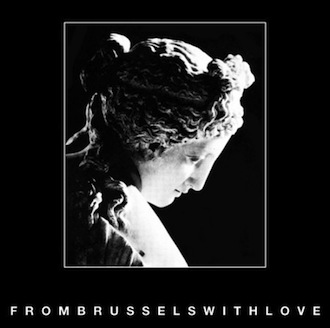
40 years ago this month, an obscure record label in Belgium released a cassette-only compilation album, which became a reference point for many post-punk projects. “From Brussels With Love”, originally put out by Les Disques du Crepuscule, has just been re-issued, so during the recent lock-down, I thought I would exhume my original copy and remind myself of why this was such a landmark album, and why its influence continues to this day.
To add some context, Sony had launched the Walkman cassette player in 1979, the first truly portable device for pre-recorded music. This led to a renewed interest in the cassette format among independent artists and labels, as it was also a cheaper means of manufacture and distribution than vinyl records (and long before CDs, mp3 and streaming services). And in the wake of the DIY aesthetic promoted by punk, some new music was being released on cassette only, such as Bow Wow Wow’s “Your Cassette Pet” and BEF’s “Music for Stowaways” (the title referencing an early model of the Sony Walkman). Some of these cassette-only releases (especially by independent, lo-fi, DIY electronic artists such as Inertia) are now highly collectable.
What made “From Brussels With Love” so significant was not just the format. It was not even alone in combining music with interviews and fully illustrated booklets. Fast Forward in Melbourne also launched their first audio-magazine in November 1980, and other similar projects followed such as Edinburgh’s “Irrationale”, Manchester’s “Northern Lights”, and London’s “Touch” label which began life releasing a series of curated audio gazettes, including both spoken-word and musical contributions.
The importance of “From Brussels With Love” was the cross-section of artists it managed to bring together: mercurial musicians such as Bill Nelson, John Foxx and Vini Reilly; side projects from members of established post-punk bands from the UK (Wire, Joy Division/New Order, the Skids and Spizzenergi); a cluster of emerging European bands (Der Plan, The Names and Radio Romance); and several leading names in modern classical and ambient music (Harold Budd, Michael Nyman, Gavin Bryars, Phil Niblock, Brian Eno and Wim Mertens). Oh, and an interview with actor Jeanne Moreau.
This eclectic mix of contemporary artists (and this deliberate approach to curation) was no doubt highly influential on subsequent projects such as the NME/Rough Trade “C81” or Rorschach Testing’s “Discreet Campaigns” – these were not compilations reflecting a single musical style or even the usual label sampler, nor were they simply collections of what was new or current. Instead, they reveal an aesthetic attitude (curiosity combined with open-mindedness mixed with a high level of quality control and a hint of audience challenge) that is harder to find today. Now we have “recommender engines” and narrow-casting streaming services that would struggle to compile similarly diverse outcomes. And more’s the pity.
I know there are a number of on-line platforms and print publications that try to bring a similar approach to their curation, but for various reasons, and despite their best intentions, they generally suffer from being cliquey, self-referencing/self-identifying, and all driven by a need to capture eyeballs to attract advertising, so they quickly lose any claim to independence or even originality. Which is a shame because there is so much great music out there that we don’t get to hear, simply because it is not mainstream, or it doesn’t conform to a particular style, or it doesn’t meet “playlist criteria”, or it doesn’t have enough marketing dollars behind it.
A couple of weekends ago in Melbourne, the question on many peoples’ minds was, “Are we there yet?” Namely, had the rate of new Covid-19 cases slowed down to the point where we could start to emerge from one of the longest and strictest lock-downs in the world? The answer was, “Yes, but not to the satisfaction of the government and their public health advisers.” So the opening up was pushed back again, having been brought forward by the very same government. It felt like the goal posts had been moved, and despite the huge sacrifices made by the general population, we were being asked to take a “cautious pause”.
No wonder some people got a bit uptight, and it took some tedious questioning from the media to establish what the Premier could have said at the outset of his umpteenth daily press conference. Yes, the Premier was tired, and he had been up late the night before, and he’d done over 100 pressers on the trot by that point. But you could hear and see the exasperation in his voice and in his body language as he realised how he’d managed to miscommunicate what should have been positive news – i.e., “We’re very close, everyone, and thank you all for your efforts, but just to be absolutely sure, please give me a couple of days more before I can confirm the decisions the government have already made.”
At the time of writing, people in Melbourne are still under pandemic restrictions, some of which have been in place since March:
There is a limit on the number of people who can come to your home
There is also a limit on the size of gatherings in public
You can’t travel more than 25km from home
You can’t travel outside the Greater Melbourne area
Retail and hospitality are only allowed to open under strict conditions
Everyone must wear a face mask in public
And while there are some exceptions to each of the above, under the current State of Emergency, the government can rescind or reimpose each and every condition, or add new ones as they deem appropriate – including re-introduction of the overnight curfew, which seems to have been a political decision as much as one made on grounds of public health or public order.
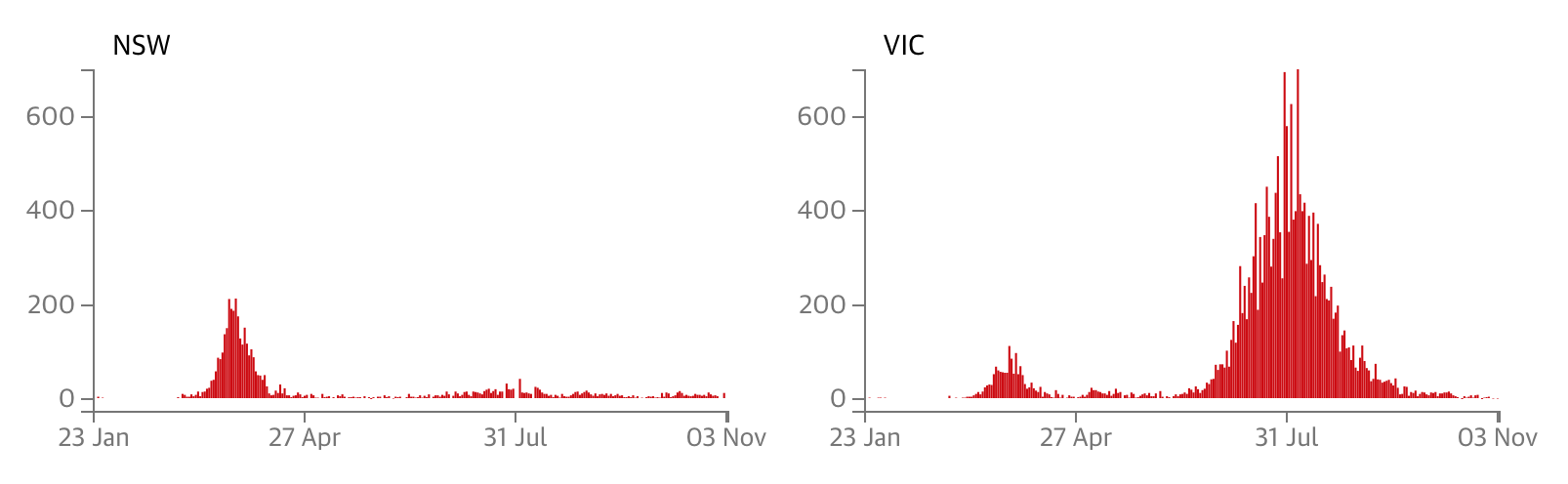
I should say that I was in favour of the first lock-down in Victoria. In fact, I was actually glad that the Victorian Premier took a more conservative approach than some of his counterparts, which meant that during lock-down #1, Victoria appeared to be doing a much better job than NSW in containing the spread of the virus, when comparing the daily number of new cases in March and April. But I think the Victorian government should have gone harder when they had the chance, to nip it in the bud:
However, masks weren’t made compulsory until much later during the so-called second wave, and lock-down #2. There could be several reasons for this:
Medical opinion was divided as to the efficacy of masks
The government wanted to reserve supplies for medical and other front line workers
There was inadequate public supply, partly because stocks had been diverted to regions impacted by the summer bush fires (and, initially, some local stocks had been donated to aid projects and sent overseas to China)
There were already too many other social behaviour changes that were needed, and which were deemed a higher priority
I’m not sure why there is still so much local resistance to wearing masks in public. Many people think it’s an infringement of their civil liberties, or they question the science, or they simply don’t like being told what to do. For men, I wonder if they feel that wearing a mask somehow emasculates them? For women, does it make them feel even more invisible than they already are in society? And for the ardent civil libbers, don’t any of them understand the concept of the mutual duty of care we each owe to our fellow citizens (even the self-styled, self-sovereign ones)? Having spent a lot of time in Asia, where social norms mean it is quite common to see people wearing masks in public, I guess I am less resistant to the idea. So much so, that I started wearing them in Melbourne before they became mandatory.
Of course, over 90% of locally-acquired cases which caused the second wave of new infections were directly the result of the failed hotel quarantine programme in two Melbourne hotels. I’ve commented on this fiasco before, and now the recent Board of Inquiry set up to investigate what happened has asked for an extension before delivering its verdict, owing to the late submission of evidence by key witnesses, including civil servants, public officials and elected representatives. As I wrote previously, the decision to engage private security to manage the quarantine programme is not the issue – it’s the decision-making process itself (referred to as “creeping assumptions”), and the oversight of the programme once it was established.
At this stage, we still don’t know who made the decision to hire private security companies; it’s not entirely clear which government department had oversight of the programme, as there was confusion and poor communication between departments; it’s also not clear whether the chosen security companies were on existing lists of Commonwealth- or State- approved contractors – and if they weren’t, what criteria were applied to employ them? And how did the other states manage to avoid the same level of community transmission that could have come from their own quarantine measures?
Anyone who has worked in or around government procurement will know how difficult it is to get on a contractor “panel”, and even then, the tendering process can be arduous and opaque. From my own experience, governments often use RFI/RFP/RFQ processes to glean as much intelligence as they can (with a view to keeping the project in-house), or to simply drive down the price, rather than to get the most qualified supplier at the best and most appropriate commercial rate. (And of course, there are examples of ex-civil servants forming their own businusses in order to tender for work they used to allocate – using their insider knowledge to the detriment of other bidders. In some cases, the civil servants don’t even wait to leave office….)
I appreciate there is a widely-held view that the breakdown in the hotel quarantine programme was not the only or direct cause of the second wave in Melbourne; but even if it were, it was the failure of the Commonwealth government to manage properly the private aged care facilities under their jurisdiction, which in turn revealed huge vulnerabilities in that sector, leading to the death of around 800 elderly Victorian residents from Covid-19. While I don’t doubt the inadequacies in aged care “settings”, I would have more sympathy with this argument if we had seen the same level of infections in aged care facilities in other states, particularly NSW, given that each state is under the same regime. The “mishaps” of the hotel quarantine programme sit front and centre as the root causes of the second wave, leading to the much severer lock-down #2.
Meanwhile, although the Premier likes to thank everyone for “doing the right thing” during the lock-down, he and his administration had a highly subjective attitude towards those members of the public who clearly weren’t doing the right thing. At times the rhetoric was merely ambivalent; other times it was highly ambiguous; occasionally it was disingenuous (if not wrong). This inconsistency and selective admonishment helped create further confusion among the public about how/when the various lock-down restrictions would be enforced. Worse, it sowed the seeds of growing discontent and underlying resentment in many parts of the community. And not helped by the apparent assertion that community cases among health care workers were all acquired in domestic “settings”, rather than in workplace “settings”.
Some of the other factors that may have contributed to Victoria’s second wave (and which have inter-state and national implications going forward as the domestic borders begin to re-open) include:
A highly centralised public health system (the current Premier was formerly the state Minister for Health, so no doubt he will have some views on that)
Inadequate PPE supplied to front-line medical staff and health workers in hospitals and clinics
Poor inter-departmental and inter-agency communication and co-ordination (plus those “creeping assumptions”)
A poor culture of “managing up” within ministerial offices (oh, and those “creeping assumptions”)
Confusion over respective roles and responsibilities, for example, as between the Chief Health Officer, the Chief Medical Officer and the Chief Preventive Health Officer
“Track and trace” systems not fit for purpose
Lack of common definitions across the country – e.g., hot spot, complex case, mystery case, locally acquired case, quarantine and isolation periods, close contact, etc.
Lack of common IT systems for “track and trace” – so without inter-state interoperability, how is that going to work as people start traveling around the country again?
One “common” definition that definitely needs to be established is what constitutes a “household”? I’m not sure if there is a practical legal definition – maybe the Census form is one point of reference? (Perhaps another “test” is the supermarket offer, which usually says “only 1 per household”?) I would have said that a “household” is defined as a group of people who ordinarily live in the same dwelling or residence (whether a house, apartment, unit, rooming house, care home or hostel), regardless of whether they are related to one another, and regardless of whether they consider themselves as “living together”. Conversely “household” does not automatically mean everyone in your immediate or extended family. Where the lines have become blurred is when family members are frequently in each other’s homes for the purposes of sharing meals, care-giving or child-minding. The issue is not one of mere semantics – as we have seen, it is critical both in terms of preventing community transmission, and in enforcing quarantine and isolation measures.
Finally, I should also stress that I am very grateful to be living in Australia at present during this global pandemic, especially given the situation in many other countries. But at the risk of sounding parochial, I really would like to understand why Victoria got it so wrong (and has had to endure a second and onerous lock-down), and how NSW (so far) appears to have got it just about right.
Despite being under lock-down, the current cohort of Australian & NZ startups participating in the Startmate accelerator programme managed to deliver their Demo Day presentations on-line, including a virtual “after party” where founders were available for Q&A.
Given the large number of startups, and the fact that several were very early stage businesses, I have grouped them into loose clusters, with just a brief summary of each project. More info can be found at the links in the names:
Real Estate
Landlord Studio – tax & book-keeping solution for landlords. I tend to think the need for very niche accounting solutions is either overstated, or existing software platforms like Xero will come up with a plug-in of their own. Also, tax rules vary greatly by jurisdiction, so scaling internationally can be a challenge.
Passingdoor – an online estate agency trying to remove some of the costs and hassles of selling your home. Rather than listing with a traditional estate agent, Passingdoor will find buyers on your behalf (via a matching process?). I assume that prospective buyers will come from: people in the process of selling their own home; buyer advocates; or recent mortgage applicants – which is why the founders will need relationships with traditional agencies (referrals), mortgage brokers (cross-selling) and real estate ad platforms (leads). But given that sellers on Passingdoor only pay a 0.5% commission once an offer becomes unconditional, I’m not sure how the cashflow model will work.
MedTech
Mass Dynamics – scaling spectrometry for improved patient care. From what I understand, Mass Dynamics is using cloud-based architecture to “lease out” spectrometry capacity on demand, and to accelerate sample analysis.
LaserTrade – a marketplace for second-hand medical laser equipment. Rather than seeing re-usable equipment go to scrap, the founder saw an opportunity to create a marketplace for unwanted items. All items are tested beforehand. Has the potential to extend to other types of equipment, assuming the certification process is valid?
Health & Wellbeing
Body Guide – semi-customised rehab exercises to suit your symptoms. With superb timing as we emerge from months of inaction (or poor posture) while working from home during lock-down, this service is an aid to physical recovery, once your condition has been formally diagnosed. I’d probably want to check in with my GP or physio that the programme was right for me, though.
Sonnar – offers a library of audio content for people with reading disabilities. This is a subscription service, which claims to be cheaper than other audio-book services, and with a broader type of content (periodicals as well as books). I was unclear whether Sonnar is cheaper because they don’t need to pay publisher or author royalties (as it is deemed a charity?), or because they only license out-of-copyright content.
Good Thnx – promises to be “the world’s best gifting and recognition tool, with impact”. Aiming to provide a service for businesses, individuals and partner charities, Good Thnx is still in development. But as part of the Startmate Demo Day, gave attendees an opportunity to allocate a small financial donation to a selection of charities.
Food & Agriculture
Cass Materials – With the search for sustainable alternatives to meat, Cass Materials is developing a cheap and edible high fibre cell scaffold on which to grow cultivated meat – otherwise known as bacterial nanocellulose (BNC). I’m not opposed to the idea of “meat substitutes”, but I’m generally wary of what are sometimes called “fake meats” – vegetable proteins that are so processed so as to resemble animal flesh. I’d rather go vegetarian (I’m not sure I can go full vegan, because if we weren’t supposed to eat honey and yoghurt, why do they taste so good, especially together?).
Digital Agriculture Services – An AgTech platform is using AI-powered applications for developing a range of data-driven solutions across rural, agricultural and climate applications. The potential to bring more business insights and practical analysis to farming and allied industries is of huge potential in the Australian economy.
Heaps Normal – This company has taken a novel approach to producing non-alcoholic beer. Rather than chemical extraction or other processing to remove alcohol from ordinary beer, Heaps Normal has managed to brew beer without alcohol content.
Energy
Gridcognition – Using digital twin mapping of buildings, structures and locations to optimise the planning and operation of distributed energy projects. Given the value of lower transmission and storage costs, as well as more efficient energy generation, Gridcognition is aiming to bring their “decarbonised, decentralised, digitised” solutions to a range of industry participants.
ZeroJet – Helping the marine industry transition to sustainable energy solutions with the development of electric propulsion systems. In particular, targeting small inshore craft which are ideal boats for this type of engine.
Logistics & Analytics
PyperVision – This startup has developed a system for fog dispersal at airports. By aiming for zero fog delays, PyperVision is helping to reduce disruption in the travel and logistics sectors.
Arlula – An API service to stream satellite images from space. As we know, satellite imagery is an important input to modelling, planning and analysis. Arlula also offers access to historic and archive content.
Database CI – A platform for in-house software developers to access the right sort of enterprise data for real-life testing purposes. For example, realistic and appropriate “dummy” data that does not compromise privacy, confidentiality or other obligations.
Law on Earth – On-line access to self-serve legal documents, forms and precedents, plus lower-cost legal advice. With a mission to “empower the public to safely manage their own legal needs”, Law on Earth already has a tie-up with Thomson Reuters, one of the largest legal information providers in the world.