Geo-blocking: the last digital frontier?

Last month, senior executives from AdobeApple and Microsoft were summoned to appear before an Australian Parliamentary inquiry into IT pricing policies. It was alleged that Australian consumers can pay up to 70% more for comparable products and services sold in other markets.

Leaving aside the additional costs of distributing and shipping physical goods to Australia, at the heart of the pricing disparity is the practice of “geo-blocking” whereby customers in one location cannot purchase digital or physical products direct from vendors outside their country of residence. It’s the sort of industry practice that prevents Australian consumers buying some print books and CD’s from Amazon.com or Amazon.co.uk (and neither store sells MP3’s to Australian customers).

When asked to explain the apparent disparity in market pricing, the tech execs responded with comments such as, “the inclusion of Australian sales tax in the retail price is confusing”, “it’s a reflection of the cost of doing business in Australia” and “it’s all because of the content owners’ and copyright holders’ archaic territorial licensing practices”.

Their answers were variously described as “evasive“, “unbelievable” and “failed to impress“. The suggestion by one CEO that Australian consumers should fly to the USA to buy cheaper products overseas, was frankly ludicrous, especially as sales warranties given in America would likely be invalid once the goods were brought back to Australia.

When it can be cheaper to buy a CD copy of an album from an on-line music retailer in the UK rather than download the MP3 version from a vendor in Australia, clearly there is something wrong with this picture.

Parallel imports” and “grey goods” are terms used in the fashion, cosmetic and other retail sectors to describe situations where wholesalers and distributors import branded goods that are technically subject to strict territorial sales and distribution licenses held by third parties. Alternatively, consumers in one country purchase goods direct from a retailer or distributor located in another country, who does not have the rights to sell or export the products to the consumer’s country of residence. The license holders can seek to block these unauthorized imports/exports, but in cases where the license holder has chosen not to distribute those specific goods, these “grey” imports could possibly be deemed legitimate (under the “use it or lose it” principle).

Whatever the legal interpretation of territorial licensing, when it comes to digital content, is geo-blocking still appropriate? Let me offer an illustration:

Imagine you are an Australian traveller on a business trip to New York. You visit a local book shop, to pick up a copy of the latest novel by your favourite author.

Unfortunately, the salesperson tells you the book is not in stock, because the publisher does not distribute that particular title to independent stores; instead, you have to go to the mega book store across town.

After making your way to the mega store, you find out that before you can make any purchase, you have to open an account, submit your credit card details and other personal information (and sign a contract that says things like “you must always keep books bought from our store in our proprietary and specially designed book shelves”).

Just as you are about to make your purchase, the shop assistant asks you for your passport. “Oh, I’m sorry, we don’t sell our books to people from Australia. You have to go to our mega store in Sydney.”

On the way back to your hotel, you phone the publisher (whose office is on your route) to see if you can buy a copy direct from their sales department. The conversation goes something like this:

“You sound Australian. Sorry, but we can’t sell it to you. You have to buy it from our Australian distributor.”

“OK, can you tell me who the Australian distributor is, or which shops stock your titles?”

“I’m not sure. I think it depends on who the author is. Or whether it’s the hardback or paperback edition. Or whether our distributor is importing that particular title. Maybe we only sell it through the Australian branch of the mega book store that wouldn’t sell you it to you while you were in town. Have a nice day.”

Great. With nothing to read on the 20-hour flight back to Australia, you catch up on a lot of episodes of “Bored to Death”, because you don’t expect them to be shown on Australian TV for at least a year. (But that’s another industry scenario…)

Back home in Australia, you visit the Sydney branch of the mega book store. “I’m sorry, we don’t have that title in stock, because we haven’t had enough customer requests to justify importing any copies…..”

Is it any wonder, with these sorts of restrictive commercial practices common in the software and digital content industries, that Australia has the highest level of illegal music downloading by capita, not because all Australian consumers are unwilling to pay for content, but often because customers cannot legitimately buy it.
Why we need a “Steam Internet”

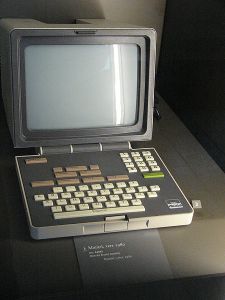
1981 Alcatel Minitel terminal(Photo by Jef Poskanzer - Licensed under Creative Commons Attribution-Share Alike)

1981 Alcatel Minitel terminal
(Photo by Jef Poskanzer – Licensed under Creative Commons Attribution-Share Alike)

The Internet is passing through a period of consolidation, as befits an industry that has reached maturity:

1. A small number of mega-players dominate the market: Microsoft, Amazon, Twitter, Apple, Facebook, Google, Yahoo!, PayPal, YouTube and Wikipedia.

2. Product lines are being rationalized, as companies trim their offerings to focus on core business – the latest victim being Google’s Reader tool for RSS feeds.

3. The distinctions between hardware, software, content and apps are blurred because of overlapping services, increased inter-connectivity via mobile platforms, and cloud-based solutions.

4. The business model for Internet access and Web usage is primarily based on data consumption and/or underwritten by 3rd party advertising. Social Media and search services are often not counted as part of the usage, thus confusing our understanding of what content actually costs.

5. Since our concept of what constitutes “news” is rapidly being redefined by Social Media, and readers increasingly rely on Social Media channels to access news, it is harder for content providers to charge a premium for value-added  information services such as quality journalism and objective news reporting.

I would argue that to rediscover a key purpose of the Net (as a means to send/receive meaningful news and information), we need to reflect on how radio broadcasting repositioned itself when television came along – hence “Steam Internet”.

“Steam Radio” was a term used in 1950’s Britain to differentiate sound broadcasting (radio) from audio-visual broadcasts (television). Although somewhat self-deprecating (suggesting something slow, and obsolete – echoing the demise of steam railways following the introduction of electric and diesel locomotives), it actually helped to embed specific values and purpose around the role of radio as a simple but effective medium to inform, educate and entertain, despite its apparent limitations.

My interest in radio means that I continue to use it as a primary source of daily news and current affairs, and as a convenient means to access international content. The discipline of radio means that content is generally well structured, the format’s limitations emphasise quality over quantity, and when done well there is both an immediacy and an intimate atmosphere that can really only be achieved by the audio format.

Far from becoming an obsolete medium in the Internet age, the growth of digital stations (as well as Internet radio and mobile-streaming) means that radio is undergoing a renaissance as it increasingly provides very specific choices in content, and offers ease of access without a lot of the “noise” of many news and information websites, with their pop-up ads, unstable video and data-hungry graphics.

Over the past decade, the major growth in Internet traffic in general, and World-wide Web usage in particular, has been driven by Social Media. However, neither the Net nor the Web was originally designed to be a mass-media platform, but the success of a highly interactive, deeply personalized and far-reaching network threatens the viability of the Internet as a means to effective communication.

As Web content and functionality has become more complex, so it actually becomes harder and more frustrating to find exactly what we want, because:

  • search and retrieval is advertising-driven and based on popularity, frequency and connectivity (rather than on context, relevance and quality);
  • content searches reduce everything to a common level of “hits” and “results”; and
  • there is little or no hierarchy as to how information and search results are structured (maybe we need a Dewey Decimal system for organising Web content?). This is one reason why Twitter is enhancing its search function by using human intervention (i.e., contextual interpretation) to make more sense of trending news themes.

I’d like to offer a short historical perspective to provide further context for the need for “Steam Internet” services:

Along with bankers and brokers, lawyers were among the first to recognize the importance of dedicated Internet services for transacting data and information. The first on-line information service I ever used was Lexis-Nexis (a research tool for lawyers) when I was a paralegal in the 1980’s. Lexis-Nexis is a database that enables users to search summaries, transcripts and reports of relevant court decisions regarding specific points of law. It is a very structured and hierarchical content source. Back then, it was a dial-up service, requiring the user to place the handset of a fixed-line telephone into an external modem that was connected to the computer terminal from which the search was conducted. The reason I can remember it so vividly is because the first time I used it, I forgot to specify sufficiently narrow search terms, which meant pages and pages of text being churned out – and probably a bill of over $200, as the service was charged according to the number of results returned and pages printed.

In the mid-1990’s, when I was setting up my Internet access, the ISP was owned and run by a university, which made sense when we think that the Net grew out of the academic world. But even though I had an ISP account, I still had to download, install and configure a graphical browser (Mosaic) to access the Web – or alternatively, I could subscribe to a dedicated dial-up service such as AOL, that offered a limited number of dedicated information services. Otherwise, my Internet access really only supported e-mail via DOS-based applications, and the exchange of files. (This was pre-Explorer and pre-Netscape, and the browser wars of the 1990’s and early-2000’s – which continue to this day with Microsoft copping another EU fine just this month.)

As the Web became more interactive, but also more dependant on “push”-content driven by advertising-based search, user experience was enhanced by RSS readers – to get to the information we really needed, and to personalize what content would be pushed to our desktops. When I was demonstrating financial market information services to new clients the built-in RSS reader was a useful talking-point, because I had configured it to display scores from the English Premier League as well as general news and industry headlines. (There is an urban myth that some of the most popular news screens on Bloomberg are the sports results…)

Just a few years ago, pre-Social Media, there were discussions about building a dedicated, faster, more robust and more secure business-oriented Internet platform, because the popular and public demands placed on the Web were putting an inordinate strain on the whole system. Businesses felt the need to create a separate platform – not just VPN’s, but a new “Internet 2” for government, universities and businesses to communicate and interact.  In the end, all that has happened is an expansion of the Top-Level Domains (.biz, .mobi), with a continued programme of generic TLD’s in the works, but this is simply creating more real-estate on the Web, not building a dedicated data and information-led Internet for business.

At this point, it’s worth reflecting that only last year, France’s Minitel videotex service and the UK’s Ceefax teletext service were both finally decommissioned, each having been in operation for over 30 years. In their prime, these were innovative precursors to the Web, even though neither of them was considered to be part of the Internet. Their relevance as dedicated information services should not be overlooked just because technology has overtaken them; that’s like saying the news media are redundant because their print circulation is in decline.

In conclusion, I’m therefore very attracted to the idea of a Steam Internet which mainly carries news and information services as a way to bring focus and structure to this content.    


Declaration of interest: from time-to-time the author is a presenter on Community Radio, but does not currently derive an income from this activity, so no commercial or financial bias should be implied by his personal enthusiasm for this broadcast medium.    

Music retailing loses its voice…

"HMV" by Margaret Manchee (courtesy of the artist)

“HMV” by Margaret Manchee (courtesy of the artist)

The decision last month by HMV (UK) to go into administration is further indication of how traditional bricks and mortar music retailing has not managed to keep up with trends. A combination of new technology, different purchasing habits and industry fragmentation has seen the retail model come unstuck – in a similar fashion to chain store book retailing.

Few mainstream or high-street music retailers have managed to survive unscathed in recent years – Tower Records and Virgin Megastores have disappeared from all major markets, and Sam Goody has been re-branded in the USA – although HMV retains stores in Hong Kong and Singapore, and both Tower and HMV stores operate in Japan under local licenses to private equity investors; Virgin retail still has a presence in France, where it competes with the domestic chain of FNAC. Otherwise, it’s mostly local independent and specialist stores that manage to keep going, although in Australia the national chain stores JB HiFi and Sanity appear to buck the trend.

One reason why the major music retailers have not survived is that in order to grow and diversify their sales turnover they started stocking books, DVD’s, games, merchandise, concert tickets and audio accessories. This meant that they reduced the amount of rack space given over to music, and as a result they lost their retailing focus.

Another factor for their demise is that like their counterparts in book retailing, they become over-reliant on high volume sales of best-selling product put out by the major music labels, overlooking the fact that the average sales for best-selling albums have been declining since the 1980’s. They ended up selling fewer copies of each title, and compounded their sales decline by reducing the number of artists/products/genres that they stocked. At the same time, the 6 major global record labels that dominated in the 1980’s have been whittled down to just 3 – Universal Music Group, Sony Music Entertainment and Warner Music Group. (It’s virtually the reverse of the long tail theory, which has been a contributing factor to the success of Amazon in book and music retailing.)

In contrast, local independent and specialist music stores have kept innovating, and kept abreast of market trends. For example, international Record Store Day each April sees music fans queuing at dawn around the block at their local record store to get their hands on exclusive and limited releases, releases that are often produced in analogue formats of vinyl and cassette.

Relying on the trio of global record labels to supply major new product and maintain bestselling legacy back catalogue meant that the music megastores became totally removed from the development of new artists, new product and new genres. Whereas, the independent and specialist stores have a vested interest in spotting and supporting new local talent, and in building stronger relationships with their customers – both on-line and in-person – via special promotions, in-store performances, and limited one-off releases. The megastores simply lacked the wit, wisdom, flexibility and credibility to deploy creative sales tactics or develop personalised customer experiences.

HMV’s closure in the UK is yet more evidence of how the old world music industry business model has been broken, except for one important area: marketing. The major labels (and an increasing number of independent labels) still have considerable marketing clout. This is a similar story to the book-publishing world, which is likewise dominated by a few global houses. But even with their marketing budgets, the major labels are under threat from viral marketing, social networking and direct-to-consumer distribution.

I would argue that the major labels have always been their own worst enemies. For around 50 years, from the 1940’s to the 1990’s, the majors tired to control all aspects of manufacturing, distribution, publishing, licensing, sales and marketing; the Virgin and HMV (aka His Master’s Voice) stores had their origins in record labels, and at various times the major labels also developed recorded music technology – HMV and gramophones, Phillips and CD’s, Sony and the Walkman etc. Vertical integration is all very well, but unless the content is continuously refreshed, the audience starts to tune out; and the one thing that the majors have never been very good at is identifying and nurturing new talent or spotting /developing new trends in music.

From the 1950’s when Sun Records unleashed rock’n’roll on the world, through to the 1990’s when the Sub Pop label defined the “Seattle sound” of Nirvana and grunge, the majority of interesting new music has been fostered by independent labels – the hey-day being the late ‘70’s and early ‘80’s when punk brought the means of production to the participants themselves, allowing musicians to engage directly with their audience and without having to be intermediated by the majors. I’m thinking of innovative UK labels like Stiff, Chiswick, New Hormones, Rough Trade, 4AD, Step Forward, Factory, Zoo, Mute, Eric’s, Fast and Postcard. The majors only picked up on this new music once it had been developed, tested and cultivated by the small independent labels.

Having survived the post-punk interregnum of the independent upstarts (often through mimicry and imitation via so-called “boutique” labels launched by the majors themselves) the majors regrouped in the 1980’s, only to flounder once more when grass roots music movements like rap, hip-hop, house, electronic and techno emerged in the mid-to-late 1980’s.

More recently, the majors over-looked the potential of the Internet and digital music – they failed to embrace the new technology, and instead they tried to control and suppress it. Witness the majors’ failed attempts to sell direct to consumers via their proprietary on-line platforms, the proliferation of different and incompatible digital formats, and the over-zealous digital rights management systems (some of which even locked content after a fixed number of plays!).

Although Apple’s iTunes platform has transformed and opened up the sales and distribution of digital music, the marketing is still dominated by artists whose major labels are willing to buy shelf space and pay for promotional content. In effect, iTunes is the new music megastore.

The latest frontier in digital music is geo-blocking – which means some content on iTunes is not available in all markets, or it is sold at vastly different prices between markets – a practice that also applies to software, films and other digital content, and an issue that is likely to come under regulatory review in the near future.

Where do I see the future of the music retailing? Although predictions are incredibly difficult when the whole industry is so fragmented, I think there are 3 key (but unrelated) themes emerging:

1. Although total CD sales continue to decline, and illegal downloading threatens commercial sales of digital music, sales of vinyl records (both new and back catalogue) seem to be increasing. Some back catalogue titles previously issued by the majors are being licensed to independent labels that restore and curate this content – suggesting that the majors have little interest in their own legacy. Both newly issued and reissued vinyl records frequently come bundled with a copy of the CD, or with access to digital files, and often feature bonus material. To me, this implies that consumers want the “authenticity” of vinyl, along with the artwork, sleeve notes and tactile/contextual experience of the music, but they also want the convenience of portable music. It  suggests that well-presented content will generally find a market, as long as the music labels and record stores continue to connect with their audience.

2. TV talent programmes like “American Idol” reinforce a very narrow, shallow and ultimately sterile style of music, delivered via a karaoke production line. This says more about the entertainment industry’s need to sell and cross-promote new talent rather than any appetite for investing in original and creative artists or content. Let’s assume that the participation in (and the audience for) these shows is rooted in show biz rather than the music biz, but does anyone really think that any of these latter-day pop idols will ever have a back catalogue to match the likes of David Bowie or Joni Mitchell?

3. Digital music technology means that anyone and everyone with a smart phone or a tablet can make their own music and distribute it via the internet without leaving home, without signing publishing deals, without entering into a recording contract and without paying royalties. A lot of musicians choose to self-release and control all aspects of production, marketing and distribution, by-passing the “traditional” music industry altogether. However, this democratisation of music production introduces a series of paradoxes – the increased quantity of content does not necessarily equate to increased quality; the commoditisation of music reinforces its disposability; and in all this “noise” it’s increasingly hard for new artists to be heard or discovered. Which is why the major media channels will continue to dominate and influence most of what we get to hear, and control the sales and distribution.