101 #Startup Pitches – What have we learned?

During the past 3 years of writing this blog, I have probably heard more than 100 startup founders pitch, present or share their insights. Most of these pitch nights have been hosted by Startup Victoria, with a few on the side run by the Melbourne FinTech Meetup and elsewhere.
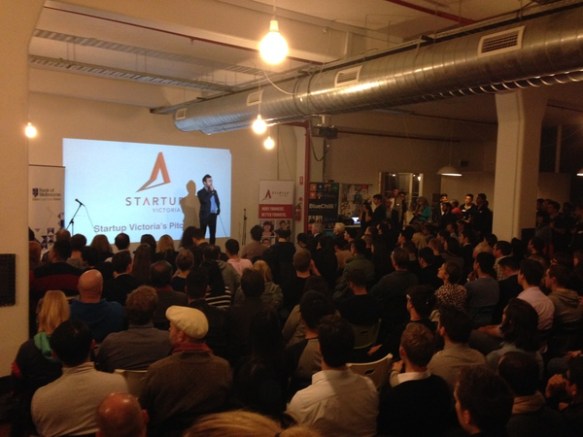
Image sourced from Startup Victoria Meetup

Image sourced from Startup Victoria Meetup

Based on all these presentations, I have collated a simple directory of each startup or pitch event I have covered or mentioned in this blog, as well as a few key accelerators and crowdfunding platforms.

What have we learned over that time?

First, apart from the constant stream of new startups pitching each month, it’s been impressive to witness the Melbourne startup community collaborate and support one another.

Second, some of the international founders who have spoken are among the rock stars of startups – and we are fortunate that they have been willing to spend time in Melbourne.

Third, a number of the local startups who have pitched during this time have become well-established and well-known businesses in their own right.

This all means that besides creating great products and services, and being willing to share their experiences, the founders have helped aspiring founders and entrepreneurs to appreciate the importance of:

  • product-market fit;
  • working with agile processes and lean startup models;
  • tackling prototyping and launching MVPs;
  • learning what to measure via key metrics;
  • figuring out funding; and
  • knowing when to pivot or fold.

Looking at the cross section of pitch nights, panel discussions and guest speakers, there are some significant trends and notable startups to have emerged:

Industry focus: Not surprisingly, the pitches are heavily biased towards FinTech, MedTech, Education, Digital Media, Enterprise Services and Consumer Services. There are a some key startups focused on devices (e.g., SwatchMate and LIFX); a smattering in recruitment, fashion, gaming, health and well-being, property services, social media and even logistics. But there are surprisingly few in environmental technology or services.

Business models: Two-sided market places abound, as do customer aggregators, sharing platforms (“the Uber for X”, or “the AirbnB of Y”), freemium apps and subscription services (as opposed to purely transactional businesses). There are also some great social enterprise startups, but surprisingly no co-operative models (apart from THINC).

Emerging stars:  Looking through the directory of startups, some of the star names to have come through during this time, based on their public profile, funding success, awards (and ubiquity at startup events….) include:

CoinJar, LIFX, Tablo, SwatchMate, etaskr, DragonBill, Culture Amp, Eyenaemia, Timelio, Moula, nuraloop,  Konnective, OutTrippin and SweetHawk.

Acknowledgments: Some of the startups and pitches in the list are just ideas, some don’t even have a website, and some didn’t get any further than a landing page. However, I have not been able to include all the startups that turned up at Startup Alley, nor the many more startup founders I have met through these events (but whom I didn’t get to see pitch or present), nor the startup ideas that were hatched during the hackathons I have participated in. And there are a few startups that I could not include because I heard them pitch at closed investor events. Finally, I am and have been very fortunate to work with a number of the startups listed, in various capacities: Brave New Coin, Ebla, Re-Imagi, Slow School of Business and Timelio. To these startups and their founders, I am extremely grateful for the opportunities they have given me.

Next week: Putting a Price on Value

 

When robots say “Humans do not compute…”

There’s a memorable scene in John Carpenter‘s 1970’s sci-fi classic, “Dark Star” where an astronaut tries to use Cartesian Logic to defuse a nuclear bomb. The bomb is equipped with artificial intelligence and is programmed to detonate via a timer once its circuits have been activated. Due to a circuit malfunction, the bomb believes it has been triggered, even though it is still attached to the spaceship, and cannot be mechanically released. Refuting the arguments against its existence, the bomb responds in kind, and simply states: “I think, therefore I am.”

Dark Star’s Bomb 20: “I think, therefore I am…”

Dark Star’s Bomb 20: “I think, therefore I am…”

The notion of artificial intelligence both thrills us, and fills us with dread: on the one hand, AI can help us (by doing a lot of routine thinking and mundane processing); on the other, it can make us the subjects of its own ill-will (think of HAL 9000 in “2001: A Space Odyssey”, or “Robocop”, or “Terminator” or any similar dystopian sci-fi story).

The current trend for smarter data processing, fuelled by AI tools such as machine learning, semantic search, sentiment analysis and social graph models, is making a world of driverless cars, robo-advice, the Internet of Things and behaviour prediction a reality. But there are concerns that we will abnegate our decision-making (and ultimately, our individual moral responsibility) to computers; that more and more jobs will be lost to robots; and we will end up being dehumanized if we no longer have to think for ourselves. Worse still, if our human behaviours cease making sense to those very same computers that we have programmed to learn how to think for us, then our demise is pre-determined.

The irony is, that if AI becomes as smart as we might imagine, then we will impart to the robots a very human fallibility: namely, the tendency to over-analyse the data (rather than examine the actual evidence before us). As Brian Aldiss wrote in his 1960 short story, “The Sterile Millennia”, when robots get together:

“…they suffer from a trouble which sometimes afflicts human gatherings: a tendency to show off their logic at the expense of the object of the meeting.”

Long live logic, but longer still live common sense!

Next week: 101 #Startup Pitches – What have we learned?


The latest installment of Startup Victoria #pitch night

The numbers were out in force for the August edition of Startup Victoria‘s monthly pitch night. A full house (no doubt helped by a new beverage sponsor…) heard from another batch of startup hopefuls, operating in very different sectors: medtech, recruitment, food logistics and domestic services. Despite some AV issues, this event showcased some interesting businesses, all of them demonstrating some impressive early stage traction.

In order of appearance, the night’s pitches came from:

VideoMyJob

Launched in April 2016, this online tool allows recruiters and hiring managers to film, edit and share their job ads. The business already boasts more than 60 clients (some of them very high-profile), with the data suggesting an 82% higher success rate in hiring outcomes. This performance is largely attributed to the simple fact that candidates spend up to 4 minutes watching a video ad, rather than the average 12 seconds candidates spend reading a text-based ad before they submit an application.

The tool, which runs on a mobile device, includes a tele-prompt feature, in-app editing functions, a one-step process to publish to social, plus e-mail. Customer pricing is based on a $79 monthly subscription to place unlimited video ads. One reported benefit for clients is much stronger candidate short lists.

Given the changing dynamics in the recruitment market, where companies are finding themselves competing for talent and striving to become employers of choice, any new hiring solution has the potential to be a game-changer. Which is what the founders are probably banking on as their exit strategy, with a likely trade sale to a complementary recruitment platform.

PredictBGL

This medtech startup (previously known as ManageBGL) offers an app-based solution to help diabetes patients manage, monitor and predict their blood glucose levels. Despite regular patient testing, according to the founders, 80% of the data is actually ignored.

Able to offer more “real-time” testing, the app claims to fix wrong insulin doses within 3 hours (not the usual 14 days with traditional clinic-based testing), offers more precision dosing, and predicts patient levels up to 8 hours ahead.

It also has the option to incorporate live exercise data (from wearables), and serve patients who can’t afford expensive insulin pumps. As well as paying a monthly subscription, patients are also paying for insights based on the data. With a $10 per month fee, over 80% customer retention rates, and around 600 sign-ups per month, the app is breaking into the US market.

Asked about potential risk factors and the margin for error in patient testing, the founders explained that the user results are somewhat conservative, so they are embarking on clinical trials to refine the analytics.

Jarvis

Billed as “your very own personal butler”, Jarvis is one of a number personal concierge services, catering to the time-poor, inner-city residents who want to outsource domestic chores and errands.

From $33 per week (and an average of $55), Jarvis differentiates itself by offering a more personal touch, because the business hires and trains employees, rather than using freelancers or contractors.

Launched in January 2016, Jarvis is experiencing 20% growth per week, 90% customer retention, high referral rates and generating 10-15% margins. The founders are working on their logistical efficiency – routing, grouping – and deploying scalable technology – such as cluster algorithms. Pat of the attraction for clients is the fact that Jarvis does not see itself as a transactional service like some freelance and task-based apps and platforms.

The panel of judges asked about the risk of being disintermediated (by their own employees going direct to client). Jarvis claims that their key defense is the proprietary Butler app for employees.

Pantreeco

Last up was Pantreeco, which was established in 2014, with the goal of building “productive partnerships in food” by streamlining the logistics and supply chain communications between food suppliers and buyers.

A self-styled “co-commerce” solution, Pantreeco includes a messaging tool between producers, wholesalers, distributors, restaurants, cafes, grocers and providores.

Offering a freemium SaaS model (based on a per customer per channel basis plus commission), Pantreeco is in the process of taking its model to overseas markets via some major international expansion.

Asked by the judges about the competition, such as TradeGecko and Unleashed, the founders stress that they are not simply an e-commerce or inventory management solution. Instead, Pantreeco developing a range of integration services in response to customer demand – e.g., invoicing, accounting, communications as well as inventory management with 3rd party platforms such as Xero, ZenDesk and SalesForce. They also have plans to on-board major enterprise clients in the food and beverage industry.

Based on the audience voting, Pantreeco took out the honours on the night.

Next week: When robots say “Humans do not compute…”

The arts for art’s sake…

Last week I wrote about the importance of learning coding skills. This prompted a response from one reader, advocating the teaching of STEM (science, technology, engineering and maths) in schools: “Coding and the STEM subjects are our gateway into the future.” I would agree. But, as other commentators have noted elsewhere, we also need to put the A (for art) into STEM to get STEAM to propel us forward….

Equivalent VIII (1966) Carl Andre (b.1935) Purchased 1972 http://www.tate.org.uk/art/work/T01534

Equivalent VIII (1966) Carl Andre (b.1935) Purchased by Tate Gallery in 1972 http://www.tate.org.uk/art/work/T01534

I recently attended a talk by renowned arts administrator Michael Lynch, as part of the FLAIR art event, where he expressed frustration at the state of the arts in Australia, the lack of a public arts policy, and the associated cuts to government funding. It can’t help that from John Howard onward, we have had a sequence of Prime Ministers who, while not total Philistines, have shown little enthusiasm, appetite or appreciation for the arts. And during Q&A, Mr Lynch referenced the conservative and “safe” nature of so much arts programming as evidenced by the lack of risk-taking and the stale and over-familiar choice of repertoire, although he did acknowledge some arts organisations were doing exciting work.

The debate then shifted to whether we need a new method to evaluate the benefits of a strong arts sector that is not purely dependent on economic terms or financial performance. It was not possible in the time available to come up with a suitable indicator, but I suggest we can derive a range of benefits from putting more emphasis on teaching, supporting and sponsoring the arts. This RoI might be measured in such terms as the following:

  • Enhancing creativity among students will benefit individual problem-solving skills and collective innovation;
  • A healthy arts scene is indicative of a balanced, self-assured and progressive society;
  • Participating in the arts can give people a sense of confidence and well-being;
  • Through art we can learn about culture, philosophy and history – especially of other societies;
  • Giving people the means to express themselves through art is an important outlet for their skills, talent and interests.

We agonize about the amount of investment in our Olympic athletes in pursuit of gold medals, and whether the money can be justified (goodness – Australia only just made the top 10!)  But no-one (yet) has suggested it’s not worth doing, even if we don’t win as many medals as is often predicted. And of course, together with the wider popular entertainment industry, professional sports attract more dollars, airtime and support through sponsorship, advertising, broadcasting rights, gambling revenue, club memberships and merchandise than the arts could ever hope to.

Part of the challenge lies in the popular notion that arts are either elitist, worthy, self-important, or simply frivolous – which makes it harder to build an economic case for the arts, but which can also lead to the worst kind of cultural cringe. Also, if the arts are really doing their job, they hold up a mirror to our society, and we may not like what we see. Populist politicians can’t afford to be associated or identified with such critiques – either as the targets or as de facto protagonists – so would they rather be seen shaking hands with gold medalists (or attending a Bruce Springsteen concert…) than maybe attending a cutting-edge performance by The Necks?

Next week: The latest installment of Startup Victoria pitch night