Will streaming kill the music industry?

The resurgence in vinyl sales is certainly not enough to save the music business. But will streaming finally cook the goose that once laid Gold Discs?
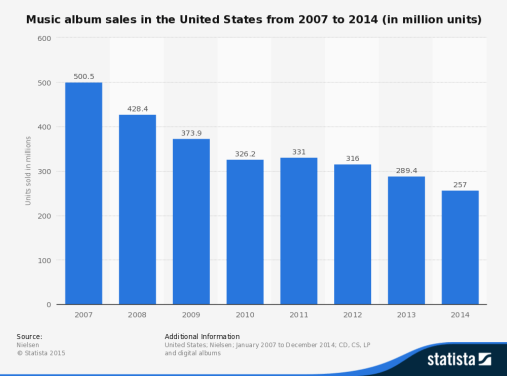
statistic_id273308_music-album-sales-in-the-us-2007-2014

US album sales (in all formats) are in decline. (Source:  Statista)

What can we learn from the music industry based on the apparent rebound of vinyl sales in recent years? Is streaming doing enough to halt the decline in total music revenue? Will CD’s soon disappear altogether? What future for LPs in a world of “Album Equivalent Sales”, “Track Equivalent Albums” and “Streaming Equivalent Albums”?

Are there parallels here with other content, publishing or entertainment sectors?

Back to Black

Last month the 8th annual Record Store Day was launched with a fanfare of upbeat data for vinyl sales. It was a good news story in an otherwise depressing saga of declining album sales, stagnating revenues, and mixed messages about the impact of digital downloads and streaming services on the music industry.

Coming off a very low base (like, near-extinction levels), the extraordinary sales growth of vinyl (especially in Australia) can be attributed to a combination of factors, although it is difficult to see how any single trend is responsible for this growth:

  • The growing popularity of Record Store Day itself (although it’s not without its problems – see below)
  • Baby boomers buying their record collections all over again
  • Hipster interest in analogue technology
  • Record labels mining their back catalogues
  • Niche market interest among audiophiles, collectors and the cool kids
  • New approaches to packaging vinyl with downloads and other bonus content
  • DJ culture
  • Secondary markets via E-bay and Discogs
  • Retailing switching from megastores to specialist shops

Infographic: Vinyl Comes Back From Near-Extinction (Source: Statista)

Where Is The Money Coming From?

Latest industry data suggests that digital sales (downloads and streaming) are now on a par with physical sales (CD, vinyl and the rest). Overall revenue has stabilised, having fallen from a peak in 1999. And streaming services are enjoying huge growth.

But the true picture is harder to establish:

First, while the IFPI provides global aggregated data, each local industry body (RIAA, BPI, ARIA etc.) likes to tell a different story from its national perspective. So it’s difficult to compare like with like. (For example, while Taylor Swift is supposed to be a worldwide phenomenon, she does not figure at all in the BPI data for 2014…..) One brave soul has tried to compile data for the past 20 years.

Second, because of the changes in distribution and consumption, music sales have to be counted in different ways:

  • Wholesale revenue vs retail sales
  • Physical sales vs digital sales
  • Per unit download sales vs streaming equivalents
  • Product revenues (e.g., album sales) vs licensing revenues (e.g., soundtracks)
  • Subscription fees (e.g., Spotify) vs per download revenue (e.g., iTunes)
  • Advertising income from video streaming vs royalties from broadcasting and soundtracks

Third, when more and more music is accessed via video platforms like YouTube, Vimeo, and Vevo, streaming platforms like Spotify, Pandora and Omny, or apps such as Bandcamp, Soundcloud, Mixcloud and Shazam, “sales” data starts to become less and less relevant. (And some people are still hanging on to the ailing MySpace platform….).

The bottom line is that despite the growth in streaming services, digital sales (in whatever format or media) are not yet enough to compensate for the continued decline in album sales in particular, and music overall:
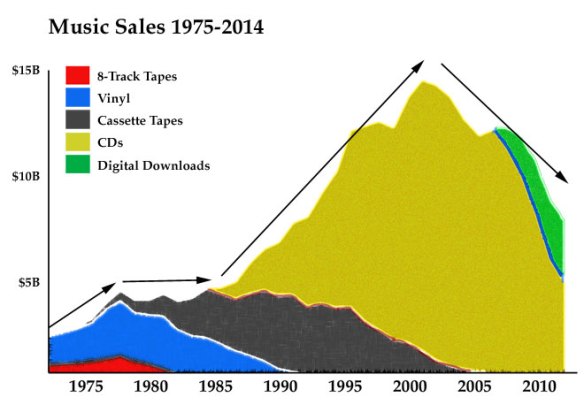
The peak era of CD sales is over. (Source: Talking New Media)

Record Store Day Woes

The success of Record Store Day has divided opinion as to whether it is actually a “good thing” for the industry. It started as a campaign by independent record labels, distributors and retailers to revive the habit of buying records in-store. Labels produce limited edition and often highly collectible items for the occasion, and there are rules as to how, when and where these releases can be made available to the public.

At first, it really was driven by the independent labels, many of whom brought out interesting product that otherwise wasn’t available, such as label samplers, unreleased material and one-off artist collaborations.

Now, the major labels have jumped on board, meaning the market is flooded with unnecessary re-releases (do we really need Bruce Springsteen‘s ’70s and ’80s albums reissued on vinyl?) drawn from their extensive back catalogues (no need to pay for recording costs or new artwork!).

This means that smaller labels who release new vinyl records on a regular basis (not just once a year) get bumped from the production line, as the major labels exert their purchasing power over the pressing plants.

In addition, some Record Store Day releases are so badly distributed that stores are unlikely to take delivery of the items in time for the event. Or bad decisions lead to over-supply of certain items, which end up in the bargain bins (major labels again especially guilty of this offence).

Some store owners appear reluctant to participate because they feel embarrassed about the prices they may have to charge for many of the limited releases, which get bought by speculative customers, rather than collectors, fans and enthusiasts – a fact borne out by the immediate listings and inflated prices on E-Bay and Discogs….

As one store owner I talked to commented: “Every day should be record store day…”

What Else Does The Data Reveal?

For all the new young pop stars that the industry keeps churning out, there’s nothing like longevity and back catalogue to prop up the sales numbers. For example, Barbara Streisand was in the Top 10 for US album sales (and with new material!), and the likes of Pink Floyd, Led Zeppelin, Miles Davis, Bob Marley and Oasis feature in the top-selling vinyl records. Will Record Store Day 2025 herald the vinyl release of Justin Bieber’s pre-pubescent “demos”?

The decline of album sales has been particularly steep in the genres of Hip-Hop and R&B, while rock and pop continue to dominate the market. Some industry commentators have suggested that music sales are merely “in transition” as consumers switch from buying CD’s and downloading music to subscribing to streaming services. Meanwhile, in the US, country music’s #4 position by overall consumption reflects substantial album sales, as streaming is still a small component for the genre.

And those vinyl sales numbers? They’re simply a blip on the chart and largely driven by avid fans willing to shell out for deluxe editions….

The future is streaming?

Apple and others certainly believe (or hope) that streaming will save the music industry. Having demolished the market for CDs, iTunes is in a battle for its own survival among competing streaming services, where Apple itself is about to lead the charge having acquired the Beats platform.

But others are not so sure, predicting that streaming is already in decline, along with download sales:

First, the streaming platforms are yet to make a profit. Part of this is due to the cost of content that has to be licensed from the record labels and artists. Part is also due to the cost of acquiring customers, even if this can be done via social media, because the decline in music buying has been so abrupt, so the industry may be permanently damaged that streaming cannot bring back paying customers.

Second, even though streaming may overtake downloads by next year, there’s still nothing certain that teen pop fans (the target audience) will pay $7.99 – $9.99 per month to listen to music via so-called “freemium” services. Evidence suggests that consumers are happy with the free services, even if they have to put up with ads.

Third, while I agree that the freemium model is a fixture in the digital economy, the problem with Spotify et al is that they are not growing the market for music, but simply cannibalising it by displacing existing platforms (commercial radio, digital downloads, physical sales), while being tied to third-party distribution channels (the internet) and devices (smart phones, tablets and computers).

Anyway, subscription-based music streaming is nothing new, and was first launched over 100 years ago (and thanks to Mark Brend’s “The Sound of Tomorrow”, I learned that Mark Twain was the first subscriber).

If the “old” record companies are charging streaming services too much to license their content, then the streaming services should just find other sources – there’s plenty out there – but then, just like the major record labels, they are not really interested in music, only in shifting product and promoting “artists” (even if they are still figuring out how to make digital pay). The record labels don’t help themselves with their reliance on back catalogue, and their archaic territorial licensing practices either – forcing customers to circumvent geo-blocking barriers (legally or otherwise…).

Unfortunately, file sharing, illegal downloads and “free” streaming have meant customers don’t feel compelled to pay for digital music content. Personally, I prefer to curate my own listening, and not let someone else dictate what I hear, even if the service “knows” my preferences…

And the moral of the story is…?

More distribution platforms, more formats and more content may not be enough to save ailing industries, whether it’s music or television, newspapers or movies. These businesses will have to learn to live with lower margins and/or smaller market shares. The quality of a home-made movie uploaded onto YouTube may not be anywhere near that of a Hollywood blockbuster, but if cat videos are what grab punters’ attention (and by default, pull in the advertisers), the studios may have to find alternative strategies. And if music fans prefer to use free streaming services, the industry has to do a better job of producing content that consumers may be willing to pay for.

Ironically, in publishing, one sector that has been written off ever since the arrival of CD-ROM’s and the internet, teen consumers are still happily buying and reading print editions, alongside e-books. More so than other content industries, publishing has rapidly adapted to the new user-defined model: aspiring authors find it easier to self-publish (e.g., via Tablo and dedicated crowdfunding platforms such as Pubslush and Unbound); they can easily connect with an audience (especially in the realm of fan fiction); and a platform like Wattpad allows writers to test material before they commit to formal publication, and lets readers vote for what they’d like to read more of.

Next week: Making connections between founders and investors


F for Facsimile: What are ‘Digital Forgeries’?

Last week, I attended the 2014 Foxcroft Lecture, given by Nicholas Barker, entitled “Forgery of Printed Documents”. The lecture prompted the question, what would we consider to be a ‘digital forgery’?

Make Up

The lecture was an investigation into a practice that emerged in the 18th century, when reproductions (‘fac similes’ – Latin for ‘make alike’) of early printed texts were created either as honest replicas, or to enable missing pages from antiquarian books to be restored to ‘make up’ a complete work. In some cases, the original pages had been removed by the censors, for others the pages had been left out in error during the binding process, and mostly they had simply been lost through damage or age.

Other factors created the need for these facsimiles: the number of copies of a book that could be printed at a time was often limited by law (censorship again at work), or works were licensed to different publishers in different markets, but printed using the original plates to save time and money.

Despite the innocent origins of facsimiles, unscrupulous dealers and collectors found a way to exploit them for financial gain – and of course, there were also attempts to pass off completely bogus works as genuine texts.

Replication vs Authentication

Technology has not only made the mass reproduction of written texts so much easier, it has also changed the way physical documents are authenticated – for example, faxed and scanned copies of signed documents are sometimes deemed sufficient proof of their existence, as evidence of specific facts, or in support of a contractual agreement or commercial arrangement. But this was not always the case, and even today, some legal documents have to be executed in written, hard-copy form, signed in person by the parties and in some situations witnessed by an independent party. For certain transactions, a formal seal needs to be attached to the original document.

Authenticating digital documents and artifacts present us with various challenges. Quite apart from the need to verify electronic copies of contracts and official documents, the ubiquity of e-mail (and social media) means it has been a target for exploitation by hackers and others, making it increasingly difficult to place our trust in these forms of communication. As a result, we use encryption and other security devices to protect our data. But what about other digital content?

Let’s define ‘digital artifacts’ in this context as things like software; music; video; photography; books; databases; or digital certificates, signatures and keys. We know that it is much easier to fabricate something that is not what it purports to be (witness the use of photo-editing in the media and fashion industries), and there is a corresponding set of tools to help uncover these fabrications. Time stamping, digital watermarks, metadata and other devices can help us to verify the authenticity and/or source of a digital asset.

Multiplication

In the case of fine art, the use of digital media (as standalone images or video, as part of an installation, or as a component in mixed media pieces) has meant that some artists have made only a single unique copy of their work, while others have created so-called ‘multiples’ – large-scale editions of their work. (The realm of ‘digital works’ and ‘digital prints’ produced by photographers and artists is worthy of a separate article.)

Making copies of existing digital works is relatively simple – the technology to reproduce and distribute digital artifacts on a widespread scale is built into practically every device linked to the Internet. Not all digital reproduction and file sharing is theft or piracy – in fact, through the wonders of social media ‘sharing’, we are actually encouraged to disseminate this content to our friends and followers.

The song doesn’t remain the same

Apart from the computer industry’s use of product keys to manage and restrict the distribution of unlicensed copies of their software, the music and film industries have probably done the most to tackle illegal copying since the introduction of the CD/DVD. At various times, the entertainment industries have deployed the following technologies:

  • copy-protection (to prevent copies being ripped and burned on computers)
  • encryption (discs and media files are ‘locked’ to a specific device or user account)
  • playback limits (mp3 files will become unplayable after a specific number of plays)
  • time expiry (content will be inaccessible beyond a specific date)

Most of these technologies have been abandoned because they either hamper our use and enjoyment of the content, or they have been easy to over-ride.

One technical issue to consider is ‘digital decay’ (*) – mostly, this relates to backing up and preserving digital archives, since we know that hard drives die, file formats become obsolete and software upgrades don’t always retrofit to existing data. But I wonder whether each subsequent copy of a digital artifact introduces unintentional flaws, which over time will generate copies that may render nothing like the original?

In the days of analogue audio tape, second, third and fourth generation copies were self-evident – namely, the audible tape hiss, wow and flutter caused by copying copies, by using machines with different motor speeds, and by minor fluctuations in power. Today, different file formats and things like compression and conversion can render very different versions of the ‘same’ digital content – for example, most mp3 files are highly compressed (for playback on certain devices) while audiophiles prefer FLAC. Although this is partly a question of taste, how do we know what the original should sound like? With a bit of effort, we can re-process an ‘original’ downloaded mp3 into our own unique ‘copy’ which may sound very different to the version put out by the record company (who probably mastered the commercially released mp3 from studio recordings created using high-quality audio processing and much faster data sampling rates).

So, would the re-processed version be a forgery?

(*) Thanks to Richard Almond for his article on Digital Decay which I found very useful.


Has streaming killed the video store?

In the era of Quickflix and internet TV services, why would anyone continue to patronise a bricks and mortar DVD shop? Well I, for one, am a  regular customer of my local independent video store, and here’s why:

First, choice. Clearly, they don’t have every film or TV series ever made, but there’s more than enough to discover during my lifetime. And they stock loads of titles not yet available to stream or download in Australia. (See previous blog on geo-blocking – and at the time of writing, Netflix is not available in Australia.)

Second, they have a great international selection, and their catalogue is not dominated by the latest Hollywood blockbusters. They have a particularly good section of art-house titles, as well as all-time classics, mainstream comedy and big-name dramas.

Third, it’s cheaper. There’s a minimal sign-up cost, no monthly subscription fees, and on average, the nightly cost of a DVD rental can be far less than alternative services. Plus, with most of their DVD’s, you get the bonus material not always available via streaming.

Fourth, it’s quicker. I know this sounds counter-intuitive, but with the slow internet speeds in Australia, it actually takes me less time to walk the few blocks to the video store and back than it does to download a full-length film.

Fifth, the staff make informed recommendations. OK, recommender engines are getting more and more sophisticated, but many still seem to be based on what people bought/downloaded, and not so much on what they actually watched, and really liked. But the video store staff are very knowledgeable about films, and having watched a lot, they can usually offer some personal suggestions based on what I have previously enjoyed.

Finally, the local DVD store is something of a community service, and for that alone I will continue to support it.

10 Examples of Cold War Nostalgia: We Can’t Get Enough Of It…

I don’t know if any historian, politician or media commentator has ever said it publicly, but someone must have coined the phrase, “You knew where you stood during the Cold War”.

tinker-dvdlrg

There was some strange comfort to be had in knowing exactly where the geo-political lines were drawn in the days before the Soviet invasion of Afghanistan and the Iranian revolution of 1979* – events which could be argued to have brought about the dismantling of the Iron Curtain, but also heralded an era of constant challenge to American hegemony.

35 years after those momentous events of 1979, numerous books, TV series and films continue to feed our appetite for Cold War nostalgia. Here is a (highly subjective and selective) list of 10 such contributions from recent years:

  1. “Stasiland” (2003) – While not strictly speaking about the Cold War, Anna Funder’s  contemporary work of non-fiction on East Germany’s surveillance regime is a powerful account of her investigation into the activities of secret police operatives and their victims, and what has become of them since the Berlin Wall collapsed and the re-unification of Germany
  2. “The Lives of Others” (2006) – This film, set in 1984, is a somewhat romanticized look at events described in Funder’s “Stasiland”, but still manages to convey the numbing effects of life behind the Iron Curtain
  3. “Equals” (2014) – The year will not be allowed to pass without SOME sort of reference/homage/pastiche/exhumation/sequel to George Orwell’s dystopian novel, “1984”, which was published 65 years ago, and set 35 years in the future of the titular year itself. While not exactly a Cold War novel, it’s seen as an allegory for life in the Soviet Union under Stalin, and a veiled warning to the rest of us about the threat of a totalitarian regime. Upcoming movie “Equals” is supposed to be a romantic interpretation of “1984”….
  4. “Tinker Tailor Soldier Spy” (2011) – A movie adaptation of John Le Carre’s spy novel (itself published 40 years ago, and first dramatised for TV 35 years ago when the Cold War was very much alive and kicking).
  5. “Foyle’s War” (2000-2013) – The latest episodes in this long-running TV detective series show our hero transitioning from investigating crime during war-time to the new world of espionage, counter-intelligence and Cold War intrigue.
  6. “The Hour” (2012-13) – This short-lived TV drama series was ostensibly a behind-the-scenes look at a 1950’s news and current affairs programme, but uses the Cold War events like the Hungary uprising and the Suez Crisis as a backdrop (along with a healthy dose of “reds under the bed” which implicitly references the Soviet agent scandals that rocked the British establishment during the 1950’s and 1960’s and beyond – Burgess, Maclean, Philby, Blunt et al).
  7. “Stephen Ward Was Innocent, OK” (2013) – Geoffrey Robertson delves into the truth behind the criminal prosecution and media castigation of a bit-player in the so-called Profumo Affair, which likely contributed to Ward’s suicide in 1963. The Profumo Affair of 1961 had it all – prostitution, Cold War politics and Soviet agents. And even though it led to the resignation of the UK’s War Minister, it has been suggested that the Establishment demanded scapegoats, and Ward was seen as a suitable victim.
  8. “Solo: A James Bond Novel” (2013) – William Boyd is the latest novelist to be invited to add to the Bond canon (original Bond author, Ian Fleming died 50 years ago), and chose to set the story in 1969 with a strong Cold War context. Boyd is, of course, no stranger to this genre – nearly all of his recent novels (“Any Human Heart”, “Restless”, “Waiting for Sunrise” and “Ordinary Thunderstorms”) incorporate elements of war-time espionage, betrayal, double agents and industrial sabotage that span the 20th century.
  9. “Sweet Tooth” (2013) – Ian McEwan uses the Cold War politics of the early 1970’s as the setting for his novel about love, trust, (self-)deception, “official” propaganda and bureaucratic betrayal.
  10. “Jack Ryan: Shadow Recruit” (2014) – Finally, bang up to date with a film version of the Tom Clancy novel. Clancy, who died only a few months ago, was a veritable Cold War warrior of the fiction world, and this latest addition to the Jack Ryan saga includes some (reassuring) Russian elements. I haven’t seen it yet, but I’m sure it will satisfy my appetite for Cold War nostalgia.

* The events of the 1979 US embassy hostage crisis in Tehran, of course, were recently dramatised to great effect in “Argo” (2012). And just this month, The Atlantic described current US-Iran relations in Cold War terms.