Content Marketing and the “New Hierarchy of Needs”

Maslow’s theory on the “Hierarchy of Needs” has become shorthand for explaining human behaviour and motivation – primarily in our personal lives, but increasingly in our working lives. At the risk of offering an answer to yet another first world problem, it seems to me that many social media platforms and content marketing solutions are trying to recalibrate Maslow for generating deeper (and sometimes more meaningful) engagement with consumers. So, by way of a simple infographic, I am offering my own theory on the new hierarchy of needs:
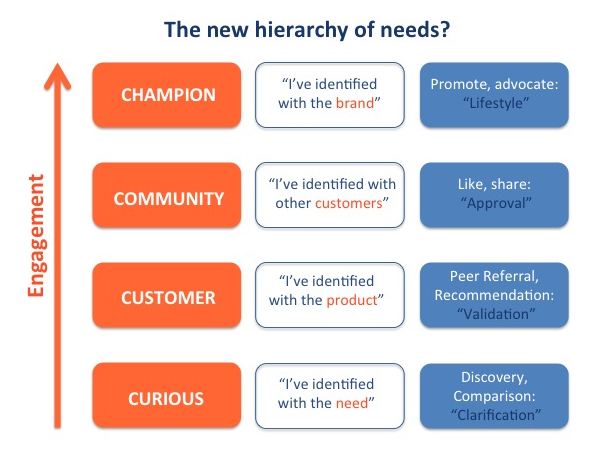
New Hierarchy of Needs


When we are looking for a product or service to meet a need, we are usually in “discovery mode” – we are searching for content that helps us by offering suggestions, comparing products and prices, and clarifying the precise need. So, we are either browsing, curious, or looking for assistance.

Having found some possible solutions, we seek reassurance via informed recommendations, peer referrals and published reviews. We may place different weight on this information depending on the source, but we are seeking justification for our reason to buy, or validation for becoming a customer.

If we are happy with our choice, and given the right opportunity and encouragement, we may be willing to tell our friends and anyone else who’s interested via Likes and social media posts and reviews. This is an interesting point in the engagement transaction – going from peer-to-peer sharing, to looking for approval for our decision from the wider community.

Finally, if we are so enamoured with the product, and we enjoy sharing our experiences, we may be flattered into making a lifestyle statement about our preferences; we could become a self-identified “voice of authority” through blogging and endorsements, or we might be willing to be closely identified with a brand as an advocate or champion (the sort of customer beloved of Net Promoter Scores).

The ultimate consumer-turned-champion was, of course Victor Kiam, the customer who liked the product so much, he bought the company….

#Startup Victoria’s Pitch Night – @ParentPaperwork takes the honours…

The repositioning of Lean Startup Melbourne as Startup Victoria continues apace, with a formal Pitch Night hosted by Inspire9, sponsored by Bank of Melbourne, Bluechilli and The X Gene, and featuring an expert panel.

The 5 plucky pitchers were (in order of appearance):

  • Arts ‘n Smarts – An early childhood learning platform, offering a subscription service comprising monthly home deliveries of craft materials for use in structured play activities. The business has identified strong channel potential via play groups, partnerships with content providers and craft suppliers, and cross-over sales from the gift and baby/toddler markets. However, the panel felt that the subscription revenue model needed more analysis, and there was a risk that they were “pitching to the converted” – that informed parents would already be engaged in their children’s learning activities.
  • CreoLud – Custom 3-D printing for Dungeons & Dragons figurines which aims to fill the design gap between concept and production. Given the somewhat esoteric nature of fantasy board games, it was unsurprising that the panel were a little perplexed by this pitch. However, quoting some McKinsey research suggesting there is a $16.2bn global market for broader physical gaming and figures markets, this pitch could represent just the start of a growth trend in customisation and personalization, leveraging 3-D printing technology.
  • ParentPaperwork – Online student consent form service for schools that uses standard e-mail templates, a secure website and real-time reporting. By adopting a SaaS model, the business eliminates the need for software installation, app downloads, or social network registration processes. Although each State education system has different purchasing models for schools, the panel clearly recognised the potential to scale the product and take it overseas. However, there were concerns about privacy and confidentiality issues; and while there may be a crossover to the school enrolment process, another similar local startup, CareMonkey is already gaining traction and incorporates permission slips into its solution.
  • YourGrocer – This home delivery service for local suppliers has been featured in my blog before and continues to grow its customer base and weekly revenues at a steady rate. The combination of local shopping with added convenience is very appealing, but the panel quickly challenged the business to specify how it will grow out of its single-suburb service, currently based on a sole delivery van and driver. There appears to be some “creative tension” about how to expand the business beyond the borders of Brunswick – the choices being either to hire more full-time drivers, to build a franchise network, or to establish a marketplace of independent owner-drivers.
  • StageLabel – Describing itself as “a crowd-funded label bringing democracy to fashion…“, this online venture recognises the high failure rate for new designer labels, but is banking on its market disruption strategy for success. The business model is to test and validate new designs in pre-production, then gain funding to go into production. The business will also offer strategy sessions on pricing and production, and take a lower sales commission on successful projects when compared to the traditional retail mark-up. With over 80 designers already signed up, partnerships with fashion schools and launch events at Melbourne Spring Fashion Week, the business is hoping to outmanoeuvre competitor betabrand which only produces own-label designs. In their feedback, the panel concluded that the idea represented “high effort, low volumes”.

On the night, the audience voted ParentPaperwork as the winning pitch, earning them a chat with Square Peg Capital, mentoring from two panel members of their choice, and temporary co-working space at Queens Collective. The successful team graciously acknowledged that all 5 teams had collaborated to help each other hone their respective pitches, and no doubt there has been a huge amount of individual effort and collective goodwill in helping to bring these startups to a wider audience.

FOOTNOTE:

This meetup was just the latest in a growing number of pitch nights coming out of the local startup scene (in the wake of similar events such as the AngelCube graduation nights, Melbourne University’s Accelerator Program, and Oxygen Venture’s BIG Pitch). If you don’t happen to live in Melbourne, or can’t get out in the evening, you could always tune into “That Start Up Show”.


Joining Australia Post’s “National Conversation”

In a previous blog, I offered some thoughts on the possible digital future for AusPost. In response, I have been contacted by one of their social media consultants, drawing my attention to the “National Conversation“.

First, I acknowledge that AusPost is attempting to have an “open” conversation with customers, but I don’t see how this is really helping, other than generating a range of (conflicting) opinions, with little cohesion around the key issues. Participation rates in the Topics to date has been very erratic (in terms of numbers, and geographic distribution).

Second, I have read CEO Ahmed Fahour’s latest address, and frankly it did not inspire me. Basically, it was a whinge about the decline in letter volume, and the “challenges” of the Internet (which, as he says, has been with us for 25 years…. hardly a new event!) I also think there are some factual inaccuracies in Mr Fahour’s assumptions: I don’t believe that Australians are any less digital citizens than their OECD counterparts – they have always been reasonably early adopters of new technology (as evidenced by the number of smart phones and tablets). Where they have been slow is in moving to online services, but this is in large part due to poor Internet services (notoriously slow connection speeds and restricted bandwidth, and exorbitant access fees), coupled with a paucity of reliable online platforms – which is ironic given the push towards eGovernment, eCommerce and the digital economy around 1999-2001.

Third, and staying on the topic of eCommerce, the one recurring theme that does emerge from the National Conversation so far is the high cost of sending small parcels. I agree with some of the feedback that it is often cheaper (and quicker!) to order consumer items from overseas online retailers. Shouldn’t Australian consumers expect to benefit from the economies of scale to be achieved from a growing parcel business?

Finally, my previous blog suggested that digital transactions are the future for AusPost (while acknowledging the need to maintain its statutory obligations for letter delivery) – but apart from e-mail and bill payments, Mr Fahour’s address was rather silent on this point. That scares me, as it suggests a lack of vision for an integrated digital strategy. After almost 5 years in the job, you’d think a few more ideas would have emerged by now.

(Afterthought: maybe AusPost should check out what Shomi is doing – a local start-up with some smarts in linking the physical and digital worlds.)

Defining RoDA: Return on #Digital Assets

How do we measure the Return on Investment for digital assets? It’s a question that is starting to challenge digital marketers and IT managers alike, but there don’t appear to be too many guidelines. Whether your social media campaign is being expensed as direct marketing costs, or your hardware upgrade is being capitalised, how do you work out the #RoDA?

In most businesses, measuring the expected RoI of plant or equipment is usually quite easy: it’s normally a financial calculation that takes the initial acquisition price, amortized over the useful life of the asset, and then forecasts the “yield” in definable terms such as manufacturing output or capacity utilisation.

However, when we look at digital assets, many of those traditional calculations won’t apply, either because the usage value is harder to define, or the benchmarks have not been established. Also, while hardware costs may be easy to capture, how are digital assets such as websites, social media accounts, software (proprietary and 3rd party) and domain names being reported in the P&L, cash-flow analysis and balance sheet?

Sure, most hardware (servers, PCs and physical networks) can be treated as capex (e.g., if the purchase price is more than $1,000 and the useful life is 2-5 years). But how do you make sure you are getting value for money – is it based on some sort of productivity analysis, or is it simply treated as fixed overhead – regardless of your turnover or operating costs?

As we move to cloud hosting and #BYOD, many of these assets utilised in the course of doing business won’t actually appear on the company balance sheet. Yet they will have some sort of impact on the operating costs. Most software is sold under a licensing model, where the customer does not actually own the asset. (But, if the international accounting standards change the treatment of operating leases longer than 12 months, that 2-year cloud hosting fee might just became a balance sheet item.)

I was once involved in the acquisition of a publishing business that was converting legacy print products to digital content. Not only did they capitalise (and amortize) the servers and the conversion software, they also capitalised the data entry costs (using freelance editors) to avoid the expense hitting the P&L. Nowadays, that’s a bit like putting the HTML coding team on the balance sheet and not the payroll…

In some cases, the costs associated with maintaining an e-commerce website or registering a URL, will remain as overhead or operating expenses. But over time, businesses will want to have a better understanding of their RoI for different online sales and digital marketing channels, especially if they have been investing considerably in their design, build and maintenance. Measuring online visitor data, customer conversion rates and average yield per sale, etc. are becoming established metrics for many B2C sites. Having a good grasp of your #RoDA may just give you a competitive edge, or at least provide a benchmark on effective marketing costs.