How to survive as #Digital Adaptors

Marc Prensky coined the phrase “Digital Natives” back in 2001. At the time, it seemed like a reasonable way to explain the gap between those who have grown up “speaking” digital, and those who have had to learn to it as a second language, and in the specific context of Prensky’s thesis, those who have to teach digital. But is the label still meaningful or helpful? Has it been reduced to a marketing tag?

Source: Charlotta Wasteson (Creative Common - some rights reserved)

Source: Charlotta Wasteson (Creative Commons – some rights reserved)

Bridging the Digital Divide

Since its inception, the term “Digital Native” has since been used to describe a key characteristic of Gen Z (otherwise known as “Generation I” or even “I-Gen”), those born since the early 1990s and who have only ever known smart phones, tablets, social media, digital music, video streaming, online search, instant chat and photo sharing.

But a generation later, I think the tag is increasingly redundant – it’s less about learning the “language of digital”, and more about engaging with the digital evolution: those who are the best “Digital Adaptors” will find it easiest to cope and survive in a constantly disruptive and disrupted world.

The key to being Digitally Adaptive is learning how to make the best use of the available technology, apps and social trends so that they work for you, and not against you. For anyone who says they have missed the digital boat, I would simply refer them to people like my parents’ generation (active retirees in their 80’s) who have had to learn to use tools such as Skype and Facebook long after their retirement.

Digital Can Be Learned

I recently asked a client of mine, a Gen Y entrepreneur, what the term “Digital Native” meant to him: “Someone born in the 1990s, who has used digital technology from early childhood.”

He did not think the description applied to him, even though there had been computers at home when he was growing up, because he had not used computers in school from day one, and because he had not really learned how to code. (In fact, given the choice, he would have probably learned computer programming instead of a mandatory foreign language.)

This is someone who prefers to use Facebook Messaging instead of e-mail or even SMS, and who is never without a smart phone and/or laptop, and works in an industry where digital technology has caused considerable disruption to the old business models, while introducing many new opportunities. So, even though he is not a “Digital Native”, he has learned to adapt and can navigate his way through the landscape.

Another acquaintance (Gen X entrepreneur) was far more bullish on digital evolution: “The only human skills required in the future that cannot be digitized or computerised are creativity and critical thinking. We won’t need to communicate via written words and numbers because machine learning will adapt to our requirements, anticipate our needs and do the calculations for us.”

His business is now part of the shared economy (one of the many “dialects” that digital natives speak) so he, too has learned to adapt.

However, the more significant developments are among baby-boomers. These are experienced entrepreneurs, business people and professionals who have embraced digital as part of their continuing personal development, and then applied the learning to create new products, services and business models that harness the power of digital. OK, so they may not be fluent in Emoji, and might not know what the coolest trending #hashtags are, but they have seen the possibilities presented by digital, and are embedding them in the way they innovate, create and manage new opportunities.

The Natives Are Restless

There have been many recent studies about the impact of “digital” on our lives – whether it is the paradox of multitasking, our shortening attention spans, the need to be constantly plugged in (and the fear of missing out…) and the gulf between our virtual and real lives.

I think the common theme is that digital has not necessarily made us smarter or cleverer – even though we have access to infinite information and a smart phone can do in seconds what might have taken several hours on a mainframe computer. Instead, digital natives (and those who have become “naturalised”, to stretch Presnky’s metaphor) are increasingly impatient, don’t appreciate that some things still take time, and are yet to realise that instant gratification not only makes us lazy but dulls our appreciation for new experiences.

Moreover, without an understanding or curiosity for how things really work (the UI/UX is all you need to know…), digital has not really empowered us to think for ourselves, nor explore the depths of what the technology might be able to do for us. Instead, we are reduced to the shallows of “Likes”, “Follows”, “Shares” and “Retweets” in the hope/expectation that someone will reciprocate. For example, I recently heard of a new business that writes on-line dating profiles for their clients. While outsourcing such tasks may be efficient for time-poor digital citizens, it suggests we are only prepared to engage in the process at a superficial level, and in doing so we risk making ourselves more digitally dependant.

This digital monomania afflicts young and old alike – witness senior citizens getting hooked on social media – and can become self-limiting, because our interactions with a touch screen and our on-line/virtual relationships are seen as ends in themselves.

Digital Survival Kit

In my own case, I would not be classified as a digital native – we certainly didn’t have computers at my school (the most high-tech we got was a language lab with reel-to-reel tape decks, cathode ray oscilloscopes in the science class, and photo screen printing in the art room). And the only coding I learned was BASIC, with the aid of a Sinclair ZX81 home computer.

Home computing circa 1980

Home computing circa 1980

But at every stage of my career, I have had to keep up with (and in some cases, be an early adopter of) digital technologies, mostly through being self-taught and by learning from experience, as well as maintaining a natural curiosity whenever something new comes along. I would not describe myself as a technologist, but more like a tourist, who tries to learn a few words and phrases before they travel abroad.

In order to survive the digital deluge, here are a few things I do to keep abreast of current developments:

  1. Beta test new apps – developers are usually looking for beta testers, and it’s a great way to get access to stuff before anyone else, and often for free. I also attend product launches and workshops where developers and product managers can showcase what they are working on.
  2. Blogging etc. – apart from this weekly blog, and in addition to my social media accounts and social networking tools, I also maintain a Bandcamp account and SoundCloud page, where I upload my own compositions (many of which are created with iOS apps)
  3. Meet-ups – I attend numerous meet-ups for startups, technology, entrepreneurship and innovation, to network, to learn about new ideas and to watch pitches in action (e.g., events organised and promoted by Startup Victoria)
  4. On-line “How To” courses – YouTube and user forums are useful sources of instructional guides on how to use new apps, software and hardware (especially music, video and graphic design tools). For more in-depth content, I sometimes dip into on-line libraries from General Assembly and SitePoint
  5. Hackathons – In recent months I participated in a FinTech weekend hackathon, and took part in a MedTech startup competition. They took me out of my comfort zone, exposed me to new ideas, introduced me to some brilliant people and provided insights on alternative perspectives which I might not otherwise have considered
  6. Newsletters – There’s loads of stuff out there, but a few industry newsletters worth scanning on a regular basis are Beta.List, Gizmag and Mantra – but no doubt you will find similar publications that serve your needs. And using aggregation tools and curation apps can help you to manage the information flow
  7. Personal development – underpinning this digital immersion (and this may sound counter-intuitive!) I participate in alternative real-world education and training communities such as the Slow School of Business. This helps to keep me grounded (theory is great, but what practical things can we do?) and also provides some context for how the digital “learning” can be applied to collaboration, co-creation and community projects.

Don’t be a Digital Dropout

I’m not saying that all things digital are wonderful – and certainly, there is much that is unhealthy in the way digital impinges on our ability to think for ourselves – but it doesn’t pay to ignore it completely. By all means, ration your use of digital tools and devices, schedule time when you go totally off-line, and learn to switch from doing task-oriented activities to purely creative or abstract “play” alongside your digital engagement. Above all, find a way to embrace digital that works for you, establish a “digital persona” that you are comfortable with, get advice from people you trust, and perhaps like a tourist, learn to blend in….

Next week: Victorian Government’s plan for Innovation & Entrepreneurship 

Personal vs Public: Rethinking Privacy

An incident I recently witnessed in my neighbourhood has caused to me to rethink how we should be defining “privacy”. Data protection is one thing, but when our privacy can be compromised via the direct connection between the digital and analog worlds, all the cyber security in the world doesn’t protect us against unwanted nuisance, intrusion or even invasion of our personal space.

Pressefotografen mit KamerasScenario

As I was walking along the street, I saw another pedestrian stop outside a house, and from the pavement, use her smart phone to take a photograph through the open bedroom window. Regardless of who was inside, and irrespective of what they were doing (assuming nothing illegal was occurring), I would consider this to be an invasion of privacy.

For example, it would be very easy to share the picture via social media, along with date and location data. From there, it could be possible to search land registries and other public records to ascertain the identity of the owners and/or occupants. And with a little more effort, you might have enough information to stalk or even cyber-bully them.

Privacy Law

Photographing people on private property (e.g., in their home) from public property (e.g., on the street outside) is not an offence, although photographers must not cause a nuisance nor interfere with the occupants’ right of quiet enjoyment. Our current privacy laws largely exclude this breach of privacy (unless it relates to disclosure of personal data by a regulated entity). Even rules about the use of drones are driven by safety rather than privacy concerns.

Since the late 1990’s, and the advent of spam and internet hacking, there have been court decisions that update the law of trespass to include what could be defined as “digital trespass”, although some judges have since tried to limit such actions to instances where actual harm or damage has been inflicted on the plaintiff. (Interestingly, in Australia, an act of trespass does not have to be “intentional”, merely “negligent”.)

Apart from economic and financial loss that can arise from internet fraud and identity theft, invasion of privacy via public disclosure of personal data could lead to personal embarrassment, damage to reputation or even ostracism. (In legal terms emotional stress falls within “pain and suffering”).

Data Protection Law

The Australian Privacy Principles contained within the 1988 Privacy Act apply to government agencies, private companies with annual turnover of $3m or more, and any organisations trading in personal data, dealing with credit information or providing health services. There are specific provisions relating to the use and misuse of government-derived identifiers such as medical records and tax file numbers.

The main purpose of the privacy legislation is to protect “sensitive” information, and to prevent such data being used unlawfully to identify specific individuals. At a minimum, this means keeping personal data such as dates of birth, financial records or hospital files in a secure format.

Some Practical Definitions

The following are not legal definitions, but hopefully offer a practical framework to understand how we might categorise such data, and manage our obligations towards it:

“Confidential”

Secret information that must not be disclosed to anyone unless there is a legal obligation or permission to do so. (There are also specific issues and exceptions relating to “classified information”, public interest matters, whistleblower protection and Freedom of Information requests.)

“Private”

Information which is not for public or general consumption, although the data itself may not be “confidential”. May still be subject to legal protection or rights, such as the right of adopted children to discover the identity of their birth parents, or the right of someone not to be identified as a lottery winner.

“Personal”

Data that relates to, or can specifically identify a particular individual. An increasing issue for Big Data, because data that otherwise resides in separate locations can now be re-connected using triangulation techniques – scrape enough websites and drill down into enough databases, and you could probably find my shoe size.

“Public”

Anything that has been published, or easily discoverable through open search or public database retrieval (but, for example, does not include my past transactions on eBay unless I have chosen to disclose them to other users). My date of birth may be a matter of record, but unless you have authorised access to the relevant database or registry, you won’t be able to discover it and you certainly shouldn’t disclose it without my permission.

Copyright Law

One further dimension to the debate is copyright law – the ownership and related rights associated with any creative works, including photographs. All original content is copyright (except those works deemed to be in the “public domain”), and nearly all copyright vests with the person who created the work (unless they have legally assigned their copyright, or the material was created in the course of their employment).

In the scenario described above, the photographer would hold copyright in the picture they took. However, if the photograph included the image of an artwork or even a framed letter hanging on the wall, they could not reproduce the photograph without the permission of the person who owned the copyright in those original works. In some (limited) situations, a photograph of a building may be subject to the architect’s copyright in the design.

Curiosity is not enough justification to share

My personal view on all this is that unless there is a compelling reason to make something public, protecting our personal privacy takes precedent over the need to post, share or upload pictures of other people in their private residence, especially any images taken without the occupants’ knowledge or permission.

Just to clarify, I’m not referring to surveillance and monitoring by the security services and law enforcement agencies, for which there are understandable motives (and appropriate safeguards).

I’m saying that if we showed a little more respect for each others’ personal space and privacy (particularly within our homes, not just in cyberspace) then we might show a little more consideration to our neighbours and fellow citizens.

Next week: It’s OK to say “I don’t know”

The Great #Data Overload Part 3: Differentiating in a #Digital World

Have you noticed that what was once old is new again? In particular, I’m talking about traditional direct marketing techniques, such as door-to-door sales, print circulars, and telephone cold calling. It’s as if businesses realise that to be heard and to get noticed in the digital world, you have to do something different or unexpected, and nobody expects to see a door-to-door salesperson these days!

MBPI mostly work from a home office, and in recent months I have had door-knockers trying to sell me car tyres, energy-saving devices and fire extinguishers. That’s in addition to the telesales calls persuading me to switch phone and utility providers, take out insurance or upgrade my security software (yes, I know that last one is probably a scam). Plus, more and more local businesses and tradespeople are using good old-fashioned leaflets and letter box drops (which is interesting, given that around 58% of local search is done on a mobile device).

Why are some advertisers reverting to this form of direct marketing?

I can think of several reasons:

  • They need to cut through the digital noise and reach their target audience via “novel” promotional tactics.
  • Their products and services are less-suited to on-line or in-app purchasing decisions.
  • Their sales activities are focused on acquiring existing customers from competitors, a conversion process more likely to succeed via personal contact.
  • Or simply, the costs make more sense.

Why is it important to differentiate? 

It’s 10 years since “Blue Ocean Strategy” was published, which stressed the need to stand apart from your competition (“avoid the shark-infested waters”). The message is even more relevant today, because the ubiquity of social media and content marketing platforms means that everyone has access to the same tools, and it’s not that difficult to play technology catch up; and while there may be good reasons for your business to engage with these channels to market, you also need some alternatives, like offering direct customer engagement that is not wholly reliant upon on-line and digital. That’s why some banks are opening more branches as part of their growth and customer acquisition strategy, why some retailers are offering “buy on-line, collect in-store”, and why some service companies are moving to an integrated, end-to-end customer experience, so that customers get the same person helping to resolve their problem from start to finish.

How to differentiate?

Standing out from the crowd (for the right reasons!) is critical to attracting customer attention. Competing on price alone is typically a race to the bottom where nobody wins. Getting noticed, especially when everyone is using the same marketing tools and sales offers, may mean doing something unusual or unexpected (for example, ALDI‘s “anti-ads”) as part of your marketing campaign. Or connecting directly with your audience in a way that doesn’t rely on “Likes”, “Shares” or “Follows”.

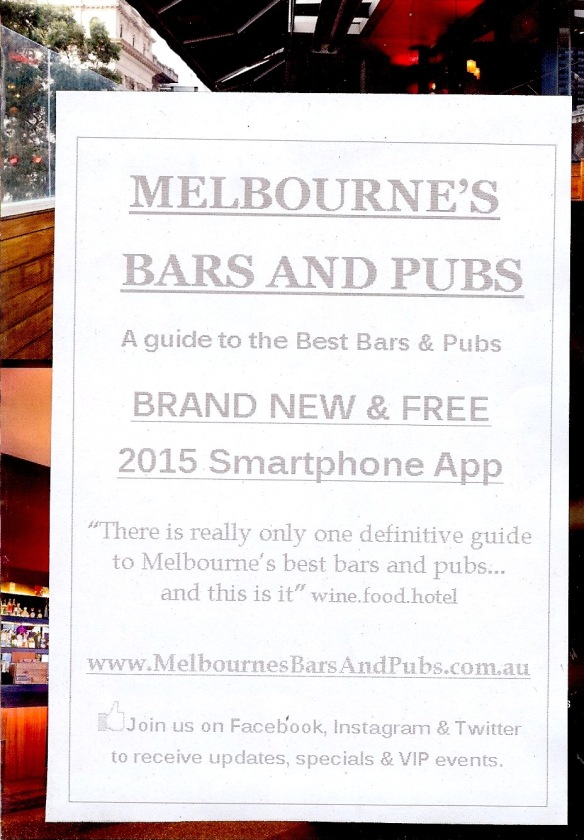
Sometimes it’s as simple as as this leaflet (shown above) found in my letter box the other day. At first, I thought it was a flyer for a local bar. Then, I noticed it was promoting a new smart phone app. On closer inspection, the flyer comprised a printed sheet hand-pasted onto a page torn from a magazine. That’s a lot of manual effort to promote a digital product, but using a lo-tech solution that totally makes sense! (No doubt, it appeals to the hipster crowd, ’cause retro’s cool, right?) So, the element of surprise (if that was the intention) worked – it got my attention because I wouldn’t have expected to receive a leaflet for a new app.*

Next week: “Why? Because we’ve always done it this way…”

Notes

* For an interesting story on the power of the unexpected, see Adam Posner’s talk on customer loyalty programs.


The Great #Data Overload Part 2: Is #Digital Making Us Dumber?

The pursuit of digital (and by implication, many data-related activities) is making us dumber. Whether it’s constant multi-tasking, the need for instant gratification, the compulsion to always be “on”, or the ease of access to content and connections, there’s actually a law of diminishing returns in trying to capture and engage with all this “stuff”.

Screen Shot 2015-02-02 at 10.24.54 am

Image © 2014 Universal Pictures

Consequently, our decision-making is increasingly governed by a hair-trigger mechanism – a single-click here, a right-swipe there, a “Like”/”Share” here, there, everywhere – which makes the outcome far less important than the instantaneous and self-validating process (“I Tweet therefore I am”). The quality of our interactions and relationships risks being reduced to a single lowest common denominator of the “fear of missing out” (#FoMo).

Current business practises focus on lean, agile and flexible – meaning that we have to get used to operating in a rapidly moving environment. However, agility is not helped by either procrastination or rash calls.

Faced with these demands on our attention, how can we come to a truly informed opinion or considered conclusion? The trick is knowing whether or not you are required to respond (not everything is relevant, vital or critical that it needs your constant or immediate participation – sometimes silence is golden). If you must make a call, then know when you have enough (hopefully, the “right”) data to make a rational and reasonable decision.

How do we build a capacity for calm, considered and constructive engagement with the digital world?

Part of the challenge is changing our (recently acquired) habits and behaviours. Speaking to friends and colleagues, there is a growing realization that reaching for your smart phone just before going to sleep (or as soon as you wake up), or constantly checking for status updates, is a noxious habit. Apart from the impact it has on our brain activity, it is also reinforcing our belief that this is normal, that we are somehow subservient to these devices, and that interacting with the digital environment takes priority over everything else. I know, I’m as guilty as the next person (watching the tennis on TV while checking the cricket scores on my iPhone…), but I am also trying to be more critical of my own digital consumption:

  • Not responding immediately to every e-mail – this is about time management skills as much as anything else; the faster you respond, the more you raise expectations that you will always answer straightway
  • Unsubscribing to mailing lists – in recent weeks, I have been unsubscribing to various newsletters because I was simply no longer interested in them or because they were no longer useful; if something’s important enough, I’ll no doubt find out about it from another source
  • Being selective about social media – I’ve written about this before in the context of authenticity and personal branding; in short, I find it essential to use different social media tools for different purposes (and to use each tool differently). That way, I manage to keep some separation between various parts of my professional and personal lives – at the very least, it acts as a helpful filter between the public and private
  • Choosing on-line connections carefully – this is another topic I have covered in a previous blog; not all our interactions are equal, and other than some basic relationship filters, most social network platforms don’t allow us to distinguish between friends, colleagues, acquaintances, and someone we met at a conference.* So, I generally decline unsolicited “friend” requests if I have not actually met or interacted with the person previously, or if I cannot find relevant mutual connections, or if I do not see what value I can add by being connected to this person.
  • Limiting notifications and status updates – similar to managing in-bound e-mail, I tend to switch off/ignore real-time notifications and updates. Instead, I prefer to check-in no more than once or twice a day, rather than always being logged in.

Finally, I’m hoping to develop a status setting for my smart phone that responds to all incoming notifications with messages such as: “Neither on nor off, merely resting”, “taking a mental pause”, “out to lunch”, or “making time for reflection before I respond”.**

Next week: Differentiating in a digital world

Notes:

* I recently heard about Humin, which is sort of moving in this direction, but it’s really a personalised CRM tool for your smart phone

** Apple’s “Do Not Disturb” function only supports “on/off” with respect to phone calls, and with a limited scope to filter contacts