Back in the USA

Happy Independence Day!!! This post has turned out to be quite timely, as I’ve just come back from a trip to the USA, following a hiatus of 4 years. Two weeks is hardly enough time for a full evaluation, and I spent most of the time in Colorado and New Mexico, with a few days in San Francisco at the end – but it was enough to gain a few significant impressions.

I hadn’t known what to expect, in a post-Trump, post-pandemic and post Roe vs Wade landscape. Nowhere on my (limited) itinerary would be considered MAGA territory, so it was difficult to get a balanced perspective. If anything, my experiences simply confirmed that America remains a complex, at times contradictory, and very often a deeply divided society. And, just like the Presidential electoral process, it remains perplexing to outsiders.

For example, I’d been advised to be aware of the fentanyl zombies, violent crime and the homeless camps on the streets of San Francisco. Even friends who are long-term residents of the city warned that the Downtown area around Union Square is “a bit rough”. Since I had planned to stay just south of Union Square, I must admit to some apprehension before I left Australia.

Another San Francisco resident I contacted before my trip had complained that: “[T]he news has done a number on San Francisco. While we have the same homeless problems as other large cities, it’s not as bad as it’s made out in the news. We are facing some impacts from companies buying at the height of the market and now backing out, which is why you are seeing some bankruptcies (and there will be [a] few more). But overall, the city is doing well.”

On the other hand, the guide on my day-long walking tour explained that of the 62 major cities in the USA, San Francisco is the slowest in recovering from the disruption of the pandemic. They also felt that California, and San Francisco in particular, had not done a very good job of implementing the legalisation of recreational cannabis use in the State. Since even legal businesses are having problems getting banked, all that cash in the system is a target for criminal activity.

In the event, my stay in San Francisco passed without incident. Yes, there was plenty of evidence of homelessness, drug and mental health issues, and that’s without having to venture into the Tenderloin district. However, there were also plenty of domestic and overseas tourists visiting the city. True, the main business district felt much quieter than on my previous visits, as people continue working from home –  some companies have moved out and shops have closed down as a result. But elsewhere, the city felt normal, with people in their local neighbourhoods going about about their daily routines. I was surprised to see so many people wearing face masks, but given there were a number of public testing facilities still operating in parts of the city it suggests that COVID is still prevalent.

Prior to San Francisco, I had spent time in Denver, Boulder and Santa Fe. Admittedly I was there on a weekend, but Denver‘s Downtown area felt very quiet and hollowed out. Even the 16th Street Mall lacked vibrancy (maybe the major street works were a factor?), although there were more signs of life around the River North Arts District, Coors Field and of course Ball Arena as the Denver Nuggets took out their first NBA title.

The City of Boulder is a curious blend of old (gold rush) money, new (tech-flavoured) money, progressive politics (rainbow flags everywhere) and counter-culture lifestyles (“do you want CBD sprinkles on your espresso?”). I was treated to a ticket to see ’90s country star, Mary Chapin Carpenter playing at the historic Chautauqua Auditorium – an artist experiencing something of a comeback, and who manages to express liberal and inclusive values via a very conservative musical format. The support act was a musician whom I’d never heard of before, and who sang with a typical American country music twang – but when she spoke, she revealed herself to be Australian, and promptly played a song about the Melbourne streets of Fitzroy and Collingwood (this was also the song that was adapted as the theme to the “Wallender” TV series…). Separately, I was invited to dinner at Flagstaff House, one of Boulder’s best restaurants (with spectacular views). As a bonus, Boulder’s Pearl Street hosts an excellent record store, a couple of decent book shops, and cafes where it’s possible to get both a coffee and glass of wine at 5pm…

Higher up and further south, Santa Fe was something of a revelation. Not knowing what to expect, I thoroughly enjoyed my few days there: from a walking tour of the historic town centre, to sampling the wines of Gruet and D.H.Lescombes; from the numerous art galleries and museums to the Sunset Serenade of the Sky Railway; from the adobe-inspired architecture to the excellent food served everywhere. I learned more about American history in the 3-hour guided tour than a whole year of history lessons at my high school in England. The latter had largely focused on the events leading up to the American War of Independence (and taught mainly from a British perspective, of course). Whereas the contemporary walking tour provided a longer and more complex narrative that covered the key phases of New Mexico’s history: First Nation settlement, Spanish conquest, US annexation, Civil War intervention, and finally Statehood in 1912. Oh, and the plot to assassinate Trotsky and the nuclear tests of the Manhattan Project along the way. (NB – the Santa Fe tourism app was an invaluable guide to planning my itinerary.)

As much as I enjoy spending time in America, I can’t help observing that for what is ostensibly a secular country, religion plays a dominant, and at times domineering, role in political and public affairs – starting with the Federal motto of “In God We Trust”. I can’t understand why a Constitution and Bill of Rights that dis-established the Anglican Church (thereby separating Church from State), and which enshrine both the right to practice a religion and the freedom to adhere to no religion, has allowed certain religious tenets to impinge upon the rights and freedoms of others. A century ago it was the Temperance movement, more recently it was the Pro-Life camp, and now a range of issues (human evolution, flat earthers, gender diversity, sexual orientation, critical race theory, etc.) have many conservatives and fundamentalists working in league to dictate the public debate and constrain freedom of expression on such topics – meanwhile, it seems impossible to have a reasoned and mature discussion about gun control in the USA. Go figure!

Next week: Music streaming is so passé…


Hong Kong – Then and Now

I’ve visited Hong Kong twice in the last 6 months, and what a difference half a year can make.

Back in October, the Covid hotel quarantine programme for visitors and returning residents had just ended (which largely prompted my visit). I still had to undergo a PCR test on arrival, plus regular testing for the first 7 days of my stay. In addition, for the first 3 days I was unable to dine-in at cafes, restaurants and bars, or visit public places (museums, cinemas, gyms, etc.), until I had a blue “all clear” QR code on a tracking app. Masks were still mandatory for everyone, indoors and outside, but the QR check-in system was only sporadically enforced.

Of course, this being Hong Kong, the 3-day ban did not prevent me from taking taxis or public transport, going to work, or shopping. So, earn, spend, travel!

Compared to my previous visit in August 2019, there were no signs of any public protests (thanks to ongoing legal and political measures), nor many visitors from mainland China or overseas. The number of expats out and about in Central was well down (although I suspect a lot of people were still working from home), and I don’t recall there being many crowds even during peak shopping and business hours in the CBD.

I visited M+, the amazing new art museum in the West Kowloon Cultural District – which was probably the most popular location I saw during my stay, in part because admission was still free. There was a really interesting and charming exhibition of art and design in Hong Kong since 1945, from the context of cultural, social, commercial, industrial and political developments.

On a past visit, the ground had not yet been broken on the Cultural precinct, and the only art exhibition on show was a series of pop-up installations housed in re-purposed shipping containers (a link to Hong Kong’s important role as an entrepôt?).

Staying near Clearwater Bay also meant being among fewer people, and even gave an opportunity to visit a beach I had never seen before – where local residents had posted signs to encourage visitors not to despoil this small and natural idyll amid Hong Kong’s ever-expanding reclaimed land development.

Talking to some local contacts, there was a suggestion that the key motivation for scrapping the hotel quarantine programme in October was due to the Hong Kong FinTech Week being held the following month along with the much-postponed Hong Kong Rugby Sevens tournament (both expected to attract lots of bankers, brokers, traders and investors…). Yes, in Hong Kong, money still talks.

Fast forward to March, and my latest visit was a stark contrast. Not only were airfares much more expensive than late last year, but the number of visitors (especially from the Mainland) had also boomed. Now that there were no PCR tests or mask mandates, and as domestic tourism has opened up, it seems everyone was desperate to get to Hong Kong. Apparently, in the 30 days since the mask mandate was lifted, 1.5 million people had entered the Special Administrative Region, compared to the few thousand monthly visitors in previous months.

During March alone, Hong Kong hosted the Clockenflap festival, Art Basel Hong Kong, Art Central, a major golf tournament and the WOW Web3 Summit, as well as the Hong Kong Rugby Sevens restored its regular (and rightful) spot on the international sporting calendar.

Out and about in Central on a Friday night at the Tai Kwun art and entertainment precinct almost felt like old times, with people competing for taxis along Hollywood Road. I also got my fill of art – Joan Miró at the HK Museum of Art, Yayoi Kusama at M+, modern Chinese art at the JC Contemporary, and installations and pop-up shows at the K11 and Landmark malls.

From a business perspective, most of my meetings centred on the recent consultation process for Hong Kong’s proposed regulations on Virtual Assets, due to come into effect in June this year. It’s expected to boost the number of licensed crypto exchanges and brokerages operating in Hong Kong, and is a significant leap forward compared to past conversations I have had on the topic, where there was a general reluctance to engage in any meaningful discussions. Now it seems, whether encouraged by Beijing, or seeing the regulatory push back on crypto in the USA, Hong Kong is seeking to become a regional and global hub for all things web3, DeFi, tokenisation and digital currencies. (Not content with the WOW Web3 Summit in March, Hong Kong hosted the Web3 Festival earlier in April.)

Hong Kong is usually very good at reinventing its economic profile following business downturns and market setbacks – especially in the areas of trade, technology, commerce and finance. Perhaps the shift towards embracing virtual assets is simply a pragmatic move. While a large part of GDP is still driven by property and traditional finance, there is a recognition among some that the future is digital…

As much as things change in Hong Kong, they also largely stay the same. Back in October, there was 100% compliance with the mask mandate – but the vast majority of passengers ignored the compulsory seat belt regulation on buses. A breach of the former would have attracted a HK$1,000 fine; the latter, HK$5,000 and 3 months’ imprisonment.

Finally, talking of masks, it’s not that long ago that masked protestors on the streets of Hong Kong were a major legal and political issue. Since then, wearing any sort of mask on a public march or demonstration has been illegal. While I was in Hong Kong last month, the city witnessed its first authorised protest march in several years (about the environmental impact of land reclamation). In a new twist on the right of assembly, march numbers were strictly limited, and all demonstrators had to wear a visible number to identify them. From the TV coverage I watched, the march stewards contained the moving protest behind a rope cordon – so that participants did not literally step out of line.

(On this last trip, I also took a side-trip to Macau – more on that next time.)

Next week: Revisiting Macau – Asia’s Casino Theme Park


The Jobs and Skills Summit

Last week’s Jobs and Skills Summit hosted by the Federal Government in Canberra was clearly designed to be a statement of intent by Prime Minister Anthony Albanese and his Labor administration. Part policy endorsement, part policy road map, the Summit was hailed (by the Prime Minister at least) for reaching agreement on “36 immediate initiatives”. By all accounts, it was a jolly affair and everyone in the Government sounded very pleased with themselves. The reality is that despite some significant pronouncements, most of them lack detail, many of them relate to existing initiatives, a number of the “36 agreements” were largely concluded and/or telegraphed ahead of the Summit – and of course, the one item that got most attention was the most divisive: the renewed prospect of multi-employer collective bargaining.

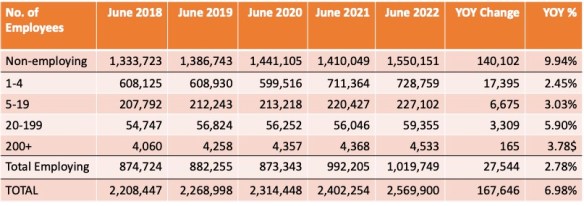
Number of Australian companies by employment size, 2018-2022 (Source: ABS)

There were some contentious views about the small business association’s pre-Summit MoU with the ACTU. Some peak industry bodies and other commentators felt that COSBOA had “sold out” in apparently agreeing to sector-wide negotiations on pay and conditions. However, this does not appear to be the case – COSBOA is merely seeking better co-operation and consultation on areas of mutual interest, and is not endorsing any form of enforced unionisation or compulsory sector bargaining. There have been suggestions that sector-wide collective bargaining will result in higher wages, but without more detail, and pending greater clarity on the “Better Off Overall Test”, this will simply add friction to the current debate about wage and employment growth.

If we do return to a previous form of Industrial Relations policy, it’s interesting to look at the latest ABS data on Australian businesses by employment size (table above). I think it’s worth noting the number of working people in Australia who are employed by SMEs. Large employers are actually small in number, so if multi-employer collective bargaining does come into effect, it could mean tens of thousands of businesses will be involved, and many probably for the first time. On the other hand, in an industry like construction, which is both highly unionised and covered by significant industry awards, many workers are either self-employed or they are employed by independent sub-contractors.

Representation at the summit was reasonably well-balanced, between Unions (including Industry Superfunds), Business (individual companies and industry associations), the NFP and Community sectors, Academia, Think Tanks, and of course Politics. The absence of the Leader of the Federal Opposition meant that his voter base was effectively disenfranchised, although his Deputy (and Leader of the National Party) did attend. Go figure.

Much was said about “streamlining” and “updating” parts of the Industrial Relations regime. Like Australia’s tax laws, the system of Modern Awards as overseen by the Fair Work Commission feels unwieldy, unnecessarily complex, over-bureaucratic, at times vague, and often archaic bordering on arcane. There are currently over 140 different awards in place – some of them relate to an individual company, some to a particular trade or profession, and some cover a whole industry. Interpretation is often in the eye of the beholder as to whether or not it applies to a particular employer and/or employee – here is an extract from one award:

“NOTE: Where there is no classification for a particular employee in this award it is possible that the employer and that employee are covered by an industry modern award or a modern award with occupational coverage.” (Emphasis added.)

I should add that one reason given by the Labor Government for removing the prohibition on sector-wide collective bargaining is because the process for employers to request an exemption from the relevant Minister is “too cumbersome”. I don’t see how this is so given that much of the IR system is overly bureaucratic. Surely the reason for this administrative process is to avoid collusion and other cartel-like activities that would otherwise fall foul of competition law and anti-trust provisions.

The Summit had some notable things to say about gender equality and pay parity, (“Legislate same job, same pay”), training, immigration and child care; but some proposals sound vague without defined objectives (“Boost quantum technology research and education”); draconian if they inhibit workplace flexibility, especially in seasonal industries (“Limit the use of fixed-term contracts”); or too aspirational without more detail such as specific goals and measurable targets (“Leverage greater private capital into national priority areas, including housing and clean energy”). We know that Labor ministers have been vocal in their dislike of the so-called “gig economy” (a “cancer” on the economy, and “I’d like to regulate the sh*t out of it”), but perhaps they need to do more to understand why some workers actually prefer it, and what benefits it brings in terms of workplace flexibility, especially in start-ups and emerging sectors, many of which are SMEs from where much of our longer-term innovation and employment opportunities actually come.

One item that didn’t receive as much attention was the “Digital Apprenticeships Scheme”, which (subject to details…) would likely have the combined support of the Tech Council of Australia and the ACTU. Certainly, despite a vibrant and innovative IT sector, and some notable high-tech and high-end manufacturing businesses in Australia, we lag behind in STEM education, and lack basic digital literacy skills in the wider population. (Hence the need for adjustments to the skilled migration scheme?) A friend of mine who runs a small manufacturing business in Melbourne recently hired an Office Assistant. The successful candidate claimed to be proficient in standard productivity tools such as Word and Excel. In fact, they didn’t know how to COPY-PASTE, nor how to use the SUM-ALL function, which are both very basic routines. They thought they could “wing it” by watching a YouTube video…

Finally, if there is one note of caution or concern about the Summit, it is the niggling thought that this was more of a talk-fest, and that any new ideas to have emerged were either covered by existing programmes and “policy settings”, or were already in train. Going through the list of Outcomes, I counted at least three dozen separate initiatives (Plans, Schemes, Agreements, Reports, Statements, Codes, Programs, Compacts, Task Forces, Working Groups or Funds) many of which already exist, or were part of Labor’s election promises, or have been proposed prior to the Summit. (And that list excludes Federal Ministries and Government Departments.) Sounds a lot like “Talks about Talks”, with “new” money already allocated and spoken for (hence Labor’s push back on some of the implied costs of the Summit proposals). At worst, this “wish list” represents a huge amount of expensive and bureaucratic overlay, whereas we need agile and flexible economic, education and employment measures.

Next week: Finding a Voice

Dud Housing*

Recent media commentary suggests we have a housing crisis in Australia – ranging from affordability and supply, to quality and location, as reported here. Renters are being priced out of the market, ageing stock means houses that are too cold in winter or too hot in summer, and there aren’t enough homes to rent where people want to live. I suspect that all of these factors have been in place for several years, but the knock-on effects from the Covid pandemic have exacerbated these trends.

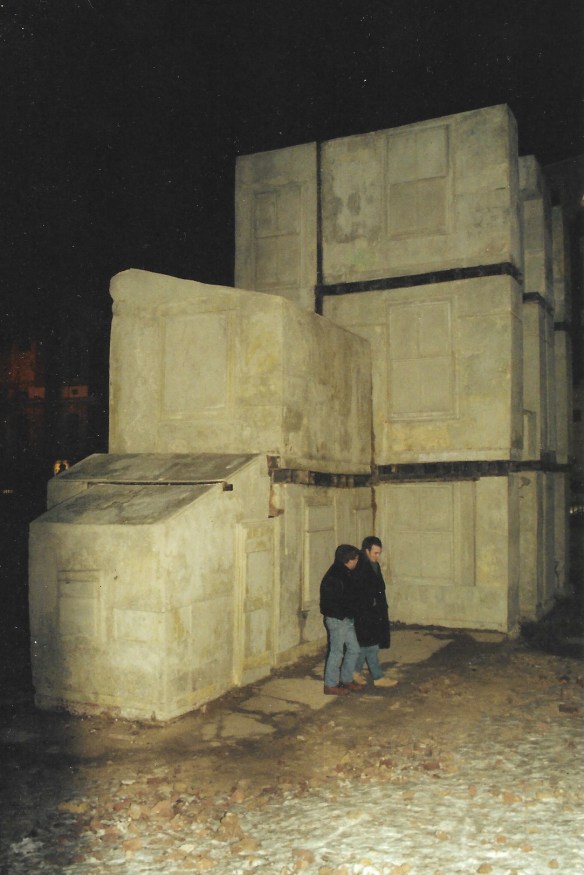
“House” (1993) © Rachel Whiteread. Photo © Rory Manchee

For background, I should explain that at the start of my career, I worked as a housing officer and paralegal in the UK. I worked for three different local councils in inner London, advising tenants, leaseholders and landlords on their respective rights and obligations – and where there were infringements, preparing prosecutions against landlords and their agents. I dealt with people facing harassment, unlawful eviction, homelessness and housing disrepair. Mostly, my work involved advising the parties of their legal position and available remedies, often I helped them reach an amicable solution, and occasionally I had to take enforcement action with the support of the council’s legal powers. The latter included injunctions against the threat of unlawful eviction, the issuance of proper rent records, repair notices, rehousing directives, and even compulsory purchase orders.

It was stressful, and at times confrontational, work – after 5 years, I was pretty burned out, and decided to make a career change. At the time, London (and the UK) was experiencing a huge amount of change that impacted both the public and private rental sectors. First, the Conservative government under Margaret Thatcher had introduced “right to buy” legislation, meaning public housing tenants could apply to buy the homes they lived in. Second, the government also introduced “mortgage interest relief at source” (MIRAS) which meant home buyers received tax relief on their interest payments. Third, central London in particular was going through a period of gentrification, with public money made available to property owners to improve and upgrade period homes. As a result, Georgian and Victorian houses that had been sub-divided into apartments (mainly occupied by long-term tenants) were restored to single family homes. Added to that, one of the council’s I worked for had been engaged in a “homes for votes” scandal, a “policy” to (re-)engineer the local demographics.

In the past, I’ve been both a tenant and a landlord, so I’ve also experienced some of these issues for myself. As a tenant, I’ve had landlords who denied that their properties were poorly wired or had defective plumbing (despite formal notifications from the council), and denied all requests to have the defects fixed. As a landlord, I’ve had tenants sub-letting to their “friends”, and who assured me that these “friends” could pay the rent.

So what is going on in parts of Australia, that there is such a misalignment between where tenants want to live, and vacant housing stock?

First, to touch on property ownership. Home owners don’t receive anything like the former MIRAS scheme in the UK, but there are various financial incentives for first-time buyers (such as zero stamp duty when buying a property off the plan), and during the Covid pandemic, some first-time buyers could access their superannuation (pension) fund to help with the deposit or down-payment. Property investors can take advantage of negative gearing to offset mortgage interest payments and costs of repairs against their income tax. These factors are generally considered to push up house prices – and despite recent interest rate rises, the cost of borrowing has remained at historic lows for more than a decade. Housing inflation means aspiring buyers are priced out of the market (especially as wages have not kept pace with inflation, let alone the rise in property prices). And landlords are now seeking to increase rents to offset rising interest rates.

Second, I’ve never really understood why some landlords don’t maintain their properties to an adequate standard – it surely detracts from the value of their assets, as well as deterring potential tenants. And when there may be improvement funds available (e.g., insulation grants, solar rebates) why wouldn’t they take advantage? On the reverse, should tenants have more powers to undertake essential repairs and improvements, and withhold rent to cover the costs? (Equally, I find it surprising that some tenants don’t feel it is their responsibility to undertake minor maintenance or running repairs, such as mowing the grass, clearing gutters or replacing cracked window panes.)

Third, it’s an economic imperative to have a supply of housing stock in the rental market. It helps people who prefer to rent rather then buy, it allows for workforce mobility, and it supports seasonal demand in industries like agriculture. I don’t believe that all rental stock should be held and managed in the public sector – it represents a huge obligation (not just an asset) on government balance sheets, tying up capital and incurring huge running costs. We need a component of public housing, but otherwise leave it to the private sector, with appropriate safeguards.

Fourth, why the apparent mismatch between supply and demand? On one level, developers are building the wrong types of properties and/or building in the wrong locations. Inner city areas have seen a massive growth in high-rise apartments over the past 20 years, supposedly in response to increased housing demand. In theory, these projects generate more yield for developers, although the apparent over-supply leads to depressed rents, and some banks won’t lend against these properties due to uncertain re-sale value and over-capitalised assets.

In the suburbs, archetypal quarter acre blocks have been sub-divided to cram in more town houses and units, or developers are building bigger houses (McMansions) on smaller plots, leaving minimal gardens and no breathing space between properties, as they build right up to the boundary lines. Many new suburban developments lack proper infrastructure and services (public transport, schools, shops, clinics), making them less attractive to renters – while the owners expect higher rents to cover the cost of their mortgages. Plus, many new properties have been built “on the cheap”, using inferior materials and design – hence the issues with heating/cooling. On the other hand, ageing stock, especially weatherboard and brick veneer structures, can also be hard to heat/cool. Many houses (new and old) lack double-glazing, for example, which would go a long way to resolving this energy conundrum.

Meanwhile, the recent lock downs in Melbourne (and to a lesser extent, Sydney) have meant many urbanites have moved to regional locations, putting upward pressure on property values and rents, pricing out locals who already live and work there. Of course, another reason for the mismatch in supply and demand is the growth in short-term lets, mainly for holiday-makers – such that local stock is taken out of the regular rental market. However, a lot of the Airbnb accommodation I have used over the years would never have been available on the rental market, because they were pre-existing holiday lets, or they are principal homes, where the owners are temporarily working abroad or interstate. And this type of flexible accommodation is also in demand by a mobile workforce that can, and prefers to, work from anywhere (so-called digital nomads).

None of which explains or resolves the current crisis. If governments want to address the bigger issues, they need to consider a range of solutions: updating building standards, upgrading land-use rezoning and planning regulations, encouraging a greater variety of housing development and management (soclal housing, shared ownership, property exchanges, rent holidays in return for repairs and improvements), and the use of modular/portable homes to meet fluctuating demand. All of which requires vision, and most party political objectives are driven by short term goals and the next election cycle.

* Apologies to Pere Ubu for (mis-)appropriating the title of their second album

Next week: Picasso and his circle