Sometimes it’s OK to Meet Your Idols

This week’s blog forms another of my occasional musical interludes.

I went to my first rock concert in the mid-70s. Since then, I have probably seen several hundred live performances; at one time in the 80s, I was going to as many as 3 or 4 gigs a week. I have also had the opportunity to meet a large number of professional musicians – mostly from the UK independent music scene. While I don’t particularly subscribe to the notion that you shouldn’t meet your idols or heroes (simply because I don’t see musicians in that light), I’m generally more interested in the music than the person. Admiration for and appreciation of the work is how I would characterise my love of music. So it was something of a departure when I found myself talking to Robert Forster, co-founder of The Go-Betweens, after one of his shows during his recent Australian tour.
During those alternative 80s, while I was living in London, The Go-Betweens (along with fellow antipodeans The Triffids, Nick Cave, The Moodists, The Scientists, Ed Kuepper, The Chills, The Apartments, The Bats and Jim Thirlwell) were regulars on the UK concert circuit. I first heard The Go-Betweens via a semi-obscure 7″ single they released on a minor Scottish label in 1980. But it wasn’t until they released the song “Cattle and Cane” in 1983 that I really took any notice, and started to see them whenever I could when they toured London.

Through some friends who worked in the music business (and who used to put me on guest lists, get me backstage passes, or give me promotional copies of records) I vaguely recall being in a bar after one Go-Betweens gig, and having a drink with Grant McLennan. Another time I saw them perform a “secret” gig in a tiny North London pub, where they were mysteriously billed as “The 16th Century”. I even have a bootleg cassette of a concert I attended in December 1985, which previewed many of the songs from their breakthrough album, “Liberty Belle and the Black Diamond Express”, released the following year.

After The Go-Betweens split in 1989, I didn’t keep up with either Forster’s or McLennan’s solo work, nor the records they made when they reformed the band in 2000. But I often revisited that first body of work, especially the albums “Before Hollywood” and “Spring Hill Fair”, which are still my favourites.

Fast forward to 2019, and there I was in the audience at Meeniyan Town Hall, in South Gippsland. Around 200 people filled this tiny venue, which has an amazing sound-system, enjoying Robert Forster and his band play songs from his recent solo albums, as well as some less obvious choices from The Go-Betweens’ back catalogue. It was a great performance.

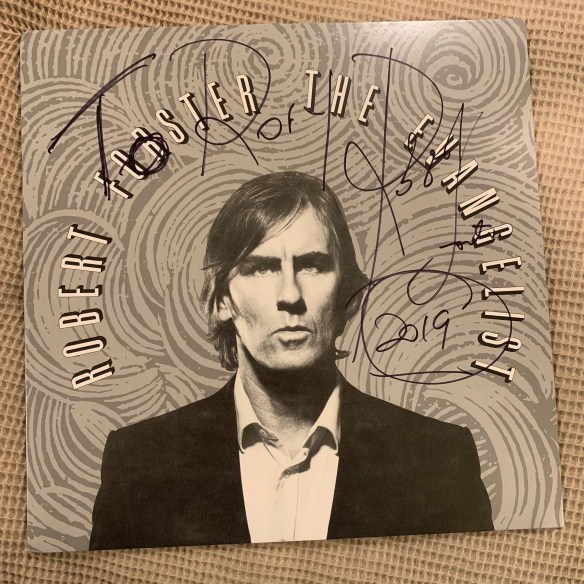
After the show, as we filed out through the foyer, my significant other prompted me to buy some merchandise, have it signed, and meet the artist. I talked about the times I’d seen The Go-Betweens in London during the 80s, and Robert was gracious and charming. He even posed for a photo, and encouraged me to get that bootleg cassette out again (“that was a significant show for us”).

So sometimes it’s OK to meet the artists and musicians whose work you enjoy.

Next week: The Pleasures of Melbourne Recital Hall
 

Demo Day #2 – Startmate

The same day as the recent Startupbootcamp event, the latest cohort of 8 founders to complete Startmate’s programme in Sydney held their own Demo Day in Melbourne.

The pitches in order of appearance were (websites links embedded in the names):

Muso

A live music marketplace, connecting venues and artists. Venue booking managers are too busy to research available talent, and artists face an inordinate number of individual processes to manage bookings and post-event admin. So Muso joins the dots, curates the artists, and takes a share of the listing and booking fees. In a world where more and more independent artists are self-releasing their recordings via platforms like Bandcamp and SoundCloud, it makes sense to extend this to managing their own tour bookings. Muso already claims to have booked 400 gigs at an average fee of $300, and also plans to expand into the US, UK and NZ markets. Currently seeking $1.2m seed funding.

VAPAR

Fault detection in infrastructure is highly manual, subjective and very expensive. VAPAR is using machine learning and cloud hosting to automate the analysis of video footage for underground pipes and sewers. A task that can currently take 2 weeks to complete can now be done in 2 minutes. Clients upload their footage and fixed asset data via a web platform, and VAPAR generate a report based on the image scanning. The business model offers a free trial access, a paid pilot project engagement, and a price per metre of pipe. Currently seeking $500k in seed funding.

VEXEV

According to the founders, vascular disease is the single largest cause of death, so there is increased focus on detection and prevention. Measuring and tracking blood flow patterns can be expensive and invasive. VEXEV uses 3D imaging captured from safer and lower cost ultra-scan technology, to measure disease progression, and to monitor and predict patient outcomes. Already secured seed funding from Blackbird Ventures.

Glamazon

This is a marketplace for at-home beauty services, “bringing a salon experience to your own living room”. According to the founders, a beautician could earn $80 per treatment compared to $23 if they work in a salon. Glamazon also offers its own business management platform via a SaaS model.

Cogniant.co

An app to “predict and manage mental health disorders before they happen“. Offers a dashboard interface for clinicians to manage their client case load, using data collected on patients’ activity and behaviour via their smart phone devices and sensors. Looking to raise $1m in seed funding. My personal observation is that a key contributing factor towards certain mental health disorders appears to be increased screen time (social media, apps that track our every move, binge watching, constant content streaming and always being “on”), leading to increased isolation, among other symptoms. While I can see the value of the data capture and analysis, hopefully the process does not reinforce the negative connotations.

Pixelated Induction

Introducing ClickCharge, a scalable wireless charging system that enables any surface to become a conductive medium. Some may remember that Apple tried its own solution, AirPower, that quietly ran out of steam. ClickCharge claims to have 3 times the charging area of AirPower, and can even charge laptops, via its inter-connecting tile design. Having filed an international patent, the founders are seeking $1.7m in seed capital to fund the build of 40,000 units for which they are currently taking pre-orders.

Bioscout

A remote system for crop monitoring and disease detection, using airborne particle tracking and analysis. Having run some field trials with banana and avocado crops, the team has identified considerable cost savings for farmers, both in terms of produce protected, and reduced use of preventive chemicals. (With the industry currently spending $2.5bn on crop monitoring and disease prevention, yet still losing $2.4bn in damaged fruit, any savings must be welcome.) Remote devices provide real-time monitoring and alerts combined with an analytics dashboard. Cost is expected to be $30k per device, plus $2k per month. The latter is presumably to pay for satellite connectivity, as the founders discovered that a key challenge for farmers is the lack of mobile phone reception in remote and rural areas.

Live Graphic Systems

This startup is aiming to reduce the cost of creating branded graphics for live sports streaming, from $5k per game to $100 per game. Current solutions involve manual processes, custom software, expensive hardware and dedicated people to operate them. Live Graphic Systems offers a scalable solution that connects brands to live streaming events, at near-zero marginal cost.

Next week: Startup Vic’s EdTech Pitch Night


Manchester, so much to answer for….

I spent most of the festive season in and around Manchester, once a focal point of the industrial revolution (and the home to dark satanic mills), now a city that is as much about technology and culture (and the location for MediaCityUK). Plus, it’s a city that takes its hedonism very seriously, a place where a table is simply something to dance on…

Manchester Town Hall – photo by Mark Andrew – image sourced from Wikimedia under Creative Commons

I have had a direct connection with Manchester going back nearly 40 years. Prior to that, Manchester for me was probably defined by its famous football club (and that other one), Coronation Street (the world’s longest-running television soap opera), and the Manchester Guardian newspaper (now one of the few remaining sources of objective news coverage).

Then, in the late 1970s, Manchester started producing some of the most innovative music in the wake of punk. Manchester was the home to cutting-edge bands, labels, producers, designers, writers and fanzines – many of which outshone the best of what even London had to offer at that time. Record labels such as Factory, New Hormones, Object and Rabid helped launch the careers of Joy Division, Durutti Column, A Certain Ratio, Buzzcocks, John Cooper Clarke, Martin Hannett, Peter Saville, Ludus, Malcolm Garrett, The Passage, James and even Jilted John; while bands like The Fall, Magazine, The Frantic Elevators and The Distractions (plus fanzine City Fun) all added to the colourful mix. Then came New Order and The Smiths, followed by the Hacienda, Happy Mondays, Stone Roses and the rest of the Madchester era (as brilliantly told in the film “24 Hour Party People”).

So Manchester’s cultural output from that period has definitely shaped and informed a lot of my musical (and reading) choices. Just before Christmas, it was announced that musician and lyricist Pete Shelley had died. Along with Howard Devoto, he formed Buzzcocks, who inspired many other bands and independent labels with their debut 1977 release, the Spiral Scratch EP (also one of the first UK punk records). Their appreciation of visual artists like Marcel Duchamp and Odilon Redon, and writers like Franz Kafka, Jean-Paul Sartre, Aldous Huxley, Albert Camus, Dostoyevsky and Gogol meant that (along with many of their contemporaries) they made music that was not just about 3 minute pop songs. Plus, these literary influences prompted me to seek out those Penguin Modern Classics – much more interesting than my high-school set texts….

Every time I visit Manchester, I’m also reminded of the wry sense of humour, and the general tendency towards gritty resignation (along the lines of, “If you can’t laugh about it, you may as well give up now”).

One example – while checking my luggage in at the airport, I had the following exchange with the staff member behind the counter:

ME: “How are you today?” (it being a very early morning during the festive season, and goodwill to all people etc.)

THEM: “I’m full of it”

ME: “Full of the joys of Christmas?”

THEM: “No, the flu”

Another example (see opening reference to tables) – a quotation from Mark Twain, appearing in a public art gallery, had been modified to read:

“Explore, Dream, Disco…”

And as if by way of reinforcement, for Christmas I was given two books, essential reading for anyone wanting to further their appreciation of Mancunian (and Salfordian) pop culture – “The Luckiest Guy Alive” by John Cooper Clarke, and “Messing Up the Paintwork – The Wit and Wisdom of Mark E. Smith”.

The late Mark E. Smith, founder of The Fall (and no relation to the band The Smiths…) led  a group famous for its longevity, its voluminous discography, and its revolving door of musicians. In reference to the latter, he once said:

“If it’s me and yer granny on bongos, it’s the Fall.”

Next week: Startup Victoria – supporting successful founders


Sakamoto – Coda and Muzak

Contemporary music documentaries tend to fall into one of two categories: the track-by-track “making of” account, in support of a new album; and the “behind the scenes” artifact of a live concert tour (often in support of that new album).* Both can be fine in their own way, but ultimately they are there to plug product. The recent documentary “Coda”, featuring Ryuichi Sakamoto clearly bucks that trend.As a recording artist, Sakamoto is one of the most prolific composers of his era. As a performer, he has maintained a regular schedule of live concerts and collaborations. That is until he was diagnosed with cancer a few years ago, and was forced to temporarily abandon his work. Fortunately, he has come through that recent health scare, even completing a major film score for “The Revenant” before he had fully recovered.

“Coda” started out as an account of Sakamoto’s anti-nuclear activism, but ended up providing an insight into his creative process, an examination of the role of sound and music in film, and a discourse on the aesthetics of minimalism.

There are two images in the film which provide a link between the “craft” of the composer and the “art” inherent in any form of creativity. The first is a close-up of Sakamoto’s working tools – the pencils he uses to write out his scores. The second is a shot of some immaculate cooking utensils – arranged in a similar fashion to his perfectly sharpened pencils. This is someone for whom both process and form serve the purpose of creativity, and which combine to determine the artistic outcome of the resulting content.

As a regular soundtrack composer, Sakamoto has been likened to a film-maker, although he is neither director nor cinematographer. He has an acute sense of the use of sound (not just music) in film, and in fact for his most recent album, “Async”, Sakamoto invited film-makers to submit short films to accompanying each of the tracks. An astounding 675 films were considered for the competition.

Ever sensitive to his environment, it was perhaps no surprise that Sakamoto chose to change the music played at one of his favourite restaurants, rather than eat elsewhere. And ever the non-egoist, none of the tracks on his restaurant playlist was his own.

The forthcoming performance by Sakamoto and long-time collaborator Alva Noto at the Melbourne International Arts Festival promises to be something special.

Next week: Revolving Doors At The Lodge

* An honourable exception in recent years was “The Go-Betweens: Right Here”