Australia 3.0 – beyond the mining boom….

In the wake of the G20 Brisbane meeting, Australia’s place in the world has been under scrutiny, in particular our role in Asia Pacific. With the announcement of a Free Trade Agreement with China (following similar treaties with Japan and Korea), a flurry of extra-mural visits by G20 leaders, and our current Presidency of the UN Security Council, you’d be forgiven for thinking that Australia was now front and centre of the world stage. Well, I hate to disappoint anyone, but I’ve recently spent 3 weeks overseas, and the only news I heard from home was the death of Gough Whitlam.

However, this does seem like a timely opportunity* to consider the question: “What’s next?” after the resources bubble has burst. This was the topic of discussion at this month’s Directors Suite luncheon, where I delivered some opening remarks based on the following text: 

Introduction

Our theme of Australia 3.0 is not to be confused with the think tank of the same name. Although it is interesting to note that their four areas of interest are Infrastructure, Health, Government Services and Mining.**

Historical Perspective?

I’m not a political or economic historian, but I would suggest that Australia’s policy agenda has followed a rough but discernible narrative:

  • Australia 1.0 – from the launch of Federation to the 1960’s – post-colonial era, bookended by WWI and the Vietnam War, and despite the dominant figure of Menzies, largely a protectionist, semi-nationalised, highly collective and quasi-socialist mixed economy
  • Australia 1.5 – The Whitlam Upgrade (or Experiment) – radical, short-lived, too much too soon?
  • Australia 2.0 – The Hawke/Keating System Reboot – currency and interest rate reforms, major privatization, re-engagement with Asia
  • Australia 2.5 – Rudd/Gillard bug fixes – a micro-managed response to the GFC, but despite the hype/promise, not much was actually achieved in macro terms, witness the 2020 summit…

What Issues Will Define Australia 3.0?

If we take it as read that there are demographic and environmental challenges ahead, I see that there are 5 Key Drivers for social and economic change, each with their own particular issues and consequences:

1. THE BIG ONE:
Economic activity post-GFC, post-mining boom, post-dollar parity
The “new normal”: slow/low/no growth and the struggle for sustainable growth; sunset on the baby boomer era; how to get internationally competitive, streamline SME regulations, remove the burden of tax administration
2. THE TECH TREND:
The age of mobile, cloud and social technology
Digital innovation backed by a new spirit of Gen Y/Gen I entrepreneurial start-ups; no more “job for life” employment – 1.3m non-employing businesses in Australia…. (40% of US workers will be freelance/self-employed by 2020)
3. THE END OF EMPIRE(S):
Declining respect for/relevance of political structures & public institutions
Minority governments, heightened clash of ideologies, power shift from Federal/State to Regional/Community; also reflects a failure of leadership within political parties, unions, corporations, religious bodies, professional sporting codes, armed forces etc.
4. OUR PLACE IN THE REGION
Free Trade Agreements with Asia, realigning regional interests
At what price? Implications for our traditional political allegiances? Challenges to Australia’s regional relevance if it’s one-way traffic only? Threat to food security?
5. NEW NATION BUILDING
Upgrading declining infrastructure and building capacity for the future
Who decides? Who pays? NIMBY? Too little too late?

Some international perspectives

Based on my recent travels to the UK and Hong Kong, we can make some interesting comparisons with conditions here at home. For example, like Australia, both UK and HK have very unpopular governments at present (but for different reasons); they are currently enjoying relatively higher (albeit still sluggish) GDP growth rates compared to other developed economies; and like the Australian dollar, Sterling has also declined recently against the US dollar (HK’s dollar is, of course, pegged to the US).

I got the impression that the cost of living in the UK has not gone up much since my last visit just over two years ago, although like Australia’s capital cities, London house prices are probably achieving/exceeding pre-GFC levels. (However, GDP growth is mainly due to pent-up demand from continuing austerity measures.) Relations with the EU are strained by budget issues and immigration polices. Following the Scottish referendum, there has been increased discussion on regional devolution, and Manchester looks set to acquire new regional powers (similar to the Mayor of London model). London remains as an important international financial centre, while selected manufacturing and services industries are enjoying renewed growth. There were numerous signs of major infrastructure projects (notably the Crossrail in London) and urban renewal initiatives (such as the Manchester City Library upgrade).

Meanwhile, HK is going through yet another constitutional crisis under the post-handover Basic Law (“One Country, Two Systems”). The Occupy Central protests, aka the Umbrella Movement were the most orderly demonstrations I have ever seen. The protests are multi-faceted; they are not just about Universal Suffrage, but also reflect social, economic and cultural struggles/challenges. There is another (speculative) property boom, fuelled in part by new subway systems, new commercial buildings, and a harbour front tunnel to by-pass the CBD; and in part by hundreds of new apartments (attracting mainland buyers). Property prices are at another all-time high (new developments can cost US$4-5m for less than 1,000 sq. ft.) – no wonder that about half of the population now live in public housing projects, and nearly one-fifth are estimated to be living below the poverty line. But food, clothing, public transport, eating out and general consumer goods can still be bought at modest prices (as long as you avoid high-end brands in high-end malls).

Making The Right Connections

I spent two days at a major Asia Pacific financial services conference in HK aimed at stock exchanges, banks and data vendors, where I only saw a couple of delegates from Australian banks, nobody from the ASX and no-one from the Australian superannuation or asset management sectors.

Does this matter? I think it does.

There was much talk about the convertibility (or internationalization) of the RMB, and one currency broker I spoke to suggested that Australia will be the next target for major RMB investment – it’s not just about Toorak mansions. There are huge RMB deposits sitting in HK, and Australia is an approved investment destination (and Australian-managed funds are an approved asset class) for approved mainland investors. The money has to go somewhere.***

By standalone stock market capitalisation, ASX is ranked 14th globally, but represents only about 2.2% by value. Furthermore, when taking into account recent stock exchange mergers and the new HK/Shanghai Stock Connect trading platform, the combined Hong Kong/Shanghai/Shenzhen market cap will leapfrog into 2nd place globally, and into 1st place in Asia Pacific, displacing Japan from its long-held position. And even though conference delegates often talked about the 4 key regional markets of HK, Japan, Singapore and Australia, the ASX comprises a mere 6% of regional market value, and the only exchange ASX has had serious (but failed) merger talks with is Singapore – which does not even make the global top 20.

The ASX market cap is $1.5tn; total superannuation funds and assets under management are about $1.6tn; while the equity in family owned businesses that needs to be refinanced over the next 5-10 years is estimated to be about $3.5tn.

Even financial market experts in Asia were acknowledging that wealth management, retirement planning and private banking services are gaining more significance than IPOs and equities trading. This in turn places greater emphasis on long-term investments, asset management for future returns, a new role for private equity, and more allocations to fixed income and bonds. But regulatory and operating costs threaten to erode any value that is being created in these asset classes, unless service providers and intermediaries can generate better efficiencies and/or develop additional, high-value products and services.

For our part, do we need to explore the role of alternative stock exchanges and non-traditional fund-raising platforms (especially for emerging companies and infrastructure projects)? And what is happening with Australia’s anticipated role as a regional fund and asset manager?

Implications for NEDs

As Non-Executive Directors, does this mean we should be shifting our focus from the “holy grail” of a seat on a public board, and instead look at how we can help, support and build value in the small businesses that will continue to be the long-term drivers of economic growth, and ensure that the boards of super funds have adequate governance?

Footnotes:

*We were not alone: “Head of PwC Australia addresses National Press Club”

**See my own “3 Pillars of the Digital Economy”

***As part of the FTA with Australia, China has opened a RMB clearing house in Sydney, and granted Australia a portion of RQFII asset allocation. And soon after the FTA was announced, the NSW Treasury issued an RMB bond.

Next week: Managing Big Data Analytics and Visualization
 

Infographic Resumes: Form over Content?

I’m old enough to remember when the filofax personal organiser (think PDA for hipsters?) became the must-have accessory in the yuppy culture boom of the early ’80s. (I recall my housemate, a creative at a leading ad agency, dashing around in panic one morning when he couldn’t find his filofax before he left for work – “That’s got my whole life in it!”.)

About the same time, home computers and desktop publishing software came on the market, and everyone became their own graphic designer.

One (thankfully short-lived) outcome when these trends collided was the emergence of the desktop designed resume, that could be printed out and stored in a filofax, including some that folded out to reveal the candidate’s illustrated profile. (I kid you not – I received several of these “cutting edge” CV’s when hiring for graduate-entry roles.)

More recently, there appears to be a fascination for infographic resumes – with a number of online tools available to turn your illustrious career into a poster with apparent ADHD – such as Pinterest, Kinzaa, Vizualize.me, and re.vu, among others.

I have no problem with using infographics to portray data and content in interesting and informative ways. But the problem with many of the resume designs I have seen is that they are either limited to portraying careers in a purely linear and/or statistical fashion; or they overcompensate by using “gimmicks” such as over-stylised graphics, irrelevant iconography and even multiple fonts. Much about these designs reveal a tendency for form over content.

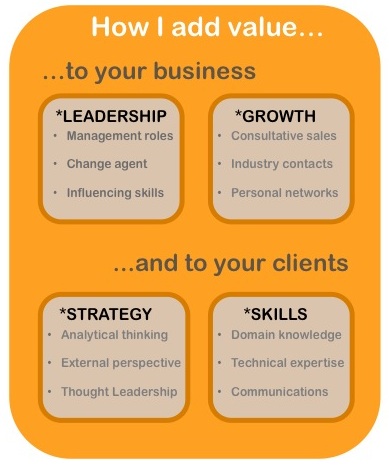
While it’s important to be able to tell a good story, what employers often want to know is: what can you do for them and their clients, now and in the future?

Rory Manchee - Value Proposition - Sept 2014


Defining RoDA: Return on #Digital Assets

How do we measure the Return on Investment for digital assets? It’s a question that is starting to challenge digital marketers and IT managers alike, but there don’t appear to be too many guidelines. Whether your social media campaign is being expensed as direct marketing costs, or your hardware upgrade is being capitalised, how do you work out the #RoDA?

In most businesses, measuring the expected RoI of plant or equipment is usually quite easy: it’s normally a financial calculation that takes the initial acquisition price, amortized over the useful life of the asset, and then forecasts the “yield” in definable terms such as manufacturing output or capacity utilisation.

However, when we look at digital assets, many of those traditional calculations won’t apply, either because the usage value is harder to define, or the benchmarks have not been established. Also, while hardware costs may be easy to capture, how are digital assets such as websites, social media accounts, software (proprietary and 3rd party) and domain names being reported in the P&L, cash-flow analysis and balance sheet?

Sure, most hardware (servers, PCs and physical networks) can be treated as capex (e.g., if the purchase price is more than $1,000 and the useful life is 2-5 years). But how do you make sure you are getting value for money – is it based on some sort of productivity analysis, or is it simply treated as fixed overhead – regardless of your turnover or operating costs?

As we move to cloud hosting and #BYOD, many of these assets utilised in the course of doing business won’t actually appear on the company balance sheet. Yet they will have some sort of impact on the operating costs. Most software is sold under a licensing model, where the customer does not actually own the asset. (But, if the international accounting standards change the treatment of operating leases longer than 12 months, that 2-year cloud hosting fee might just became a balance sheet item.)

I was once involved in the acquisition of a publishing business that was converting legacy print products to digital content. Not only did they capitalise (and amortize) the servers and the conversion software, they also capitalised the data entry costs (using freelance editors) to avoid the expense hitting the P&L. Nowadays, that’s a bit like putting the HTML coding team on the balance sheet and not the payroll…

In some cases, the costs associated with maintaining an e-commerce website or registering a URL, will remain as overhead or operating expenses. But over time, businesses will want to have a better understanding of their RoI for different online sales and digital marketing channels, especially if they have been investing considerably in their design, build and maintenance. Measuring online visitor data, customer conversion rates and average yield per sale, etc. are becoming established metrics for many B2C sites. Having a good grasp of your #RoDA may just give you a competitive edge, or at least provide a benchmark on effective marketing costs.


Why #collaboration is not simply “working together”

Along with productivity, innovation and employee engagement, collaboration is fast becoming the new mantra for businesses seeking growth and/or competitor advantage. But while collaboration can take many forms, the mere act of “working together” does not of itself lead to sustainable collaborative outcomes.

The theme for last week’s inaugural class of Melbourne’s Slow Business School was “How to collaborate effectively with other businesses”. Hosted by Carolyn Tate and facilitated by Richard Meredith, the class did not arrive at any prescriptive processes or techniques for collaboration. But, as one student wryly observed, our discussions took the form of a dance without choreography, which is perhaps the highest form of collaboration. However, we did identify a few core attributes without which successful collaboration would be unlikely, if not impossible:

  • Shared values among the players
  • Defined roles
  • Common purpose or vision
  • Mutual trust between all participants
  • Voluntary (i.e., parties choose to be here)
  • Equitability (e.g., recognition of each contribution)

I would also add that from my experience, collaboration does not happen unless there are opportunities for the participants to be co-located at least some of the time.

Which leads me to those activities that are NOT collaborations:

  • A routine or regular project (“BAU”)
  • Outsourcing
  • Commissioning
  • Remote teamwork
  • Shared services
  • Trading transactions

For example, if I commission an architect to design a house, even if I am intimately involved in all the detailed decisions about materials, specifications and aesthetic choices, it is not a collaboration – it’s a transaction between client and professional. However, if I was a heating engineer, and I used my knowledge and experience to work with my architect to come up with some new energy-saving solutions (that could be used in future projects) that would be a collaborative outcome.

Collaboration certainly cannot happen if organisations operate within silos, but nor does it come about by happenstance – there has to be a deliberate and conscious decision to collaborate, even if at the outset there is no specific product or solution in mind other than a desire to collaborate (“Let’s see where the dance takes us”).

One aspect of this approach is “co-creation”, where companies embed themselves in their client’s world to identify what problems they can work on to solve together. In this way, collaboration leads to the outcome. Clearly, to be effective, co-creation would be backed by some formal product development or service design techniques, agreed ground rules and even a game plan – whether that is a lean canvas business model methodology, an iterative prototyping process, or a defined supply chain framework.

In any collaboration, one party may try to force the pace, but if this is not reciprocated, the mutuality will be lost – it becomes just another transaction (or a series of mis-timed steps). The best partnerships and joint ventures are founded on the commonalities of purpose, process and participation. Further, a successful venture will know when it has run its course – even if this means having those “difficult conversations”, which the class felt were also a vital feature of the best collaborations.

By strange coincidence, the same day Slow Business School was in session, Deloitte Access Economics published a research report commissioned by Google Australia. It concluded that greater collaboration by Australian companies could be worth $46bn to the local economy, based on increased productivity and reduced costs/wastage. Although the report reads more as an OD approach to collaboration (linked to the productivity, employee engagement and innovation mantras) it nevertheless offers some empirical evidence that companies who get it right will see benefits across a range of KPIs. If nothing else, employees who are given more opportunity to collaborate will display greater job satisfaction (this is part of the philosophy behind etaskr, about which I have written before).

For me, there are a few interesting data points in the Deloitte report:

  1. While technology has been important in enabling increased collaboration, the right workplace culture, management structure and team members are seen as paramount.
  2. Although “shared electronic resources” were seen as the single most important tool for effective collaboration, “common areas for staff to socialise” was not far behind, and “more meeting rooms” scored higher than “open plan office”, while having more technology solutions (collaboration software, video conferencing facilities and social media) all rated lower.
  3. Finally, just over a third of respondents reported that “collaboration helps them work faster” (and nearly a fifth said “their work would be impossible without collaboration”), but nearly a quarter felt that collaboration meant their work took longer.

So, a paradoxical interpretation of the report could be:

  • fewer open plan offices (but more meeting rooms);
  • more technology (but not just productivity tools); and
  • more teamwork (but not at the expense of getting my own work done).

A final thought: If we think that the prerequisite for collaboration is the “willingness to co-operate”, then this can get murky, as participants will only be prepared to operate at the level of trading favours (and only because they’ve been told they have to play nicely) rather than entering into the venture with enthusiasm and without ulterior motives.