#AngelCube favours B2B #startups…

The latest intake to AngelCube‘s accelerator program presented at the recent Startup Victoria meetup event. It was interesting to see that all 6 pitches were aimed at B2B audiences, since I have heard several angel investors and startup advisers express a strong preference for end-consumer products (or those with 2-sided markets). Perhaps there is more appetite for enterprise solutions, despite the longer lead times for sales, and the challenge of strategies required to displace incumbant products.

Screen Shot 2015-08-31 at 5.18.46 pmWhether there is a new interest in B2B startups, or whether more founders are identifying B2B opportunities, there’s probably some further analysis to be done. Meanwhile, here are the 6 fledgling startups in the order they pitched on the night:

Screen Shot 2015-08-31 at 5.45.53 pm1. Peer Academy

Peer Academy aims to “change the way professionals learn”. It does this by offering students access to open enrollment classes via an online market place. The classes are conducted by facilitators and experts (“hosts”) who have been “screened” for quality by Peer Academy, with a focus on “soft” management and leadership skills.

Peer Academy hopes that students will act as “warm leads” for corporate sales, by taking their classroom experience back into their organisations, and acting as champions or brand advocates. With follow-up introductions to training and HR managers, Peer Academy then curates programs for corporate clients, by matching training needs to individual users.

I like the notion of “peer-to-peer” learning (although I presume that the hosts are expected to have more advanced and developed skills than their students), and there is certainly a trend for alternative learning platforms. At least one major bank has expressed interest in sourcing corporate training via Peer Academy, who take a 30% commission on course sales.

A huge challenge will be to engage corporate clients who already have established relationships with trusted training providers, or who have existing panels of approved organisations, or who outsource training procurement to third parties.

Screen Shot 2015-08-31 at 6.04.05 pm2. Jack

Workplace wellbeing is becoming big business ($5bn and counting?), and in the process, sedentary workers are in the firing line. According to Apple CEO TIM Cook, “Sitting is the new cancer”, and hence the recent fad/trend/fashion for sit-stand desks which is driving market interest in ergonomic solutions. The team at Jack have built a device that can monitor how much time people are sitting or standing, and even provide some feedback on user posture.

As you would expect, Jack uses cloud connectivity to monitor user activity, and to relay data via cross-platform apps and dashboards. It also uses elements of social media engagement and gamification, and has already launched a pilot scheme with several desk suppliers, as well as a paid beta at a well-known payments provider.

Customers will buy the device plus pay for a monthly subscription service. There is a direct competitor, but Jack claim their device can be retrofitted to any sit-stand desk. The unit price is much higher than, say a Fitbit, but since this is not a consumer product, Jack is confident it can sustain current pricing.

Finally, with the data it aims to collect, Jack reckons it may even be able to help reduce insurance premiums, although this will no doubt be subject to actuarial scrutiny, Work Cover and OH&S requirements, as well as data privacy issues.

Screen Shot 2015-08-31 at 6.24.11 pm3. Coin-Craft

In the professional services and consulting sectors, tracking project costs and resourcing have become highly demanding activities – witness the plethora of project management, costing, billing, ERP and time-tracking solutions on the market. Based on personal experience, the founders of Coin-Craft have identified a specific need among architects, and have built an all-in-one tool for Project Management, Cashflow Analysis and Resource Planning. Built “for architects by architects”, Coin-Craft is designed to help clients stay optimal, by managing staff over/under utilisation, and tracking cashflow projections.

The system also claims to integrate with third-party accounting software, and has around a dozen firms using the service, with another 30 in the pipeline. Although Coin-Craft have chosen a niche client base to protect their market entry, they claim the solution can also be adopted by engineering practices, graphic art studios and project management firms.

However, feedback from the audience suggested there are already similar, mature products that are tracking individual billable hours against specific projects, so Coin-Craft may need to work on their value proposition and differentiation.

Screen Shot 2015-08-31 at 6.38.22 pm4. CurveUp!

As social media and content marketing become more ubiquitous (if not more sophisticated), companies need to understand the value of their direct marketing spend. Mostly, they can do this via web analytics, e-commerce tracking, campaign conversions, and cost of customer acquisition. According to CurveUp! however, measuring the ROI of your PR activity is not so easy using “conventional” social media monitoring tools. For example, CurveUp! claim they can deliver tailored reports to show which blog post or article converted to a ticket sale for a concert or event.

Currently using web and online sources only, CurveUp! track mentions and link this to customer data. Some platforms, such as Instagram, are harder to track, and even via a possible API solution, it will only be possible to monitor the number of views and shares, but otherwise little or no data will be available.

However, at least one online market place has expressed interest, and CurveUp! has the potential to integrate with Facebook and Google, so that clients could possibly use campaign codes to track referral activity from mention to firm sale. Overall, the service will need to align itself with the ROI outcomes linked to PR campaign goals – which will vary between clients and markets, depending on organisational KPIs around brand advocacy, share of wallet, products per customer and customer satisfaction.

Screen Shot 2015-08-31 at 6.56.07 pm5. TribeGrowth

In a similar vein, the team at TribeGrowth claim to have built “artificial intelligence for social media marketing“. Their goal is to help clients build an audience and get customers, via the use of “intelligent engagement” to generate conversions.

Initially targeting startups, professional service providers and the hospitality sector, TribeGrowth offers a tiered monthly subscription service, and claims to be a (cheaper) alternative to agencies or even Twitter ads.

Currently in private beta (and so far, only designed for Twitter and Instagram), TribeGrowth focuses on audience growth by careful selection of connections and influencers. According to the founders, this is not “pay & spray”, but uses machine learning to refine audience outreach and engagement.

Screen Shot 2015-08-31 at 6.59.11 pm6. SweetHawk

Finally, and in what was probably the most technical presentation of the evening, came SweetHawk, which is building “voice for e-commerce”. I have to confess that, although I had previously heard about this product, I’m still not totally clear how it works.

In essence, it’s an outbound platform that enables companies to have more focused/targeted real-time conversations with warm sales prospects, namely people who are visiting their websites. Personally, I would find that a bit spooky, if I was browsing a site and suddenly a widget popped up asking me if I wanted to receive a call right there and then. Isn’t it a bit like stalking?

The business model is designed to offer tiered services in return for monthly subscription fees – depending on call volumes and functionality, such as workflow tools. I would see it as sitting somewhere between an outbound sales call centre and a SaaS-style inbound helpdesk solution.

On the plus side, I do see the opportunity to deliver superior and more responsive customer service, except that SweetHawk appears to be a sales and prospecting platform, not an after-sales or support solution. I’m also used to live chat tools that pop up on various software and other service sites I use, so I would probably engage with a similar offering if I was browsing to purchase.

Final Thoughts

While none of these pitches has so far demonstrated anything truly disruptive (but let’s not criticise them for that), they all seem reasonably sensible and logical solutions using a mix of digitally-driven technologies (cloud, mobile, social, peer-to-peer, data analytics) that we are all increasingly familiar with. So, rather than major game changers, I see each of them building on established platforms. By refining the potential that new technologies and business models are creating, they are tapping into better-defined client needs rather than taking a “build it and they will come” approach.

In conclusion, I was generally impressed by the 6 pitches on offer, although some of the presentations will no doubt be reworked in light of the audience feedback and Q&A, and before the plucky founders hit the investor road show organised by AngelCube.

The event was hosted by inspire9, and sponsored by BlueChilli and PwC.

Next week: More on FinTech – another look at data and disintermediation



It’s not enough to be #disruptive – you also have to #collaborate

For most tech #startups, especially in #fintech, it’s no longer just about being #disruptive – there’s a growing realization that entrepreneurs also have to be #collaborative.

One year on from his last visit to Melbourne, Stripe co-founder John Collison was back in conversation with Paul Bassat from Square Peg Capital, courtesy of Startup Victoria and sponsors Envato, LIFX, BlueChilli, Bank of Melbourne and PwC. Previously, John spoke about the need to be “disruptive rather than incumbent”, yet it seems that Stripe’s growing success can be attributed to relationships with other providers in the payments industry, such as AliPay and VISA, plus deals with retail sites such as Catch Of The Day and RedBalloon. Oh, and it probably helps that most U.S. presidential candidates are using Stripe for campaign donations….

Stripe has already launched an SDK platform for developers, and is planning to launch StripeConnect, a market place platform. The point being, the more users (upstream and downstream) you can plug into your platform, the greater the traction, but also the deeper the collaboration. Why would you want to annoy your potential partners, vendors and suppliers?

Meanwhile, Australia is now Stripe’s 4th largest market, and close to being its 3rd largest.

Going forward, despite some criticism (e.g., it’s still not rolled out in Australia), ApplePay has huge potential. It has an estimated 800m credit cards registered with iTunes (making it 5x bigger than PayPal), and with people currently paying as little as $1.69 per song download, ApplePay could crack the market for broader micropayments (e.g., the $2 on-line daily newspaper?).

However, Stripe stills sees that there are disconnects between traditional credit card application processes, account registration forms, payment solutions, merchant set-up and downstream payments for low-value (but high volume) transactions.

Looking ahead, Collison is talking up opportunities in same-day delivery for e-commerce (hard to see this happening outside of Australia’s main metro areas – unless the infrastructure is there…), and better video-conferencing services (again, in Australia this is hampered by poor broadband services).

A few days later, and Adrian Stone from AngelCube was in conversation with StartUpGrind‘s Melbourne convener, Chris Joannou. Adrian restated the sentiment that angel investors tend to back founders rather than ideas, which can seen by some of the ventures AngelCube has backed so far, including Tablo, LIFX and CoinJar. Each venture has been successful in raising early-stage funding (despite some teething problems and much pivoting), although AngelCube itself has not yet completed an exit.

Rather like his associate Dave McClure from 500 Startups, Adrian recognizes that for various reasons, VCs are having to make smaller, multiple bets, rather than betting the farm on single or a few ideas.

Perhaps this gives further credibility to the proposition that every portfolio (including individual members in retail and industry superannuation funds?) should have a discretionary 1-2% allocation to startups, but you still need an investment vehicle or platform to screen and manage opportunities. Sadly, we see that there is still a disconnect between institutional investors and startup founders. The former are having to get bigger to reduce operating costs, yet this means they have what one friend of mine has defined as the “Allocation Gap”. And of course, founders far outnumber the available sources of VC funding. Time for a rethink on how investors can collaborate to access startup opportunities?

Next week: Cultural Overload


Who needs banks? My experience of “We R One World”

This past weekend, I participated in the “We R One World” game hosted by Carolyn Tate on behalf of the Slow School of Business, and facilitated by Ron Laurie from MetaIntegral. The game is an immersive learning experience in the form of a simulated global strategy workshop, based on the work of Buckminster Fuller. I joined a team whose role was to represent the interests of the commercial banks. It was a rather sobering experience, because as the workshop unfolded, it soon became clear that in the context of the game the banks were almost redundant – which partly reflects what is going on in the real world, as banks face increased disintermediation and disruption by FinTech, crowdfunding and the shared economy.

The Fuller Projection or Dymaxion Map

The Fuller Projection or Dymaxion Map

The Premise – Earth as Spaceship

Without going into too much detail, “We R One World” mimics elements of the board games “Risk” and “Monopoly”, and takes the form of a narrative-based hackathon, combined with a meetup and an unconference. Played out on a floor-size version of the dymaxion map, the game also draws on Fuller’s concept that the Earth is a spaceship, of which the players are the crew, and the “fuel” is the inventory of global resources at the crew’s disposal, including people, technology, capital, food, energy, munitions, water, etc. The participants form teams to represent various geo-political regions, supranational NGOs, multinational corporations and banks. The goal is to achieve (through trade negotiations), the best socio-economic outcomes for everyone, with a few surprises along the way!

There is a lot of information to absorb, as well as the structure of the game. One challenge for the players is to not get hung up on the presented “data” (which is more representative, rather than precisely factual). Even though we live with access to real-time, on-line statistics and research, and despite the Internet and search engines, in real life we still experience considerable information asymmetry.

The Prelude – We Are Star Dust

As a prelude, we were shown the documentary “The Overview Effect”, which includes the comment by former Apollo astronaut Edgar Mitchell that we are made of star dust (a now common concept echoed in various songs such as Moby’s “We Are All Made of Stars” or Joni Mitchell’s “Woodstock”, depending on your musical taste/cultural perspective).

It was also a timely connection, given the increased media coverage of space exploration, and Hollywood’s renewed interest in space travel. The recurring theme (in reality as much as in fiction) is that human survival will depend on relocating to, or harnessing other planets.

As examples, in the real world, we have the latest discovery of an Earth-like planet, tweets from Philae on a frozen comet, and the remarkable images from Pluto. While the entertainment world is enjoying critical and popular success with films such as “Moon”, “Gravity”, “Elysium” and “Interstellar” (plus the forthcoming “The Martian”). Even veteran Sci-Fi writer Brain Aldiss has bowed out with his final space novel, “The Finches of Mars”.

The Banks – Increasingly dispensable

But back to the game, and what we might conclude from the outcomes.

From the start, in the role of the banks we had a strategy for encouraging “good” behaviour, and punishing the “bad”. We had a catalogue of regional problems, and a set of possible solutions. “Good” behaviour was predicated on regions finding creating solutions to their problems, based on partnering, prioritization, planning and promotion. “Bad” behaviour might include late or failed interest repayments, misuse of funds (e.g., deploying more military hardware ahead of feeding their population), or actions that led to worsening conditions (increased poverty, hunger and illiteracy, or depleted natural resources).

At the outset, the banks’ role was to manage existing loans (by collecting interest due), and to originate new loans for development and commercial projects. In the initial stages, despite Japan’s attempt to renegotiate its existing repayment terms on the fly, the commercial banks managed to collect all interest due, on time and in full (with a small surplus, thanks to some regions’ lax monetary management). One region paid up without much prompting, cheerfully (or ironically?) commenting that “we must keep the banks happy!”.

However, as the game progressed, the banks were basically ignored, as regions switched their focus to responding to new circumstances, such that the consequences of not servicing their debts seemed irrelevant. Even the risk/threat of bankruptcy did not carry much persuasion, as regions were more willing to find new ways to trade with each other, less reliant on bank capital, and more focussed on alternative value exchanges (part of the game’s secret sauce).

For example, we received only two loan applications throughout the game: one was for a worthy but ambitious development project, but when asked to resubmit the request with some further information, the loan did not materialise; and the other was more in the way of a short-term deposit with the bank, to generate interest income to buy food. Given that deposit rates are low, our response was to suggest using the capital (with additional bank funding) to increase food production, but our offer was declined, maybe because of the need to trade out of a short-term food shortage rather than investing in long-term supply.

Towards the end, the banks were almost mere spectators in the game, and were reduced to protecting their self-interests: namely their capital, and their stalled/stagnant loan assets. If borrowers don’t want the banks’ money, where and what will the banks invest in order to generate depositor, investor and shareholder returns? As one regional participant commented, “we are all bank shareholders”. Just as in real life, we deposit money with the banks, we invest in their financial products (especially through our superannuation and pension funds), and we may even buy their shares and bonds. And of course, following the GFC, many taxpayers found themselves indirect shareholders of banks that were bailed out by their respective governments.

The Conclusion – An alternative approach?

I’m not going to give the game away (you can experience it for yourself in September) but the conclusion and outcome reinforce the view that in order to tackle the world’s problems, we all have to take a different perspective – whether that is challenging existing structures, subverting traditional business models, or questioning our personal motives and objectives. For myself, I recognise that this means an increased awareness of “living lean” (mostly around personal preferences and lifestyle choices), and (multi-)lateral thinking.

For institutions like banks (as well as governments, corporations and NGOs) this alternative approach means re-assessing their roles and contribution (which can also be framed as re-connecting with their “purpose”), remodelling their processes and systems, and redefining the measures of their success. As my team member concluded, “the other players only see the banks as a source of capital, rather than a resource for knowledge, expertise and networks”.

Footnote

Declaration of interest: I participated in the game at the kind invitation of the Slow School of Business.

Next week: “I’m old, not obsolete”


The future of #FinTech is in Enterprise Solutions

Talk to anyone involved in FinTech, and apart from telling you the sector is “hot”, there’s little consensus on what happens next. Despite positioning itself as a disruptive force within financial services, much of what goes on in the sector is either driven by regulatory reform, or by technological developments in allied fields. Most of the disruption so far is in retail and B2C services, yet the more significant opportunities are likely to be found in enterprise and B2B solutions. But as The Economist commented recently, “The fintech firms are not about to kill off traditional banks.”

The Current State

In broad terms, FinTech is working in four main areas:

  • Cryptocurrencies
  • Payments
  • P2P lending
  • Financial Advice and Planning

The first two are responding to dual technological advances – namely, the use of block chains and cryptography; and increased sophistication around mobile and GPS. Patrick Maes, CTO of ANZ Bank, has stated that “Bitcoin and block chain are the first payments innovations in 2,000 years.” He also has a FinTech “wish list”.

The second two (at least, within Australia) are benefitting from regulatory changes, such as the new positive consumer credit reporting regime, and the Future of Financial Advice reforms. And when the National Payments Platform scheduled for 2017 mandates real-time settlements, everyone will have access to immediate inter-bank payment services.

Of course, there is some overlap among these categories, which in turn are also benefitting from developments in big data analytics, mobile solutions, social media platforms, and consumer trends like crowdsourcing and the shared economy.

CCE2z9TVIAENCcE

It may be interesting – but it’s not whole picture

Disintermediation May Not Be Enough?

Most of the FinTech disruption has been in the nature of disintermediation – displacing the role of traditional banks and merchant services in providing payment solutions, point-of-sale facilities and personal loan products. But given the relatively small margins on these services, you either need to have a totally different cost structure, or a significantly large market position to achieve scale and volume.

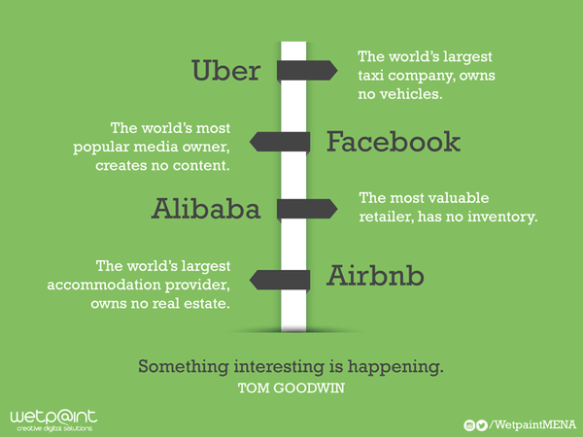
You will have seen the above infographic, often quoted with a sense of wonder at how these companies have built huge businesses seemingly without having to own any physical assets. Well, yes, but dig deeper, and what do we find? The banks have always worked on the same principle – they take customer deposits (which they don’t own), and then lend them to borrowers (whose secured assets they don’t own unless there is a default).

The main difference is that banks are highly regulated (unlike most of these digital market disruptors), and as such they have to hold sufficient capital assets to cover their exposures. Meanwhile, the banks finance the car loans taken out by Uber drivers, they provide credit facilities and export guarantees to Alibaba traders, they underwrite the mortgages on properties used for Airbnb, and will likely provide e-commerce services to advertisers who use Facebook.

For me, probably the last major FinTech disruptor was Bloomberg (founded back in 1981), because it changed the way banks and brokers accessed news and information to support their trading activities, by introducing proprietary analytics and data tools via dedicated terminals, screens and datafeeds. So successful has Bloomberg been that it now owns about one-third of the global market for financial data, and is the single-largest player (albeit by a very small margin over main rival Thomson Reuters – itself, a merger of two key data vendors). Plus Bloomberg is still privately held.

The Future State

I don’t believe FinTech can truly come of age until a major enterprise solution appears. For different reasons, Stripe and BlueDot could be on their way, but both are primarily operating in the consumer payments sector.

I have written previously on the areas where FinTech could impact institutional banking and securities trading, including loan origination, data analytics and risk management. I’ve also reported on the opportunity to disrupt traditional market data vendors by changing the pricing and consumption models. And elsewhere, I have hypothesized on how banks’ trade finance services could be disrupted.

The areas where “Big FinTech” could truly make a difference are:

  • Counterparty Risk Management
  • Predictive Credit Risk Analytics
  • Loan Pricing Models
  • Unit Pricing Calculations
  • Collateral Management
  • Portfolio Performance Attribution
  • Sentiment-based Trading and Risk Pricing

However, the final word should go to Patrick Maes, who suggested that a huge opportunity exists in deposit products linked to customer loyalty programs and frequent flyer points – what if your credit card points could be used to finance a car lease or as part of the deposit on your first home?

Next week: Change Management for Successful Product Development