How to Survive a #Startup Weekend

A rite of passage for any startup founder or budding entrepreneur is a weekend hackathon, and a Startup Weekend is probably the best way to throw yourself in at the deep end. As part of Startup Week, the York Butter Factory hosted Melbourne’s first fintech event. Here’s how I managed to survive the ordeal….
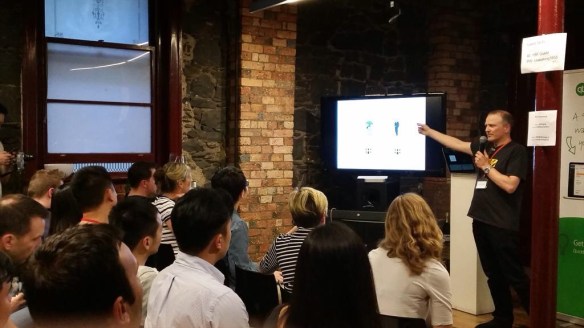
IMG_0210

Your correspondent in full flow at the Final Pitch…

Rather than provide an hour-by-hour account of my experience (the schedule is on the website and you can read the Twitter feed), here’s my thoughts on what it takes to participate and get the most out of the experience:

Courage

Take a leap of faith, step up and pitch an idea at the open mike session on the first night. Not only does this force you to craft your message, it also helps overcome any nervousness or awkwardness in joining a room full of total strangers with whom you will be working for the next 54 hours. My idea didn’t get enough votes, but it did spark several interesting conversations with other participants, such that I will probably take it further.

Stamina

Pace yourself. Yes, you could spend every available hour on finishing that customer validation, or refining the pitch, or making sure your demo site is up and running – all of which are important – but you also need to make time for rest, sleep, eating (all catering is laid on) and exercise. Again, 54 hours is a long time to spend on a single activity.

Open Mindedness

I had some idea from the program notes what to expect, but I still didn’t really know what it would it be like. So it was great to just go with the flow, to see what would happen. The format, structure and schedule (as well as the rules and requirements for the Final Pitch competition), pretty much define what goes on. But your attitude and willingness to be open to new ideas determine how much you get out of the experience.

I should also mention the value in having direct access to so many experienced mentors throughout the weekend – although I know from the experience, it’s hard not to get too defensive when mentors find fault with your project, and difficult to remain true to the idea when some of the feedback is contradictory.

Teamwork

Building teams to collaborate on a startup idea forms the basis of the hackathon model. As my own idea did not get enough votes at the open pitch, I looked to join a team that was a good fit in terms of the idea, the mix of skills to complement my own, and the ability to execute. As a “non technical” participant, I was extremely fortunate to be part of team that had a great balance of back-end and front developers, design skills and mobile deployment. Plus, given the theme was fintech, it was fantastic working with people from a banking IT background. (It also helped that several team members were veterans of Startup Weekend.)

Defining Roles

Although we didn’t spend a great deal of time creating or defining roles within the team, each of us played to our strengths, by self-determining what we would work on, and what our contribution would be. The only tricky decision was choosing who would present the Final Pitch to the panel of judges – but a process of elimination, preference and negotiation resulted in yours truly taking on the role.

Tools

In addition to the various software, hosting and domain name resources provided to each team, I was impressed by how many other tools the team plugged into – such as Trello, GoogleForms, Hangouts, ThemeForest, CanvasModel Design and Launchrock – most of which were free. We also spent some time reviewing competing and complementary products as part our MVP validation.

Less Is More

We could have spent a lot of time on customer validation – but we chose instead to talk to 3 or 4 key target customers for the MVP (qualitative), and run an on-line survey (quantitative) which generated around 100 responses overnight (not bad considering it was a weekend…). We also had more content than we actually used: the lean canvas business model was used sparingly, as was a competitor heat map; but it also meant that when we came to developing our pitch presentation, we had the luxury of being able to take stuff out and only focus on the important and most relevant points. Thanks, also, to a presentation template that one of the team had just used at a recent management course!

Practise

Having been chosen to make the Final Pitch on behalf of the team, and despite quite a lot of experience in making business presentations and in public speaking, I was extremely grateful for the coaching, feedback and rehearsals the team put me through. Getting to know the material, understanding the anchor points and how to navigate from topic to topic, helped me to give a presentation that flowed logically and hopefully demonstrated that the team had met the competition brief.

The Result?

Unfortunately our team did not win, nor did it place in the top 3. The judges pinged our presentation for being “too confident”, and for not demoing our prototype (we did briefly put up our beta website) – but given the working prototype mostly comprised some backend coding, it wouldn’t have been that interesting from a visual perspective.

Notwithstanding our disappointment on the night, the team is planning to get together to see how far we can take the idea, and separately I’ve been asked to join a new team at an upcoming hackathon.

(If anyone is interested, we designed a P2P payments tool called PayMee)

Next week: 3 Ways to Fund Your #Startup

The 3L’s that kill #data projects

The typical data project starts with the BA or systems architect asking: “fast, cheap or good – which one do you want?” But in my experience, no matter how much time you have, or how much money you are willing to throw at it, or what features you are willing to sacrifice, many initiatives are doomed to fail before you even start because of inherent obstacles – what I like to refer to as the 3L’s of data projects.

Image taken from "Computers at Work" © 1969 The Hamlyn Publishing Group

Image taken from “Computers at Work” © 1969 The Hamlyn Publishing Group

Reflecting on work I have been doing with various clients over the past few years, it seems to me that despite their commitment to invest in system upgrades, migrate their content to new delivery platforms and automate their data processing, they often come unstuck due to fundamental flaws in their existing operations:

Legacy

This is the most common challenge – overhauling legacy IT systems or outmoded data sets. Often, the incumbent system is still working fine (provided someone remembers how it was built, configured or programmed), and the data in and of itself is perfectly good (as long as it can be kept up-to-date). But the old applications won’t talk to the new ones (or even each other), or the data format is not suited to new business needs or customer requirements.

Legacy systems require the most time and money to replace or upgrade. A colleague who works in financial services was recently bemoaning the costs being quoted to rewrite part of a legacy application – it seemed an astronomical amount of money to write a single line of code…

As painful as it seems, there may be little alternative but to salvage what data you can, decommission the software and throw it out along with the old mainframe it was running on!

Latency

Many data projects (especially in financial services) focus on reducing systems latency to enhance high-frequency and algorithmic securities trading, data streaming, real-time content delivery, complex search and retrieval, and multiple simultaneous user logins. From a machine-to-machine data handover and transaction perspective, such projects can deliver spectacular results – with the goal being end-to-end straight through processing in real-time.

However, what often gets overlooked is the level of human intervention – from collecting, normalizing and entering the data, to the double- and triple-handling to transform, convert and manipulate individual records before the content goes into production. For example, when you contact a telco, utility or other service provider to update your account details, have you ever wondered why they tell you it will take several working days for these changes to take effect? Invariably, the system that captures your information in “real-time” needs to wait for someone to run an overnight batch upload or someone else to convert the data to the appropriate format or yet another person to run a verification check BEFORE the new information can be entered into the central database or repository.

Latency caused by inefficient data processing not only costs time, it can also introduce data errors caused by multiple handling. Better to reduce the number of hand-off stages, and focus on improving data quality via batch sampling, error rate reduction and “capture once, use many” workflows.

Which leads me the third element of the troika – data governance (or the lack thereof).

Laissez-faire

In an ideal world, organisations would have an overarching data governance model, which embraces formal management and operational functions including: data acquisition, capture, processing, maintenance and stewardship.

However, we often see that the lack of a common data governance model (or worse, a laissez-faire attitude that allows individual departments to do their own thing) means there is little co-operation between functions, additional costs arising from multiple handling and higher error rates, plus inefficiencies in getting the data to where it needs to be within the shortest time possible and within acceptable transaction costs.

Some examples of where even a simple data capture model would help include:

  • standardising data entry rules for basic information like names and addresses, telephone numbers and postal codes
  • consistent formatting for dates, prices, measurements and product codes
  • clear data structures for parent/child/sibling relationships and related parties
  • coherent tagging and taxonomies for field types, values and other attributes
  • streamlining processes for new record verification and de-duplication

From experience, autonomous business units often work against the idea of a common data model because of the way departmental IT budgets are handled (including the P&L treatment of and ROI assumptions used for managing data costs), or because every team thinks they have unique and special data needs which only they can address, or because of a misplaced sense of “ownership” over enterprise data (notwithstanding compliance firewalls and other regulatory requirements necessitating some data separation).

Conclusion

One way to think about major data projects (systems upgrades, database migration, data automation) is to approach it rather like a house renovation or extension: if the existing foundations are inadequate, or if the old infrastructure (pipes, wiring, drains, etc.) is antiquated, what would your architect or builder recommend (and how much would they quote) if you said you simply wanted to incorporate what was already there into the new project? Would your budget accommodate a major retrofit or complex re-build? And would you expect to live in the property while the work is being carried out?

Next week: AngelCube15 – has your #startup got what it takes?

The Great #Data Overload Part 2: Is #Digital Making Us Dumber?

The pursuit of digital (and by implication, many data-related activities) is making us dumber. Whether it’s constant multi-tasking, the need for instant gratification, the compulsion to always be “on”, or the ease of access to content and connections, there’s actually a law of diminishing returns in trying to capture and engage with all this “stuff”.

Screen Shot 2015-02-02 at 10.24.54 am

Image © 2014 Universal Pictures

Consequently, our decision-making is increasingly governed by a hair-trigger mechanism – a single-click here, a right-swipe there, a “Like”/”Share” here, there, everywhere – which makes the outcome far less important than the instantaneous and self-validating process (“I Tweet therefore I am”). The quality of our interactions and relationships risks being reduced to a single lowest common denominator of the “fear of missing out” (#FoMo).

Current business practises focus on lean, agile and flexible – meaning that we have to get used to operating in a rapidly moving environment. However, agility is not helped by either procrastination or rash calls.

Faced with these demands on our attention, how can we come to a truly informed opinion or considered conclusion? The trick is knowing whether or not you are required to respond (not everything is relevant, vital or critical that it needs your constant or immediate participation – sometimes silence is golden). If you must make a call, then know when you have enough (hopefully, the “right”) data to make a rational and reasonable decision.

How do we build a capacity for calm, considered and constructive engagement with the digital world?

Part of the challenge is changing our (recently acquired) habits and behaviours. Speaking to friends and colleagues, there is a growing realization that reaching for your smart phone just before going to sleep (or as soon as you wake up), or constantly checking for status updates, is a noxious habit. Apart from the impact it has on our brain activity, it is also reinforcing our belief that this is normal, that we are somehow subservient to these devices, and that interacting with the digital environment takes priority over everything else. I know, I’m as guilty as the next person (watching the tennis on TV while checking the cricket scores on my iPhone…), but I am also trying to be more critical of my own digital consumption:

  • Not responding immediately to every e-mail – this is about time management skills as much as anything else; the faster you respond, the more you raise expectations that you will always answer straightway
  • Unsubscribing to mailing lists – in recent weeks, I have been unsubscribing to various newsletters because I was simply no longer interested in them or because they were no longer useful; if something’s important enough, I’ll no doubt find out about it from another source
  • Being selective about social media – I’ve written about this before in the context of authenticity and personal branding; in short, I find it essential to use different social media tools for different purposes (and to use each tool differently). That way, I manage to keep some separation between various parts of my professional and personal lives – at the very least, it acts as a helpful filter between the public and private
  • Choosing on-line connections carefully – this is another topic I have covered in a previous blog; not all our interactions are equal, and other than some basic relationship filters, most social network platforms don’t allow us to distinguish between friends, colleagues, acquaintances, and someone we met at a conference.* So, I generally decline unsolicited “friend” requests if I have not actually met or interacted with the person previously, or if I cannot find relevant mutual connections, or if I do not see what value I can add by being connected to this person.
  • Limiting notifications and status updates – similar to managing in-bound e-mail, I tend to switch off/ignore real-time notifications and updates. Instead, I prefer to check-in no more than once or twice a day, rather than always being logged in.

Finally, I’m hoping to develop a status setting for my smart phone that responds to all incoming notifications with messages such as: “Neither on nor off, merely resting”, “taking a mental pause”, “out to lunch”, or “making time for reflection before I respond”.**

Next week: Differentiating in a digital world

Notes:

* I recently heard about Humin, which is sort of moving in this direction, but it’s really a personalised CRM tool for your smart phone

** Apple’s “Do Not Disturb” function only supports “on/off” with respect to phone calls, and with a limited scope to filter contacts

Analog games – interactive, real-time, educational, creative

At various times this blog has featured articles on analog technology, and the importance of making time for play. My theme this week returns to these topics – and quite appropriately as the holiday season and gift-giving are upon us.

As part of the run-up to the holidays, last week my wife and I were at a local restaurant to meet with friends who were visiting from overseas. Among the party were four children, all aged under 10. Now, I’m sure many readers will be familiar with the situation – friends who haven’t seen each other for a while want to catch up and enjoy some good conversation over a relaxing dinner, and more often than not, the digital pacifier (smart phone, tablet, portable DVD player or games console) will be brought out to keep the children occupied.

Well, I have to say I was very pleasantly surprised that our four younger diners were fully engaged in each other’s company for nearly four hours – and not a screen in sight. Instead, they happily played together with the following toys and games:

  • A board game of Ludo
  • Some LEGO mini-figures
  • A box of alphabet flash cards

They even managed to invent their own game using the flash cards.

I’m not saying that younger children shouldn’t be playing with apps or video games – but screen time has to be used constructively, not as a default setting. I’m also aware that many apps and games can be educational and interactive. But I don’t think we place enough value on enabling and encouraging children to play games in real-time, with real friends, using toys that they can easily understand and control.

On a related note, another friend recently bought his wife a record player, so they could rediscover their vinyl music collection. Their young daughter, on seeing and hearing the gramophone in action asked, “How does the sound come out of those round things?”

How often do children display the same curiosity about how mp3’s or YouTube work?

On that note, I would like to take this opportunity to wish you a safe and peaceful festive season. In particular, I would like to thank all my regular readers who have each given me feedback on what they like about this blog, especially those who have been generous enough to either comment on or critique specific content.