“When I’m Sixty-Four”

Last week, I achieved the eponymous age of The Beatles’ song, “When I’m Sixty-Four”, as featured on their “Sgt. Pepper’s Lonely Hearts Club Band” album. Like many of the people who commented on YouTube, I was just a kid when I heard this song on its release; and I, too, could not imagine being that age.

For one thing, at that time, back in the late 1960s, my grandparents, great uncles and great aunts were all in their mid- to late-sixties; to me they were already so old, even ancient. God forbid that I should end up like that! Of course, given their life experiences, perhaps it was not surprising that they seemed so wizened (physically and metaphorically) before their time. Living through two world wars and a deep economic depression takes its toll. Also, in 1967, life expectancy was around 72 years; now it’s close to 82. And back then, the UK state pension age was 65. Consequently, people seemed “old” because that’s how they were expected to behave, and they were treated as such by government and society alike.

Now I have reached this milestone myself, I realise more than ever before that aging is also a mental construct, not just a biological process. Hence the notion of “subjective age”. If you think you are too old to do something, then you are probably limiting your options (and narrowing your outlook). Little wonder that articles about “life begins at 60” seem popular!

I know have had a very different life experience to my grandparents. For example, two of them never went abroad, three of them never drove a car, and one didn’t live past the age of 50. Unlike them, I don’t have children or grand children, I have lived outside my country of birth for more than half my life, and I have traveled to far more countries than they ever did.

On the other hand, unlike many of my parents’ generation, many of whom enjoyed jobs with life-long career expectations, I have had a more erratic and inconsistent work experience – similar to my grandparents. In their cases, they either had to create their own work (e.g., small business owner) or endure periods of patchy employment. In my own case, I went into corporate employment at a relatively late age, and exited at age 50 – hitting something of a grey ceiling. Mainly for that reason, I have endeavoured to remain curious, stay open-minded, be flexible and willing to adapt – which I believe has helped me to maintain a “younger” subjective age. I think it also helps to have non-work pursuits and interests, so you can remain active if (and when) your employment comes to an end. Plus, having social interactions with people who are not all the same age as you can help to develop more of an inter-generational perspective.

One last comment – I was very surprised to read recently that according to a global study, boomers like me may be living longer, but not healthier, than our parents and grandparents. Despite medical advances, our lifestyles and other factors may result in more chronic disease and illness. I’m not suggesting that this decline is due to psychological ageing, but I can’t help thinking that if you say you are old, old age (and all its ailments) will soon catch up with you.

Next week: What “wallet” it say about you?


Bad Sports

The Paris Olympics have just ended, and overall we can say that sport was the winner – although there were the usual political spats, doping allegations, faux outrage, athlete arrests and typical media hyperbole.

Speaking of the latter, I can’t believe that the following headline appeared in a serious newspaper:

Civil war bubbling in Paris as Ariarne Titmus and Mollie O’Callaghan clash in Olympic 200m

“Civil war”? Really? Quite apart from the implied hysteria, is this a responsible use of language in today’s turbulent and highly charged political environment? And after all, it’s JUST a sporting contest, between a couple of athletes who have chosen to pursue a career in sport – it’s not like a life and death situation! Plus there were a few other swimmers competing in the final – but you might be forgiven for thinking it was a two horse race.

Of course, Australians are fanatical about sport, so perhaps this kind of OTT reporting is what we have become used to. Actually, let me clarify. The Australian public has become addicted to watching professional team sports on TV, and gambling on the outcomes. But there are so many paradoxes about this sporting obsession.

First, the two main sporting codes that dominate domestic media coverage, sponsorship dollars and betting apps are the AFL and NRL. Despite what these big businesses would like to believe, neither of these competitions is national, as defined by geographic team representation. No teams from Northern Territory or Tasmania in either league, and none from Western Australia or South Australia in the NRL (and only one from Victoria – which to many people, is the bastion of Australian sport, being the home of the MCG!). As for the travesty of a national Rugby Union competition, let’s not go there…

Second, despite all the attention that the AFL and NRL command, Association Football (aka soccer) is the largest by player participation. Which should not be too surprising given soccer’s global reach and appeal.

Third, there are more people involved with individual rather than team sports. Recreational walking, fitness/gym, athletics, swimming, yoga and golf have higher participation rates. Again, not surprising, as most people drop out of team sports once they leave school. (This may also explain the recent surge in gyms and fitness centres in Australia.)

Fourth, despite being a sport-obsessed nation, Australia has a high percentage of children who are overweight or obese. So rather than pouring public money into a new Tasmanian sports stadium, or failed bids to host the Commonwealth Games (and who knows how many billions the 2032 Brisbane Olympics will eventually cost?), perhaps our State and Federal governments should look at how they can fund greater participation rates, especially among children and teenagers, and make existing sporting facilities more accessible to the wider population.

Finally, as a long-suffering supporter of England in cricket, rugby union and soccer, I can sometimes admire (albeit grudgingly) the difference between English and Australian fans – the former hope their teams will do well, whereas the latter expect (nay, demand!) nothing short of a win. But this obsession with winning comes with a price – sandpaper, anyone? It can also be unhealthy – I was living in Sydney when Australia last hosted the Olympic Games, in 2000. It was a fantastic time to be in the city, and the locals put on a great show. But as I walked away from watching the closing ceremony fireworks over the harbour, one young Aussie supporter was loudly declaring that “we won the Olympics”. I think he was under the misapprehension that Australia topped the medal table (they were fourth) or that it was “Australia vs the World”, not quite in the Olympic spirit!

Next week: Notes from Hong Kong


Is it OK to take selfies in the gym?

Time to discuss personal boundaries when it comes to taking or sharing photos and video.

First, whatever the circumstances, it is usually respectful (and even a legal obligation) to ask a person’s consent before sharing a photo or video of them. And of course, you should only share content that you own, unless you have permission from the copyright holder.

Second, the sharing of third party content pay be permissible (depending on the situation) if it’s covered by established copyright law (e.g., fair use, public domain, creative commons, open source) or other legal principle (e.g., public interest).

Third, there are also legal principles about taking photos of private property from a public place, which largely build on privacy and data protection laws. (See my previous blog on this topic)

But in a selfie-driven and smartphone-obsessed world, I see too many examples of people snapping and sharing photos without a concern in the world (either for themselves or for others).

The gym I attend is a private club. All members and guests must abide by the terms and conditions of entry, otherwise they can be asked to leave (and their membership cancelled).

One of those conditions states that gym users must not film or take photos without the express prior consent of the gym management.

Some users may argue, “it’s only a selfie of me flexing” or “I’m only filming my buddy lifting weights”. But gym walls are usually mirrored, so there is no guarantee that your video or photo won’t inadvertently capture someone’s image without their knowledge or permission, and if you then share it on social media that is a potential breach of privacy.

(I have similar issues when people make audio and video calls, listen to music or watch videos on their smart phones in public places, without wearing earphones – I don’t want to listen to your crap!)

Going to the gym is an important part of my physical and mental well-being. I expect it to be a safe environment, and a small respite from the intrusions of the outside world.

Respect the space and the people who use it!

Next week: Perfect Days – and the Analogue Life

Living in limbo

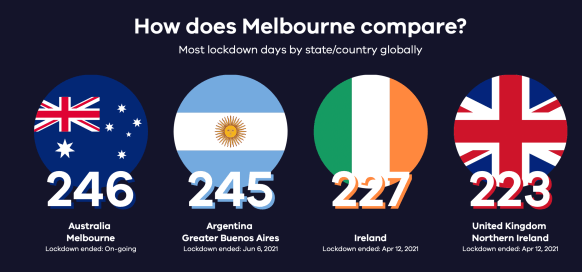
Please forgive the self-indulgence, but not only is this the 9th week of Melbourne’s 6th lock-down, we now hold the world record for total number of days under “stay at home” orders. I know we love our sporting superlatives and gold medals down-under, but surely this is one title that even the most fanatic supporter of our fair city wished we had conceded (to Sydney, perhaps…).Of course, I understand why we find ourselves in this situation – the government fears that the COVID pandemic will overwhelm the local health system if the virus is allowed to run riot, and before a sufficient proportion of the population has been vaccinated. Clearly, lock-down has helped to reduce the total number of cases and deaths per capita compared to many other countries. And vaccinations appear to be mitigating the impact of the Delta variant, depending on what numbers you track.

However, while most people I know have generally been supportive of the public health measures, the effect of continued lock-down is taking its toll on peoples’ income, mental health and general well-being. It feels that our collective nerves are frayed from the shifting goal posts (in terms of targets and milestones), the continued in-fighting and bickering between the States and the Commonwealth (and with each other), the constant blame games, and the drip-feed of information (despite the daily press conferences and media updates).

This current lock-down, which was initially expected to last a week(!), has been particularly hard to endure. Especially so for the majority of people who, hitherto, have been prepared to buy in to the lock-down measures (albeit somewhat reluctantly and not necessarily willingly). But to be told by our political leaders and their public servants that the growth in case numbers (and the lock-down extension) is due to members of the public breaching the public health orders (“AFL Grand Final parties”) or not complying with the lock-down measures (“household visits”) is extremely galling for those “doing the right thing” – it’s all stick, no carrot. At the same time, in the vast majority of alleged infringements there does not appear to be any consistent approach to penalties or other consequences. (So, why bother with compliance, since the lack of enforcement can lead to the law falling into disrepute?)

The government has long since given up the idea of achieving zero cases, yet seems unwilling to give much relief to people who are fully vaccinated and who have consistently observed the lock-down measures, other than the prospect of small picnics outdoors. Increasingly, the lock-down itself feels like a blunt instrument – why not apply it in a more targeted fashion, rather than a blanket measure? By now, it looks like a game of whack-a-mole as outbreaks keep popping up again (and again) in the same “settings”.

I appreciate that the government wants to keep us safe, and overall I’m extremely grateful that we have not seen the sorts of health statistics witnessed elsewhere. But by maintaining the prolonged lock-down, our elected leaders and their civil servants risk wearing out our patience and burning up any goodwill they may have accrued in the process.

We are living in a sort of limbo, with severe restrictions on the one hand, and uncertainty/anxiety on the other. Among other things, the current situation makes it very difficult to plan any trips to visit family and friends inter-state, let alone abroad. (I’ve not seen my immediate family overseas for nearly 3 years.) While I am extremely thankful that I don’t work in the “front line”, and I am very fortunate in being able to work from home, the inability to meet in person after such a lengthy hiatus does mean some of those relationships have become impaired or have become a little harder to manage and maintain.

Anyway, as I look forward to a second birthday under lock-down, I try not to look too far ahead, maintain the daily routine and walks (and enjoy the occasional glass of wine).

Next week: “What Should We Build?”