Intersekt FinTech Pitch Night

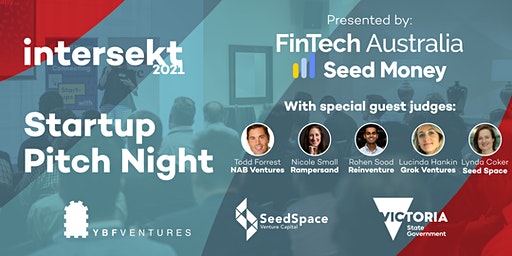
The opening event of the Intersekt 2021 Australian FinTech Conference was a startup pitch night, organised by FinTech Australia, hosted by YBF Ventures, and sponsored by Seed Money. The esteemed judging panel was drawn from a range of VC funds: Todd Forest (NAB Ventures), Nicole Small (Rampersand), Rohen Sood (Reinventure), Lynda Coker (SpeedSpace) and Lucinda Hankin (Grok Ventures).
The pitches in order of presentation (links are in the names):

Boulevard

A cloud-based share registry management platform for startups, founders and their employees. Designed to to be an exchange for unlisted securities, the platform also offers Investor Relations support and automated compliance solutions. Using Distributed Ledger Technology (which underpins Blockchain), the team are working with ASX DLT Solutions (responsible for the CHESS replacement) and deploying DAML, the programming language for modelling digital assets. They have also developed ASICLink, to automate company filings with the corporate regulator, plan to support corporate actions (including the verification of company financials), and are working with equity crowdfunding platforms. Boulevard has already on-boarded 30 companies, comprising 4,000 shareholders.

COGSflow

Describing itself as “Performance based finance”, this is essentially a merchant service offering cash-flow funding solutions for physical goods. This involves purchasing client inventory, and getting repaid on the sales performance. Using a funding ratio calculation as the basis of its credit risk model, the COGSflow will track sales data from the likes of eBay and Amazon (although both of these platforms, like PayPal, Alibaba etc. already offer SME financing of various forms). COGSflow will also analyze variable marketing and customer acquisition costs as inputs to its lending model, and plans to become a member of the Personal Property Securities Register (PPSR), as well as seeking B Corp certification.

Archa

Archa is solving the challenges many SMEs face when trying to access corporate credit cards – banks generally demand personal guarantees from owners or directors before they issue cards, and when they do the “product is awful”. As the pitch described it, many bank-issued corporate cards are really designed as “a line of credit to acquire air miles”. With a mobile app already in the market, Archa incorporates an administration and expense management solution. A major bug bear for many companies is managing corporate subscriptions – all those SaaS apps that are tied to individual employee cards; consolidating, renewing and cancelling those services can be time-consuming and painful. The account administrator can also manage each card’s credit limit. Archa itself has principal issuer membership with MasterCard. In addition to an equity raise, the team is seeking debt funding to offer lines of credit. Channels to market will include SME lenders, accountants and lawyers.

Sherlok

According to the founders, most people paying too much on their mortgages – based on their home loan rate. Because mortgage brokers have 60% of the market, and rely on trailing commissions, there is little incentive for brokers to help their clients find a better rate or provider. However, 15% of brokers’ clients are leaving each year. Sherlok is an SaaS platform that uses AI to help brokers reprice and refinance their existing mortgage book. Using a broker subscription model, Sherlok is aiming to offer “single click refinancing”, although there was some equivocation about becoming a virtual brokerage itself. The founders feel that mortgage broking is still a relationship based business, and requires a human touch.

Axichain

Axichain is building a blockchain-based agricultural supply chain – a digital trading solution for cross-border commodities trading, with an initial focus on red meat. The founders are addressing three main supply chain pain points – market access, paperwork and payment.
Axichain combines smart contracts, an escrow solution and traceability linked to legal processes. Overall, the platform envisages multiple products and revenue streams. The team are seeking both equity and debt funding, the latter to provide lines of credit lines.

Parpera

The meaning of “Parpera” is “fair wallet”. By that, the founders mean they want to offer a range of banking and related services aimed at SME owners, sole traders and freelances. This could include business registration and set-up, better financial insights, and access to smarter banking products etc. It will include card services, payments and invoicing. The plan is to target customers who are about to set up a business, and to promote the service at the start/end of the financial year, hence the intention to use accountants as a channel to market.

Next week: Monash University Virtual Demo Day
Blockchain Start-up Showcase

As part of the recent Australian Blockchain Week, YBF Ventures hosted a showcase of Blockchain start-ups – not a standard pitch event, but more an opportunity to hear how some teams are deploying Blockchain technology in their projects.

Here are the projects in order of presentation (links in the project names):

ProvenDB – developing immutable and tamper-proof document management, built on Hedera Hashgraph

BuildSort – a construction contract management solution to improve the industry supply chain and project management

Laava ID – product authentication via “smart fingerprints”

Verida – decentralized identity (with a focus on health records) – a user-centric solution focused on building user trust – resulting in hyper-personalisation

Cryptocate – crypto tax management service – with the growth in DeFi, there is a lack of data standardization or formal tax guidance on taxable events – e.g., how to handle crypto options?

Elbaite – a non-custody exchange using a “TraderTrust” verification system to support P2P transactions – platform confirms the exchange transaction on-chain, then the platform uses the transaction hash to release clients’ fiat funds from escrow – platform charges fees and commission

Sempo – a remittance service, with a particular focus on supporting migrant workers, the unbanked and refugees

Future CX – decentralized middle-ware development – e.g., data containers, NFTs, smart contracts – using a “proof of distribution” model

Luca+ – e-invoicing solution that integrates with major third-party accounting software

BC Gateways – using Blockchain to facilitate secure data transfer within the superannuation industry – recently acquired by IRESS – scaling from 10k transactions per day to 5m per annum

DayByDay – an asset management solution for the insurance industry

Get Paid in Bitcoin – a Bitcoin payroll and savings account

DLTX – a smart contract development vendor

Next week: Decay Music

Notes from Blockchain Week

Blockchain Australia, the national industry body, recently organised the first National Australian Blockchain Week – a mix of on-line and in-person events, hosted in Sydney and Melbourne. Overall, it was an impressive line up of speakers and topics, featuring key local figures and presenting some intriguing announcements from politicians, regulators and practitioners alike.

The recurring themes were: Regulation, Tax and Innovation.

Despite past pronouncements about adopting a light-touch regulatory regime when it comes to Blockchain technology, the absence of definite regulation risks stifling innovation and/or driving projects overseas to more receptive jurisdictions. (Irony of the week #1: contrast this with the early and positive regulatory engagement with Digital Currency Exchanges (DCE) and other market participants in Australia, not to mention previous progress in removing the absurd GST treatment on the purchase and sale of cryptocurrencies).

Now, the industry is (once again) asking policy makers: to clarify the law as it relates to decentralised protocols, digital assets and utility tokens; to streamline the confusing and over-complex tax system as it applies to DeFi: and to define a specific regulatory boundary (rather like the UK’s FCA perimeter) within which crypto assets need to be regulated. Sadly, the latter is extremely hard to acheive thanks to the very broad definition of “financial product” within the Australian Corporations Act.

Throughout the four days, there were several highlights: Senator Bragg’s keynote speech on driving the policy agenda to bring clarity to regulators and markets alike; a progress report on the National Blockchain Roadmap; tax and legal updates from Joni Pirovich and Michael Bacina; a showcase of local Blockchain start-up projects (more on that next week); and a couple of enterprise presentations on the ASX’s DLT replacement for CHESS and the Blockchain-based insurance project between the R3 consortium and Grow Super. But apart from a couple of other Blockchain-in-business sessions, there was a noticeable absence of corporates, major banks, traditional financial services and institutional investors.

There was a lot of commentary around the fact that many Blockchain businesses and crypto projects still find it challenging to access regular banking facilities in Australia (Irony of the week #2: Westpac’s windfall from the recent Coinbase IPO). There was also a lot of discussion about the need for investor education before crypto and digital assets can go “mainstream” – which I find surprising when plenty of people seem to be finding their way without any help from traditional financial advisors, and yet no-one is required to educate themselves before their money is put into compulsory superannuation or real estate assets. Even where crypto assets are being included in retail investor products, the allocation is very modest and is being transacted offshore (see Raiz’s 5% allocation via the US-based Gemini Trust). Why not use one of the several established and well-run exchanges, crypto funds and OTC providers here in Australia?

Regarding the potential offshore brain drain, much was made of the work that Singapore is doing to attract Blockchain and crypto businesses. But I think the focus on Singapore risks overstating the situation there, and overlooks what is actually happening (and could happen) in Australia. For example, while Singapore may have more favourable tax arrangements for new Blockchain projects, I understand that ordinary retail investors don’t have access to crypto funds (not even ETPs). The Singaporean issuance of digital assets via tokenisation has to be done via an SPV structure. And while many ICOs have been issued from Singapore, they could not be marketed to local investors. At least Australia has a robust DCE sector, e.g. Independent Reserve, BTC Markets, and Bit Trade (now part of Kraken); early on we saw some very successful retail products such as CoinJar; and the local industry continues to nurture innovative decentralisation projects – we just need to sort out those “policy settings”, and give more encouragement to local entrpreneuers and innovation. (Irony of the week #3 – when former ALP politician and self-styled crypto OG, Sam Dastyari, was asked if the private equity fund he works for was investing in Blockchain or crypto, there was a deafening silence…)

Finally, one of the main benefits of Blockchain Week has been to entice people out of hibernation, and to attend in-person events after months of lock-downs and restricted movement. It felt good to be back.

Next week: Blockchain Start-up Showcase

FinTech Australia Road Show

This week I had hoped to blog about the latest FinTech Australia Road Show in Melbourne – unfortunately, COVID-19 intervened, and the event has been postponed.

So instead, here is my personal quick take on recent developments in the local FinTech scene:

A tale of 2 neobanks

Maybe Australia isn’t ready for challenger banks, despite the early interest and apparent market demand. Xinja* has decided to give back its banking license, having spent a ton of money on obtaining it in the first place. It couldn’t sustain savings and deposit accounts (even in a low-interest rate environment) without sufficient regulatory capital, the funding for which has failed to materialise; and without deposits, Xinja couldn’t offer loans. There is talk of launching a US share-trading app instead (à la Robinhood) but given the recent shenanigans with Wall Street Bets, Reddit, hedge funds and GameStop day traders I don’t suppose the regulatory path to market will be that easy. Xinja looks like it’s done.

Meanwhile, NAB has just announced that it is acquiring the shares in 86 400 that it does not already own, in order to merge it with NAB’s digital brand, Ubank. Which further suggests neobanks can’t survive on their own in the Australian market, with the dominant and regulatory protected cartel of the Big 4. (My good friend Alan Tsen has described this latest transaction as a turducken….)

Other challenger brands in Australia are having to take different approaches: Up is piggybacking off Bendigo and Adelaide Bank’s ADI license; Volt describes itself as a BaaS provider (“banking as a service”); Judo is focused on business banking; and the UK’s Revolut is bringing a mix of credit cards, payment solutions and forex services (including crypto), rather than transaction banking. Meanwhile, another BaaS from the UK, Railsbank is currently recruiting locally for a GM to leads its Australian roll-out.

Finally, despite some concerns about the BNPL sector (“buy now, pay later”), Afterpay is partnering with Westpac‘s BaaS platform to offer banking services to its customers.

Whither the Big 4?

Speaking of which, what are the Big 4 doing in the broader sphere of FinTech?

Despite (or because of?) buying a neobank, NAB has apparently closed down the Labs part of NAB Ventures, the often-mentioned, but largely silent startup incubator. CBA has created X15, a similar FinTech ventures platform with the ambitious goal of launching 25 businesses in 5 years (I seem to recall NAB Ventures once had a similar mandate?). Westpac‘s own FinTech fund, Reinventure is expected to do well out of the forthcoming Coinbase IPO; so much so that Reinventure is planning to decouple from Westpac, and launch a new fund focused on DeFi opportunities. ANZ has been putting out some commentary on its ANZi platform for FinTech innovation and partnerships – but its remit is limited to trade finance, home ownership and open data, and it is being very coy as to what specific bets they are making. Ho hum.

Did somebody mention crypto?

In case you hadn’t realised, we are experiencing something of a bull market in crypto.

Coinspot just announced they have 1,000,000 customers. Raiz Invest has launched its retail savings portfolio product with a 5% allocation to Bitcoin. Other funds like Every Capital are planning similar retail offerings. Luno is advertising on Melbourne’s tram shelters. And the Australian division of eToro is talking up DeFi. Game on!

Next week: Transition – post-pandemic career moves

* Declaration of interest – the author participated in the Xinja equity crowd-sale a few years ago