The General Taxonomy for Cryptographic Assets

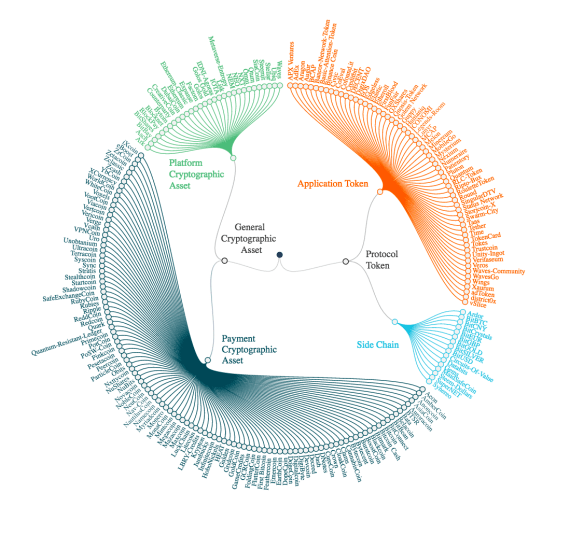
It’s not often I get to shamelessly plug a project I have been involved with – so please indulge me in the case of Brave New Coin’s recent publication, “The General Taxonomy for Cryptographic Assets”. It’s a significant piece of work, designed to bring some structure to the classification of this new asset class.

In particular, it aims to help market participants (traders, brokers, investors, fund managers, asset managers, portfolio managers, regulators etc.) make sense of the growing list of digital currencies, as not all tokens are the same. Each one has a specific use case that needs to be understood in the context of Blockchain applications, whether decentralized protocols, or trust-less payment solutions.

Currently capturing around 60 data points and metrics on around 700 tokens, in the coming months the underlying database will double in size, and constantly maintained thereafter to keep current with the most significant assets.

Useful for portfolio screening, construction and diversification, the Taxonomy methodology and underlying database, when combined with Brave New Coin’s aggregated market data and indices will provide a 360-degree view of each asset, combining key elements of a CUSIP or ISIN record, a company directory profile and a regulatory filing.

The significance of having access to robust market data and reference data tools cannot be underestimated, given the price volatility and emerging nature of this new asset class. The Taxonomy will be presented at various Blockchain and Crypto events over the coming weeks, but for further information, the authors can be contacted at: contact@bravenewcoin.com

Next week: APAC Blockchain Conference

Blockchain, or Schmockchain?

About a year ago, I was having dinner with family and friends, explaining the work I am doing in blockchain and cryptocurrency at Brave New Coin. My mother, in her mid 80s, asked if she should be buying Bitcoin as part of her retirement savings – I suggested she talk to her financial adviser first….

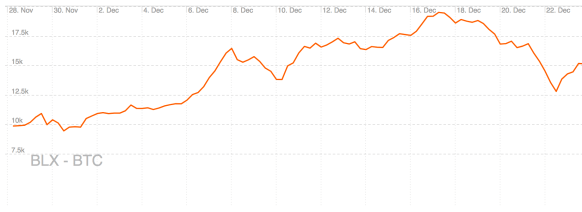
The BLX: Bitcoin Liquid Index (Source: Brave New Coin)

Then, late last year, the  Wall Street Journal made a splash with a front page headline: Bitcoin Mania: Even Grandma Wants In on the Action. This was just after the price of Bitcoin broke through US$10,000 for the first time, as part of its year-end rally after a year-long bull run. Of course, since late November, Bitcoin has gone from $10k to $16k, back down to $13k, back up to nearly $20k, then back to around $10k, before falling further to as low as $6k, while recently “stabilising” between $9k and $11k.

It wasn’t just cryptocurrencies (or even CryptoKitties) that were getting the hype and the headlines. An American soft drink company saw its stock price soar when it changed its name to Long Island Blockchain Company, and announced plans to invest in cryptocurrency mining technology. Amid some backlash (and SEC action against similarly motivated name changes), those plans have since been modified.

Just last week, I received an e-mail from a financial planner in regional Australia:

“I’m a 30-year veteran of the financial industry. I’ve just returned from the Annual Self Managed Superannuation Fund conference where it was evident the industry is treating crypto like a new little toy. Most wish to sound intelligent about what it is, but over 98% have no idea. When asked, the speaker from ASIC fobbed it off as a high risk area, and moved the topic to Investment property….”

He went on to explain how he didn’t just want to help his clients understand how to invest in this new asset class; he also wanted to leverage the underlying blockchain technology to improve his financial services practice, and offer better solutions to his clients.

If blockchain technology is good enough for the ASX, then it should be good enough for the individual investors whose share portfolios are traded, cleared and settled (either through their brokers, or via their superannuation funds) on the ASX itself.

Which was a key point made by Rick Klink, founder of OpenMarkets, during a presentation at a recent Startup Grind event: why shouldn’t his business take advantage of this new technology, and the new assets it is creating, to reduce customer transaction fees, streamline trading processes, and enable portfolio diversification.

Once you cut through the noise, there are examples of companies bringing scalable and real-world blockchain solutions to market that benefit a range of industry sectors, from supply chain logistics to biotech research, from agri-product provenance to IP registration and tracking. 2018 could be the year when the hype becomes reality.

Next week: Startup Vic’s Professional Services Pitch Night


What should we expect from our banks?

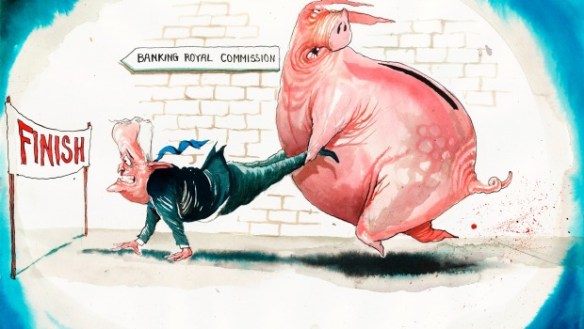
As I have written elsewhere, bank bashing is a favourite Australian pastime. In recent months, this has struck a new crescendo. There have been various allegations, legal cases and regulatory investigations surrounding such misconduct as mis-selling of products, rate fixing, over-charging and money laundering, all culminating in a hastily announced Financial Services Royal Commission.

Cartoon by David Rowe, sourced from the AFR, published November 30, 2017

The banks had tried to get on the front foot, by abolishing ATM fees, reigning in some of their lending practices, and appointing a former Labor politician to help them navigate the growing calls for a Royal Commission (largely coming from her former colleagues in the Labor party). But the (Coalition) government clearly decided enough was a enough, and sprung their own inquiry into the industry.

For the benefit of overseas readers, Australia has a highly concentrated banking sector, which is also highly regulated, highly profitable, and in some ways, a highly protected market oligopoly. There are only four major banks (also know as the four pillars, as they cannot acquire one another, nor can they be acquired by foreign banks), and a few regional banks. There is a smattering of non-bank financial institutions, but by their very nature, they don’t offer the full range of banking products and services. As an example of this market concentration, the big four banks traditionally account for something like 80% or more of all home loans.

Aside from the Royal Commission, there are a number of policy developments in play which will inevitably change the banking landscape, and the dynamic between market participants. In addition to the growth of FinTech startups aiming to disrupt through digital innovation, there are four key areas of policy that will impact traditional banking:

  1. Open Banking – giving customers greater access to and control over their own banking data
  2. Comprehensive Credit Reportingmandating the hitherto voluntary regime among the big four banks
  3. The New Payments Platform – designed to allow real-time payment and settlement between customers, even without using bank account details
  4. Restricted ADI Regime – to encourage more competition in the banking sector

The major banks have tried to laugh off, rebuff or diminish the threat of FinTech disruption. They believe they have deeper pockets than startups and just as good, if not better, technology processes. Moreover, customers are traditionally so sticky that there is an inherent inertia to switch providers.

But with banks having to set aside more risk-weighted capital to cover their loans, they may be vulnerable to startups focusing on very specific products, rather than trying to be a full service provider. Banks no longer have the technology edge, partly because of the legacy core banking systems they have to maintain, partly because they lack the know-how or incentive to innovate. And changing demographics will influence the way new customers interact with their banks: “mobile first”, “end-to-end digital”, and “banking for the gig economy” are just some of the challenges/opportunities facing the sector.

So what should we expect from our banks? I would say that at a minimum, a bank should provide: trust (but with Blockchain, DLT and trustless, zero-knowledge proof solutions, banks are no longer the sole arbiter of trust); security (linked to trust, but again, with biometrics, digital ID solutions and layered encryption, banks do not have a monopoly on these solutions); capital protection (although no bank can fully guarantee your deposits); reasonable fees (still a way to go on account keeping fees and some point of sale transaction fees – while disruptive technology will continue to challenge legacy costs); and an expectation that it will not bet against the direct interests of their customers (like, shorting the housing market, for example). The latter is particularly tricky, when banks are mainly designed to deliver shareholder value – although of course, most Australian bank customers also own shares in the banks, either directly, or indirectly through their superannuation.

In recent months, and based on personal experience, I think a bank should also know its customers. Not just KYC (for regulatory purposes), but really understand a customer as more than just a collection of separate products, which is how most banking CRM systems seem to work. Given how much banks spend on consumer research and behavioral data, and how much they talk about using big data, artificial intelligence and machine learning to anticipate customer needs, it’s a constant frustration that my bank does not really know me – whenever I contact them, for any reason, I always feel like it’s a process of “product first, customer second”.

Moreover, I can’t think of a single new product that my bank has launched in the past 15 years of being a customer. Sure, they have rolled out mobile apps and online banking, and they may have even launched some new accounts and credit cards – but these are simply the same products (accounts, loans, cards) with different prices and a few new features. Even the so-called “special offers” I get for being a “loyal” customer bear no relation to my interests, or even my spending patterns (despite all the data they claim to have about me). And because banks are product or transaction-driven, rather than relationship-driven, their internal processes fuel silo behaviors, to the extent that the left hand very often does not know what the right hand is doing.

Finally, with more and more of the working population becoming self-directed (self-employed, freelance, portfolio career, contracting, gig-economy, etc.) banks will have to innovate to meet the financial services needs of this new workforce. Bring on the disruption, I say.

Next week: Box Set Culture 


Equity crowdfunding comes to town

Earlier this month, the Australian Securities and Investments Commission (ASIC) announced it had approved the first seven crowdsourced funding platforms (CSFs). It seems that after much debate, equity crowdfunding is finally open for business.

Image: Aaron Pruzaniec, sourced from Wikimedia Commons

Although not named in the ASIC media release, the seven successful applicants are:

There are significant limitations to the CSF legislation – namely:

  • the type of eligible companies (only smaller, public unlisted companies);
  • the amounts individual investors can invest (up to $10,000 per company per 12 month period); and
  • how much companies can raise (no more than $5m in any 12 month period)

Also, there is no indication as to whether other CSF license applications are still pending, or which applications may have been rejected. It may also be difficult to assess the relative merits of each platform, since there only appears to be one class of license.

Meanwhile, legislation is already in the pipeline to extend the CSF regime to proprietary companies – which would significantly expand the potential number of issuers.

Compared to some of the largest initial coin offerings (ICOs) over the past 18 months, a $5m capital raise looks like small change. If anything, ICOs took the decade-old crowdfunding experience and supercharged it with Blockchain, cryptocurrency and decentralized issuance platforms. But then, regulators tend to lag markets and technology; plus, their primary focus is protecting the interests of less sophisticated retail investors (as well as market stability).

It’s also worth remembering that a limited crowdsourced funding model has been available in Australia for several years, almost as long as crowdfunding itself: Enable Funding (formerly ASSOB) was established in 2007, but with a much more restricted license than the latest CSF legislation. (And in other countries, early-stage companies have been able to more easily raise equity capital via market listings on secondary boards of the main exchanges – e.g., Mothers in Japan, GEM in Hong Kong, and AIM in London.)

The new CSF regime (and whatever else comes in its wake) does raise a few interesting points:

1. Although expressly confined to equity issuance in the form of common shares, by giving it a more generic name, does this mean CSF will be used for other types of securities (bonds, structured finance)?

2. What expectations has ASIC placed on the number of raises, and the total amounts to be raised, over the next 3-5 years – how will it measure or define the success of CSF?

3. More importantly, where is investor money expected to come from – will investors switch from property or other assets?

4. How will the increasing practice of issuing digital tokens as traditional securities (and potentially vice versa) add to the demand for CSF platforms and services?

It’s very early days, of course, and very small scale, but judging by the response so far to one of the first companies to take advantage of the CSF legislation, investors like what they are seeing.

Next week: Australia Post and navigating the last mile