What “wallet” it say about you?

Just as your e-mail domain name can say a lot about how/when you first got online, I have a theory that our choice of digital wallet will also reflect our blockchain, crypto and web3 profile. (Remember those early ISPs and e-mail services such as AOL, Lycos, Compuserve and Pacific Internet?)

Part of the challenge with early digital wallets was the UX/UI – before the advent of software, browser-based and hardware wallets, users relied on “paper wallets” to manage their private keys. The first software wallets needed to be set up very carefully, so that your seed phrase or private key was not stranded on an abandoned hard drive, and thus lost forever. I think the first BTC wallet I used was CoPay, which was an early multi-sig wallet, but which has largely been discontinued. The arrival of browser extensions such as MetaMask have made a difference when it comes to bridging between chains, and managing a wider range of assets.

Even though there is more interoperability between digital wallets (cross-chain, multi-asset), dedicated applications are still needed for BTC and other chains. Also, some use cases (iGaming, web3/DeFi) may demand more specific wallets to support particular functionality. But like many crypto users, I still maintain about 6 different applications, including exchange-based wallets.

I suppose the eventual user experience will be a seamless transition between crypto, web3, DeFi, TradFi, NFTs and RWAs. But until then, stay safe and make sure you know where your private keys are at all times!

Next week: Signing off for 2024….


Blockchain and Crypto Updates

Courtesy of Techemy and Brave New Coin, I’ve just been on another whistle-stop global tour: 5 cities, 4 countries, 3 continents in two and a half weeks….. Along the way, I caught up on some of the latest market and regulatory developments in Blockchain and cryptocurrency.

Giant billboard in Tokyo’s Ginza district

First, there was no hiding the fact that the past six-month “correction” in crypto markets has had an impact on trading volumes, investor appetite and institutional enthusiasm – as well as generating some regulatory noises. More on the latter below. At the same time, many of the first wave of Blockchain projects that attracted funding over the past 4 years are still at the development or test net stage, or only just launching their MVPs. Hence some investor caution on new token issuance.

Second, there are probably far too many Blockchain and crypto conferences – or rather, volume is diluting the quality of content, meaning too many sub-par events. There is no shortage of interesting topics and informed speakers, but the format and delivery of so many panel discussions and plenary sessions end up sounding tired and lacklustre.

Third, expect a crypto-backed ETF to be listed on a major exchange very soon. I even think it will come out of Europe, rather than the US, but that’s just a personal view. Such a product is going to help with investor diversification and will eventually enable retail investors to get exposure to this new asset class, even within their personal pension plans, without the same level of risk and volatility than direct holdings or spot trading.

Fourth, institutional investors are still looking for institutional products and services: proper custody solutions, robust benchmarks, hedging instruments, portfolio tools and risk analytics. One challenge is that the market is still trying to define crypto fundamentals – the sorts of analysis we take for granted in other asset classes (earnings per share, p/e ratio, yields, Sharp ratio, credit risk, etc.).

Fifth, Japan feels like a case of “two steps forward, one step back”. Just over a year ago, cryptocurrencies were formally recognised as a legal form of payment. Then in late 2017, the FSA issued the first batch of crypto licenses to qualifying exchanges. Japan continues to represent a significant portion of crypto trading (partly a legacy of retail FX trading, partly a result of regulatory restriction in other markets). But yet another exchange hack earlier this year prompted the regulator to put the industry on notice to smarten up, or face the consequences. Exchanges are subject to monthly monitoring, and the self-regulating industry body is undergoing a few changes. Plus, exchanges are no longer able to list privacy coins.

Finally, with the lack of legal clarity or regulatory detail around initial coin offerings (aside from blanket statements that “all ICOs are securities until proven otherwise”), there is still a lot of regulatory arbitrage. Certain jurisdictions are actively attracting new issuance projects to their shores, and positioning themselves as being “ICO friendly”. Ironically, even though the SEC in the USA has been particularly vocal about ICOs that may actually be deemed securities, it has not defined what constitutes a utility token (or made any announcement on the new category of security tokens). However, there have been some recent announcements out of the SEC suggesting that neither Ethereum nor Bitcoin are in fact securities. More interestingly, the State of Wyoming is looking to make Blockchain and associated crypto assets a major pillar of its economy.

NOTE: The comments above are made in a purely personal capacity, and do not purport to represent the views of Techemy or Brave New Coin, their clients or any other organisation I work with. These comments are intended as opinion only and should not be construed as financial advice.

Next week: Bad sports
Token Investment Summit, Vienna

To demonstrate how far Blockchain, cryptocurrencies and digital assets have permeated the traditional world of asset management, the Token Investment Summit in Vienna (organised by Crypto42 and hosted by the Vienna University of Economics and Business) covered a number of topics of particular interest to institutional investors.

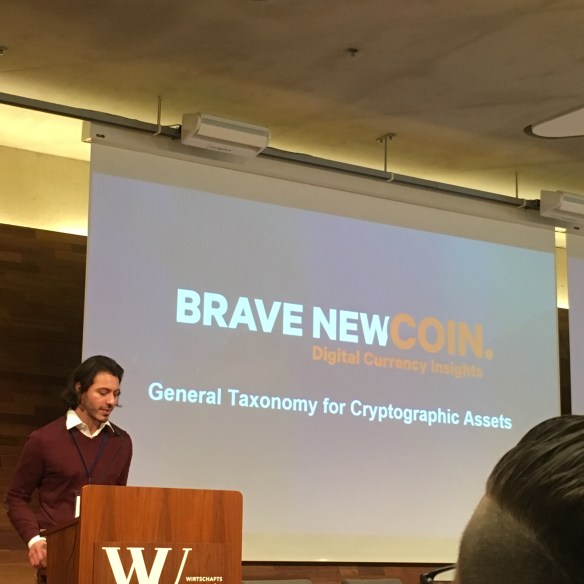
Brave New Coin Head of Research, Rafael Delfin introduces the General Taxonomy for Cryptographic Assets

William Mougayer kicked the day off, discussing the need to define “Blockchain fundamentals”. In particular, some of the token jargon needs to be better explained (air dropping, locking, burning), and some industry practices (token definition, protocol design, staking, and on-chain governance) require more formal and consistent standards. Projects need to address their “Token-Market Fit”; chains need to think about their scaling and interoperability; and tokens need to deal with decentralized exchanges, post trade clearing, and asset classification.

Next, Rafael Delfin from Brave New Coin presented the General Taxonomy for Cryptographic Assets (covered here before), followed by pitches on behalf of Rigoblock (decentralized fund infrastructure), HydroMiner (green mining), Conda (equity tokens via a crowdfunding platform), Artis (time-based value or asset transfer on chain), Streem (“start & end” events only) and Ocean Protocol (the data exchange network from BigChainDB).

There was an overview of ICO regulation, comparing some of the developments in Germany (Bundes Block’s Token Regulation Paper), Austria (University of Graz’s KryptoStaat project), Switzerland (FINMA paper on ICOs) and Gibraltar (GBX token listing using a risk-based model).

Much of the day was given over to discussing compliance, taxation, accounting, token economics and investment research (such as token valuation models, correlation analysis and crypto returns). There was also a local case study on the Optioment scam, and the potential criminal and civil breaches.

Finally, a panel of VCs provided their perspective how to navigate this asset class, as the industry weighs up the recent wave of more speculative tokens, and moves to more structured capital gains, especially from so-called security tokens.

Next week: CoinAlts Fund Symposium, New York


Beyond Blocks, Tokyo

Thanks to my work with Techemy and Brave New Coin, Content in Context is currently on the road, attending various Blockchain and crypto events in Tokyo, Vienna, NYC and Chicago. The next few blogs will attempt to capture notes from the field.

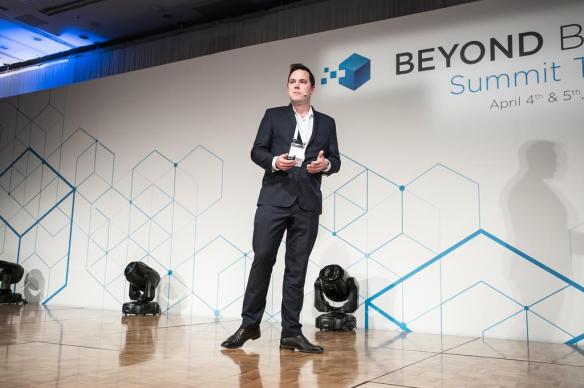
Techemy CEO, Fran Strajnar presents on the new asset class of digital value

In Tokyo, the Beyond Blocks Summit was a stellar affair, with marquee blockchain projects and major investors presenting on stage, alongside cosplay characters, light shows, upbeat music and a crowd of crypto fanatics.

Given the significant developments in Japan’s regulatory framework for crypto-currency trading, there was a lot of interest in the presentations by bitFlyer, Quoine and Smart Contract Inc.

As with the recent APAC Blockchain Conference in Melbourne, there was a strong representation from China’s growing base of Blockchain projects (but not ICOs, of course), keen to demonstrate their infrastructure projects.

There was much debate about regulatory developments across Asia, made all the more interesting by the announcement that Monex is acquiring Coincheck, despite (or because of?) the recent hack on NEM tokens held on the local exchange.

Among international key speakers were Patrick Byrne from Overstock and tZERO, John Burbank of Passport Capital, and Techemy’s own Fran Strajnar – all looking to the future of this new asset class, especially so-called security tokens.

Interspersed throughout the two days were panel discussions and presentations on scaling, infrastructure, decentralized exchanges, stable coins and the future of ICOs.

Although this was only their second event of this kind, the Beyond Blocks team have quickly established themselves on the conference circuit.

Next week: Token Investment Summit, Vienna