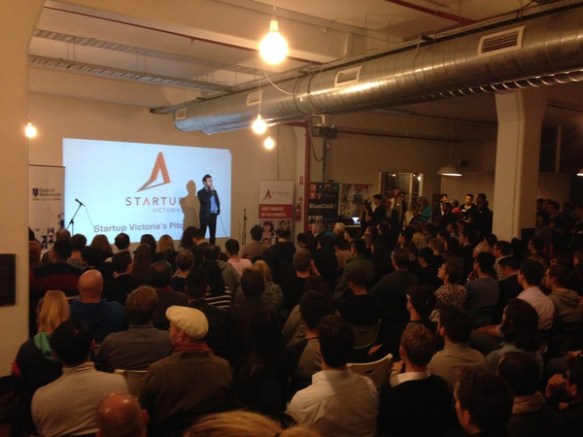
There was something of a festive mood in the room for StartupVic‘s final pitch night of 2016, hosted at inspire9. It certainly had an end of term feel, as a number of the long-term Startup Vic team members said their farewells before moving on to new ventures. So it will be interesting to see how these monthly events continue to evolve in 2017.
 Continuing the theme of recent pitch nights, diversity was the key – this month’s startup hopefuls came from the energy, AI, environmental and consumer sectors. As usual, I will comment on each pitch in the order that they presented:
BioFuel Innovations
With the simple aim of turning waste into fuel, BioFuel Innovations uses an enzyme, as opposed to a more caustic chemical catalyst, to convert used cooking oil from restaurant kitchens into biodiesel. Given this greener and more sustainable process, the company can use lower quality feedstock, consume less energy and reduce the amount of waste water.
Having built a pilot plant in Dandenong, the founders are currently developing a containerised “turnkey solution” comprising a pilot micro-refinery, which can be financed by 3rd party lenders (a bit like some solar energy schemes). However, they are seeking funding to gain access to a startup accelerator program.
With a number of existing service providers that collect used cooking oil from restaurants and food processing plants, BioFuel Innovations only plan to produce their own fuel on a small scale. Rather, their business model is to sell micro-refineries for biodiesel production.
Asked by the judges why they are focusing on biodiesel rather than other higher-yield fuels, the team pointed out that some of those products require high temperature processing, and therefore consume more energy. Also, in concentrating on this type of biodiesel production, the founders believe they are helping to solve the problem of disposing of waste oils. However, longer term, they may explore even more sustainable energy derivatives and regeneratives. And in Asia Pacific, for example, there is a need to re-process palm oil residues.
Finally, a key to their success will be streamlined manufacturing processes and logistics, such as building supply chain partnerships for the shipping containers that hold the micro-refineries.
Breathable
This is an environmental design concept that aims to use plants to replace air ventilation systems in offices and homes. Based on research from Maastricht University in the Netherlands, Breathable uses an algorithm based design solution. Taking into account the building dimensions, natural light, air flow, number of people, amount of mechanical and electrical equipment, etc., the team can design the right combination and layout of plants for each given location.
Established as a bootstrapped social enterprise, whose profits go to helping asthma sufferers and patients with respiratory complaints, Breathable is hoping to make a large and sustainable impact.
The first question from the judges was, why set up in Australia? The team explained that given certain plants are not allowed here, the underlying algorithm has to be reconfigured for native plants, by a local team.
This was a very timely comment, given the recent episode of “thunderstorm asthma” in Melbourne. However, the judges were a little concerned that while there was a clear connection between purpose and passion, they wondered whether it is more of a lifestyle business for the founders, especially as thus far, no IP has been registered or protected. (On this specific point, the team simply said, “we challenge people to do it better”.)
There is an expansion plan, to develop fully self-sustaining eco-systems – such as using plants to power lights that help generate photosynthesis. But big goals need big marketing budgets, and with an active waiting list of 20 corporate clients, the challenge for the business is in how to scale.
MagicPi
I should say upfront that based on what I had read in advance on their website, this pitch was not what I had expected. Instead of a presentation on artificial intelligence, we got a pitch about Australia’s Chinese tourism “problem”. Namely that, based on a 2016 report from Bloomberg, by 2020 Australia will host 5 million Chinese visitors a year, representing a $13bn market. (And as I know from having worked with the founders at China Digital, many tourist destinations in Australia are far from China ready.)
Using natural language AI (cognitive, cloud, machine learning – “Siri with a human touch”) MagicPi is targeting Destination Marketing Organisations (conventions, conferences, local tourism boards). They plan to create content and solutions for client websites, and then take a commission on bookings. With a presence on both WeChat (including a voice recognition bot) and AliPay, MagicPi has a long-term vision of being the “intelligent interface for everything”.
However, the judges questioned whether the solution works or even exists. They felt that there was currently no visibility for investors or consumers. Claiming to have built a demo app, the team stated that there is a lack of quality information for Chinese tourists, and people are willing to pay for premium content – and to distinguish mere “recommendations” from the visitor “reality”.
Despite adopting a deliberate enterprise solution, the judges felt that the pitch needed to stress the “why”, rather than focusing on the problem.
The Cider Link
I should mention that I first met the team from The Cider Link about a year ago, and was intrigued by their mission to build an online craft cider market that connects makers with customers. (So much so, that I connected them to local wine producer, Richard Stockman, who invited them to appear as guests on his weekly food and drink radio program.)
The Cider Link is challenging both the market duopoly for cider retailing, and the ubiquity of “commercial” cider, much of which is produced from bulk juice mixed with alcohol – rather than being fomented from freshly pressed fruit, as is the case with craft ciders.
Cider is currently enjoying 10% annual growth by volume (based on bottle shop sales alone). So, online, cider and craft are all “on trend”. The founders have built a commission-based market place, and with connections to producers who are members of industry body Cider Australia, The Cider Link is also appearing at festivals and related events.
In the Q&A with judges, the team explained that success for them would be sales of 1000 cases a month, making it a $1m business. They also plan to take the model to the UK, which has the largest cider market in the world.
In addition to attracting more customers, the founders are seeking investment to improve sales conversions and support some advertising.
Given the mix of pitches, and the range of business models and sectors, based on judging criteria and audience votes, the winner was Breathable.
Next week: End of Year Reflection
 Content in Context